Nuclear and energy issues this week in Australia
 Election mania grips the media. Not a mention of nuclear/uranium issues. But Gem Romuld of International Campaign to Abolish Nuclear Weapons- has come up with a nifty little table, to show you where the major parties stand on these issues.

As far as I could tell, the Australian media did not see fit to commemorate Hiroshima Day. However, there were many events around Australia, where people came together for this. – such as Melbourne’s Hiroshima Day Vigil, Sydney’s Sunday March and Rally. There will be more, as Nagasaki is remembered, too – August 10 – Melbourne – Hiroshima and Nagasaki Memorial Concert 2013, and August 9 – Sydney Nagasaki Day Film screening.
The media is a real worry in Australia. They have HAD to report on the crisis now at Fukushima, as there seems no workable solution to the escalating problem of radioactive water leaking. I predict that the nuclear lobby’s next push will be a renewed attack on radiation as a health hazard. They’ll need this, as radioactive water pours into the ocean, from Fukushima, and enters the marine food chain. We will be told yet again that “low dose radiation” is OK. Ionising radiation is a complex topic, and now that the Australian mainstream press have pretty well sacked all their science writers – just who is going to give the facts to the public?
Renewable energy. Even though the brakes are on, in the very real fear of an Abbott government destroying Australia’s clean energy laws, still, things are happening.
- A large scale solar photovoltaic plant to go ahead in New South Wales.
- Work started on the Ararat (Victoria) wind farm, today.
- The Zero Carbon Australia Buildings Plan was launched today – a foresighted plan for energy efficiency.
- The Centre for Sustainable Energy Systems at the Australia National University reports that Australia could be 100% powered by renewable energy by 2040.
Uranium price has sunk to an unsustainable level – media takes this as proof that it will have a booming future – a kind of religious belief?
Fukushima’s escalating crisis – radioactive water leak at 300 tonnes daily
 An official from the newly created nuclear watchdog told Reuters on Monday that the highly radioactive water seeping into the ocean from Fukushima was creating an “emergency” that Tepco was not containing on its own.
 Highly radioactive water pouring out of Japan’s Fukushima nuclear plant http://www.ndtv.com/article/world/highly-radioactive-water-pouring-out-of-japan-s-fukushima-nuclear-plant-402630 Reuters August 07, 2013 Tokyo: Highly radioactive water from Japan’s crippled Fukushima nuclear plant is pouring out at a rate of 300 tonnes a day, officials said today, as Prime Minister Shinzo Abe ordered the government to step in and help in the clean-up.
The revelation amounted to an acknowledgement that plant operator Tokyo Electric Power Corporation (Tepco) has yet to come to grips with the scale of the catastrophe, 2 1/2 years after the plant was hit by a huge earthquake and tsunami. Tepco only recently admitted water had leaked at all.
Calling water containment at the Fukushima Daiichi station an “urgent issue,” Abe ordered the government for the first time to get involved to help struggling Tepco handle the crisis.
The leak from the plant 220 km northeast of Tokyo is enough to fill an Olympic swimming pool in a week. Continue reading
Risk that pooling underground water could topple Fukushima nuclear reactors
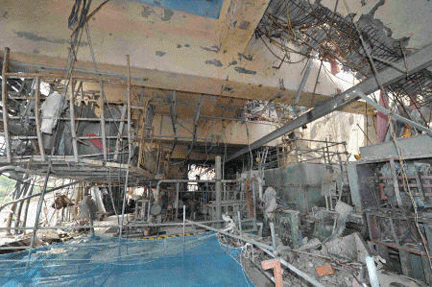 The Fukushima plant sits smack in the middle of an underground aquifer. Deep beneath the ground, the site is rapidly being overwhelmed by water.
What happens when you pour hundreds of thousands of tons of water (400 metric tons each day times 2.5 years times 365 days in a year equals 365,000 metric tons of water) onto soil which sits above a massive aquifer?
The spent fuel pool at Fukushima Unit 4 is the top short-term threat to humanity, and is a national security issue for America.
As such, it is disturbing news that the ground beneath unit 4 is sinking.
Fukushima: Japan’s Nuclear Accident Response Director Warns that Tepco’s Actions Might Cause Reactor BuIldings to Collapse http://www.globalresearch.ca/fukushima-japans-nuclear-accident-response-director-warns-that-tepcos-actions-might-cause-reactor-buildings-to-collapse/5345279?utm_source=rss&utm_medium=rss&utm_campaign=fukushima-japans-nuclear-accident-response-director-warns-that-tepcos-actions-might-cause-reactor-buildings-to-collapse By Washington’s Blog Global Research, August 07, 2013 Tepco’s ill-considered efforts to change soil permeability and water flow have caused severe problems at the site … including highly radioactive groundwater bubbling up to the surface.
NHK notes:
The vice governor of Fukushima Prefecture has asked the government to take the lead in handling the matter and stop the leakage. Masao Uchibori told an official from the Nuclear Regulation Authority that some of Tepco’s measures have increased the risk of further leaks. Continue reading
Japan’s Prime Minister needs to focus on Fukushima’s safety, not on nuclear restart

The first thing Abe must do is shift the Nuclear Regulation Authority’s focus away from evaluating the safety of atomic plants for restart, back to the fast-growing crisis of toxic sludge flowing into the sea around Fukushima. Really folks, first things first. Let’s first make sure children living within a 100 mile radius won’t develop cancer 10 years from now.
Japan’s Nuclear Nightmare Bloomberg By William Pesek Aug 7, 2013 “………It also would have been great if Abe himself had cared more about nuclear safety than dollars when he assumed the premiership in December. His focus was on restarting the 52 reactors taken offline out of an abundance of caution after the earthquake. Never mind that most Japanese want them to remain mothballed. Japan’s potent “nuclear village,” the nexus of power companies and pro-nuclear regulators, bureaucrats and researchers, packs way too much political firepower.
This nuclear-industrial complex is one of the nation’s biggest advertisers, which keeps the Japanese media in line. That’s partly why international campaigners like Greenpeace received so few column inches as they presented report after report showing radiation levels far above what Tepco would admit. (Tepco was eventually forced to come clean.)
So, is Abe’s sudden interest in Fukushima’s radiation mess for real? Well, it has to be at this point. Aside from the risk to his approval ratings, Tokyo is actively vying for the 2020 Summer Olympics. International Olympic Committee officials might find the threat of protests in Istanbul preferable to jokes about Tokyo hosting the Chernobyl Games. Continue reading
3 public forums for climate change campaigners and coal workers
 Forums to bring together climate change campaigners and coal workers http://www.abc.net.au/news/2013-08-07/forums-to-bring-together-climate-change/4870166 Aug 7, 2013
The events have been organised by Melbourne University honours student Dan Musil.
He says it is not often people involved in the environment movement and people from the Latrobe Valley discuss the coal industry.
“Primarily my hope is just that people will have the chance to hear other perspectives,” he said.
Mr Musil says he also wanted to understand where people stand on certain issues.
“That will hopefully allow the discussion to move forward to what common ground we do have and what we can do together to address these things,” he said.
The first workshop will be held tomorrow from 6:30pm (AEST) at the Morwell Multicultural Resource Centre.
Call to Indigenous Australians to enrol to vote
 Video and podcast Calls on Indigenous Aussies to enrol to vote The Australian Electoral Commission says more than half of Indigenous Australians who are eligible to vote are not on the electoral roll. (Transcript from World News Australia Radio)The Australian Electoral Commission says more than half of Indigenous Australians who are eligible to vote are not on the electoral roll.
The Commission says, as the federal election approaches, it’s working towards increasing Indigenous participation.
It says this is particularly important as Australia considers changes to the Constitution to recognise Aboriginal and Torres Strait Islander peoples.
Bob Eckhardt, Director of the AEC’s Indigenous Electoral Participation Program, says Indigenous Australians are significantly under-represented in the voting process. He says Indigenous Australians are much less likely to enrol to vote than other Australians.
And he says many of those who are enrolled either do not vote, or vote incorrectly…….. The Electoral Commission says people have until August the 12th to enrol to vote. The Electoral Commission can be contacted at www.aec.gov.au.
Launch of Australia’s Zero Carbon Australia Buildings Plan today
 Australia maps out smart energy plans Asian Correspondent, By Rowena Dela Rosa Yoon Aug 08, 2013 Climate solutions think-tank Beyond Zero Emissions (BZE) and the University of Melbourne are launching a joint project that hopes to help builders build smarter buildings: eco-friendly and energy-efficient. Climate solutions think-tank Beyond Zero Emissions (BZE) and the University of Melbourne are launching a joint project that hopes to help builders build smarter buildings: eco-friendly and energy-efficient.
The Zero Carbon Australia Buildings Plan, to be unveiled Thursday (8 Aug), will showcase a blueprint will make existing buildings cut their energy usage by half. Residential and commercial buildings can achieve maximum energy efficiency in 10 years…… Continue reading
Time for a Nuclear Weapons Convention
 the manufacture and maintenance of nuclear warheads and the missiles, planes and submarines to deliver them anywhere in the world has grown into a huge business. In excess of $50 billion a year, this business — including Air Force bases, nuclear laboratories, manufacturing plants and other facilities — employs people in almost every congressional district, though far more Americans could be employed rebuilding infrastructure teaching, or providing health care if an equivalent sum were spent creating those jobs. The corporations that manufacture and manage these facilities spend millions a year in campaign contributions and lobbyists persuading our representatives in Congress not to cut the budget from any part of this huge “defense” conglomerate.
 There is now a draft convention for the abolition of nuclear weapons at the United Nations, similar to those that ended chemical and germ warfare.
Peter G. Cohen: Time for a convention to abolish nuclear weapons The Cap Times, PETER G. COHEN | author of www.nukefreeworld.com 7 Aug 13 We now know that nuclear winter, ozone layer destruction, phytoplankton reduction and other effects of a nuclear exchange would massively affect health and life everywhere on Earth. How can we respond to something so overwhelming, so huge, so threatening that there is nowhere to hide except in denial? We’ve been trying that for almost 70 years. The numbers of weapons are down, their accuracy and lethality are up. It is time to try something new. Continue reading
New study says Australia could be 100% renewable energy powered by 2040
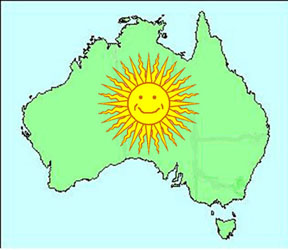 Australian Power Could be Totally Renewable by 2040 : http://sourceable.net/australian-power-could-be-totally-renewable-by-2040/#sthash.CbwC9lEd.dpuf– Marc Howe 7 Aug 13, -A new study claims that renewable energy sources such as solar and wind power could completely replace all fossil fuels for electricity generation purposes in Australia by 2040 given current trends and rates of deployment. – Research conducted by Andrew Blakers, director of the Centre for Sustainable Energy Systems at the Australia National University, has concluded that if current trends in the country’s energy sector continue over the long term, Australia will be host to a completely renewable electricity system by 2040. Continue reading
New wind turbines store energy
Wind Turbines Store Energy For Less Breezy Days HUFF POST, 7 Aug 13 “……a new wind turbine that generates more electricity at lower wind speeds, stores some excess energy for sale to the grid later (allowing owners to take advantage of higher prices), and also does a better job of analyzing and predicting the supply of wind energy too. In short, many clean energy advocates are pretty excited about GE’s 1.6-100 and 1.7-100 wind turbines and power management system.
Specifically, here are some of the features that clean tech geeks are getting excited about: Continue reading
Victoria’s Ararat wind farm under way
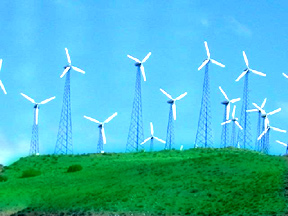 Wind farm start quells fears of more delays http://www.abc.net.au/news/2013-08-07/wind-farm-start-quells-fears-of-more-delays/4870540 Wed Aug 7, 2013 Concerns a wind farm planning permit could expire have been eliminated with construction starting near Ararat today. Work on the 41-turbine farm at Crowlands had been delayed because of uncertainty caused by the Federal Government’s Renewable Energy Target, which is reviewed every two years.
The Pyrenees Shire Council permit for the Pacific Hydro farm was due to expire next Sunday.
Andrew Richards from Pacific Hydro says concerns about the federal election and a lull in the renewable energy market also contributed to delays.
“We need to start this project in order to keep our planning approval,” he said.
“I think the State Government is quite keen for us to get started on these sorts of projects so they’re quite supportive, so moving forward we have got confidence the renewable energy market is going to turn around and become quite buoyant and hopefully this project will be well positioned to take advantage of that.”
He says the project will cost about $100 million and use local workers and businesses.
“We’ll produce enough clean electricity for around about 55,000 homes per annum,” he said.
“Then there’ll be some jobs as part of operations and maintenance of the project over the next 20 to 25 years, there’ll be payments to the host landholders and of course our sustainable community’s fund and in the case of Crowlands that’ll be about $80,000 a year for every year the project’s there.”
The solar powered lap-top, and it’s not expensive
 SOL – The Affordable Solar Powered Laptop http://www.energymatters.com.au/index.php?main_page=news_article&article_id=3879 8 Aug 13SOL can be run entirely on the power of the sun and could make a big difference to education and communications in developing countries.
Developed by Canadian R&D corporation WeWi Telecommunications, Inc.; SOL is a laptop initially aimed at the 1 in 4 people in the world who have little to no access to reliable power.
Able to run 8-10 hours on a full charge, the laptop features an Intel Atom D2500 1.86 GHz Duo Core processor, 2-4 gigabytes of RAM and a 320 gigabyte hard drive; plus a 13.3 inch display, WiFi, 3G/4G modem and a camera. Multiple external ports extend SOL’s capabilities.
Cutting the cost of software to run the laptop has been achieved through the use of the free Ubuntu operating system.
While information on the capacity of the detachable folding solar panels doesn’t appear to be on the SOL web site; according to the FAQ, the battery can be fully recharged in a little over 2 hours.
Far from being a fragile device that wouldn’t survive long in target markets, WeWi claims it was developed with “durable, reinforced materials, complex military industrial design and architecture that are meant to keep the laptop in good shape.”
The standard unit is expected to sell for around USD $350 and a submersible version, approximately USD $400. It will be initially rolled out in Ghana before other markets. While geared towards developing nations; SOL will ultimately be available globally and the company intends developing “adventurer” versions of the laptop with enhanced capabilities.
WeWi Telecommunications, Inc originally launched as a B2B Internet Service Provider and then evolved into a global solutions provider with an advanced research division specializing in security, telecom and innovative energy products.
Read more on the Sol web site.
Australia’s solar energy future
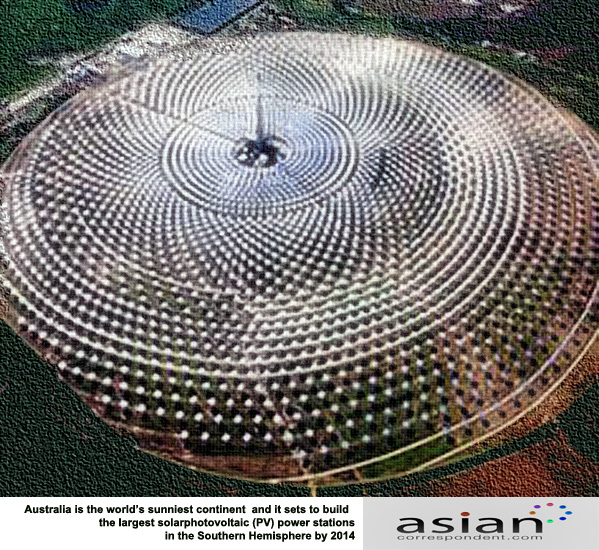
Largest solar panels in the Southern Hemisphere Last week, Australia reached another milestone with the announcement of the large-scale solar power stations to be built in New South Wales costing a combined total of $450 million. he Australia Renewable Energy Agency approved the fund of $166.7 million while the NSW Government committed $64.9 million to support the project.
Australia maps out smart energy plans Asian Correspondent, By Rowena Dela Rosa Yoon Aug 07, 2013 “……….Solar Power By 2020, Australia aims to generate 20 per cent of its energy need from renewables. The Climate Commission earlier released a modelling of Australia’s future energy usage that consistently indicates a growing solar energy. By 2050, solar photovoltaics are projected to provide 29 per cent of Australia’s power needs.
Last year, the Climate Commission released a report– The Critical Decade: Generating a renewable Australia– which projects the unlimited potential of renewables, particularly solar.
The report underscores a major shift in global energy policy moving towards renewables and Australia has an advantage given the enormous potential for solar generation as the world’s sunniest continent.
The report also highlights major developments in Australia such as the cost of solar photovoltaic systems which have significantly dropped over the years enabling more consumers to shift to such technology.
In 2012, over one million rooftop solar photovoltaic systems have been installed, up from about 8,000 in 2007. About 2.6 million people, 11 per cent of our population, now use the sun for their electricity needs, the report said.
The Commission also admitted that while Australia generated $60 billion from the export of coal and gas, it, however, concluded that 80 per cent of global fossil fuel resources need to stay in the ground to limit global temperature increase to a relatively safe 2C.
Largest solar panels in the Southern Hemisphere
Last week, Australia reached another milestone with the announcement of the large-scale solar power stations to be built in New South Wales costing a combined total of $450 million. he Australia Renewable Energy Agency approved the fund of $166.7 million while the NSW Government committed $64.9 million to support the project.
The power stations will be built in two separate locations: Broken Hill (NSW) and Nyngan (NSW) which will generate a capacity of up to 155 megawatts (MW) (AC) of electricity. Construction in Nyngan is due on January 2014 and Broken Hill, July 2014 to be completed in 2015.
AGL Energy Pty Ltd was named to build the project and has contracted First Solar to do the engineering, procurement and construction (EPC) of the project. First Solar will build the power stations using its thin film PV technology and will maintain the facilities for an initial five year period following construction.
The Federal Government boasts it will be the largest solar power stations in the entire Southern Hemisphere.
Mark Butler MP. Minister for Climate Change said the project will cover a combined area four times the size of the Sydney CBD. http://asiancorrespondent.com/111636/australia-maps-out-smart-energy-plans/
Helen Caldicott in Taiwan
 Helen Caldicott: Nuclear Power, Radiation & Our Health, Part ONE of TWO http://www.radio4all.net/index.php/program/70264&90454 Summary: The keynote presentation at a public forum in Taipei, Taiwan, on July 7, 2013. The organizer was an antinuclear alliance of mothers called Mom Loves Taiwan. They are campaigning to prevent the opening of yet another nuclear power plant on that small island and invited Dr. Helen Caldicott to help inform the public and the media. This is a brief and concise talk covering the nature of power plants accidents, the different forms of radiation released, and how exactly radiation acts on human cells and causes cancer.
There are very few people currently alive who have given as much time and effort to the whole complex of the nuclear nightmare, as Helen Caldicott. Beginning in 1971 with atmospheric bomb testing to nuclear war to nuclear power to nuclear weapons in space, and to climate change. In 1971 Caldicott played a major public role in Australia’s opposition to French atmospheric nuclear testing in the Pacific. Four years later she worked with the Australian trade unions to educate their members about the medical dangers of the nuclear fuel cycle, with a particular focus on uranium mining.
At the end of the nineteen-seventies Helen Caldicott gave up a profession she loves, that of a medical doctor, and a career that could have given her a comfortable life. In 1978 she left her position teaching pediatrics at Harvard Medical School to fully immerse herself in nuclear disarmament and joined those who were ending the cold war.
Caldicott formed several important organizations in her over four decades of activism. A lasting contribution was her co-founding Physicians for Social Responsibility. The international umbrella group: International Physicians for the Preventions of Nuclear War won the Noble Peace Prize in 1985. The Smithsonian has named her one of the most influential women of the 20th Century. She is the author of several books, among them Nuclear Madness, If You Love This Planet, The New Nuclear Danger and Nuclear Power is Not the Answer
1 This month
17 October, Free Public Talk on Nuclear Issues in South Australia
David Noonan will speak on public interest concerns over the new Roxby Downs Indenture Act 2026 on BHP copper-uranium mining and ore processing in SA, and on how AUKUS may face SA with a High-Level nuclear waste agenda.
Dr Jim Green will discuss international developments in the field of nuclear power including ‘small modular reactors’ and Generation 4 ‘advanced’ nuclear reactor concepts.


Help Aunty Sue Protect Her Land and Sacred Sites From Destructive Rocket Testing.
.

Australians deserve the truth
about
AUKUS – https://aukuspublicinquiry.com/

PETITION – To: Prime Minister Anthony Albanese and the Australian Labor Government

of the week – Australians for War Powers Reform (AWPR)
To see nuclear-related stories in greater depth and intensity

