Australia’s hypocrisy on the South Pacific Nuclear Free Zone Treaty
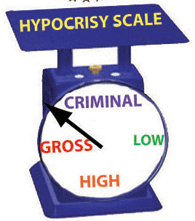 Declassified documents from the National Archives of Australia, including the 1985 Cabinet minute about the SPNFZ Treaty, show clearly that Australia designed the treaty to protect US interests in the Pacific, including the deployment of nuclear-armed warships and the testing of nuclear missiles.
Hayden’s cabinet submission includes details of Australian negotiating positions in the final months before the treaty was signed:
(iii) Australia oppose the inclusion in the draft SPNFZ Treaty of a ban on missile tests.
(iv) Australia oppose the inclusion in the draft SPNFZ Treaty of a ban on the facilitation of the stationing of nuclear weapons,
Delaying the nuclear-free zone in the Pacific, Inside story, 27 Aug 13 As Pacific leaders gather this week in the Marshall Islands, the United States continues to delay ratification of the South Pacific Nuclear Free Zone Treaty. Using previously classified documents Nic Maclellan recounts a history of opposition to a nuclear free Pacific, and a reminder that Australia could be breaching the treaty
AT THE height of the nuclear arms race between the United States and Soviet Union, a treaty to create a South Pacific Nuclear Free Zone, or SPNFZ, was opened for signature on Hiroshima Day, 6 August 1985, at the Pacific Islands Forum meeting in Rarotonga. Twenty-eight years after it was signed on that day by Australia, New Zealand and island nations, the United States still hasn’t ratified its protocols, in spite of a request from president Barack Obama to the US Senate more than two years ago. Next week, as Forum leaders gather in the Marshall Islands – site of sixty-seven US nuclear tests at Bikini and Enewetak Atolls – the US government will be eager to keep nuclear issues off the agenda, as it has been since the Treaty was first mooted. Declassified documents from the National Archives of Australia, and US diplomatic cables published by WikiLeaks, highlight longstanding opposition in Canberra and Washington to a comprehensive nuclear-free zone that might hamper US nuclear deployments in the Pacific. The Forum meeting, and the US Senate’s continued stalling, coincide with on-going concerns that Australia’s decision to sell uranium to India threatens to breach Australian treaty obligations.
AS CONSERVATIVE Australian governments in the 1960s debated the acquisition of nuclear weapons and purchased aircraft capable of delivering nuclear strikes in Southeast Asia, the labour movement across the region proposed a nuclear free zone designed to ban the bomb in this part of the world. The SPNFZ Treaty was finally negotiated in the 1980s after decades of campaigning by unions, Pacific churches and the Nuclear Free and Independent Pacific movement.
Under the treaty, countries in the zone commit never to develop nuclear weapons. Under three protocols, nuclear states with territories in the zone (France, Britain and the United States) agree to apply the treaty to their territories. In accepting the protocols, all nuclear powers also undertake not to use or threaten to use any nuclear device against countries in the zone, and not to test nuclear devices in the zone.
Russia and China were first to sign the protocols, in 1986 and 1987 respectively, pledging not to store or test nuclear weapons in the region or use them against Australia, New Zealand or island nations. France, Britain and the United States refused to sign the treaty protocols for a decade, only signing on 25 March 1996 after the end of French nuclear testing at Moruroa and Fangataufa atolls.
Until now, however, the US government has refused to ratify its signature by passing legislation through the US Senate. President Obama formally called on the US Senate to ratify the SPNFZ protocols the day after a US Special Forces unit shot and killed Osama bin Laden in May 2011. “Ratification of Protocols 1, 2, and 3 to the Treaty would fully support US non-proliferation policy and goals,” he told the Senate, “and I am convinced that it is in the best interest of the United States to ratify these Protocols.”
But the Senate has failed to act on President Obama’s request. On 2 May 2011, the Senate referred the treaty to its Committee on Foreign Relations “pursuant to the removal of the injunction of secrecy.” The committee hasn’t yet discussed the legislation, even though Obama’s Democratic Party has held a majority of its membership since 2007.
The US Embassy in Canberra has confirmed that no hearings are scheduled to discuss the ratification. “There is no time period for ratification,” said an embassy official. “For example, it took the Senate thirty years to ratify the Genocide Convention. The Committee has many other treaties under consideration, so there is no way to tell how long it will be before this treaty is approved by the Committee and referred to the full Senate for its advice and consent.”
THE delay reflects longstanding American opposition to limits on its nuclear deployments in the region. US diplomatic cables published by WikiLeaks show Washington’s opposition to SPNFZ dating back to the 1970s, when the New Zealand government considered taking up the issue………
Declassified documents from the National Archives of Australia, including the 1985 Cabinet minute about the SPNFZ Treaty, show clearly that Australia designed the treaty to protect US interests in the Pacific, including the deployment of nuclear-armed warships and the testing of nuclear missiles. As an April 1985 submission by Foreign Minister Bill Hayden to Cabinet notes, “The proposal is designed to maintain the security advantages afforded to the South West Pacific through the ANZUS Treaty and the United States security presence in the region.”
At the time, the Hawke government was embroiled in debate over a US proposal to test-fire two MX inter-continental ballistic missiles into Pacific waters east of Tasmania. Hayden’s cabinet submission includes details of Australian negotiating positions in the final months before the treaty was signed:
(iii) Australia oppose the inclusion in the draft SPNFZ Treaty of a ban on missile tests.
(iv) Australia oppose the inclusion in the draft SPNFZ Treaty of a ban on the facilitation of the stationing of nuclear weapons, and limit the proposed non-facilitation provisions on the testing and acquisition of nuclear weapons to practical measures consistent with established Australian government positions.
…….. Since the SPNFZ was created in 1986, there has not been a formal review of the Rarotonga Treaty by Forum member countries, even though it includes provisions for a consultative committee to discuss “any matter arising in relation to this Treaty or for reviewing its operation.” This committee must convene “at the request of any Party,” so any Forum member country could call for a SPNFZ review conference. Today, island governments are focused on climate change as the greatest threat to their national security. But with 17,000 nuclear weapons still held in arsenals around the world, maybe it’s time to revive longstanding regional opposition to the threat of nuclear war. •
Nic Maclellan works as a journalist with Islands Business magazine (Fiji) and other Pacific media, and is co-author of three books on nuclear testing in the South Pacific. – See more at: http://inside.org.au/delaying-the-nuclear-free-zone-in-the-pacific/#sthash.RKE5RAqL.dpuf- See more at: http://inside.org.au/delaying-the-nuclear-free-zone-in-the-pacific/#sthash.RKE5RAqL.dpuf
2 Comments »
Leave a reply to Christina MacPherson Cancel reply
1 This month.


PETITION – To: Prime Minister Anthony Albanese and the Australian Labor Government
Chernobyl: The Lost Tapes – A good documentary on Chernobyl on SBS available On Demand for the next 3 weeks– https://www.sbs.com.au/ondemand/tv-program/chernobyl-the-lost-tapes/235274195556
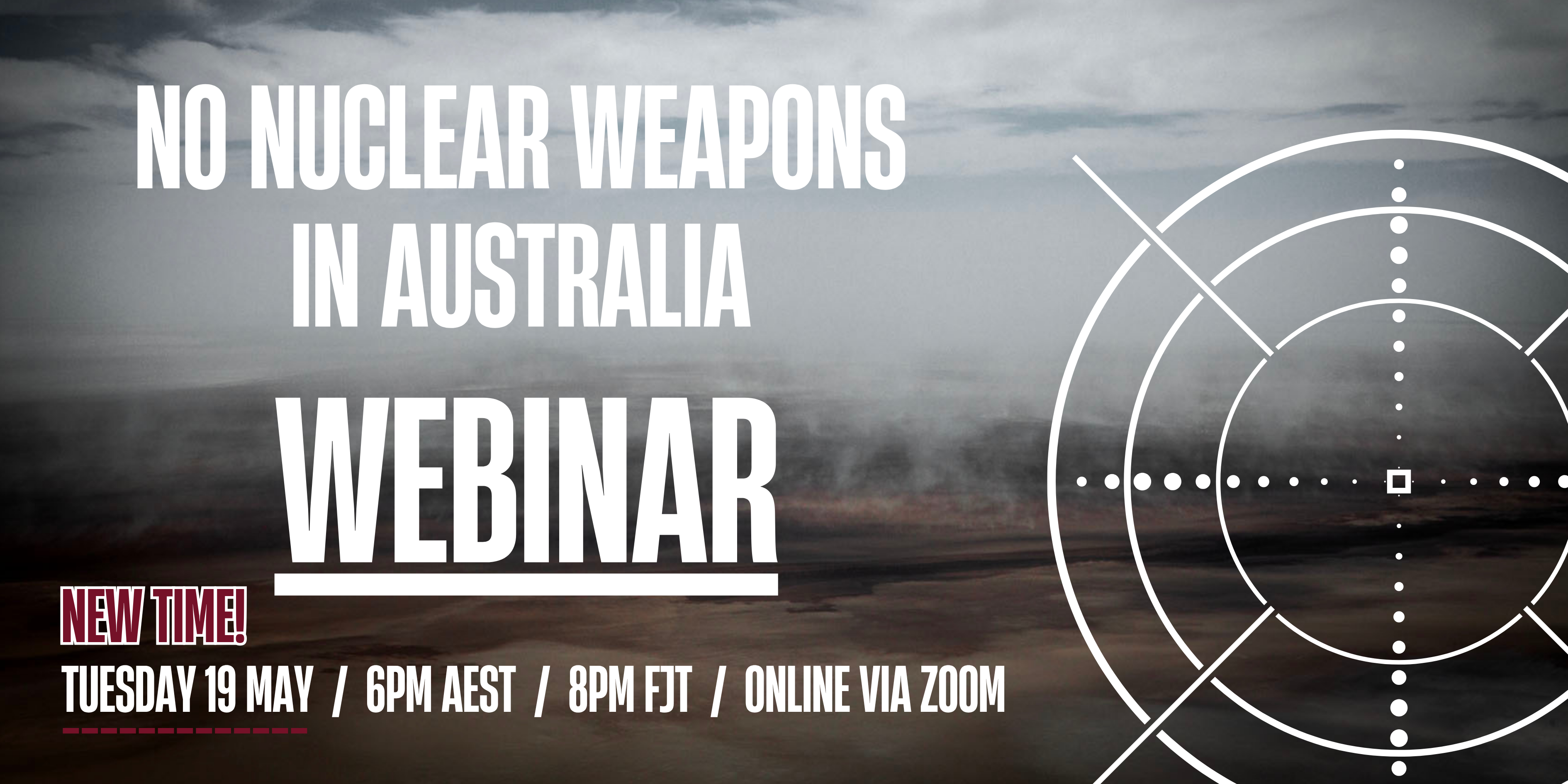
19 May – Webinar- Webinar: No Nuclear Weapons in Australia
Start: 2026-05-19 18:00:00 UTC Canberra, Melbourne, Sydney (GMT+10:00)
End: 2026-05-19 19:30:00 UTC Canberra, Melbourne, Sydney (GMT+10:00)
20 May – Webinar – The dangerous world of AUKUS, US, military occupation and suppression of dissent

National Webinar, 20th May, 2026, 6.30pm AEST. Confronting laws restricting/suppressing protest speech and action
Speakers: Former Sen. Rex Patrick, Lawyer Nick Hanna ,Arthur Rorris ,Jorgen Doyle, Sen David Shoebbridge,
Facilitator Kelley Tranter.

of the week – Australians for War Powers Reform (AWPR)
To see nuclear-related stories in greater depth and intensity
 Antinuclear
The greatest hypocrisy is that Australia still uses nuclear medicine.
More people have died in accidents relating to nuclear medicine than nuclear power – granted, it has saved more people as well – but if you are going to be consistent it ought to be banned as well.
LikeLike
That’s an extraordinary and unreasonable generalisation about the “deaths caused by nuclear medicine”. I would agree that nuclear medicine is at times over-used, and it does indeed carry risks to both patients and staff.
However, I don’t see why nuclear medicine should be abandoned, alongside the abandoning of nuclear power. All the isotopes necessary for nuclear medicine can be obtained in other ways, e.g. in cyclotrons.
The making on medical isotopes in a nuclear reactor, such as the Lucas Heights one – the major use for this small add-on to the reactor’s tasks – is to justify the existence of the nuclear reactor – a foot in the door to the nuclear industry.
LikeLike