Traditional owners’ court case against plan for Muckaty radioactive trash dump
 Spurious excuses The rationale for the dump is spurious. There is no compelling scientific or public safety necessity for one to be built.It has been repeatedly claimed that a specialised waste dump is required to safely store low level waste (LLW) and long lived intermediate level waste (LLIW).
Most of the LLW is derived from medical isotopes used in hospitals and clinics, while the LLIW comes almost exclusively from the nuclear reactor at Lucas Heights in Sydney. It is this latter type of waste that is of most concern because it is highly toxic and radioactive for a lengthy period
No Northern Territory nuclear waste dump!, En Passant Posted by John, September 19th, 2013 Despite clear opposition  from the Aboriginal traditional owners, the push for a nuclear waste dump at Muckaty Station, 120 kilometres north of Tennant Creek in the Northern Territory, continues, write Jon Lamb and Cathy Lawless in Red Flag.
The campaign led by traditional owners to stop the waste dump is gearing up for the next stage in the fight.
On 26 August, the Federal Court set June 2014 for a case to be heard on whether the nomination of the site for the waste dump followed due process. The nuclear free campaigner for the Australian Conservation Foundation, Dave Sweeney, told Red Flag: Continue reading
Film ‘The Way The Wind Blows’ counters the myths about Waubra wind farm
 The truth about Waubra… Locals set record straight on wind farm http://yes2renewables.org/2013/09/20/the-truth-about-waubra/#comment-39331 Those who have followed the rollout of wind energy in Australia would have heard of the quaint Victorian town of Waubra–the location of one of Australia’s largest wind farms. Producing enough clean electricity to for 143,000 households, more than enough to power Ballarat, Waubra’s 128 wind turbines offset a massive 635,000 tonnes of carbon emissions each year which would have been generated by burning coal in the LaTrobe Valley.

While the town should be known for its leadership role addressing climate change and repowering Australia with renewable energy, its name has been tarnished by anti-wind farm lobbyists.
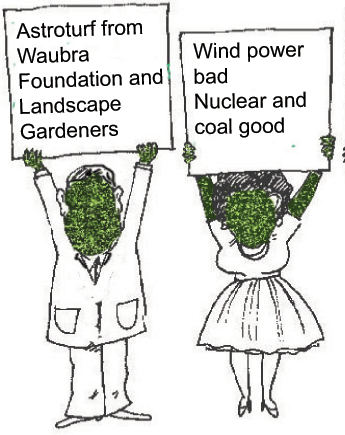 In 2010, the Waubra Foundation was formed by Peter Mitchell–a fossil fuel investor and wind farm opponent–and has unleashed a scare campaign about the alleged health risk of wind energy ever since. The organisation coopted the town’s name without consent of it residents. Unfortunately for locals, the town is linked to a so-called wind farm noise disease rather than its strong community and quality produce.
This all could be about the change.
Over a year in the making, independent filmmaker Neil Barrett has interviewed wind farmers, neighbours and locals to get to the bottom of the negative claims surrounding the project. Barratt has produced a short film entitles The Way The Wind Blows which counters the myths and gives locals a voice for the first time. The short film is a must view.
Australia’s public servants – be careful! or Abbott will sack you
 With blood still on the carpet, a public servant in a senior position will need extra courage to provide objective and critical assessments about climate policy and other contentious issues. We should salute those who will continue to provide frank and fearless advice, and understand if some will be cautious
Australia needs climate institutions, whoever is in power, The Conversation Frank Jotzo Director, Centre for Climate Economics and Policy at Australian National University 20 Sept 13 The new Australian government is sacking the public service heads who implemented Australia’s carbon pricing scheme, and is closing institutions for climate change information and policy advice.
It risks further politicisation of the climate change issue in the public service. Keeping at the very least the Climate Change Authority as an independent agency would send a positive signal about the government’s commitment to economically sound climate policy. Science and economics are needed to underpin policy choices, especially in a field where ideological positions now play such a big role in public debate.
Sackings Continue reading
Moves in Japan towards a non nuclear economic recovery
 Electricity in Japan Power struggle The Economist, Sep 21st 2013 | TOKYO “……….The LDP’s anti-nuclear coalition partner, New Komeito, also constrains the government somewhat. Meanwhile, rising business optimism appears to undermine the case that economic recovery depends on nuclear power. Probably no more than 12-15 reactors will be switched back on, says Kazuhiro Ueta, a renewable-energy specialist who sits on the government’s energy-advisory board. For the nuclear village, which once expected to supply at least half of Japan’s power, that would be a grave disappointment.
Instead, Japan is preparing for other long-term energy supplies. Since 2011 the number of independent power producers tapping renewable sources, such as solar power, has tripled, thanks in part to a new “feed-in” tariff system for renewables. Including hydro-electricity, renewables now represent 10% of the energy mix, leading to hopes that they might one day replace the share that nuclear power once claimed…………..
Long-overdue proposals to liberalise the electricity market may do much to diversify energy sources and lower electricity bills. The government’s plan, easier to push through now that TEPCO, the biggest utility, has been brought low by its handling of the Fukushima fiasco, is to split generation and transmission, with the residential electricity market open to new competition. If the reform succeeds, says Hiroshi Takahashi of the Fujitsu Research Institute in Tokyo, the share of nuclear power in the energy mix would fall as new, non-nuclear providers won customers. It would, at long last, give the public some say over Japan’s energy choices. http://www.economist.com/news/asia/21586570-shadow-fukushima-worlds-worst-nuclear-disaster-after-chernobyl-hangs-over-japans-energy
European Union considering a 40 percent 2030 carbon-cutting goal

 Europe weighing 40 percent 2030 carbon-cutting goal: EU sources By Barbara Lewis BRUSSELS | Thu Sep 19, 2013 (Reuters) – European Union regulators are considering doubling the bloc’s target to cut greenhouse gas emissions by 2030 and setting a tougher binding goal for renewable energy use, EU sources said…… If agreed, the new European goals would be more ambitious than other nations have managed…..http://www.reuters.com/article/2013/09/19/us-eu-climate-idUSBRE98I0RP20130919
Australia moves backward on climate action, as USA moves forward


Prof Sherwood said the best way to solve the long-term problems of climate change was to move away from burning coal – a strategy clearly backed by President Obama. “I don’t know how viable it (the Coalition plan) is to meet the targets, but I’m not too optimistic,” he said.
Australia being left behind on clean energy http://www.thechronicle.com.au/news/Australia-being-left-behind-on-clean-energy/2027248/ AUSTRALIA appears in danger of being left behind on climate change, as United States President Barack Obama moves to cut carbon emissions from America’s power stations. The US move, reported by the New York Times, signals the Obama administration has firmed its resolve to tackle emissions after a year of coal industry opposition to the plan.
President Obama first announced the plans a year ago and the US Environmental Protection Authority was expected to announce the limits on emissions on Saturday, Australian time. The plan will bypass Congress to force new and existing American power plants to limit their overall carbon emissions. Continue reading
The business case for a nuclear free USA
 Should the U.S. Go Nuclear-Free? The Motley Fool, By Justin Loiseau September 20, 2013 For the second time since the Fukushima disaster and the third time in over 40 years, Japan is entirely nuclear-free. With proponents and opponents battling fiercely over the future of nuclear power in Japan, let’s take a look at whether the United States should be nuclear-free….
….With the recent rise of natural gas and renewables, a decline in nuclear might not seem so bad. Natural gas has already surpassed coal as our largest source of electricity, and wind power alone is expected to triple capacity in the next three years. Crude oil is a relic of the past for electricity, and we’ve managed fine with recent coal closures………
If the United States said no to nuclear, we’d be in a tight spot. Nuclear provides cheap baseload electricity with enviable consistency. But there are advantages to a nuclear-free nation. If supportive policy jumps in to save the day, the generation gap could put the U.S. on a fast track to ramping up alternative energies. Duke Energy’s (NYSE: DUK ) recent winfor wind energy storage would need a massive influx of R&D to expand beyond a 36 MW battery, and new energy sources like Dominion‘s (NYSE: D ) long-term lease for offshore wind would need a timelier timeline than ten years from now.
Our nation would also need to take a hard look at its power system, decentralizing generation via smart investments in smart grid technology……… http://www.fool.com/investing/general/2013/09/20/should-the-us-go-nuclear-free.aspx
The case for the Climate Change Authority
 Australia needs climate institutions, whoever is in power, The Conversation Frank Jotzo Director, Centre for Climate Economics and Policy at Australian National University 20 Sept 13 “……..The most important element of the institutional structure at risk is the Climate Change Authority. This was established as a statutory agency to provide advice to the government and parliament, modelled after the UK Committee on Climate Change.

The Authority conducts reviews on Australia’s climate change policies. Its draft report on Australia’s climate change target – which has bipartisan support – is due in October. The final report, as well as a report on Australia’s emissions trends and drivers, is due early in 2014. A review of Australia’s renewable energy target is already out.
The government has said it will abolish the Authority. Doing so will require a change to legislation so cannot happen immediately.
Axing the Authority would be the most severe blow to Australia’s climate change policy institutions. Even if the carbon price was repealed, the authority has an important role. It has to advise on Australia’s national emissions target, and provide deep and critical analysis on any policy aimed at cutting emissions.
By all indications, the Authority has been taking very seriously its task to critically evaluate the evidence and form well-supported recommendations for policy. The Authority employs some of the sharpest climate policy analysts in Australia, led by Anthea Harris, one of the country’s most experienced climate policy practitioners……….http://theconversation.com/australia-needs-climate-institutions-whoever-is-in-power-18371
The motivation behind the push for a radioactive trash dump in the Northern Territory
 No Northern Territory nuclear waste dump!, En Passant Posted by John, September 19th, 2013 “………Dave Sweeney explains further: “In the 1990s there was a departmental decision made that the best way to manage Australia’s radioactive waste was through developing a centralised remote dump or store. This decision was made by unelected bureaucrats and has since been uncritically adopted and advanced by successive federal governments. A remote dump is one way to manage waste; it is not the only way and has never been proven to be the best way.”
The push for a nuclear waste facility also ties in with a desire by the Australian ruling class to maintain a stake in the global nuclear industry. Aboriginal rights, the safety of workers and environmental concerns are being quashed or ignored in order to pursue profit.
The justification for storage of medical waste is also a complete furphy. Sweeney told Red Flag, “The medical myth is a deeply disturbing aspect of the Muckaty story. Both major parties have consistently misrepresented the situation by claiming that the Muckaty dump is needed to ensure Australians have access to nuclear medicine for therapeutic and diagnostic reasons.
“This is not the case – and medical waste is not the driver for the planned dump. Medical and public health bodies including the Medical Association for the Prevention of War and the Public Health Association of Australia have repeatedly condemned the conflation of these issues”, he said.
The promotion of the waste dump on an economic basis, including for local Aboriginal communities, also deeply concerns Shaw. “It is disgusting to talk about a nuclear waste dump as being part of economic development because there is no economic development in nuclear waste dumping”, she said……http://enpassant.com.au/2013/09/19/no-northern-territory-nuclear-waste-dump/
Polluting corporations pay up big to climate change sceptics
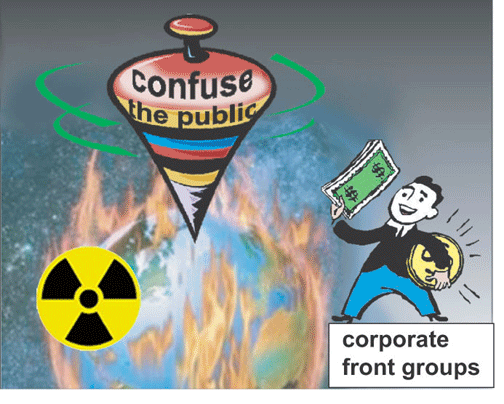
The Competitive Enterprise Institute has in the past received funding from Exxon Mobil, the oil company, and the American Petroleum Institute, Texaco, General Motors and the Koch Family Foundations, controlled by the Koch brothers who made their fortune from fossil fuels.
Big business funds effort to discredit climate science, warns UN official http://www.theguardian.com/science/2013/sep/20/big-business-funding-climate-change-sceptics Climate change summit braced for counterblast from sceptics as report warns greenhouse gas emissions still increasing Fiona Harvey and Graham Readfern The Guardian, Saturday 21 September 2013 Big companies are paying contrarians to undermine the work of climate scientists, according to a top UN official speaking before the release of a landmark review of climate science this weekby international researchers next Friday.
Halldór Thorgeirsson, a director who reports to the head of the UN body that governs the on-going high level international climate negotiations, said that scientists would need to be prepared for a counter-blast from sceptics.
“Vested interests are paying for the discrediting of scientists all the time. We need to be ready for that,” he said……..
His outspoken views will set the tone for a fractious meeting of the world’s leading climate scientists, kicking off on Monday in Stockholm, that will set out the evidence that the world’s governments use when formulating policies to deal with global warming for decades to come. More than 800 scientists have contributed to the report, the final details of which will be hammered out in a gruelling four-day session next week.
According to a draft of the “Summary for Policy Makers” dated June , seen by the Guardian– the most important part of the document – the scientists will argue that the evidence points to 95% certainty that climate change is occurring and is caused mainly by greenhouse gases released by humans – up from 90% certainty in the previous 2007 report. Continue reading
Abbott government’s prelude to Australia’s climate calamity
Coalition commences coordinated climate change calamity Well befitting a man who thinks climate change science is crap, new Prime Minister Tony Abbott is shutting down every climate change commission in the country, reports Torin Peel. Independent Australia 20 Sept 13 TONY ABBOTT HAS BECOME a man who has become notorious on the issue of climate change, the science of which he once dismissed as ‘absolute crap’…
Tim Flannery defends Climate Commission
…..Despite Abbott believing that the evidence pointing toward climate change is ‘absolute crap’, he has still made a commitment to enforce his new direct action policy, even while striving to abolish every climate board in the country. Abbott has also said that the world has stopped warming, which would render his plan as useless if he was to stick to his views. http://www.independentaustralia.net/2013/politics/coalition-commences-coordinated-climate-change-calamity/
It’s getting harder for foreign uranium companies to rip off the Africans
 Niger audits Areva uranium mines, seeking better deal By Daniel Flynn and Abdoulaye Massalatchi NIAMEY | Fri Sep 20, 2013 (Reuters) – Niger has ordered an audit of French nuclear group Areva’s (AREVA.PA) uranium mines in the West African country as it presses for a better deal in talks over a new long-term contract, Mining Minister Omar Hamidou Tchiana told Reuters.
Areva’s two mines in Niger – Somair and Cominak – produce the fuel for roughly one-third of France’s nuclear power, providing some of the cheapest electricity in the West.
Niger, a former French colony and one of the world’s poorest countries, has long complained it does not reap enough benefits from these resources……..
Extractive industries watchdogs, including the local branch of Publish What You Pay, have accused Areva of a lack of transparency in its revenues and costs in Niger…….
Previous Niger governments have struggled to substantially increase the state’s take from uranium and details of the 2003 mining contract have been kept confidential. The IMF estimates Niger’s gross domestic product at around 5.5 billion euros, only just over half of Areva’s revenues of 9.3 billion in 2012……..http://www.reuters.com/article/2013/09/20/us-niger-areva-idUSBRE98J0MY20130920
Australia’s Climate Commission and Clean Energy Finance Corporation – what they actually do
Australia needs climate institutions, whoever is in power, The Conversation Frank Jotzo Director, Centre for Climate Economics and Policy at Australian National University 20 Sept 13 “……The first of Australia’s independent climate change institutions to get the axe is the Climate Commission, the agency created by the Labor government to disseminate public information about climate change.
It made its mark with reports about climate change impacts and the scientific basis for prompt action. But it also explained the advantages of carbon pricing and listed mitigation policy actions that other countries are taking, and took its message to many public forums.
It is by no means revolutionary stuff. The fact the incoming government sees the Commission as a problem is an indication of just how deeply politicised the Australian climate debate has become.
Next on the block is the Clean Energy Finance Corporation, which is charged with making co-investments in renewable energy and energy efficiency projects in the commercial sector.
The Corporation has a A$10 billion investment mandate – not a subsidy, but the mandate to invest up to that amount and earn an appropriate return on the investments. The Corporation has been told to stop lending, though whether the government can legally require it to do so before new legislation is passed appears somewhat unclear.
It is slated to be abolished if and when the government repeals the Clean Energy legislation including the carbon price.http://theconversation.com/australia-needs-climate-institutions-whoever-is-in-power-18371
1 This month

of the week – Australians for War Powers Reform (AWPR)
To see nuclear-related stories in greater depth and intensity
 Antinuclear