South Australian election to end support for renewable energy?
In the current campaigning South Australia, renewables are hardly mentioned. They do not yet feature in any of the major parties policy platforms, and nor are they likely too. This is despite the fact that in South Australia nearly one in five houses has modules on the roof, and rooftop solar contributes more than 15 per cent of electricity on some days, and recently has been contributing more than 10 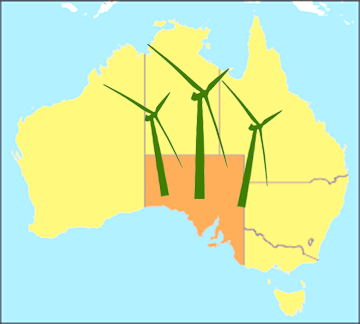 per cent for more than 6 daylight hours.
Even with the likely roll-out of rooftop solar, and more wind farms (depending on the fate of the RET, which is not an election issue yet either), the state is likely to be the first to reach 50 per cent, and could do this by 2020, as several government reports have also concluded.
 Australia may lose last mainland state supportive of renewableshttp://reneweconomy.com.au/2014/australia-may-lose-last-mainland-state-supportive-renewables-98625 By Giles Parkinson on 7 February 2014 The public feuding within the ruling Labor Party in South Australia in this past week confirmed to many that the last Labor state government in mainland Australia is about to lose power. And with it will go the last government openly supportive of renewable energy.
Voters go to the polls in South Australia and Tasmania on March 15, and the Labor Premiers in both states may be replaced by their conservative opponents.
In Tasmania, this may not mean a lot for renewables because the state is mostly powered by hydro anyway, but it will be interesting to see if a Liberal government pursues such projects as the King Island win project and a second interconnector to the mainland (to sell more green energy) with the same vigor, or indeed its aim to be “100% renewable”.
In South Australia, the circumstances are different. The Labor government has been in power – and the state has become the nation’s leader in both wind energy and rooftop solar PV. Former Premier Mike Rann announced a state target of 33 per cent by 2020, an initiative that helped the state gain nearly half of the wind farms in the country, and the highest penetration of rooftop solar, but it has already nearly met its target giving it a combined contribution of 31 per cent from variable sources in 2012/13.
The state’s strong push into renewables was made possible by the fact that the local fossil fuel industry in that state is not strong. This is a circumstance shared by Tasmania and the ACT Labor government, the only other with strong renewables policy – 90% renewables by 2020. The other mainland states, WA, Victoria, Queensland and NSW, feature strong fossil fuel interests and conservative governments that have shown – particularly in WA and Queensland, and in Victoria in the case of wind – open hostility towards renewable energy.
But in the current campaigning South Australia, renewables are hardly mentioned. They do not yet feature in any of the major parties policy platforms, and nor are they likely too. This is despite the fact that in South Australia nearly one in five houses has modules on the roof, and rooftop solar contributes more than 15 per cent of electricity on some days, and recently has been contributing more than 10 per cent for more than 6 daylight hours.
Even with the likely roll-out of rooftop solar, and more wind farms (depending on the fate of the RET, which is not an election issue yet either), the state is likely to be the first to reach 50 per cent, and could do this by 2020, as several government reports have also concluded.
The failure to embrace such targets is disappointing, but probably not surprising. Politicians have yet to get their mind around rooftop solar, despite the obvious attraction to households and its ability to reduce bills. And in South Australia, there is plenty to boast about – jobs, the biggest reduction in wholesale prices in any state, less coal-fired electricity made locally and less coal imports, and a big reduction in emissions.
The issue about solar thermal has also been “neutralized” by an agreement to conduct a two year “feasibility study” co-founded by ARENA and the state government. Essentially, this is designed to postpone any decisions on new technology until after Alinta, the owner of the Port Augusta coal generators where the solar thermal power station could be located, is sold by its private equity owners.
The one positive note to the campaign so far is the Liberal’s focus on home energy consumption, costs and awareness. It proposes introducing monthly billing, and a voluntary rollout of smart meters. It recognizes that the current system of billing and metering is based on an antiquated system that provides little data, and makes it impossible for a family to understand when it is using its energy and how it can shift consumption patterns to get costs down. That awareness will be crucial as more households look to install solar, or even battery storage systems, and distributed energy emerges as a viable alternative in a state with one of the most elongated, and expensive, network of poles and wires in the world.
It’s interesting, though, to look back at some of the advice that laid the foundation of Rann’s 33 per cent target. At the time, it was thought that a large part of the target (600MW to 900MW) would be met by geothermal energy. There will probably be little or none by 2020.
It was also though that solar PV, at most, would contribute 100MW. The state is already at 450MW and likely to at least double that by 2020. And it was thought that wind energy would cause grid instability if it went over 20 per cent. As it turns out it is at 27 per cent, and doing fine – even if it is clipping the earnings of aggrieved coal and gas generators.
2 Comments »
Leave a reply to Dennis Matthews Cancel reply
1 This month
Chernobyl: The Lost Tapes – A good documentary on Chernobyl on SBS available On Demand for the next 3 weeks– https://www.sbs.com.au/ondemand/tv-program/chernobyl-the-lost-tapes/2352741955560
15 April – Zoom –Nuclear Power is Not the Solution
Apr 15, 2026 01:00 AM in Canberra, Melbourne, Sydney

Join the International Physicians for the Prevention of Nuclear War (IPPNW) on Tuesday, April 14th for a timely webinar exploring the risks associated with nuclear power and challenging the myth that it offers a simple, safe, carbon-free solution to the climate crisis

21 April Webinar: No Nuclear Weapons in Australia
Start: 2026-04-21 18:00:00 UTC Canberra, Melbourne, Sydney (GMT+10:00)
End: 2026-04-21 19:30:00 UTC Canberra, Melbourne, Sydney (GMT+10:00)
Event Type: Virtual
A virtual link will be communicated before the event.
Host Contact Info: australia@icanw.org

of the week – Australians for War Powers Reform (AWPR)
To see nuclear-related stories in greater depth and intensity
 Antinuclear
I am putting together a group (Fisher Electoral Lobby) to lobby candidates in my electorate (Fisher) in the SA elections. I have put together a questionaire, with all questions put in the form “do you support” even though I don’t support them all.
If anyone wants to sign up to the lobby please contact me. I’ll do all the work and it won’t cost anything. People will be able to sign on or off at any time. The more people we have the greater the clout. I will send media releases to local and state media.
The q’aire is given below’
1. Do you support the call from Business SA for:
1.1 Nuclear power in SA? YES NO
1.2 Uranium enrichment in SA? YES NO
1.3 The import of nuclear waste into SA? YES NO
2. Do you support
2.1 The feed-in tariff for electricity from solar cells? YES NO
2.2 Making exporters of solar electricity
pay more for the electricity network? YES NO
2.3 Making users of air-conditioners
pay a higher tariff for electricity? YES NO
2.4 Tighter regulation of the monopoly
electricity network utility? YES NO
2.5 SA Government incentives for
energy efficient homes? YES NO
3. Do you support repealing recent changes to the Electoral Act that:
3.1 Increased the cost of nominating for the
SA elections from $450 to $3000? YES NO
3.2 Increased the number of nominators required for an
Independent Legislative Council nominee to 250? YES NO
3.3 Placed independents at the end of the ballot paper? YES NO
4. Do you support an official apology to SA’s Aboriginal Peoples for the harm caused by:
4.1 Forcibly taking away their land? YES NO
4.2 Forcibly imposing an alien culture? YES NO
4.3 The introduction of toxic substances
into their communities? YES NO
4.4 The lack of aid in combating the
effects of the above? YES NO
LikeLike
The Editor
The Advertiser
When it comes to electricity and water charges the Nick Xenophon Group is way too late (The Advertiser, 10/2/14) a veritable herd of horses has stampeded out of the gate left open by the Labor-Liberal duopoly.
The time for bravado was when ETSA was being dismantled and sold off to mostly overseas interests, when they sold off the monopoly electricity network business, when they set up the farcical Industry regulator, and when they built the energy and capital intensive white elephant desalinator.
These decisions were made in the face of strong public opposition and will continue to put upward pressure on household budgets.
What can be done now is to oppose the powerful fossil fuel and electricity lobbies from derailing the growing solar energy industry. Now that’s an objective that is not only worthwhile but is feasible and would get strong community support.
Dennis Matthews
LikeLike