3 things that I worry about relating to nuclear waste dumping in Australia
 1. The Abbott government’s move to get rid of its responsibilities about environment – letting the States have control of many issues and decisions
2, A new Bill in the Western Australian Parliament, that could give power to an Aboriginal leader to evaluate and negotiate decisions on land use HG Alert: 12 June 2014 http://www.mondaq.com/australia/x/323176/indigenous+peoples/Aboriginal+heritage+takes+a+contemporary+twist+in+Western+Australia
3. The proposal, in the article below, by one such Aboriginal leader, for a nuclear waste dump in his area. Nuclear dump plan for desert MICHAEL DULANEY The West Australian July 6, 2014,https://au.news.yahoo.com/thewest/business/wa/a/24395664/nuclear-dump-plan-for-desert/
Proposal for Nuclear Waste Dump on Aboriginal Land in Western Australia
 Nuclear dump plan for desert MICHAEL DULANEY The West Australian July 6, 2014, A traditional owner in the northern Goldfields wants to house a proposed nuclear waste dump on land in the Gibson Desert to help develop the region’s economy.
Kanpa community chairman Preston Thomas has seized on the Commonwealth dumping Muckaty Station as the site for a Federal nuclear waste repository.
It is part of his vision to provide biofuel to the Ngaanyatjarra Lands and develop agriculture around the remote Kanpa Aboriginal community, about 900 km north-east of Kalgoorlie-Boulder.
The Northern Territory station was withdrawn last month after a Federal Court case and division between Aboriginal groups in the region who claim they were not consulted properly.
The Federal Government is looking for an alternative site for Australia’s first radioactive waste dump.
Kanpa’s representative body the Pira Kata Aboriginal Corporation, chaired by Mr Thomas, has applied for a native title sublease of about 500sqkm between Kanpa and the Great Central Road.
Mr Thomas wants this area to be considered for the facility, which requires an area of about 3sqkm – about the size of two football fields……..Mr Thomas has been in discussions for the project with AgGrow Energy Resources since 2010, after the company’s involvement in a similar pilot project in the Pilbara………Industry Minister Ian Macfarlane said the Northern Land Council, which represented traditional owner interests at Muckaty Station, had been given three months to find an alternative site.
If the process was not concluded by September, a nationwide tender would be conducted, with “preliminary discussions” already under way.https://au.news.yahoo.com/thewest/business/wa/a/24395664/nuclear-dump-plan-for-desert/
Japan’s P.M. in Australia- talks with Abbott will ignore Fukushima!
 Abbott and Abe should be talking about Fukushima Japanese Prime Minister Shinzo Abe is making an official visit to Australia this week talking free trade and increased resource and defence co-operation. But he should be talking about Australia’s role in fueling Fukushima, says Dave Sweeney. http://www.sbs.com.au/news/article/2014/07/07/comment-abbott-and-abe-should-be-talking-about-fukushima
It would be fitting for the Australian and Japanese PM’s to acknowledge the October 2011 statement by Robert Floyd, the director general of DFAT’s Australian Safeguards and Non-Proliferation Office, that confirmed to the parliament that “Australian obligated nuclear material [uranium] was at the Fukushima Daiichi site and in each of the reactors”.
It would be timely for the leaders to commit to an independent cost-benefit assessment of Australia’s uranium trade, as directly requested by the UN secretary general Ban Ki Moon in the wake of the accident and supported by a recent Senate Inquiry as a pre-condition before any planned new uranium sales. Aptly enough, the Australian uranium sector has been hard hit by the market fallout from Fukushima and low uranium prices have seen existing uranium mines close down. New uranium mining projects are being delayed and the sector is in serious trouble. And that’s before mentioning spills such as the December 2013 uranium tank collapse and the leak at Rio Tinto’s Ranger mine in Kakadu. Ranger got the federal go ahead to resume processing operations last month but the troubled site remains under pressure and under-performing.
Australia also continues to uncritically supply our existing uranium customers, despite evidence of unsafe practices in countries like South Korea. Our yellowcake deal with Russia also deserves greater scrutiny, especially in the light of escalating tensions in Ukraine, as the International Atomic Energy Agency has not carried out any inspections there since at least 2001. We aggressively push new uranium deals to countries like India, whose nuclear industry has been called unsafe by its own auditor general, and which point blank refuses to sign the global nuclear non-proliferation treaty.
PM Abe’s visit is an ideal time to reflect on the very nature of Australia’s uranium – it is not like any other mineral.
Uranium can fuel both nuclear reactors and nuclear weapons and it all becomes radioactive waste. Australia is home to around 40% of the worlds’ uranium, and the decisions we make matter. In the shadow of Fukushima, we need to review the costs and consequences of our uranium trade at home and abroad and act on the UN’s Inquiry call.
If our political leaders continue to put the interests of a high risk, low return industrial sector before those of our nation and region, the consequence is that it is likely that Australia’s uranium sector will fuel future Fukushima’s.
It is said that those who do not heed the lessons of history are doomed to repeat them – we must not allow this to happen. It is time for an independent assessment of the domestic and international costs and consequences of Australia’s uranium trade and it is time for our leaders to acknowledge the increasingly obvious – our shared energy future is renewable, not radioactive.
Aboriginal Australia needs a genuine representative, not Abbott’s token Warren Mundine
It is not acceptable for political parties to appoint a token representative to address the issue, misrepresent to the community they are going to be acting in the best interests of the community and then fail to consult the community upon which they are imposing laws and policies.
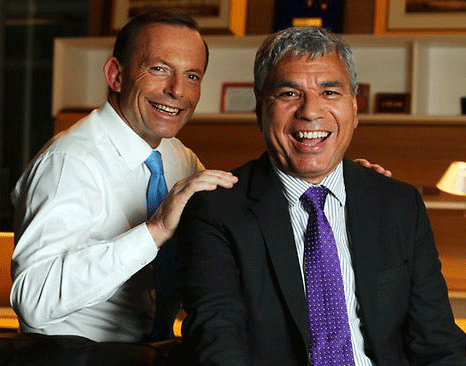 Tony Abbott, terra nullius and Warren Mundine, Independent Australia Natalie Cromb 4 July 2014, Prime Minister – and supposed Indigenous Affairs Minister – Tony Abbott has insulted First Australians, saying Australia was “unsettled” before British colonisation, while his Indigenous advisor Warren Mundine laughed off the calumny. First Australian Natalie Cromb comments.
PRIME MINISTER TONU ABBOTT delivered the keynote address at a Melbourne Instituteconference last night and, whilst advocating for foreign investment, he shed some light on his particular take on history, crediting Australia’s existence on British “foreign investment” in
“… the then unsettled or, um, scarcely settlement, Great South Land.”
This, of course, is the same Tony Abbott who, in the lead up to last year’s election, told a large group at Arnhem land that he would spend his first week as Prime Minister with the Yolngu People.
When it was pointed out by David Donovan in late September that he had not, actually, done that, PM Abbott was backed to the hilt by his hand-picked Indigenous advisor, Warren Mundine, who excoriated IA‘s managing editor for foolishly taking Tony at his word.
Again, today, Mundine has downplayed Abbott’s latest insensitive comments as “silly”, saying Tony Abbott’s
So, who is this Mundine? And why has he thrown his support behind a prime minister whose attitude towards Indigenous Australia is ambivalent at best and downright duplicitous at worst?
As a proud member of Australia’s First Peoples, I would like to talk about Warren Mundine and his relationship and connection to Indigenous Australia, as well as lay out what a person in his position should aim to achieve.
Warren Mundine is an accomplished man with a large family and extensive political history with the Australian Labor Party — however, those closest to Mundine do consider his political aspirations self-serving rather than for the greater good of the Aboriginal people.
Lending weight to this critique is the fact that he has jumped ship from Labor, citing he was “sick at heart” following the appointment of Bob Carr to the position that he was courting and now he is Prime Minister Abbott’s key advisor on Aboriginal Affairs.
I am sure that Warren Mundine’s ‘leadership’ status and ‘advisor’ capacity has nothing to do with the fact that he shares the same religious philosophy as the Prime Minister, is an economic conservative that supports Abbott’s policies of individual economic participation as being of more importance than the empowerment of communities and he appears to tow the party line.
Warren Mundine’s views are widely criticised and rightly so.
He has supported a political party and policies that have set Indigenous people back, and makes outlandish comments of this nature, which not only deny the history of this nation, but belittle it for an economic cause.
An example is the recent announcement of $42m funding being cut from the National Aboriginal and Torres Strait Islander Legal Service (ATSILS).
The ATSILS is the one organisation that attempts to counterbalance the obvious discrimination that occurs in the criminal justice system. It is accepted as fact, and there is a tremendous amount of data to support, the contention that Indigenous Australians are racially profiled and are more likely to receive custodial sentences than their non-Indigenous counterparts for the same crime. Nevertheless, ATSILS is staring down the barrel of a crippling funding cut.
Mundine did little to oppose this cut and, in fact, said Indigenous programmes should be looking for further “efficiencies”.
In my opinion, Mundine and Abbott can expel rhetoric about efficiencies until the cows come home but a cut is a cut and cuts of this magnitude, targeted in such a manner, illustrate a complete disconnect between Abbott, his adviser and the Aboriginal populace at large. Continue reading
Why the arguments for thorium nuclear energy don’t stack up
 Writing in Oil Price, Andrew Topf 18 June 2014 discusses the very real impediments to starting a thorium nuclear reactor industry
“One large hole that can be punched in the argument for thorium involves the economics of thorium reactors. Experts say compared to uranium, the thorium fuel cycle is more costly and would require extensive taxpayer subsidies.
Another issue is time. With a viable thorium reactor at least a decade away if not more, the cost of renewable alternatives like solar and wind may come down to a point where thorium reactors won’t be economical. Critics also point out that the nuclear industry has invested too much in uranium reactors – along with government buy-in and a set of regulations around them – to be supplanted by thorium.
As for the “green nuclear” argument, thorium’s detractors say that isn’t necessarily the case. While thorium reactors produce less waste, they also produce other radioactive by-products that will need safe disposal, including U-232, which has a half-life of 160,000 years.
“It will create a whole new volume of radioactive waste from previously radio-inert thorium, on top of the waste from uranium reactors. Looked at in these terms, it’s a way of multiplying the volume of radioactive waste humanity can create several times over,” said Oliver Tickell, author of Kyoto2, speaking to The Guardian.”
Australia’s solar energy revolution is underway
Australia’s solar boom has only just begun Echo Net Daily Giles Parkinson, RenewEconomy 6 July 14 Australia is expected to spend some $55 billion on new electricity generation over the next decade and a half, but two thirds of this will be in the form of solar technology, and nearly half in rooftop solar PV.
These forecasts are included in Bloomberg New Energy Finance’s Market 2030 outlook, which includes detailed forecasts for Australia and Asia, both of which have major implications for the coal industry – exporters and local generators.
The most striking prediction is that for solar PV, which BNEF says will dominate capacity and investment over the next decade and a half. It expects 15.8GW of rooftop solar to be built in Australia out to 2030 – mostly on the basis of fundamental economics.
It suggests the payback for rooftop solar will halve to just three years by 2030. That is based on no subsidies and no carbon price, but it argues that it is still a compelling proposition to households.
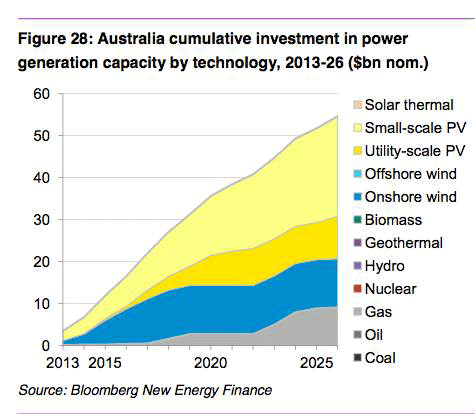
“Australia, like Japan, has high retail electricity prices which, combined with continuously reducing technology costs, are the main reasons for the small-scale PV adoption rate,” it writes.
“The favourable economics of the small-scale PV technology – ie, the reduction in payback period – will drive the sixfold increase in small-scale PV capacity and the technology’s contribution to total capacity additions between 2013 and 2030.”
BNEF expects households and businesses will invest another $24 billion on rooftop solar.
While the speed and breadth of the rooftop solar deployment will be influenced slightly by policy changes, the deployment of large-scale renewables is almost entirely dependent on the state of policies such as the renewable energy target…….http://www.echo.net.au/2014/07/australias-solar-boom-just-begun/
Illawarra Aboriginal leader Sharralyn Robinson rejects Tony Abbott’s “unsettled Australia” views
Illawarra Aboriginal leader reacts to Abbott’s ‘unsettled’ speech, Illawarra Mercury By BEN LANGFORD July 4, 2014, Prime Minister Tony Abbott’s comments that Australia was “unsettled” before British “foreign investment” arrived in 1788 were out of step with a great number of Australians who recognised Aboriginal history, Illawarra Aboriginal leader Sharralyn Robinson said on Friday.
Mr Abbott surprised many with his comments, made in a speech about foreign investment on Thursday night.
“Our country is unimaginable without foreign investment,” Mr Abbott said.
“I guess our country owes its existence to a form of foreign investment by the British government in the then unsettled or, um, scarcely settled, Great South Land.”
Ms Robinson, the acting chief executive of the Illawarra Local Aboriginal Land Council, said more than 40,000 years of Aboriginal history needed to be remembered.
“It’s very disturbing to think we’ve got a Prime Minister who isn’t aware of what was here prior to invasion,” she said. “This country was very settled. We had our laws in place, we had our Parliament houses, our opera houses, our hospitals, our homes.”
Ms Robinson said most Australians did not cling to the myth that Australia was uninhabited…….
Mr Abbott’s comments exposed him to criticism that he had not moved on from the old doctrine of terra nullius – nobody’s land – that was dumped by the High Court last century.
Northern Territory Labor senator Nova Peris said Mr Abbott’s comments were “highly offensive, dismissive of indigenous peoples and simply incorrect”……http://www.illawarramercury.com.au/story/2396912/illawarra-aboriginal-leader-reacts-to-abbotts-unsettled-speech/?cs=300
Australia in desperate need of true history education, and a Treaty with Indigenous people
 Tony Abbott, terra nullius and Warren Mundine, Independent Australia Natalie Cromb 4 July 2014, “……..This government, and all governments that seek to enact laws in this manner, need a history lesson. A truthful history lesson.
The crux of the matter is that European people settled on land belonging to the Indigenous inhabitants under the falsehood of terra nullius and, thereafter, the settlers imposed English law upon the Indigenous inhabitants, including laws which sought to disperse them from the lands to which they belonged on a spiritual level, and further to diminish and/or destroy the families and culture with which they identified.
This history, however bleak and embarrassing to Australians – and Tony Abbott – is what actually did occur.
Australia needs a leader and a government that will look at the history of this nation and utilise this history as a lesson in tolerance and how to be more appreciative of a culture that owned and cared for this land for at least 40,000 years before European settlement occurred.
This nation needs leaders that understand the racial divide of this nation and how to go about correcting and bridging this divide.
There are two key and pressing ways in which to make the first steps to effect dramatic change that will bridge this divide. The first is education and the second is a treaty. Continue reading
Small solar generators have helped electricity utilities
To The Editor The Advertiser, from Dennis Matthews, 6 July 14
In the National Electricity Market (NEM) it is the active participants who determine supply and demand.
The active participants are large electricity generators and large electricity consumers. It is the large generators that determine the wholesale price of electricity and it is large consumers who are able to negotiate with the generators.
Small electricity generators and consumers, such as small businesses and households have always been passive participants whose options are constrained by the active participants.
It makes more sense that large electricity consumers should be charged according to the maximum load they put on the network. Not only would this have a large and predictable effect on peak demand but it would be much easier than the proposal of the Grattan Institute (The Advertiser, 7/7/14) to put the onus on to households.
Thanks to the growth in roof mounted solar panels, peak demand has not only decreased but has been shifted to late in the day, thus making it easier for industry to reduce its demand at times of peak demand.
The solar boom will not be limited to Australia
Australia’s solar boom has only just begun Echo Net Daily Giles Parkinson, RenewEconomy 6 July 14“……….the solar boom will not be limited to Australia. BNEF expects solar to form a significant part of the power generation build in the major economies of Asia, to the exclusion of coal-fired generation in particular – a bad sign for Australia’s aspiring coal exporters.
BNEF says the expected capacity build for the Asia-Pacific region will require an investment of a cumulative $3.61 trillion by 2026.
Of this, nearly $1 trillion will be in the form of solar, $0.62 trillion for hydro and $0.55 trillion for wind.
And this graph below [see original article] illustrates what it means in terms of capacity additions. Coal declines rapidly, nuclear has the bumpiest ride, and eventually falls as India will allocate no more financing to the technology from 2023 due to policy uncertainty and fuel restrictions.
China will invest $38 billion a year on solar (utility and small-scale) and $28 billion a year on onshore and offshore wind, Japan will throw $11 billion a year on solar (mostly small-scale), India $10 billion (mostly utility-scale, off-grid or micro-grid), while Indonesia and the Philippines will each invest $3 billion a year in geothermal.http://www.echo.net.au/2014/07/australias-solar-boom-just-begun/
1 This month.

Help Aunty Sue Protect Her Land and Sacred Sites From Destructive Rocket Testing.
29 August – UN International Day Against Nuclear Tests -HOW WE CAN PREVENT ANUCLEAR WAR DURING TRUMP’S PRESIDENCY
12:30 PM – 4 PM Saturday August 29 Pilgrim Church, Adelaide. Joint presentation afternoon with Doctors for the Environment Australia & Medical Association for the Prevention of War (SA)https://www.mapw.org.au/ Speakers are Professor Dale Bagshaw, internationally renowned mediator; Dr Kate Wylie, National Executive Officer of Doctors for the Environment (DEA);
Dr Teresa Pham, Drs for the Environment; Ben Crouch MPhil, Medical Physicist, and Amanda Ruler, PhD. – and hear expert opinion on how peaceful mediation and negotiation can prevent a nuclear war during Trump’s presidency.

Australians deserve the truth
about
AUKUS – https://aukuspublicinquiry.com/


PETITION – To: Prime Minister Anthony Albanese and the Australian Labor Government

of the week – Australians for War Powers Reform (AWPR)
To see nuclear-related stories in greater depth and intensity
 Antinuclear