Nothing changes. ‘Nuclear Village’ is still controlling Japan
the corruption and collusion of Japan’s nuclear village led to numerous accidents before the Fukushima disaster.
And the corruption and collusion of Japan’s nuclear village was a root cause of the Fukushima disaster itself. On that point the Nuclear Accident Independent Investigation Commission could not have been blunter: “The accident was the result of collusion between the government, the regulators and TEPCO, and the lack of governance by said parties.”
A big part of the post-Fukushima spin is that lessons were learned from the nuclear disaster and improvements made. But the real lesson from this saga is that the nuclear industry – in Japan at least – has learned nothing from its catastrophic mistakes.
As Yotaro Hatamura says, an accident will surely happen again.
After Fukushima: Japan’s ‘nuclear village’ is back in charge, Ecologist Jim Green28th March 2015 Public opposition to nuclear power in Japan remains strong, writes Jim Green, but piece by piece, Shinzo Abe’s right-wing government has been putting the country’s infamous ‘nuclear village’ back in control – boosted by draconian press censorship laws, massive interest-free loans, and a determination to forget all the ‘lessons’ of Fukushima. Is another big accident inevitable?
Public opposition to reactor restarts (and the nuclear industry more generally) continues to exert some influence in Japan.
Five to seven of the oldest of Japan’s 48 ‘operable’ reactors are likely to be sacrificed to dampen opposition to the restart of other reactors, and local opposition may result in the permanent shut down of some other reactors.
Currently, all 48 of Japan’s ‘operable’ reactors are shut down – and the six reactors at Fukushima Daiichi have been written off.
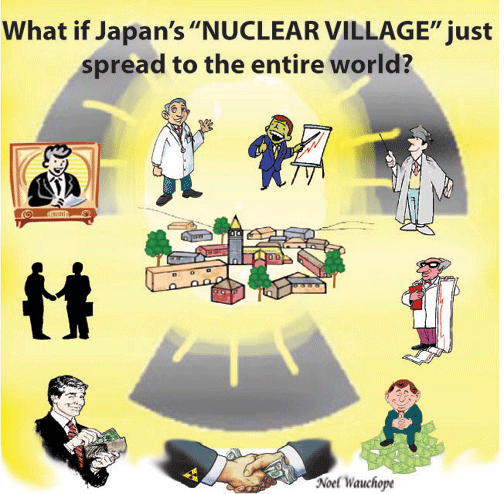
However, slowly but surely, the corrupt and collusive practices that led to the Fukushima disaster are re-emerging. The ‘nuclear village’ is back in control……..
The Basic Energy Plan approved by Cabinet in April 2014 contains nothing more than a meaningless nod to widespread public anti-nuclear sentiment, stating that dependence on nuclear energy will be reduced ‘to the extent possible’.
Junko Edahiro, chief executive of Japan for Sustainability and one of the people removed from the energy policy advisory committee, noted in November 2014:
“Now what we have is a situation where government officials and committees are back to doing their jobs as if the March 2011 disasters had never occurred. They have resumed what they had been doing for 30 or 40 years, focusing on nuclear power …
“In Japan we have what some people refer to as a ‘nuclear village’: a group of government officials, industries, and academia notorious for being strongly pro-nuclear. There has been little change in this group, and the regulatory committee to oversee nuclear policies and operations is currently headed by a well-known nuclear proponent.”
‘An accident will surely happen again’
Yotaro Hatamura, who previously chaired the ‘Cabinet Office Investigation Committee on the Accident at the Fukushima Nuclear Power Stations of TEPCO’, recently told the Asahi Shimbun newspaper that pre-Fukushima complacency is returning.
“Sufficient investigations have not been conducted” into the causes of the Fukushima disaster, said Hatamura, professor emeritus of mechanical engineering at the University of Tokyo.
The Cabinet Office Investigation Committee report called on the government to continue efforts to determine the cause of the nuclear disaster, but “almost none” of its proposals have been reflected in recent government actions, Hatamura said.
He further noted that tougher nuclear safety standards were introduced after the Fukushima disaster, but with the exception of this “regulatory hurdle … the situation seems unchanged from before the accident.”
“It does not appear that organizations to watch [government actions] are working properly”, Hatamura said. “There could always be lapses in oversight in safety assessments, and an accident will surely happen again.”
Hatamura questioned the adequacy of evacuation plans, saying they have been compiled without fully reflecting on the Fukushima accident: “The restarts of reactors should be declared only after sufficient preparations are made, such as conducting evacuation drills covering all residents living within 30 kilometers of each plant based on developed evacuation plans.”
Japan Atomic Energy Commission
In September 2012, the DPJ government promised that a review of the Japan Atomic Energy Commission (JAEC) would be conducted ‘with its abolition and reorganization in mind’. The government established a review committee, which published a report in December 2012. After taking office, the incoming LDP government shelved the report and commenced a new review.
The second review recommended that the JAEC no longer produce an overarching Framework for Nuclear Energy Policy. But an LDP committee has reportedly decided that the JAEC will be tasked with putting together a nuclear energy policy that would effectively have equivalent status to the Framework for Nuclear Energy Policy.
Two reviews, very little change – and far from being abolished, the JAEC retains a role in framing nuclear policy. Moreover, the government has proposed that the JAEC, a promoter of nuclear power, could acts as a ‘third party’ in the choice of a final disposal site for nuclear waste.
Some experts who attended a ministry panel meeting in February questioned the JAEC’s independence.
Government’s massive financial support for TEPCO………..
Special Committee for Investigation of Nuclear Power Issues
An early example of the LDP government’s reconstitution of the nuclear village was theSpecial Committee for Investigation of Nuclear Power Issues, established by the LDP government in 2013 to monitor nuclear power administration.
A majority of the Committee members double as members of the LDP. “We avoided anti-nuclear lawmakers”, said a senior official of the LDP’s Diet Affairs Committee. LDP parliamentarian Taro Kono, a member of a multi-party group of anti-nuclear parliamentarians, wanted to join the committee but was snubbed.
Ironically, the Special Committee was formed as a result of a recommendation from theNuclear Accident Independent Investigation Commission, which was scathing about the sort of cynical cronyism that its recommendation led to.
Media censorship and intimidation
Japan has steadily slipped down Reporters Without Borders global ranking for press freedom since the Fukushima disaster, from 11th in 2010 to 61st in the latest ranking.
Journalists have been threatened with ‘criminal contempt’ and defamation suits, and Japan’s ‘state secrets’ law makes investigative journalism about Japan’s nuclear industry a perilous undertaking. Under the law, which took effect in December 2014, the government can sentence those who divulge government secrets – which are broadly defined – to a decade in jail.
Benjamin Ismaïl from Reporters Without Borders wrote in March 2014:
“As we feared in 2012, the freedom to inform and be informed continues to be restricted by the ‘nuclear village’ and government, which are trying to control coverage of their handling of the aftermath of this disaster.
“Its long-term consequences are only now beginning to emerge and coverage of the health risks and public health issues is more important than ever.”
Reporters Without Borders said in March 2014:
“Both Japanese and foreign reporters have described to Reporters Without Borders the various methods used by the authorities to prevent independent coverage of the [Fukushima] disaster and its consequences. They have been prevented from covering anti-nuclear demonstrations and have been threatened with criminal proceedings for entering the ‘red zone’ declared around the plant.
“And they have even been interrogated and subjected to intimidation by the intelligence services.”
Lessons learned … and quickly forgotten
The corruption and collusion of Japan’s nuclear village led to numerous accidents before the Fukushima disaster.
And the corruption and collusion of Japan’s nuclear village was a root cause of the Fukushima disaster itself. On that point the Nuclear Accident Independent Investigation Commission could not have been blunter: “The accident was the result of collusion between the government, the regulators and TEPCO, and the lack of governance by said parties.”
A big part of the post-Fukushima spin is that lessons were learned from the nuclear disaster and improvements made. But the real lesson from this saga is that the nuclear industry – in Japan at least – has learned nothing from its catastrophic mistakes.
As Yotaro Hatamura says, an accident will surely happen again.
Dr Jim Green is the national nuclear campaigner with Friends of the Earth Australia and editor of the Nuclear Monitor newsletter, where this article was originally published (March 19, 2015 | No. 800).
Nuclear Monitor is published 20 times a year. It has been publishing deeply researched, often strongly critical articles on all aspects of the nuclear cycle since 1978. A must-read for all those who work on this issue! http://www.theecologist.org/News/news_analysis/2810545/after_fukushima_japans_nuclear_village_is_back_in_charge.html
1 Comment »
Leave a reply to CaptD Cancel reply
1 This month

PETITION – To: Prime Minister Anthony Albanese and the Australian Labor Government
Chernobyl: The Lost Tapes – A good documentary on Chernobyl on SBS available On Demand for the next 3 weeks– https://www.sbs.com.au/ondemand/tv-program/chernobyl-the-lost-tapes/235274195556

19 May – Webinar- Webinar: No Nuclear Weapons in Australia
Start: 2026-05-19 18:00:00 UTC Canberra, Melbourne, Sydney (GMT+10:00)
End: 2026-05-19 19:30:00 UTC Canberra, Melbourne, Sydney (GMT+10:00)
20 May – Webinar – The dangerous world of AUKUS, US, military occupation and suppression of dissent
National Webinar, 20th May, 2026, 6.30pm AEST. Confronting laws restricting/suppressing protest speech and action
Speakers: Former Sen. Rex Patrick, Lawyer Nick Hanna ,Arthur Rorris ,Jorgen Doyle, Sen David Shoebbridge,
Facilitator Kelley Tranter.

of the week – Australians for War Powers Reform (AWPR)
To see nuclear-related stories in greater depth and intensity
 Antinuclear
Just say N☢ to Nuclear.
and
Call out all those that seek Nuclear Payback*
* http://www.urbandictionary.com/define.php?term=Nuclear+payback
Those that support nuclear power because nuclear power somehow supports them; no matter what the health implications or other “costs” are for others.
LikeLike