South Australia’s Nuclear Royal Commission appoints prominent pro nuclear advisors
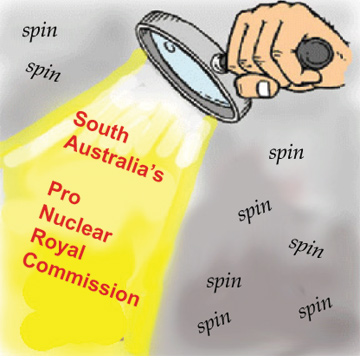 South Australia’s Nuclear Royal Commission: 3 out of 5 of those named for the Expert Advisory Committee are well known pro nuclear industry advocates.
1. Professor Barry Brook purports to be a leader in climate action, but in fact is internationally known as a strident advocate for the nuclear industry
2. Dr Timothy Stone comes from the Office for Nuclear Development (OND): it “focuses on removing potential barriers to investment, and signals clearly to the industry the serious intent of the Government to push forward nuclear new build”
3. John Carlson – advocate for An Asia Pacific Nuclear Energy Community
http://nuclearrc.sa.gov.au/media-centre/17-april-2015-nuclear-fuel-cycle-royal-commission-begins-public-consultation/The Royal Commissioner the Nuclear Fuel Cycle Royal Commission, Rear Admiral the Honourable Kevin Scarce AC CSC RANR (Rtd) detailed two key milestones today with announcement of the Expert Advisory Committee and the first of the Commission’s Issues Papers.
The Expert Advisory Committee comprises eminent leaders from academia, law, industry and the community and includes:
- Visiting professor at University College London Dr Timothy Stone CBE
- Professor of Environmental Sustainability Professor Barry Brook from Tasmania
- Past president of the Australian Conservation Foundation and Emeritus Professor of Science, Technology and Society at Griffith University Ian Lowe
- South Australian’s chief scientist Dr Leanna Read, who has a medical science background, and Mr John Carlson, former director of the Australian Safeguards and Non Proliferation Office (ASNO).
However, the committee does include Ian Lowe who has a long and honourable record of pointing out the risks and the diseconomics of the nuclear industry
Commissioner Scarce said the Expert Advisory Committee had been engaged to provide high-level expert advice to him and the Commission’s staff for the duration of the Royal Commission.
“The members of this Committee have been chosen to ensure that the Commission receives a broad range of advice and reflects the diversity of views that the community holds,” he said.
“The membership of the Committee comprises both proponents and opponents of the nuclear fuel cycle, and I believe this type of diverse contribution will ultimately allow the Royal Commission to develop a comprehensive final report.”
Commissioner Scarce said that the release of the first of four Issues Papers today was a key milestone for the Royal Commission and marked the start of the formal engagement process.
“Today is also an important step in the consultation process with the release of the first Issues Paper, which will help guide the community and industry in their understanding of the nuclear fuel cycle and assist them in making their submissions,” he said.
“I want this Royal Commission to be a far reaching enquiry into the nuclear fuel cycle, investigating the associated risks and opportunities.
“I am seeking to engage in a conversation with the South Australian community, speak to people, hear their lived experience and obtain the views of those who wish to have a say on this important matter.”
The Commission also announced its first public forum will be held at Mount Gambier City Hall at noon on Monday, April 20, with future metropolitan and regional meeting dates to be confirmed.
Written submissions can be made through www.nuclearrc.sa.gov.au and must be lodged by July 24, 2015.
1 Comment »
Leave a comment
1 This month

of the week – Australians for War Powers Reform (AWPR)
To see nuclear-related stories in greater depth and intensity
 Antinuclear
Commissioner Kevin Scarce has made an unconvincing start to his inquiry into the nuclear industry, now officially “The Nuclear Fuel Cycle” Royal Commissioner.
By accepting the nuclear industry spin that it is a nuclear fuel cycle he has immediately identified himself with the nuclear industry. Do we talk about the coal fuel cycle or the gas fuel cycle? No, like nuclear fuel these are one way processes – fuel in, heat and waste out.
It is typical of the nuclear industry that they would like to give the impression that it is otherwise – fuel in, more fuel out – a mirage fostered by its so-called fast breeder programme, itself another example of nuclear spin. The only thing fast about fast breeders is that they use fast neutrons to attempt to slowly produce nuclear fuel in a nuclear reactor. This technology has not only failed to produce significant amounts of nuclear fuel but has rapidly consumed huge amounts of tax payers money.
If Kevin Scarce and the SA Government want to retain any skerrick of credibility then they will take immediate steps to change the name to the “Nuclear Industry” commission.
LikeLike