The death of the nuclear industry – theme for June 2015
 The world is waking up to the unaffordable costs of the nuclear fuel chain.
Forget health, environment, safety, future generations, weapons proliferation – today’s killer of the nuclear industry is that good old reliable thing – the exorbitant MONEY that is required
Are “developing” countries really buying the nuclear lobby’s advertising drivel? Is China really on a nuclear build spree? Is Australia really going to “embrace” the nuclear fuel chain and become the planet’s nuclear toilet?
The nuclear lobby , like everyone else, knows that the game is over as soon as the next radioactive catastrophe occurs. That’s predicted as50% probability before 2050. It could be this week. That’s a big reason why the nuclear lobby is in such a panic to lock in contracts to buy its toxic products – while the going’s good.
Only tax-payers will fund nuclear facilities, despite the drivel from democracies about private enterprise. Russia, China are more honest about it – the State owns the nuclear companies. And they’re all so keen to export the technology to other countries. Heck! Russia evenpays for them to buy the stuff.
The nuke industry is in trouble – In USA the nuclear industry is a thing of the past. Investors flee Nordic nuclear company Vattenfall. Finland pulls out of building Olkiluoto 4 nuclear reactor. AREVA teeters on bankruptcy.
A French Farce indeed – South Australia’s Nuclear Royal Commission in Paris – talking to AREVA
 It would be funny if it were not so serious. Australians hear little about this secretive Royal Commission. But France’s failed nuclear giant AREVA was invited to put in a submission to the Commission.
The SA Royal Commissioner and some support staff will be in Paris this weekend – at the end of a week that saw the French government confirm that they will take apart the nuclear ‘global leader’ AREVA and give some failed pieces to EDF, which subsequently fell by over 6% on the stock market – let’s hope they read the papers.
Northern Territory Mines Departments Credibility and ERA’s Contaminants both down the Creek
ENVIRONMENT CENTRE NT – AUSTRALIAN CONSERVATION FOUNDATION 5 JUNE 2015 On World Environment Day NT and national environment organisations have called on the NT Department of Mines to explain why Energy Resources of Australia, operator of the embattled Ranger uranium mine, should not be prosecuted over a major radioactive spill inside the boundaries of Kakadu National Park.

“Today – World Environment Day – marks twelve months since Energy Resources of Australia gained approval to restart processing at Ranger following a major radioactive spill from a collapsed leach tank in December 2013,” said Lauren Mellor from the Environment Centre NT.
“That a spill of over 1.3 million litres of radioactive slurry happened inside a World Heritage listed National Park is unacceptable: that we still don’t know why twelve months after operations have been resumed is derelict”.
Environment groups are concerned that a subsequent string of regulatory failures indicates that the NT Mines Department is ill-equipped to meet its responsibilities to protect the environment, workers and communities.
In the 12 months since the Ranger restart was approved DME has:
- Failed to release its report into the 2013 radioactive spill accident, even to other Investigative Taskforce member agencies or Traditional Owners.
- Failed to prosecute ERA for clear operational breaches under the Mines Management Act to improve safety and environmental protection at Ranger.
- Been unable to oversight ERA’s water monitoring due to staff shortages and deficient testing, meaning at some sites with contamination trends there was no independent oversight.
- Not implemented a key recommendation of the Independent Expert’s incident report into the leach tank failure and radioactive spill calling for a complete regulatory overhaul at Ranger.
- Failed to address contamination trends in Gulungul Creek, part of Kakadu National Park downstream from the mines leaking tailings dam. DME must apply statutory requirements to its deficient monitoring program as recommended by a 2003 Senate Inquiry into Ranger Uranium Mine. This is despite significant spikes of electrical conductivity indicating impacts from the mine are now being seen in Kakadu waters.
“The NT Mines Minister’s inaction on this major incident appears to be a case of prioritising the operations of Energy Resources of Australia above the protection of Kakadu National Park,” said ACF campaigner Dave Sweeney.
World Environment Day is a perfect time to send a clear message that poor mining practises are neither acceptable, nor above the law. Kakadu deserves better than complacency,” concluded Mr Sweeney.
Contact: Lauren Mellor, Environment Centre NT, 0413 534 125 Dave Sweeney, Australian Conservation Foundation, 0408 317 812
Australia is obligated to take back Lucas Heights nuclear waste from France
 the Australian Conservation Foundation doesn’t think the outback is the ideal location.
Spokesman Dave Sweeney believes the bulk of the waste should remain at the ANSTO facility in Sydney and at the CSIRO facility in Woomera, SA, where the country’s, if not the world’s top minds, are located.
He says there wasn’t an urgent need to move the waste and argued there were still risks associated with transporting and storing radioactive material in the middle of nowhere.
“We are not aware of all the sites that have nominated, but we are aware of some of them and there are problems,” Mr Sweeney said.
The sites the ACF are aware of all rest in outback WA
 At present, a Royal Commission is being held in South Australia to examine the feasibility of developing a nuclear storage facility which would house not only our waste but international waste.
Time is ticking for Australia’s first nuclear waste dump, news.com.au JUNE 05, 2015“…..[THE AUSTRALIAN GOVERNMENT] put out a call for any land owner, council or company to nominate their land for the facility. Submissions closed last month. And the Department of Industry and Science plans to release the short list in mid-July. Industry and Science Minister, Ian McFarlane, has said he wants to settle on a site by mid-2016.
Why the hurry?
Well, at the end of next month around 28 steel canisters of reprocessed nuclear waste is set to return home from France and the government needs to find somewhere to put it. Continue reading
Let’s hope that South Australia’s Royal Commission is using the Nuclear Fuel Chain Cost Calculator
 What’s the true cost of nuclear power? Ask The Nuclear Fuel Cycle Cost Calculator. http://boingboing.net/2015/06/05/whats-the-true-cost-of-nucle.html
By Xeni Jardin , Jun 5, 2015 Created by the Bulletin of the Atomic Scientists, this nifty Nuclear Fuel Cycle Cost Calculator serves “provide countries around the world with nuanced estimates of the full cost of nuclear power—-almost instantly.”
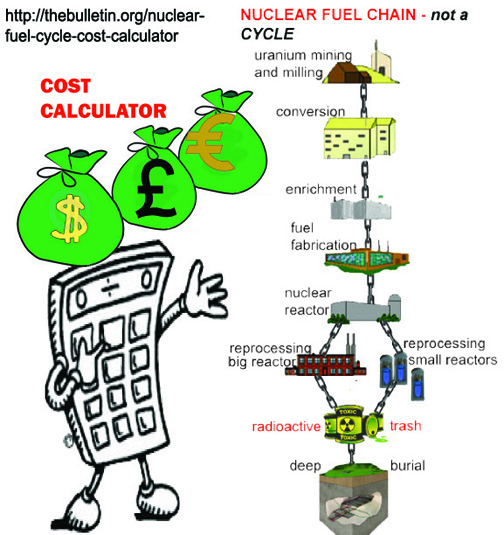
Discussions of the future of nuclear power often focus on safety,proliferation, waste storage, and carbon emissions – accepting cost as a given. This tool breaks the cost of investing in nuclear power into its component parts and considers the price of three configurations of the ‘fuel cycle’ – that is, the process that includes everything from the mining and production of uranium fuel to the disposal of spent fuel after it has been used to generate electricity.
France’s nuclear industry economic crash (a warning to South Australia?)
External factors may have precipitated the crash of Areva, but the cause is internal. Areva and the French nuclear industry is controlled by engineers and state officials and the market comes as an afterthought.
The problems of time and cost overruns in China, Finland and now in France at Flamanville are self-made and part of the “esprit de corps” arrogant attitude of the organisation.
Now, 13 years later, the problem needs to be addressed and risks costing billion of euros and thousands of jobs
 France’s Nuclear Industry Dream Faces Melt-Down At Expense Of State Coffers, Tax Payers Forbes, Marcel Michelson, 3 June 15 France has decided to rescue its Areva nuclear energy company once again, this time by combining the nuclear power station creation business with state-controlled power operator EDF , its biggest client. Continue reading
Northern Territory Government fails to act on radioactive spill by Energy resources of Australia
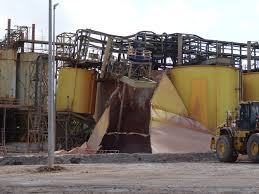 NT govt must end delay on Ranger action http://www.sbs.com.au/news/article/2015/06/05/nt-govt-must-end-delay-ranger-action It is “completely unacceptable” Ranger uranium mine operators have not been prosecuted over a slurry spill within Kakadu, traditional owners say.
The Northern Territory government is taking too long to punish those responsible for a radioactive spill on Aboriginal land in Kakadu, traditional owners say.
They have set their sights on the Department of Mines and Energy, which has investigated the 2013 spill of up to 1.5 million litres of acidic slurry from a collapsing leach tank at the Energy Resources of Australia operated Ranger uranium mine.
But the department is yet to share its report with stakeholders, despite a request six months ago from the Office of the Supervising Scientist.
The Gundjeihmi Aboriginal Corporation, which acts for the Mirarr traditional owners, says the delay is “completely unacceptable” especially given ERA was able to restart operations at Ranger a year ago.
“Members of the investigative taskforce as well as the general public are still waiting for the regulator to release its report, let alone prosecute the mining company,” corporation CEO Justin O’Brien said.
The traditional owners want the government to impose a fine, or declare an operational breach for the spill.
The Environment Centre NT claims ERA breached its operating conditions, and in particular a section of the Mine Management Act which requires “no unauthorised release of waste or contaminant”.
A department spokeswoman said the incident was still being investigated. Comment is being sought from ERA.
“Normalising” radioactive trash – Maralinga as tourist attraction
The indigenous people who used to wander these lands called the radioactive plume the “puyu,” or black mist, and still are reluctant to visit despite having fought hard for the land to be returned.
“They deem it as a bad place, what they call ‘mamu,’ like a devil country,” says Mr. Matthews, whose wife is indigenous to the area…….
 Australia’s Newest Tourist Attraction: Nuclear Test Zone At Maralinga, Australia, visitors are given an unusual welcome: Don’t stay too long and never, ever dig. WSJ, By
Maralinga, a deserted former military base in the Outback, has become ground zero for an unusual type of vacation Down Under. In a country best known for its white beaches and coral reefs, Mr. Matthews wants vacationers to wish they were here: on land once used for nuclear-weapons explosions.
Nearly 2,000 warning signs ring the red soil around Maralinga, displaying a Ghostbuster-style graphic prohibiting camping ……
The stark beauty of the hills here, on the edge of the vast Nullarbor Plain where the sun sinks in the same ocher color of the desert, belies its notorious past. Continue reading
Yackandandah – small Victorian town with a big renewable energy future
Yackandandah’s small steps to a big renewable future, http://www.theage.com.au/national/yackandandahs-small-steps-to-a-big-renewable-future-20150605-ghfj1l Michael Green The old brick-veneer community centre in Yackandandah has been transformed.
“We’ve had some really cold days this week,” says Ali Pockley, the centre’s manager. “But you come in here and it’s just toasty. It was hopelessly inefficient up until the retrofit, no doubt about that.”
With the help of a state government grant, local tradies installed a large solar photovoltaic system, insulation, double-glazing, shading and efficient air conditioners for heating and cooling. Electricity bills have plunged by three-quarters.
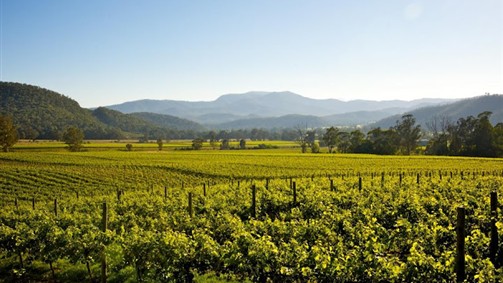
Pockley launched the retrofit of the community centre together with an even bigger initiative: Totally Renewable Yackandandah. A group of residents are aiming for the north-eastern Victorian town to produce more electricity than it uses, by 2022. They began working on their scheme twelve months ago, and already the number of solar households in the town has jumped. Now, one in every three houses has solar power, more than double the national average.
Matthew Charles-Jones, from Totally Renewable Yackandandah, says they’re surveying residents and working on their grand plan, with the help of a local council grant. In the meantime, new solar panels, like those on the Men’s Shed, will make it easier to reach the target.
Yackandandah is one of four Australian towns plotting to become 100 per cent renewable, along with Newstead, in central Victoria, and Byron Bay and Uralla in northern NSW. Newstead was recently awarded a $200,000 grant from the state government to develop its plan. Continue reading
International embarassment: Led by Tony Abbott, Australia has lost the plot on climate change
Australia was grilled by other delegatesat a United Nations conference in Bonn, Germany on Thursday.
 Australia has forfeited world leadership on climate policy, says Kofi Annan panel, Guardian, Shalailah Medhora, 5 June 15 Canberra has withdrawn from constructive engagement on the issue, says report, as Australia is grilled at crucial meeting in Germany. Australia has forfeited its position as a global leader on tackling climate change and is now a “free-rider”, a panel led by former secretary general of the United Nations Kofi Annan has said.
The Africa Progress Report 2015 disputes claims by the fossil fuel lobby that moving away from carbon would impede economic growth in developing countries. It says high-emitting nations, such as Australia, have stepped back from global discussions in favour of unilateral action.
It is particular scathing about the direction in which Australia’s climate change policies are headed.
“With one of the world’s highest levels of per capita emissions, Australia has gone from leadership to free-rider status in climate diplomacy. Repeal of the Clean Energy Future Plan effectively abolished carbon pricing. Continue reading
House of Representatives passes draft laws on Renewable Energy Target
 Draft laws on renewable energy targets pass through lower house 9 News 3 June 15 Draft laws on a bipartisan renewable energy target have passed the lower house despite the concerns of two government MPs.
Nationals MP Keith Pitt broke ranks during debate on the legislation, which pares back the target from 41,000 gigawatt hours to 33,000,
………However, his vote was not formally counted among those in opposition, with only independents Bob Katter and Andrew Wilkie voting against the bill.
Liberal Craig Kelly questioned the efficacy of solar panels, saying such an investment would simply be “pissed up against the window”.
He ridiculed how building 2000 new wind turbines would reduce the impact of climate change……..
The government included the burning of wood waste as a renewable source of fuel in the legislation, to much consternation from Labor, which wants it removed and omitted from any future laws on the target.
The opposition argues that what is considered wood waste is not just timber offcuts, bark and branches but also the whole of any tree not harvested………
Read more at http://www.9news.com.au/national/2015/06/03/02/36/draft-renewable-energy-laws-pass-through-lower-house#HlQSdZTUvSdZvczq.99
Powering the world without Oil, Coal or Nuclear

 A Fossil Fuel Free World is Possible: How to Power a Warming Earth Without Oil, Coal and Nuclear Democracy Now, 5 June 15 Is a 100% renewable energy future possible? According to Stanford professor Mark Jacobson, the answer is yes. Jacobson has developed plans for all 50 states to transform their power infrastructure to rely on wind, water and solar power.
This comes as California lawmakers have approved a dozen ambitious environmental and energy bills creating new standards for energy efficiency. Dubbed the California climate leadership package, the 12 bills set high benchmarks for reducing greenhouse gas emissions and petroleum use. We speak with Jacobson and Noah Diffenbaugh, Stanford University Associate Professor and a Senior Fellow at the Stanford Woods Institute for the Environment.
TRANSCRIPT
This is a rush transcript. Copy may not be in its final form…………
MARK JACOBSON: Well, our plans are to change the energy infrastructure in each and every state in the United States, and in fact, ultimately, every country of the world, to infrastructures run entirely on wind, water, and solar power for all purposes. So that is electricity, transportation, heating and cooling and industry……
MARK JACOBSON: Well in our plans, we do it state-by-state. Continue reading
South Australia the renewable energy leader- and now with battery storage!

 Plans for Australia’s first non-hydro renewable storage project move forward http://reneweconomy.com.au/2015/plans-for-australias-first-non-hydro-renewable-storage-project-move-forward-52911 By Giles Parkinson on 4 June 2015 The potential site for what will be the first large-scale, non-hydro storage project for renewable energy in Australia has identified three possible sites in South Australia, and received more than 40 different storage proposals and ideas. The project – known as Energy Storage for Commercial Renewable Integration South Australia (ESCRI-SA) – is a ground breaking project for Australia because it will be first and biggest of its type.
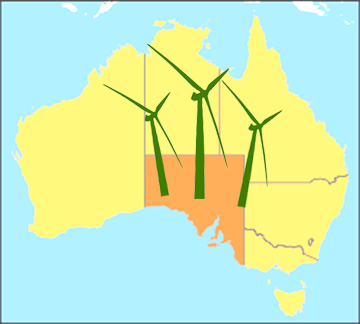 South Australia has already reached 40 per cent generation from variable renewable energy sources such as wind (33 per cent) and solar (7 per cent). It is one of the highest penetrations of variable renewables in modern industrial economies.
Up to now, that share of wind and solar has been relatively easily accommodated, but as this share grow, battery storage will be required as yet more coal-fired generators are retired, and even the need for gas plant diminishes.
The storage will be needed to soak up excess generation (such as wind at night-time or solar during the day) to be stored for use at peak time. It will also be used to provide ancillary services such as frequency – a critical component of the grid. In Germany, battery storage is being used for the same purpose.
Paul Ebert, from Worley Parsons who is leading the project lead funded by the Australian Renewable Energy Agency and with support from AGL Energy, and transmission group ElectraNet says the storage is likely to be located in one of three locations – near Port Lincoln on the Eyre Peninsula, near the Monash sub station on the Yorke Peninsula, or the Dalrymple sub-station in the river land area of the state. Continue reading
Queensland’s Millmerran solar farm to go ahead – biggest in Australia?
 Millmerran solar farm plans move ahead despite disappointment over lower Renewable Energy Target http://www.abc.net.au/news/2015-06-04/solar-firm-pushes-ahead-with-plans-for-big-darling/6520796 By Fidelis Rego, 4 June 15 A solar company says it is disappointing the Federal Government wants to reduce the Renewable Energy Target (RET) but it is still forging ahead with plans for a solar farm on the Darling Downs in southern Queensland.
The Government and Opposition have agreed to reduce the amount of power produced from renewable energy sources to 33,000 gigawatt hours by 2020.
Angus Gemmel from Solar Choice said it had not jeopardised its plans to build what could be the country’s biggest solar farm at Millmerran.
He said construction was expected to begin later next year.
“It’ll certainly have an impact, it is sad to see Australia is the first country to go backwards on a renewable energy target rather than forwards, so I guess it’s with a mixture of disappointment but also relief that we can finally get some first major stages underway,” he said.
“We’re still very confident that even in the medium to longer term this project will be built.
“We’re at an excellent site with optimal conditions for large-scale solar farming long-term and once our first stage is in the ground that’s going to make it so much easier and cost-effective to make stages two and three and subsequent away as well.”
Australian environment groups under attack on World Environment Day
David Ritter: Under attack in Australia on World Environment Day “… In a coordinated campaign with the mining industry, the LNP has announced an inquiry into the tax status of environment groups.
This is an attempt to stifle dissent from the environment groups. It fails to acknowledge that the LNP take considerable donations from companies who benefit from their damaging and destructive policies.
Because we have taken a stand defending the rights of farmers to access healthy drinking water, the rights of the tourism industry to have a healthy Reef and the renewable energy industry to exist — we are being threatened.
The most hypocritical aspect of this debate is that the donations the LNP receive from mining companies are tax deductible. That’s right.
We even have the situation where the extreme members of the LNP who are running this inquiry, people like George Christensen, are the leading advocates for dredging and dumping in the Great Barrier Reef’s waters. We also have Andrew Nikolic, an advocate for delisting Tasmania’s native forests from the World Heritage Committee.
So this Environment Day, we have a simple message. The environment is under attack like never before. The people who fight for it are also under attack. If you want to protect the Reef, the forests or just the planet, help out an environment group while you still can http://www.abc.net.au/environment/articles/2015/06/05/4248838.htm
1 This month
17 October, Free Public Talk on Nuclear Issues in South Australia
David Noonan will speak on public interest concerns over the new Roxby Downs Indenture Act 2026 on BHP copper-uranium mining and ore processing in SA, and on how AUKUS may face SA with a High-Level nuclear waste agenda.
Dr Jim Green will discuss international developments in the field of nuclear power including ‘small modular reactors’ and Generation 4 ‘advanced’ nuclear reactor concepts.


Help Aunty Sue Protect Her Land and Sacred Sites From Destructive Rocket Testing.
.

Australians deserve the truth
about
AUKUS – https://aukuspublicinquiry.com/

PETITION – To: Prime Minister Anthony Albanese and the Australian Labor Government

of the week – Australians for War Powers Reform (AWPR)
To see nuclear-related stories in greater depth and intensity

