South Australia already a world leader in renewable energy – could reach 100% by 2030
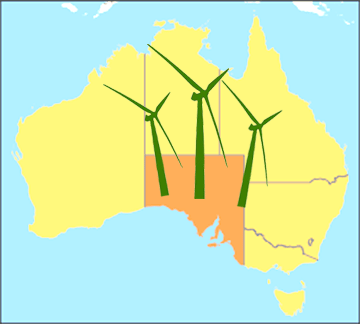 South Australia powered by renewable energy in 2030
http://www.dailytelegraph.com.au/news/breaking-news/sa-100-per-cent-renewable-by-2030/story-fni0xqi3-1227399824523AAP JUNE 16, 2015
SOUTH Australia could be completely powered by renewable energy in just 15 years.
A REPORT released by the Conservation Council on Tuesday says the 100 per cent target is achievable based on extensive modelling of future power needs.The report says renewable energy is a safe, reliable and affordable option and rejects suggestions South Australia will need more base load power.
“South Australia has a very real opportunity to become the first Australian state to reach 100 per cent renewable energy,” report author Professor Mark Diesendorf from the University of NSW said.
“Our research team has taken years of real time data and matched it with detailed weather results and run hourly simulations to see if 100 per cent renewable energy is possible.
“It’s not only possible, but could be done effectively and reliably within 15 years.” The report comes after news last week that Alinta Energy plans to close down its South Australian power stations and the Leigh Creek coal mine that supplies them as early as March next year.
South Australia already gets 40 per cent of its power from wind and solar energy and around a quarter of local households have rooftop solar systems.
Conservation Council chief executive Craig Wilkins said South Australia was already a world leader in renewable energy. “The exciting thing is we don’t need to wait for the federal government to act.
“If we are smart, our state is uniquely poised to attract sorely needed job-rich investment into this important industry,” he said.
1 Comment »
Leave a reply to Dennis Matthews Cancel reply
1 This month
Chernobyl: The Lost Tapes – A good documentary on Chernobyl on SBS available On Demand for the next 3 weeks– https://www.sbs.com.au/ondemand/tv-program/chernobyl-the-lost-tapes/235274195556

21 April Webinar: No Nuclear Weapons in Australia
Start: 2026-04-21 18:00:00 UTC Canberra, Melbourne, Sydney (GMT+10:00)
End: 2026-04-21 19:30:00 UTC Canberra, Melbourne, Sydney (GMT+10:00)
Event Type: Virtual
A virtual link will be communicated before the event.
Host Contact Info: australia@icanw.org

of the week – Australians for War Powers Reform (AWPR)
To see nuclear-related stories in greater depth and intensity
 Antinuclear
The Editor
The Advertiser
Support by the Minerals Council of Australia for fossil fuels comes as no surprise, nor does their apparent ignorance of the difference between the Conservation Council of SA (CCSA) and the (Australian) Conservation Foundation (ACF) but it is of concern that they seem to be ignorant of basic economics (The Advertiser, 18/6/15).
Rooftop solar electricity has gone from strength to strength in a classic case of increased demand leading to decreased price. All solar electricity needed was the ability to compete with entrenched fossil fuels. This was done through the Renewable Energy Target , which was an acknowledgement that fossil fuels had pollution derived hidden costs.
The worldwide acknowledgement of these hidden costs is now putting fossil fueled power stations on the endangered list, especially in countries that have “developed” by ignoring the cost of pollution.
Similar advances can be made by addressing other aspects of electricity demand, such as solar hot water or more energy efficient buildings.
Dennis Matthews
LikeLike