Rooftop solar taking over in South Australia – the test State for Renewable Energy
 Rooftop solar to cut total grid demand to zero in South Australia,
  REneweconomy By Giles Parkinson on 18 June 2015 See also Rooftop solar to overtake coal capacity before 2030
The Australian Energy Market Operator predicts that the growing uptake of rooftop solar by homes and businesses will reduce grid demand in South Australia on certain occasions to zero by 2023, highlighting the rapid change in the nature of energy markets, and the growing shift from centralised baseload generation.
The predictions from AEMO came in its 2015 National Electricity Forecasting Report, released on 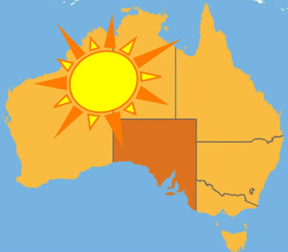 Thursday. It says that the near 575MW of rooftop solar is already accounting for one-third of total grid demand on certain days in the state.
But within a decade this total could treble, pushing minimum demand required from the grid in the whole state to below 0MW (zero) on some occasions in 2023-24, and for several hours at a time by 2024/25 – when AEMO expects 1864MW of rooftop solar.
It says zero demand from the grid could last from 11.30am to 2.30pm local time on some days………..
South Australia will be a test case for Australia, and indeed the world, because of its high level of “variable renewables” such as wind and solar in its energy mix.
It already stands at more than 40 per cent and AEMO expects this to grow as the renewable energy target encourages more wind generation and households continue to take up solar. One in four homes in the state already have solar PV……………
It explains why Alinta this week announced the imminent closure of its two base load coal-fired generators, giving the state the opportunity to move towards high renewable penetration, possibly 100 per cent.
Renewable proponents suggest that the two coal plants should be replaced with solar thermal and storage facilities, which have the flexibility to provide power when needed, and to store it when it is not required……..
In South Australia, the minimum load has already shifted from the early morning to the middle of the day, and peak demand has been shunted from the late afternoon to early evening, around 6.30pm. This is expected to move to 7.30pm as more solar is put into the grid.
South Australia is considered to be one of the prime markets for battery storage in Australia, given the high penetration of rooftop solar, and the difference between grid prices and payments for solar exports. Large-scale storage, at grid level, is also being considered in a trial co-sponsored by the Australian Renewable Energy Agency and AGL Energy.
See this story for state by state breakdown of AEMO solar PV forecasts. http://reneweconomy.com.au/2015/rooftop-solar-to-cut-total-grid-demand-to-zero-in-south-australia-32943
1 Comment »
Leave a reply to Dennis Matthews Cancel reply
1 This month

PETITION – To: Prime Minister Anthony Albanese and the Australian Labor Government
Chernobyl: The Lost Tapes – A good documentary on Chernobyl on SBS available On Demand for the next 3 weeks– https://www.sbs.com.au/ondemand/tv-program/chernobyl-the-lost-tapes/235274195556

19 May – Webinar- Webinar: No Nuclear Weapons in Australia
Start: 2026-05-19 18:00:00 UTC Canberra, Melbourne, Sydney (GMT+10:00)
End: 2026-05-19 19:30:00 UTC Canberra, Melbourne, Sydney (GMT+10:00)
20 May – Webinar – The dangerous world of AUKUS, US, military occupation and suppression of dissent
National Webinar, 20th May, 2026, 6.30pm AEST. Confronting laws restricting/suppressing protest speech and action
Speakers: Former Sen. Rex Patrick, Lawyer Nick Hanna ,Arthur Rorris ,Jorgen Doyle, Sen David Shoebbridge,
Facilitator Kelley Tranter.

of the week – Australians for War Powers Reform (AWPR)
To see nuclear-related stories in greater depth and intensity
 Antinuclear
25th June 2015
The Editor
The Advertiser
There is little doubt that South Australians have embraced rooftop solar electricity, with gusto. This is undoubtedly a worry to the pro-nuclear lobby ( a long time opponent of renewable energy) and to companies who stand to lose income from such independent electricity producers.
Thanks to the breakup and privatisation of the former publicly owned ETSA, what one part of the electricity industry gives, another part can just as easily take away. Or as the monopoly electricity network company SAPN has so coyly put (The Advertiser, 25/6/15) “it was ultimately up to the energy retailers as to how much of the reduction in SAPN charges were passed on to householders.”
Given that SAPN and the retailers do not compete for the electricity dollar, what’s the bet that prices will continue to go up, maybe not this year but almost certainly by the end of 2016, and that each segment of the privatised electricity industry will blame the other.
Dennis Matthews
LikeLike