The billionaires’ mission to make nuclear great again
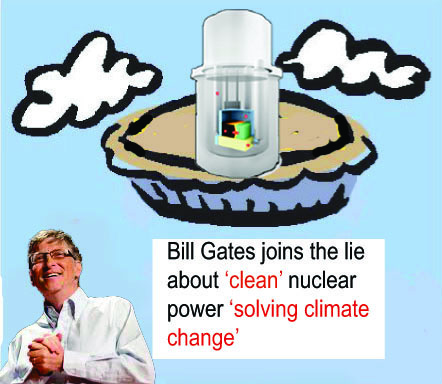
“If we are serious about replacing fossil fuels, we are going to need nuclear power,” PayPal co-founder and Facebook mega-investor Peter Thiel crowed in a New York Times op-ed shortly before negotiators from 195 nations gathered in Paris to seal an international climate pact.
Thiel, who personally invests in nuclear energy, made the self-serving demand that the U.S. government forge a “plan to fund and prototype the new reactors that we badly need.”
In other words: What does a guy like me with only $2.2 billion to my name gotta do to get my corporate welfare handout?
Bill Gates is also advocating heavy public investment in novel designs that these nuclear cheerleaders swear will be safer and cheaper than the 391 reactors that now generate about one in 10 watts around the world.
As the Paris climate talks got underway, the Microsoft co-founder launched an unprecedented multibillion-dollar “clean” energy fund, backed by the U.S., Chinese, and Indian governments, as well as other billionaires and some foundations. Don’t be surprised if it’s nuclear-friendly.
The crowd of rich men with tech cred dipping their toes in these radioactive waters also includes Amazon titan Jeff Bezos and Paul Allen, Gates’ fellow Microsoft co-founder.
But there are many reasons why governments, including our own, should resist their call to pump more tax dollars into nuclear energy. Namely:
Reactors are expensive, they’re very difficult to shield from terrorist and other security threats, and they’re prone to catastrophic accidents that have created ghost towns in Japan and the former Soviet Union. Furthermore, there are still no solutions for meeting the daunting challenges of safeguarding nuclear waste and cleaning upabandoned uranium mines.
And nuclear power takes too long to crank up. Remarkably, five of the 62 reactors under construction worldwide have been in the nuclear pipeline for three decades. It’s too slow to stop the climate crisis.
Besides — to a much greater extent than solar and wind power — nuclear energy emits its own carbon pollution. Those greenhouse gas emissions come largely through the use of fossil fuels in activities like reactor construction, waste transportation, and uranium mining.
More importantly, successful businessmen ought to be able to spot an uncompetitive industry when they see one.
Here’s what Lazard, an investment bank with $180 billion under management, has to say about today’s top energy options: Utility-scale “wind and solar are much cheaper than gas and coal, and less than half the cost of nuclear.”
Renewable energy’s competitive edge makes it no surprise that generation from solar power is now growing exponentially and wind power has been expanding by more than 20 percent annually for the past seven years around the world as nukes have fumbled. The total amount of global nuclear energy remained well below 1996 levels in 2014.
A total of four new nuclear reactors in Georgia and South Carolina are at least three years behind schedule and billions of dollars over budget. That bodes badly for the save-our-nukes billionaire class because (sorry, guys) those power stations weresupposed to be models for ramping up nuclear energy quickly without cost overruns.
I wonder what they’ll choose as their next losing battle.
Emily Schwartz Greco is the managing editor of OtherWords, a non-profit national editorial service run by the Institute for Policy Studies. OtherWords.org.
1 Comment »
Leave a comment
1 This month.

Help Aunty Sue Protect Her Land and Sacred Sites From Destructive Rocket Testing.
29 August – UN International Day Against Nuclear Tests -HOW WE CAN PREVENT ANUCLEAR WAR DURING TRUMP’S PRESIDENCY
12:30 PM – 4 PM Saturday August 29 Pilgrim Church, Adelaide. Joint presentation afternoon with Doctors for the Environment Australia & Medical Association for the Prevention of War (SA)https://www.mapw.org.au/ Speakers are Professor Dale Bagshaw, internationally renowned mediator; Dr Kate Wylie, National Executive Officer of Doctors for the Environment (DEA);
Dr Teresa Pham, Drs for the Environment; Ben Crouch MPhil, Medical Physicist, and Amanda Ruler, PhD. – and hear expert opinion on how peaceful mediation and negotiation can prevent a nuclear war during Trump’s presidency.

Australians deserve the truth
about
AUKUS – https://aukuspublicinquiry.com/

PETITION – To: Prime Minister Anthony Albanese and the Australian Labor Government

of the week – Australians for War Powers Reform (AWPR)
To see nuclear-related stories in greater depth and intensity
 Antinuclear
Nuclear keep ratepayers in Energy Slavery to Utilities while Renewables allow endusers to profit from their own generations.
Another Big reason is Nuclear Payback*
* http://www.urbandictionary.com/define.php?term=Nuclear+payback
Those that support nuclear power because nuclear power somehow supports them; no matter what the health implications or other “costs” are for others.
=====
This is yet another reason why Nuclear is to be avoided and one of the prime reasons why Big Business wants ever more nuclear!
Parts of this comment have been posted on http://www.forbes.com/sites/kensilverstein/2015/03/10/how-fast-and-how-deep-will-utilities-venture-into-the-solar-energy-craze/
Here is yet another reason why Solar (of all flavors) is starting to look better and better:
‘Nuclear power is risky and unprofitable’
Mycle Schneider, an expert on nuclear energy, expects bankruptcy in the nuclear industry and “substantial security risks.”
http://www.dw.de/nuclear-power-is-risky-and-unprofitable/a-18299318
snip
DW: Mycle Schneider, every year you publish the World Nuclear Industry Status Report. What are the global trends?
The production costs for nuclear energy have increased over the last couple of years. It’s a dramatic development as the costs of all the other technologies, especially renewable energies, are decreasing. Renewable energies are, therefore, now in real competition. Furthermore, power demand in Europe is shrinking, and for operators of nuclear power stations, these are real problems.
So if nuclear power isn’t economically viable, why then are some governments – such as the British government – planning to build new nuclear power stations?
Energie- und Atomexperte Mycle Schneider
Sees nuclear power as too risky and expensive: Mycle Schneider, expert on nuclear energy.
For years, the British government has counted on nuclear power and not put forward a reasonable energy policy. Well, nuclear energy has become more expensive now but other, more intelligent scenarios have not been developed. It’s also not certain yet, whether or not the new Hinkley Point nuclear power plant will be built as planned. There are no signed contracts yet. But the estimated cost to generate power from these plants is about twice as high as the average price of electricity today.
===> See cost of energy chart in the above article for a real eye opener
LikeLike