Australia’s nuclear weapons plan, and the connection with NSW nuclear reactor
On Nov. 2, 1956, Australia’s Defense Committee formally recommended the acquisition of kiloton-range tactical nuclear weapons.
In 1969, the government announced plans to construct a 500-megawatt nuclear reactor at Jervis Bay in New South Wales.
The intention was clear — this reactor was to support a nuclear weapons program. The reactor project pushed ahead and preliminary site work commenced.
 Revealed: Australia’s Failed Bid for Nuclear Weapons, Chris Walsh, The
  National Interest 16 Sept 15, At 9:00 in the morning on Oct. 3, 1952, a 25-kiloton nuclear explosion vaporized the retired British frigate HMS Plym off Australia’s remote western coast. The Operation Hurricane detonation in the Monte Bello Islands was a seminal moment for Britain and marked its return to the club of great powers.
But for Australia, these tests and others served a murkier purpose – as important and deliberate steps toward Australia’s own acquisition of nuclear weapons. It was in the tense Cold War environment of the late 1950s and early 1960s that these aspirations moved beyond talk and into concrete action.
By the time the Hurricane detonation took place, Australia was already experienced in weapons of mass destruction. From 1943 and in the shadow of a possible Japanese invasion, Australia built extensive stocks of chemical weapons and delivery systems…….
Australia — with its vast coastlines and deserts — emerged as a key player in Britain’s nuclear strategy.
When Britain approached Australia to host nuclear tests, a sympathetic government led by Prime Minister Robert Menzies readily agreed. While Menzies — an Anglophile — focused on his relationship with the United Kingdom, others saw this as an opportunity for Australia to buy membership into the nuclear club. Continue reading
Moving on to the Post Nuclear World – theme for December 15
The sinister side of the push for “New Nuclear” is that it is a justification for doing nothing about the accumulating toxic wastes and the toxic nuclear weapons and reactors. Such a comfortable temptation – leave this nastiness for our grand and great granchildren to fix.
The present entire reptilean assembly of nuclear industry chiefs and wannabe chiefs, and executives and lobbyists, and the bought politicians and media, will be dead then, having enjoyed their comfortable well-paid lives.
It is up to the ‘alternative’ and ‘social’ media to expose their lies and to highlight the compelling three present day challenges:
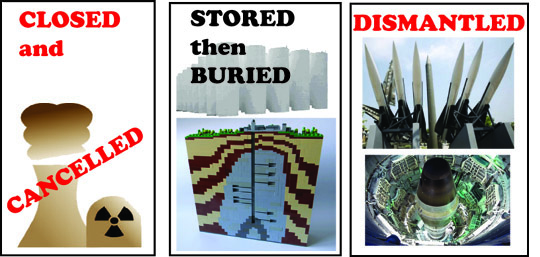
– to close down the global nuclear industry, and especially to expose and prevent the ‘New ‘Nuclear’ deception.
– to deal with the existing masses of radioactive trash – interim above ground storage, then burial near to the site of production – the ‘least worst’ option.
-to dismantle the useless nuclear weapons empire, including the poisonous depleted uranium weapons. (Today’s enemies effectively use much simpler and cheaper weapons)
Global warming: below 1.5 degrees – last hope for the planet
 Paris UN climate conference 2015: Is it possible to keep global warming below 1.5 degrees?, SMH, December 11, 2015 Tom Arup Environment editor, The Age In a significant shift, more than 100 countries – including Australia, the US, Germany and France – have agreed to support recognition of a goal to keep global warming below 1.5 degrees.
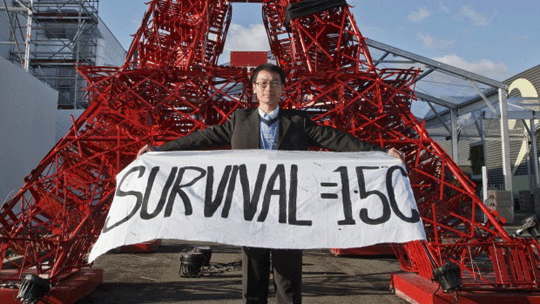
Until now, the common goal has been to keep warming to less than two degrees above pre-industrial levels.
So why is there sudden momentum for this more ambitious target? And what is the real world difference between 1.5 and 2 degrees?
The 1.5 degree goal has been the focus of a long-term push by small island states and least-developed African nations – the most vulnerable countries to climate change due to their geography and economic position.
A recent review by the UN climate body found that when temperatures do rise above 1.5 degrees, polar regions, high mountains, tropics and low-lying coastal regions will be most in the gun. In Africa, the ability to grow food will be hit, particularly for the sub-Sahara..
What needs to be done to get there?
This is the problem: the 2 degree goal is hard enough. The scientific models show 1.5 degrees is almost impossible.
Global emissions remainhigh, and the world has already warmed by one degree since industrial times. Glen Peters, a senior researcher with Oslo-based organisation CEIRCO, says at current rate of emissions the world will have produced enough carbon dioxide by 2020 to lock in 1.5 degrees warming.
And even if sharp cuts to emissions are made, there is a kicker. Temperatures would almost certainly first go over the threshold, meaning technology to draw carbon from the atmosphere will be needed to help cool the planet and bring it under 1.5 degrees……
If there are two targets in any Paris agreement, would having 1.5 degrees mean anything?
Its inclusion in the text would ensure the more ambitious target is considered alongside two degrees in any official reviews or assessments by the UN. And coupled with strong measures to encourage countries to cut emissions faster, those in favour say it could drive greater climate ambition.
For vulnerable countries, it could help them set a legal threshold to trigger a form of compensation – called loss and damage – to help them recover from climate change driven natural disasters. Loss and damage is another of the moving elements at the Paris talks.
Ultimately is 1.5 degrees scientifically realistic?
Let’s give the final word to Peters, who suggests: “Take a cold shower”. http://www.smh.com.au/environment/un-climate-conference/paris-un-climate-conference-2015-is-it-possible-to-keep-global-warming-below-15-degrees-20151209-gljtzu.html#ixzz3u4Qn6qB6
Follow us: @smh on Twitter | sydneymorningherald on Facebook
Nuclear Lobby is in Overdrive at Paris Climate Conference
Nuclear Champions go into Overdrive http://www.no2nuclearpower.org.uk/recent-additions/nuclear-champions-go-into-overdrive/ 11 Dec 15
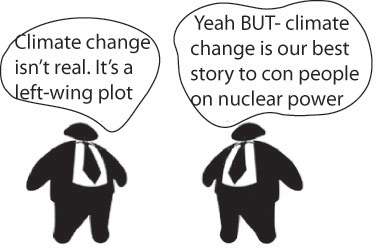 Pro-nuclear lobbyists and nuclear industry champions have been in overdrive during the Paris Climate Conference.
They seem to be making a desperate last-ditch effort to convince us all that nuclear power is an important part of the answer to the climate crisis with blatant attacks on those who envisage a future based on renewable energy without nuclear. (1) But the truth is that nuclear power is a dangerous distraction from what we really need to be doing. Because every pound spent on nuclear power could have been spent more effectively, making greater reductions in carbon emissions, nuclear is actually damaging efforts to tackle climate change. Continue reading
Hill End community not satisfied with MP John Cobb’s attitude to nuclear waste dump proposal
MP’s apology fails to pacify residents, Western Advocate By LOUISE EDDY Dec. 11, 2015 When members of the Hill End community gathered in the Royal Hall on Wednesday morning they wanted only one thing – for Member for Calare John Cobb to ask what he could do to help.
This was the third meeting the community has held to discuss Sallys Flat being short-listed for a national nuclear waste dump, and the first the federal member has been able to attend.
Community spokesperson Robyn Rayner said around 100 people attended the meeting, many of them new faces. Mr Cobb had earlier drawn the community’s anger when he dismissed their concerns about the safety of the proposed facility.

Ms Rayner said Mr Cobb apologised to the meeting for the way the matter had been handled, and for not being in contact with the community prior to Wednesday’s meeting.
“We appreciate the fact that he did turn up, but he treated us with utter contempt,” she said. “At no time did he say ‘What can I do to help you’,” she said…….
Yesterday Mr Cobb said he would help by conveying to the minister the fact that the community don’t want the waste dump.
However, despite assurances Sallys Flat won’t be further shortlisted if the community opposes the nuclear waste dump, Mr Cobb said the matter cannot end here and now. “They do want to finish this now, but the minister has set that consultation period because those who do want to consult privately with the minister should have that right,” Mr Cobb said. He said it was a good meeting.
“But I think people had made their minds up they didn’t want it,” he said.
“There are some communities in Australia who will think – here’s an opportunity. You are not often offered the chance to get $10 million. But it’s their choice. I don’t live there,” he said. Mr Cobb said he would be visiting the Lucas Heights reactor shortly to take a look.“It’s 14 years since I’ve been there. I’m sure there is no danger but I want to go back and reassure myself,” he said.
Ms Rayner said there were concerns Mr Cobb was not taking the matter seriously enough. http://www.westernadvocate.com.au/story/3552229/mps-apology-fails-to-pacify-residents/?cs=115#disqus_thread
Disappointment at Climate Conference weakening of several provisions
Paris UN Climate Conference 2015: Australia has ‘serious concerns’ about climate draft, SMH December 11, 2015 Peter Hannam and Tom Arup“…..Speaking on behalf of a collection of non-European industrialised countries known as “the umbrella group”, Australian lead negotiator Peter Woolcott said: “We are deeply disappointed at the weakening of several provisions.”
He said the group wanted an ambitious agreement that motivated all countries and did not bind them into historic static groupings – a reference to the long-term divide between developed and developing nations.
“We must avoid a situation where, in an effort to reach consensus, we strip the Paris outcome of its ability to be a genuine step change,” Mr Woolcott said.
Meanwhile, the new high ambition coalition, which is understood to have come together through a series of informal gatherings during the year, said it would push for the strongest deal possible.
“We will not accept a minimalist or bare bones agreement,” Tony De Brum, minister of foreign affairs for the Marshall Islands and chair of the group, said.
Mr De Brum said an ambitious treaty would include a goal of keeping warming to 1.5 degrees, have a clear pathway to a low-carbon future, five-yearly updates, a strong package of support for developing countries and aid of at least A$136 billion a year……
while progress edged forward on some fronts, they retreated on others. The EU criticised the omission from the draft of pollution from the shipping and air transport sectors – key industries that cross international boundarie: http://www.smh.com.au/environment/un-climate-conference/paris-un-climate-conference-2015-high-ambition-coalition-emerges-to-spur-deal-20151209-gljuha.html#ixzz3u3jcs2xU
Japan’s nuclear regulator consider need for deeper disposal for nuclear waste
 NRA panel wants deeper disposal for nuclear waste http://www3.nhk.or.jp/nhkworld/english/news/20151211_01.html A team of experts at Japan’s nuclear regulator has proposed that nuclear waste with relatively high levels of radiation be buried deeper underground than current law requires.
The team at the Nuclear Regulation Authority, or NRA, presented a draft of regulations for such waste on Thursday. The waste comes from the decommissioning of reactors. The draft calls for such waste to be buried at least 70 meters underground. This is to prevent people from approaching the waste.
Current law requires that waste with low or relatively high levels of radiation be buried at least 50 meters underground. The draft requires utilities to maintain buried waste for 300 to 400 years.
The draft also would have the central government prepare a system to prevent the buried waste from being dug up after the maintenance period ends. The NRA team plans to gather opinions from the Federation of Electric Power Companies of Japan and compile basic ideas by the end of next March.
Wangan and Jagalingou traditional owners continue to fight $16.5 billion Carmichael coal mine
 Vow to fight mine ‘Wangan and Jagalingou (W&J) traditional owners were blindsided last week..’
http://www.cpa.org.au/guardian/2015/1714/05-vow-to-fight.html 9 Dec 15:
“Wangan and Jagalingou (W&J) traditional owners were blindsided last week by revelations that Queensland Coordinator-General Barry Broe was proposing to extinguish native title on parts of their traditional lands in the Galilee Basin in order to enable Indian company Adani to develop infrastructure for its $16.5 billion Carmichael coal mine. …
“It is beyond comprehension that the government would consider such a shameful and absurd proposal in an era when our rights are sanctioned under international law and when we are already in the Federal Court contesting the state government and Adani’s attempts to override our rights,”
[Adrian] Burragubba said. “I assure the Premier she will be bringing on one of the biggest human rights battles we’ve seen in Queensland in a long time. … ” … “
Julie Bishop signs Paris Declaration for clear rules for carbon trading
What a tortuous track Julie Bishop, Greg Hunt and co. have to navigate, as they weave about within the Turnbull government’s climate policies – which are exactly the same as Tony Abbott’s !
 How long before the Turnbull government trips itself up in its own convoluted
rhetoric?
How long before Australia’s voters wake up to them?
Australia signs up for clear carbon trading rules, hinting at policy change, Guardian, Lenore Taylor in Paris, 10 Dec 15
Signing declaration at the Paris climate talks ‘recognises the role a carbon market might play after 2020’, foreign minister Julie Bishop says. Australia has signed a Paris declaration calling for new clear rules for international carbon trading in a signal the Coalition’s six-year carbon pricing policy veto could be softening as it prepares to review its climate policy in 2017.
Foreign minister Julie Bishop, who signed the declaration in Paris, said it was in Australia’s interests to recognise the role an international carbon market might play in reducing emissions after 2020.
“It’s just a declaration, it’s not legally binding,” she said after a speech to an event organised by Australia’s Carbon Market Institute. Continue reading
“Red Alert! Sharp increase in radiation… at Fukushima”
 Report: “Red Alert! Sharp increase in radiation… at Fukushima” — Levels spike 400,000% under plant — Almost 1,000,000,000 becquerels per cubic meter — TV: Officials investigating cause http://enenews.com/report-red-alert-sharp-increase-radiation-fukushima-levels-spike-400000-plant-tv-officials-investigating?utm_source=feedburner&utm_medium=email&utm_campaign=Feed%3A+ENENews+%28Energy+News%29NHK World, Dec 9, 2015: Radiation spikes in Fukushima underground ducts — The operator of the Fukushima Daiichi nuclear power plant says levels of radioactivity in underground tunnels have sharply risen. Tokyo Electric Power Company has detected 482,000 becquerels per liter of radioactive cesium in water samples taken from the tunnels on December 3rd. That’s 4000 times higher than data taken in December last year. The samples also contained 500,000 becquerels of a beta-ray-emitting substance, up 4,100 times from the same period… They plan to investigate what caused the spike in radiation. Continue reading
The cancer and death legacy on America’s nuclear workers
 US Nuclear Weapons Complex Leaves ‘Legacy of Death on American Soil’ http://www.globalresearch.ca/us-nuclear-weapons-complex-leaves-legacy-of-death-on-american-soil/5495206 By Deirdre Fulton Common Dreams 11 Dec 15
More than 100,000 Americans have been diagnosed with cancers and other diseases after building the nation’s atomic stockpile over last 70 years New investigative reporting from McClatchy has exposed the hidden legacy—and “enormous human cost”—of the U.S. nuclear weapons complex, providing “an unprecedented glimpse of the costs of war.”
The reporting, which comes as the nation prepares to upgrade its aging nuclear arsenal to the tune of $1 trillion over the next 30 years, reveals the abundant health and safety risks from radiation exposure at atomic weapons facilities. It’s based on more than 100 interviews at current and former weapons plants and in the towns that surround them, as well as analysis of more than 70 million records in a federal database obtained under the Freedom of Information Act.
According to McClatchy, 107,394 Americans have been diagnosed with cancers and other diseases after building the nation’s nuclear stockpile over the last seven decades. And at least 33,480 former nuclear workers who received compensation from a special fund—created in 2001 for those sickened in the construction of America’s nuclear bombs—are dead.
Declaring that “the great push to win the Cold War has left a legacy of death on American soil,” McClatchy notes that the death toll “is more than four times the number of American casualties in the wars in Afghanistan and Iraq.” Continue reading
Australia not welcomed into “high ambition coalition” climate action group
Aust missing from climate change group, Herald Sun, 12 Dec 15 Australia has not yet been welcomed into a new “high ambition coalition” of 100 nations at major climate talks in Paris, despite claiming it had joined through the European Union.
Marshall Islands Foreign Minister Tony de Brum revealed the alliance of around 100 countries, including the United States, this week at the United Nations summit.
Australia was not among them and Foreign Minister Julie Bishop seemed unaware of the group when it was revealed on Wednesday.
Mr de Brum, who spearheaded the alliance, issued an open invitation to countries in Paris.
A spokeswoman for Ms Bishop on Friday confirmed Australia had been formally invited by the European Union and had accepted the invitation. However, it appears Australia hasn’t yet been welcomed into the group, the Marshall Islands hinting the country would have to prove its worth.
“We are delighted to learn of Australia’s interest and look forward to hearing what more they may be able to do to join our coalition of high ambition here in Paris,” a spokesman for Mr de Brum said.
Earlier on Friday Mr de Brum read out a list of countries that had accepted his open invitation, with Australia notably absent.
WHAT THEY WANT *Reference to limiting global warming to 1.5C (is in the text)
*Clear path towards a low-carbon future (emissions neutrality by second half of century in text)
*Five yearly updates (is in the text)
*Strong package of financial support for developing nations ($100 billion per year plus scale up after 2020 is an option in the text – could be removed) http://www.heraldsun.com.au/news/breaking-news/aust-not-yet-welcome-in-climate-alliance/news-story/f7812eb6755851c7cc8ecd71ae9ca55f
Round-up of climate news
 Oceans may be left out of climate plan, but here’s what’s at stake.
Troubles in the Mediterranean and potential fixes in the Seychelles show why the world’s seas need more attention during the climate negotiations
http://news.nationalgeographic.com/2015/12/151209-Paris-climate-change-oceans-Mediterranean-Seychelles-fish/ &http://www.environmentalhealthnews.org/t/3710335569332210561
Climate talks – slimmed-down draft proposal still leaves major issues unresolved.
With time running out to meet a self-imposed deadline, negotiators on Wednesday released a new draft agreement on fighting climate change that was slimmer than earlier versions while still leaving major issues unresolved.
http://www.latimes.com/world/europe/la-fg-climate-talks-new-draft-plan-20151209-story.html & http://www.environmentalhealthnews.org/t/3710335569332210545
Paris climate negotiations turn to Zulu-style meetings in a bid to break deadlocks
Climate negotiators have turned to the idea of “indaba” – a traditional Zulu meeting style – as they seek for breakthroughs on deadlocks plaguing the Paris climate talks.
http://www.smh.com.au/environment/un-climate-conference/paris-un-climate-conference-2015-negotiations-turn-to-zulustyle-meetings-20151210-glkwg9.html
New and heartening alliances form at Paris climate conference, expert says
An Australian climate change and renewables specialist at the conference in Paris says that new and unusual alliances have formed at these international talks that he hasn’t seen in 21 years of negotiations. Giles Parkinson, the founder of the Renew Economy website, told The World Today it gives him optimism that there will be a deal by the end of the weekend.
http://www.abc.net.au/worldtoday/content/2015/s4369557.htm
India adamant developed nations lead climate change measures
One country determined to see the distinction drawn between developed and developing nations is India, the world’s third largest emitter of greenhouse gases despite the fact that 300 million of its citizens have no access to electricity. The Modi Government is adamant that advanced nations must lead efforts to reduce global warming because of the historical benefit they’ve derived from polluting. The Indian Environment Minister Prakash Javadekar spoke to The World Today’s Melissa Clarke in Paris.
http://www.abc.net.au/worldtoday/content/2015/s4369568.htm
US doubles climate adaption aid to nearly $900 million.
The United States announced plans on Wednesday to double grant funding it provides to help developing countries adapt to climate change to around $860 million a year, a pledge that may help clinch a global climate pact this week
http://www.reuters.com/article/us-climatechange-summit-funding-idUSKBN0TS1Q220151209 & http://www.dailyclimate.org/t/-1961356102316278594
Canada’s nuclear waste dump plan, near Great Lakes: decision hangs on First Nations people
Saugeen Nation May Be Final Word in Nuclear Waste Storage Next to Lake Huron, Indian Country Today Konnie LeMay 12/11/15 Lots of voices have been heard about whether to dig a deep geological repository for storing low- and medium-level nuclear waste about half a mile down and less than a mile from Lake Huron.
Canadian and U.S. environmental groups and even members of the U.S. Congress have registered protests; some local municipality councils voted support, and a federally appointed joint review panel recommended licensing it. A decision, originally scheduled for mid-December, has been delayed until March 1, whenOntario Power Generationmay get a decision from the Ministry of the Environment about proceeding with its multimillion dollar, multi-decade project.
But whether a repository is constructed at that site could come down to just one voice —that of the people of the Saugeen First Nation. Continue reading
Japan’s media and government keep silent on Fukushima radiation effects

 The Taboo Of Radiation Exposure In Japan: The Social Effects Of Fukushima, Activist Post, By Erin O’Flaherty, 11 Dec 15 “…..why is society reacting in such a way? [keeping quiet about radiation effects] In order to attempt to answer this question, let us break society into two groups: the government/nuclear power companies, and the ordinary Japanese people.
The level of intensity with which the former group have tried to diminish the seriousness of the incident and divert blame from themselves – by appealing to public well-being (avoiding panic), ‘radiophobia’, and the supposed harmlessness of radiation – leads to the obvious conclusion that they are acting to protect their own interests. Companies such as TEPCO (Tokyo Electric Power Company) wish to continue running so they can continue making money. It appears the government also wants to continue the use of nuclear power. This may be to do with nuclear power’s close relationship to war and military power, due to its association with nuclear weapons. It is no secret that the current government are in favour of restoring Japan’s military status, as evidenced by the recent changes to Article 9, which essentially render it meaningless.[24]
The down-playing of the catastrophe of Fukushima is crucial not only for economic reasons (the issue of the continuing operation of the remaining 54 nuclear power plants); it is also vital for the implementation of the state’s military plans for the future.[25]
In order to keep these plans, it is necessary to make everything feel normal, meaning there will be no questioning of nuclear power or of the government’s policies towards it. Information about radiation exposure would breed more empathy with the victims of Fukushima among the public, thus bringing the issue to a more personal level. This empathy could potentially cause a much larger number of people to become angry at the government and wish for the nuclear power companies to be held responsible. It is to avoid this situation that radiation exposure is intentionally not discussed in mainstream Japanese media……..
In order to break past the social stigmas and question the government and nuclear power companies’ actions, people need to start speaking out. But this is an extremely risky and frightening thing to do, especially in light of the treatment journalists may face if they discuss radiation exposure. At the end of the day, people need to make a living, put food on the table and protect their families. Thus, it is much easier to keep your head down and look the other way.
As we have seen, the social effects of the Fukushima nuclear incident are many, including displacement, poverty, depression, anxiety and social discrimination. These effects are all compounded by the media treatment of the incident: lack of information breeds fear and encourages discrimination, victims’ fears are dismissed as irrational, and the actions of the government and nuclear power companies are not questioned because it is made to appear as if everything is fine. The reason for such a reaction can be understood as the government and nuclear power companies protecting their own interests, both economically and militarily. Traditional conceptions of impurity combined with a general by-stander effect within Japanese society, also encourage discrimination and allow the status-quo to be maintained. In this way, we can see that the social effects on Fukushima victims are complex and interwoven, and that their lives have been changed, perhaps irreversibly; “Their lives will be divided into two parts: before and after Fukushima.”[27] References: …… http://www.activistpost.com/2015/12/the-taboo-of-radiation-exposure-in-japan-the-social-effects-of-fukushima.html
1 This month
17 October, Free Public Talk on Nuclear Issues in South Australia
David Noonan will speak on public interest concerns over the new Roxby Downs Indenture Act 2026 on BHP copper-uranium mining and ore processing in SA, and on how AUKUS may face SA with a High-Level nuclear waste agenda.
Dr Jim Green will discuss international developments in the field of nuclear power including ‘small modular reactors’ and Generation 4 ‘advanced’ nuclear reactor concepts.


Help Aunty Sue Protect Her Land and Sacred Sites From Destructive Rocket Testing.
.

Australians deserve the truth
about
AUKUS – https://aukuspublicinquiry.com/

PETITION – To: Prime Minister Anthony Albanese and the Australian Labor Government

of the week – Australians for War Powers Reform (AWPR)
To see nuclear-related stories in greater depth and intensity

