Maralinga nuclear toxicity continues
Mr Kerin and the Minister for Aboriginal Affairs, Robert Tickner, told the cabinet that the Commonwealth would plead the Statute of Limitations if any Aboriginal initiated a common law  action against Canberra.
Further, the ministers stipulated that if Yami Lester, a Yankunytjatjara man blinded by a “black mist from the south in the 1950s”, rejected the offer and proceeded with his common law action the Commonwealth should also plead the Statute of Limitations.
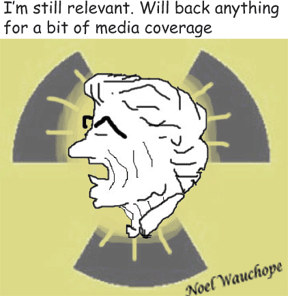 In a coda, Bob Hawke [at left] told journalists attending a National Archives briefing on the cabinet papers last month that Australia should take the world’s nuclear waste as a way to raise new revenue as an alternative to raising the GST or reducing expenditure.
Cabinet papers: Fallout continues from British atomic tests http://www.smh.com.au/nsw/cabinet-papers-fallout-continues-from-british-atomic-tests-20151217-glqlmg.html January 1, 2016 Damien Murphy The cabinet papers reveal how ignorant various Australian governments had remained about contamination at the British atomic test sites in Maralinga in South Australia.
They also erroneously believed that British clean-up operations were effective in removing plutonium contamination. Continue reading
Hundreds of $billions of tax-payer money enabled the nuclear industry
*Subsidies at inception, reducing capital costs and operating costs.
*Accounting rules allowing companies to write down capital costs after cost overruns, cancellations and plant abandonments, reducing capital-recovery requirements,
*Recovery of “stranded costs” (costs to a utility’s assets because of new regulations or a deregulated market) passed on to rate payers.
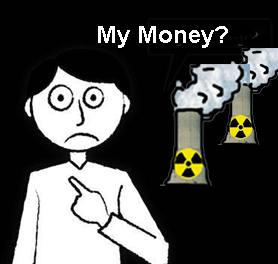 Nuclear Energy Dangerous to Your Wallet, Not Only the Environment, CounterPunch, by PETE DOLACK , 1 JAN 16 The ongoing environmental disaster at Fukushima is a grim enough reminder of the dangers of nuclear power, but nuclear does not make sense economically, either. The entire industry would not exist without massive government subsidies.
Quite an insult: Subsidies prop up an industry that points a dagger at the heart of the communities where ever it operates. The building of nuclear power plants drastically slowed after the disasters at Three Mile Island and Chernobyl, so it is at a minimum reckless that the latest attempt to resuscitate nuclear power pushes forward heedless of Fukushima’s discharge of radioactive materials into the air, soil and ocean.
There are no definitive statistics on the amount of subsidies enjoyed by nuclear power providers — in part because there so many different types of subsidies — but it amounts to a figure, whether we calculate in dollars, euros or pounds, in the hundreds of billions. Quite a result for an industry whose boosters, at its dawn a half-century ago, declared that it would provide energy “too cheap to meter.”
Taxpayers are not finished footing the bill for the industry, however. There is the matter of disposing radioactive waste (often borne by governments rather than energy companies) and fresh subsidies being granted for new nuclear power plants. None of this is unprecedented — government handouts have the been the industry’s rule from its inception. Continue reading
How a fire can, and did, happen in a nuclear waste dump

 Beatty waste dump fire blamed on rain-sodium reaction By Wesley
  Juhl Las Vegas Review-Journal, December 31, 2015
 A fire at a low-level radioactive waste dump in Nye County that shut down a 140-mile stretch of Nevada’s main north-south highway for almost 24 hours in October was caused by rainfall that seeped through a compromised cover and reacted with metallic sodium, according to a report released Thursday.
On Oct. 18, during heavy rainfall, the now-closed, state-owned landfill at the US Ecology dump near Beatty roared to life with explosions and fire. Beatty is about 115 miles northwest of Las Vegas, off of U.S. Highway 95.
A state probe of the incident was launched to consider if the fire was related to the wet weather, and if disposal records kept by the state in Carson City and at the site list any materials that could have reacted with water to cause the fire. Monday’s report details how corrosion of the steel drums containing the metallic sodium allowed the packing fluid to seep out, leaving the metallic sodium exposed to underground elements.
The 305-page report released Thursday collects statements from staffers who were there, aerial maps, results of laboratory analyses and a 195-page study on low-level radioactive waste management from 1981 as an attachment……..
Recommendations for long-term fixes from the Nevada Division of Environmental Protection include setting up enhanced monitoring of the waste facility capable of handling remote video surveillance and radioactivity measurement. The agency suggested an evaluation of the various types of wastes placed in the site and a redesign of a more protective cover cap…….. http://www.reviewjournal.com/news/nevada/beatty-waste-dump-fire-blamed-rain-sodium-reaction
Only tax-payer bounty allows any nuclear industry to exist
 Should Australia set up a nuclear waste import business, current safety and environmental laws would first have to be overturned.
The Vermont Law School paper aptly sums up this picture with this conclusion:
“If the owners and operators of nuclear reactors had to face the full liability of a nuclear accident and meet the alternatives in competition that is unfettered by subsidies, no one would have built a nuclear reactor in the past, no one would build a reactor today, and anyone who owned one would exit the nuclear business as quickly as they could.” [page 69]
If we had a rational economic system, they surely would.
Australia 2015 in nuclear news
You wouldn’t think this, from the mainstream media coverage, but 2015 has been a successful year for the Australian nuclear-free movement, with Aboriginal led opposition to nuclear waste dump plans, the end to the Ranger uranium mine, and a lively anti-nuclear movement. In polling, 72% of Australians oppose this nation becoming the world’s radioactive trash dump.
The key nuclear issue for 2015 was radioactive trash. Australia is obligated to take back nuclear trash, reprocessed in France, UK and Argentina, but which originated at the Lucas Heights nuclear reactor in Sydney.
An intelligent visitor from Mars might wonder as to why Australia doesn’t just shut down that reactor, store that small amount of trash at Lucas Heights, and stop producing more, especially as a nuclear reactor is now not necessary for production of medical radioisotopes.
But hey – you’d have to explain to that Martian that Lucas Heights is the nuclear lobby’s foot in the door to Australia, and also that the lobby hopes to confuse Australians into accepting something entirely different – a global nuclear waste import business.
Hence the setting up of South Australia’s Nuclear Fuel Chain Royal Commission, an attempt to establish a waste-dump in South Australia. With breathtaking hypocrisy, this clearly biased Royal Commission pretends that this is just a South Australian matter. Australia’s government and truly pathetic mainstream media go along with this hypocrisy, so the question of Australia becoming the world’s nuclear toilet is just not even discussed across the nation.
The Australian government had already learned, to its cost, that Northern Territory indigenous landowners can defeat their plans for nuclear waste dumping on Aboriginal land. So the government was forced to set up an unwieldy system of inviting volunteers to host the nuclear waste that must be received back from France in 2016. So far,only non indigenous volunteers have been forthcoming, and these met with strong local opposition.
Despite continual funding cutbacks, the Australian Renewable Energy Agency is pushing ahead, and investing in projects which will change the face of Australia’s energy market — if the government allows it for any longer. Australia leads the world in home rooftop solar.
The Nuclear Fuel Chain Royal Commission might have bitten off more than it intended to. There were numerous powerful and well constructed Submissions to this Commission, opposing its nuclear waste dump plan. You can read some of these at the Submissions pages on my Antinuclear website.
Space does not here permit discussion of Australia’s rather embarrassing role at the December Paris climate talks.
1 This month
17 October, Free Public Talk on Nuclear Issues in South Australia
David Noonan will speak on public interest concerns over the new Roxby Downs Indenture Act 2026 on BHP copper-uranium mining and ore processing in SA, and on how AUKUS may face SA with a High-Level nuclear waste agenda.
Dr Jim Green will discuss international developments in the field of nuclear power including ‘small modular reactors’ and Generation 4 ‘advanced’ nuclear reactor concepts.


Help Aunty Sue Protect Her Land and Sacred Sites From Destructive Rocket Testing.
.

Australians deserve the truth
about
AUKUS – https://aukuspublicinquiry.com/

PETITION – To: Prime Minister Anthony Albanese and the Australian Labor Government

of the week – Australians for War Powers Reform (AWPR)
To see nuclear-related stories in greater depth and intensity


