Australia: nuclear news this week
 Mercifully short newslist today – I hope. I’ve been preoccupied with reading all the dreary pro nuclear Submissions to the South Australia Nuclear Fuel Chain Royal Commission. (You can read the Submissions here, or my potted versions here. )
Nearly all pro nuclear Submissions come from people with either obvious or vested interests in the nuclear industry, (in contrast to the variety of sources of anti nuclear Submissions)
Anyway, the Commission will announce its tentative findings on 15 February. These are their likely recommendations. The pro nuke lobby is beavering away, lobbying especially lobbying the ALP.
My favourite pro nuke Submissions come from Geoff Russell, who sent in two. I am indebted to the Twitter troll “Thomas Huxley” for recommending these as “essential reading” . Russell devotes his confusing jargon to rubbishing thee media, reputable authors, governments, because he knows, and ?proves it with confusing jargon, that ionising radiation is just nothing to worry about. Falling off a solar roof is the big public heath worry. Another Geoff, Geoff Hudson, wants the Commission to go for floating nuclear reactors at sea.
South Australian Cabinet gets two new pro nuclear enthusiasts.
Australian Nuclear science and Technology Organisation (ANSTO) not honest about cyclotrons.
The campaign against Oman Ama nuclear dump site is gaining momentum.
Mongolia secret [but failed] nuclear waste deal – a model for Australia?
Oh my God! Global Warming Is Affecting The TENNIS!
Geoff Russell Submission to #NuclearCommissionSAust: convince public that radiation is OK
 Geoff Russell’s Submission is all about how to overcome public dislike of the nuclear industry.
I love it! Russell doesn’t bother with the nuances of argument, or indeed, even with the facts. Here he goes on radiation:
“The demonstrated health risks associated with the Fukushima meltdowns are various and it’s simple to show that radiation was and remains the smallest. Fear of radiation demonstrably killed more people than radiation could ever have. “
Note the use of the word “demonstrated”. As with smoking, the cancer cases from ionising radiation appear decades later – but not much in the early years after exposure, can’t be “demonstrated then) .
Russell explains that public concern about Fukushima radiation is due to “ignorance” and ““incompetent news reporting”. He tries to demolish any information that Chernobyl nuclear radiation caused illness or death. He’s good at dazzling you with jargony non-science : – “Put another way, normal DNA damage is about 10,000-15,000 times greater than the public was getting from radiation at Fukushima”
Russell’s forte is rubbishing well known people, authors Guy Rundle and Mark Willacy, Professor Ian Lowe, and also governments: “But it isn’t just the news media that seem to go out of their way to ignore evidence, the Government of Japan provides an excellent, but tragic, example with its response to the meltdowns at Fukushima in 2011” He rubbishes the Japanese government’s response to the Fukuhsima nuclear disaster as an over-reaction, with the evacuation as unnecessary.
He rubbishes the idea of ionising radiation as a cause of cancer, except for these odd remarks
“only a small section of the community will generally be at any significant risk at all; young children and pregnant woman…….The Hiroshima and Nagasaki doses and outcome makes it clear that any general outcome from Fukushima can only be, at worst, a slight ripple in cancer rates….”
(Now we know who matters to Geoff Russell, and who doesn’t!)
He attacks the accepted Linear No Threshold Theory (LNT) of radiation – the one endorsed by World Health Organisation (WHO) all reputable health organisations world-wide:
“Radiation experts know that LNT is simply a model which is useful in some circumstances but quite clearly wrong; both for high doses and low doses”
“……If this Royal Commission is to present an expansion of the nuclear industry as a viable option in South Australia it must deal explicitly with the causes of the Fukushima evacuation. ….. The truth is that the Fukushima meltdowns never posed any significant public health risk and that the Government of Japan mishandled the event from the outset and at every subsequent point.”
Russell goes on to a big jargony waffle about why ionising radiation in water is of no concern. Then he wanders all over the place about other causes and mechanisms of cancer development.
Russell’s conclusion:
The Royal Commission is uniquely placed to learn from the past, but it will need to deal with the drivers of nuclear fear in the community. To build confidence in the community, the Commission’s report will need to convince both sides of politics to speak with one voice about the misinformation that drove (and drives) the Fukushima evacuation. Appeasement, in the form of more and more levels of safeguards and protocols to attempt to say that “it can’t happen here” isn’t the answer.
There will always be accidents despite every effort to avoid them. Planes still crash, but people understand the relative risks and board them regardless of personal fear. They understand that fear is their personal problem and not a function of the objective facts…….
In Australia in 2010-11 there were 7730 Worker’s45 Compensation claims for serious injury resulting from falls from a height. How many were associated with rooftop solar panels? As far as I can see, nobody is even counting, but a million solar rooftops means more people on ladders; many of them amateurs. This is real danger, the kind that can put you in a wheel chair for the rest of your life. http://nuclearrc.sa.gov.au/app/uploads/2015/11/Geoff-Russell-22-07-2015.pdf
Floating nuclear reactors – a Submission to #NuclearCommissionSaust
Geoff Hudson’s Submission to the South Australia Nuclear Fuel Chain Royal Commission recommends SeaBurn – floating Portable Generation IV Reactor Development to process existing used fuel rods.
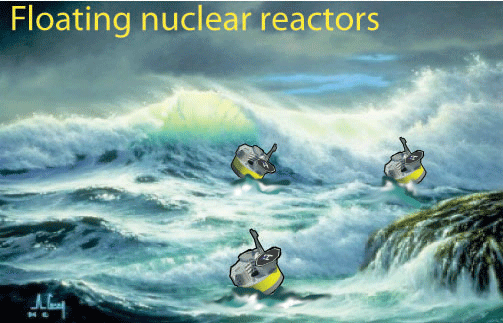
“…..It is expected that one or more foreign companies like Transatomic Power, GEHitachi, or Westinghouse would be involved. A consortium involving a South Australian Government authority (to be created), one or more overseas companies (to be chosen) and possibly the United States Department of Energy would develop the technology, first on land near a waste repository, and then in ships or submarines.
A major contribution from South Australia will be a significant fraction of the funding. It is expected that the source of that funding will be part of the income from a waste repository. The repository needs SeaBurn to offer reduction in the life time of the wastes, but will support SeaBurn from its income. This synergy means that SeaBurn should not be adopted if there is no waste repository……http://nuclearrc.sa.gov.au/app/uploads/2015/11/Geoff-Hudson-15-06-2015.pdf
Geoff Russell: a pro nuclear Submission to #NuclearCommissionSAust
Geoff Russell seems to have sent two Submissions. He is preoccupied with the need for the Royal Commission to build public confidence in the nuclear industry.
“There is extensive evidence that people in Australia are strongly opposed to any artificial nuclear process, and in the view of the author, the entire work of the Commission could easily be wasted because of this opposition.
A procedure to address this opposition is presented, beginning with surveys, passing through production of media materials, to a referendum.”
MANAGEMENT, STORAGE, AND DISPOSAL OF NUCLEAR AND RADIOACTIVE WASTE On building public confidence in the nuclear waste dump plan:
“1. The relationship between knowledge of nuclear processes and the desire to limit any nuclear activities or industry. I keep in touch with colleagues who also studied Nuclear Physics, To a man, they regard the great bulk of the general phobia about all things nuclear as an aberrant result of lack of knowledge combined with passionate but incorrect argument.
- The cost of an insurance premium to cover any damage caused by any nuclear accident or leakage. If you can take out a policy which, for example, will pay you $1,000,000 if your farm becomes unsafe for food production for $100 per year, then you are much more inclined to take a rational view of the risks”
Russell advises the Commission to survey public knowledge and level of aversion:
“Measure Correlation between Knowledge and Aversion Check the correlation between the knowledge and the level of aversion shown in the survey. Most people trained in nuclear physics expect that strong aversion will be correlated strongly with low knowledge.
Publicize the Correlation In the event that the correlation anticipated above is observed, then publicise that fact. The ABC or SBS may be willing to assist here. …..”
“Prepare Communication Materials on Nuclear processes Prepare general materials (e.g. a short film) suitable for high schools to explain the actual risks of radioactivity and the actual risks of other industrial processes, especially power production. Provide copies of these materials to schools and the media. Having produced two Ockham’s Razor talks on nuclear issues, as well as a keynote presentation to the Uranium conference held in Adelaide and to a U3A group, I feel able to contribute to this activity, and would welcome the opportunity to do so…”
He suggests an insurance plan for damage to life or property from an nuclear waste establishment.
“…….Analysis The strong public resistance to nuclear power and the storage of nuclear waste means that the chance that nothing will come of this Royal Commission, other than affirmation of the existing public opinion, is very high. This is the elephant in the room, and failure to address it is an admission that the cost and effort of the Commission will be wasted.”……. http://nuclearrc.sa.gov.au/app/uploads/2015/11/Geoff-Hudson-15-06-2015.pdf
John Emerson’s Submission to #NuclearCommissionSAust – wants a BHP waste dump
 John Emerson wants BHP to set up a nuclear waste dump http://nuclearrc.sa.gov.au/app/uploads/2015/11/John-Emerson-22-07-2015.pdf – a pity that BHP has ruled this out in its own Submission :
BHP Billiton does not handle or manage intermediate and high-level radioactive wastes. Nevertheless we understand that current thinking is toward long term storage rather than disposal, as it is foreseeable that the contained energy may be able to be harnessed in the future. Irrespective of whether storage or disposal is preferred, BHP Billiton considers that either option would be inconsistent with our core business of mining and the production of high quality copper and associated by-products at Olympic Dam. http://nuclearrc.sa.gov.au/app/uploads/2015/11/BHP-Billiton-03-08-2015.pdf

Medical isotopes: tax-payer funded ANSTO should be promoting non nuclear technology
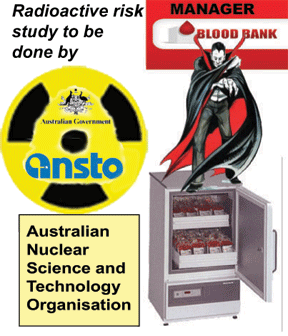 Medical isotope production in Australia: Should we be using reactor based or cyclotron technology? 15th January 2016 Dr Margaret Beavis MBBS FRACGP MPH Medical Association for Prevention of War, Australia Health Professionals Promoting Peace
Plan for USA nuclear waste deep burial, rather than exporting it
 The deep borehole project is particularly interesting because almost anywhere you look in America, there are deep rocks perfect for this method. Every state can have its own borehole repository, much to some of these state’s annoyance, since most political leaders would rather foist their waste off on someone else and claim victory for their constituents.
But Congress doesn’t exactly like the deep borehole idea because they would not be able to gang up on one state and force it down their throat. Each state would have its own deep nuclear disposal boreholes and wouldn’t be able to promise their citizens that the nuclear waste would ever leave their state

DOE Tries To Change The Rules On Nuclear Waste Disposal http://www.forbes.com/sites/jamesconca/2016/01/21/doe-tries-to-change-the-rules-on-nuclear-waste-disposal/#2715e4857a0b28df073f561e James Conca , “……..DOE is funding a study to drill a borehole more than 3 miles deep into the Earth’s crust below North Dakota to test a disposal method for radioactive waste called Deep Borehole Disposal. In this scenario, waste would be placed in the lower mile of the borehole in crystalline rock that would isolate the waste from the surface and shallow environments.
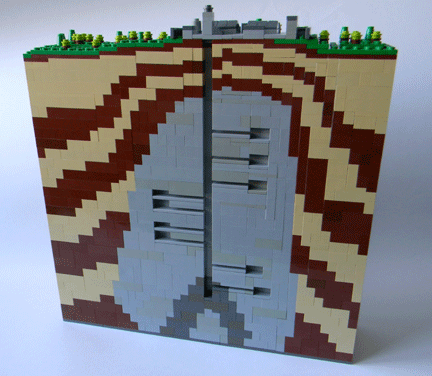
The borehole would then be filled up with some special layers, including asphalt, bentonite, concrete and crushed rock that will isolate the waste for geologic time. The borehole would need a diameter of at least 17 inches at the bottom for placing containers, and would be lined with steel casing. Future boreholes will be wider as the technology evolves, which is has been doing lately.
These developments follow directly the recommendations of President Obama’s Blue Ribbon Commission on America’s Nuclear Future, and followed up in thePresident’s Memorandum on disposal of Defense High-Level Waste and the2013 Administration’s Strategy for the Management and Disposal of Used Nuclear Fuel and High-Level Radioactive Waste. Conca and Wright (2012)provide background on nuclear waste and interpretation of the three BRC recommendations pertaining to nuclear waste disposal that has led to these changes.
But the basic strategy of this new disposal initiative is: Continue reading
Campaign against Oman Ama nuclear dump site is gaining momentum
 Group steps up campaign against Oman Ama nuclear dump http://www.warwickdailynews.com.au/news/anti-nuke-dump-petition/2905419/ 21st Jan 2016 THE Friends of Oman Ama are continuing to grow their grassroots campaign against the nuclear waste facility proposed for their community.
From hitting the streets of Inglewood to reaching thousands of people online, the group is doing what it can to get its message across. Placards, banners and signs have been displayed across the area, while leaflets have been distributed to every home in Inglewood. The group’s information street stall in Inglewood is also gathering momentum.
Information street stall group members Vanessa Grady and Rechelle Privitera said they believed the overwhelming mood on the street was people did not want the nuclear waste facility. While some were hesitant about signing the petition, street stall members claimed people were happy to sign once they read the information available.
So far the Friends of Oman Ama’s petition has gathered several hundred signatures. The group is encouraging people to have their say on the issue as the consultation continues.
Resident Sue Campbell said the proposal had challenged the community. “I feel we need to come together as a community and determine our own future,” she said. “We need to decide what we want this community to look like in 10, 20 or 30 years time.”
Community consultation on the issue ends on Friday, March 11, at 5pm.
To have your say visit www.radioactivewaste.gov.au/proposed-sites#3.
People directly involved in the Oman Ama proposal will be given an opportunity to take a tour of the proposed property tomorrow afternoon.
Now and always, the nuclear industry’s survival depends on massive subsidies
The many ways of counting subsidies
Among the goodies routinely given away, according to the Concerned Scientists, are:
- Subsidies at inception, reducing capital costs and operating costs.
- Accounting rules allowing companies to write down capital costs after cost overruns, cancellations and plant abandonments, reducing capital-recovery requirements,
- Recovery of ‘stranded costs’ (costs to a utility’s assets because of new regulations or a deregulated market) passed on to rate payers.
Yes, you read that last item correctly. Even when the energy industry receives its wish to be rid of regulation, it is entitled to extra money because of the resulting rigors of market pressures.
 After 60 years of nuclear power, the industry survives only on stupendous subsidies, Ecologist, Pete Dolack 4th January 2016 Almost 60 years since the world’s first commercial nuclear power station began to deliver power to the UK’s grid, the industry remains as far from being able to cover its costs as ever, writes Pete Dolack. But while unfunded liabilities increase year by year, governments are still willing to commit their taxpayers’ billions to new nuclear plants with no hope of ever being viable.
The ongoing environmental disaster at Fukushima is a grim enough reminder of the dangers of nuclear power. But nuclear does not make sense economically, either. Continue reading
Cyclotrons able to produce medical isotopes; no need for Lucas Heights nuclear reactor
 This production method for Tc-99m can be used by retrofitting various brands of conventional cyclotrons already in use in hospitals and health centres across Canada.
Without ‘liability caps’ the #nuclear industry would have been dead long ago

After 60 years of nuclear power, the industry survives only on stupendous subsidies, Ecologist, Pete Dolack 4th January 2016
“……….The British government, for instance, currently foots more than three-quarters of the bill for radioactive waste management and decommissioning, and for nuclear legacy sites. Areport prepared for Parliament estimates that total public liability to date just for this program is around £50 billion, with tens of billions more to come.
Liability caps for accidents are also routine. In the US the Price-Anderson Act, in force since 1957, caps the total liability of nuclear operators in the event of a serious accident or attack to $10.5 billion. If the total is higher, as it surely would be, taxpayers would be on the hook for the rest.
As a further sweetener, the Bush II / Cheney administration, in 2005, signed into law new nuclear subsidies and tax breaks worth $13 billion. The Obama administration, attempting its own nuclear push, has offered an additional $36 billion in federal loan guarantees to underwrite new reactor construction, again putting the risk on taxpayers, not investors.
The Vermont Law School paper aptly sums up this picture with this conclusion: [page 69]
“If the owners and operators of nuclear reactors had to face the full liability of a nuclear accident and meet the alternatives in competition that is unfettered by subsidies, no one would have built a nuclear reactor in the past, no one would build a reactor today, and anyone who owned one would exit the nuclear business as quickly as they could.”
If we had a rational economic system, they surely would.http://www.theecologist.org/News/news_analysis/2986749/after_60_years_of_nuclear_power_the_industry_survives_only_on_stupendous_subsidies.html
1 This month

of the week – Australians for War Powers Reform (AWPR)
To see nuclear-related stories in greater depth and intensity
 Antinuclear