Cutback in solar payments: smart meters might help
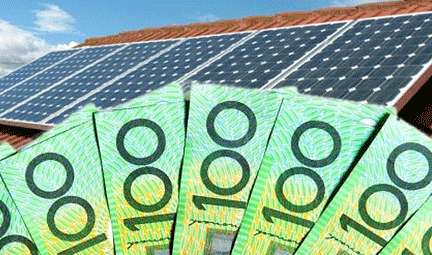 From solar boom to bill shock: Australians face loss of rooftop payments
About 275,000 people across the country will have their solar energy payments reduced by up to 80% over the next six months, Guardian, Michael Slezak 31 July 16 “……. more than 275,000 people across Australia who will see the subsidised payments they receive for their solar energy disappear over the next six months, replaced with rates up to 80% lower.
The solar boom in Australia, which has led to 1.5m households generating their own electricity from the sun, was accelerated by subsidised payments for people who sell solar-generated electricity back to the grid.
In some cases, like Shaw’s, solar customers were able to receive more than twice the money for the electricity they put in the grid, compared with what they paid for electricity they took out of it.
But for a lot of homes and businesses, those schemes are coming to an end over the next six months and, if they’re not prepared, they will be heading towards some serious bill shock.
Customers in New South Wales, who got the most generous rate, will be in for the biggest hit and will need to do the most to adapt to the changes…….
While about 150,000 homes and business will be kicked off these schemes in NSW on 1 January 2017, the party is ending for about 130,000 customers inVictoria and South Australia too.
(Others are on schemes that will continue for years to come. So if people are confused about their own feed-in tariffs, they should ask their retailer what’s happening with them.)…….
Smart meters
The issue of what kind of meter to get is a minefield right now, with different issues affecting consumers depending on where they are, and options are changing rapidly.
One thing that can help anyone make the most of their solar electricity is a smart meter, says Claire O’Rourke, national director of Solar Citizens, a group that lobbies on behalf of solar customers.
A smart meter can be read remotely, and can tell when the most power is being drawn, helping maximise the benefits. They can also open up services such as time-of-use tariffs, providing savings for people who avoid using energy during periods of high demand.
“You’re probably better off with a smart meter but they do have an increased cost,” says O’Rourke.
Some retailers are offering discounts for smart meters in return for fixed-term contracts. “It is really in the interest of consumers to shop around,” she says.
For many people right now a smart meter could be overkill. The smart meter will either be paid upfront, or in the case of free meters offered by retailers, will be paid for through increased tariffs, says Moyse. Whether the meter will allow consumers to recoup that cost is unclear.
For people outside NSW, the lowest-cost option is to keep their current meter, at least until it’s clear a smart meter is worth it. Outside NSW, the current meter will work fine on the new deals.
Unfortunately, for most people on the NSW solar bonus scheme, their meters will need to be replaced……..
the loss of generous feed-in tariffs is driving interest in battery storage, says Chris Cooper, chief executive of Suncrowd, a company using group purchasing power to get cheaper prices for batteries.
“It’s a bit of a trigger point for people to look at new technology,” Cooper says. So far Suncrowd has run its first round in Newcastle, and had about 200 homes join together and buy batteries at discount rates.
He says lots of the customers who have been approaching Suncrowd have been people coming off the NSW solar bonus scheme. Having a battery added to an existing solar system can significantly increase “solar self-sufficiency”, Cooper says, a measure of how much the customer relies on solar rather than electricity from the grid. “With an appropriately sized battery you can boost it from 20% to about 60 or 70% self-sufficiency,” he says. Cooper says Suncrowd is building an online tool to help people calculate their solar self-sufficiency and have been showing it to people at events they’ve been holding. “People are really motivated by seeing the numbers go up,” he says…….https://www.theguardian.com/environment/2016/jul/31/australia-residents-solar-rooftop-lose-payments
1 Comment »
Leave a reply to Dennis Matthews Cancel reply
1 This month
Chernobyl: The Lost Tapes – A good documentary on Chernobyl on SBS available On Demand for the next 3 weeks– https://www.sbs.com.au/ondemand/tv-program/chernobyl-the-lost-tapes/2352741955560
15 April – Zoom –Nuclear Power is Not the Solution
Apr 15, 2026 01:00 AM in Canberra, Melbourne, Sydney

Join the International Physicians for the Prevention of Nuclear War (IPPNW) on Tuesday, April 14th for a timely webinar exploring the risks associated with nuclear power and challenging the myth that it offers a simple, safe, carbon-free solution to the climate crisis

21 April Webinar: No Nuclear Weapons in Australia
Start: 2026-04-21 18:00:00 UTC Canberra, Melbourne, Sydney (GMT+10:00)
End: 2026-04-21 19:30:00 UTC Canberra, Melbourne, Sydney (GMT+10:00)
Event Type: Virtual
A virtual link will be communicated before the event.
Host Contact Info: australia@icanw.org

of the week – Australians for War Powers Reform (AWPR)
To see nuclear-related stories in greater depth and intensity
 Antinuclear
In periods of peak demand, like during summer heat waves, gas-fired peaking power stations get 300 times the average wholesale price for their electricity.
From the point of view of households, “smart” meters make sense only if they have the ability to give time-of-day tariffs for electricity supplied by rooftop solar, in other words, up to $12,000 a MWh, just like the gas-fired power stations.
LikeLike