The Australian government’s role, notwithstanding its ineffectual murmurings about how bad the weapons are, has been to lead the charge in opposing the growing push for a ban treaty, arguing that, without the support of the nations with the weapons, it’s an impractical process. That’s a bit like arguing that we must consult with criminals about the sort of laws they’d agree to before we enact any.
It also misrepresents the purpose of a ban treaty, which is to delegitimise and stigmatise the weapons and change the legal landscape by which nations are judged.
Australia’s stance, of course, has everything to do with our reliance on “extended nuclear deterrence”, which is a preparedness to have US weapons destroy cities on our behalf. Just which cities, or in what circumstances, the government refuses to say
71 Years On, We’re Still Dodging Bullets While Australia Leads The Charge To Promote Nuclear Weapons, New Matilda By Sue Wareham on August 8, 2016 There is some light on the horizon in terms of the international fight to ban nuclear weapons. But it’s certainly not emanating from Australia, writes Dr Sue Wareham.
Early August marks the anniversaries of the atomic bombings on August 6 and 9, 1945, of Hiroshima and Nagasaki – dates which most often come and go with little to offer except a terrifying reminder of humanity’s capacity to destroy ourselves. Nevertheless, we’ve made it to 71 years, having tempted fate with tens of thousands of the most destructive devices ever created, escaping within a whisker of global catastrophe more times than bears thinking about. Continue reading →
What’s happening in Whyalla? These articles come From February. I hope that Council and the newspaper editor have done their homework on nuclear waste, since then
Acting Whyalla mayor Tom Antonio has said that he is “positive” about nuclear energy’s future in South Australia ahead of his visit to the Lucas Heights nuclear reactor in Sydney next week.
The trip on February 9 will be made by a delegation from the Upper Spencer Gulf Common Purpose Group pending the findings of the Nuclear Fuel Cycle Royal Commission in South Australia….
Huge income and many jobs hinge on a proposal for a nuclear-waste repository in Whyalla in the wake of devastating news about the future of the Arrium steelworks.
Meanwhile, in an exclusive report, The Whyalla News can reveal that Whyalla City Council is close to declaring an interest in hosting a low-level nuclear waste repository…..
Nuclear waste dump just another bad option — what about renewable energy?
John Willoughby, The Advertiser February 18, 2016 SOUTH Australia’s Nuclear Fuel Cycle Royal Commission, in its tentative findings, has recommended avoiding some bad options: no nuclear power generation and no reprocessing or fuel leasing in the foreseeable future.
However, a bad option it found acceptable is allowing a proportion of the world’s most dangerous high-level nuclear waste to be transported to SA for long-term disposal.
The royal commission is not proposing to import this material in its hottest, radioactive state — the initial cooling of the waste will take place overseas.
From the health point of view, the risks are largely borne by those who work in the nuclear industry and, perhaps because the risks are not high, the report does not adequately address them. Employees involved in the processing would have to accept increased health risks.
The impact on life and health from a major release of radioactivity from nuclear accidents is severe and immediate. Safety problems cannot be excluded: in existing repositories overseas (Germany and US), water ingress occurred in one, and failure in cooling systems caused an explosion in another. Both required expensive remediation.
Radiation toxicity is the primary reason so much care is required in dealing with nuclear material and why safe disposal of radioactive waste is critical. As the royal commission report says, “Used fuel requires isolation from the environment for many hundreds of thousands of years”…….
the costs of renewable sources of energy (solar, wind) are very low. Solar and wind plants can be built quickly and relatively cheaply, can be maintained or deconstructed easily, and have no ongoing population risks.
The endeavours of our scientists and engineers are needed in dealing with the many facets of climate challenge, including the transition to renewable energy, and they should be focused on this.
Thousands of people took to the streets of an eastern Chinese city this weekend to protest against a proposed nuclear waste reprocessing facility, in a show of public opposition that China fears could derail its ambitious plans to construct dozens of nuclear reactors. Continue reading →
The notion that climate science denial is no longer a part of Australian politics was swept away yesterday by One Nation Senator-Elect Malcolm Roberts.
In his inaugural press conference, Roberts claimed that “[t]here’s not one piece of empirical evidence anywhere, anywhere, showing that humans cause, through CO₂ production, climate change”.
He also promoted conspiracy theories that the CSIRO and Bureau of Meteorology are corrupt accomplices in climate conspiracy driven by the United Nations.
His claims conflict with many independent lines of evidence for human-caused global warming. Coincidentally, the University of Queensland is releasing a free online coursethis month examining the psychology and techniques of climate science denial. The very first video lecture addresses Roberts’ central claim, summarising the empirical evidence that humans are causing climate change.
UQx DENIAL101x 1.2.1.1 Consensus of Evidence
Scientists have observed various human fingerprints in recent climate change, documented in many peer-reviewed scientific papers.
Not only do these unique fingerprints confirm humanity’s role in recent climate change, they also rule out other potential natural contributors. If the Sun caused global warming, we would expect to see days warming faster than nights, and summers warming faster than winters.
Instead we observe the opposite: nights are warming faster than days, and winters are warming faster than summers, which is a greenhouse pattern predicted by John Tyndallas long ago as 1859.
Similarly, if global warming were caused by internal variability, we would expect to seeheat shuffling around the climate system with no net build-up. Instead, scientists observe our climate system accumulating heat at a rate of more than four atomic bombs per second.
The scientific consensus on climate change has also been endorsed by many scientific organisations all over the world, including the national science academies of 80 countries
Is it a conspiracy?
How does one dismiss a global scientific consensus built on a robust body of empirical evidence?
There are five characteristics of science denial. These common traits are seen when people reject climate science, the benefits of vaccination, or the research linking smoking to cancer.
The techniques of denial are: fake experts; logical fallacies; impossible expectations; cherrypicking; and conspiracy theories. This is summarised in the acronym FLICC.
UQx DENIAL101x 1.4.3.1 Five Characteristics of Science Denial
Climate science denial and conspiratorial thinking are often found together. A well-known example is that of Donald Trump, who has dismissed climate change by blaming it on a Chinese conspiracy.
Several studies have linked climate science denial and conspiratorial thinking. If a person disagrees with a global scientific consensus, they’ll typically believe that the scientists are all engaging in a conspiracy to deceive them.
Malcolm Roberts’ conspiracy theories have been well documented and were once again on offer in yesterday’s speech. He espouses a conspiracy that encompasses the CSIRO, Bureau of Meteorology, international banking families, the United Nations and Al Gore.
Unfortunately, I am not optimistic that the evidence for human-caused global warming will persuade Malcolm Roberts. The scientific evidence from psychology tells us that scientific evidence is largely ineffective on those who dismiss climate science with conspiracy theories.
My own research found that communicating the science of climate change to those who exhibit conspiratorial thinking can even be counterproductive, activating their distrust of scientists and strengthening their denial of the evidence.
Furthermore, conspiratorial thinking is self-sealing. When conspiracy theorists are presented evidence that there is no conspiracy, they often respond by broadening the conspiracy to include that evidence. In other words, they interpret evidence against a conspiracy as evidence for the conspiracy.
Our course on climate science denial will be much more useful to those who are open to scientific evidence and curious about the research into the causes and impacts of climate change and the psychology of climate science denial.
Don Hancock, a nuclear waste expert with the nonprofit Southwest Research and Information Center, is skeptical officials will make the December 2016 deadline. He thinks it could take several million dollars more and a few more years to fully reopen WIPP.
“DOE was overly optimistic about scheduling and overly optimistic about costs,” Hancock said. “Unfortunately, DOE continues to not learn from its past. This is not unique to WIPP.”
That prediction comes after federal officials once promised the Waste Isolation Pilot Plant would be cleaned up and reopened by this March, the Santa Fe New Mexican reports (http://goo.gl/9QvNEq).
The New Mexico plant has been closed since February 2014, when an inappropriately packed container of waste from Los Alamos National Laboratory ruptured and contaminated part of the facility.
The closure derailed cleanup at federal sites around the nation and recovery is costing the Energy Department hundreds of millions of dollars. Continue reading →
Join in the solar chorus, says council, as North Melbourne gets on the ball http://www.theage.com.au/victoria/join-in-the-solar-chorus-says-council-as-north-melbourne-gets-on-the-ball-20160807-gqmtz2.html, Clay Lucas Councillor Arron Wood can understand why more businesses don’t put solar panels on their roof.
It’s not because they don’t want to save money. And it’s not because they don’t want to do the right thing. “The biggest barrier to wider uptake [of solar power] is the complexity of going through the process,” says Cr Wood, the chairman of Melbourne City Council’s environment committee.
Which is why, he says, opening North Melbourne Football Club’s new solar panel bank – 800 panels set across the club’s roof and that of the neighbouring council-run recreation centre – is a major breakthrough.
“There’s this sense that footy speaks to all parts of life in Melbourne, so partnering with … North Melbourne footy club might drive others to think ‘Maybe this is something we can do’,” he says.
The panels on the club’s roof will produce enough electricity per year to run 70 average Melbourne homes. North Melbourne’s chief executive Carl Dilena said the club expected to cut its energy use by almost a quarter as a result of installing the solar panels.
But as many Melbourne home owners know, solar does not always come cheap, at least initially. The system cost almost half a million dollars to install, and was partly financed by the council, via the Clean Energy Finance Corporation. The club contributed about $67,000 of the funding, with the rest coming from the city council.
It is the first partnership the council has undertaken with an outside party – all other installations it has done have been on council-owned building rooftops.
The council is working with Sustainability Victoria to find businesses interested in reducing either emissions or energy bills that have previously considered going solar.
“The driver for a lot of businesses isn’t saving the environment, it’s to save dollars and that’s completely fine,” says Cr Wood.
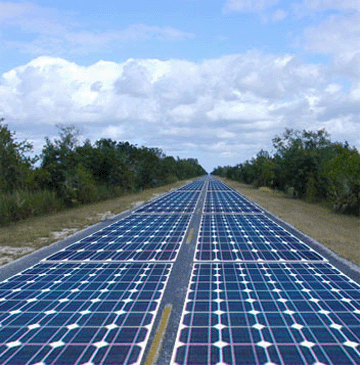
France gets a step closer to solar roadshttp://reneweconomy.com.au/2016/france-gets-step-closer-solar-roads-56433By Ilias Tsagas on 5 August 2016 French energy minister Ségolène Royal has inaugurated a manufacturing plant that will produce the so-called “Wattway” paving, made of solar PV. One of its pilot projects will be a 1 kilometer solar road, built in the same region as where the plant is located.
On 26 July French energy minister Ségolène Royal inaugurated a manufacturing unit for the Wattway photovoltaic panels in Tourouvre, Orne. Wattway is a French innovation and is the result of 5 years of research undertaken by Colas, a transport infrastructure company, and the French National Institute for Solar Energy (INES).
The joint patent for the product is based on crystalline silicon, and although it is very thin, Colas argues it is also “very sturdy, skid-resistant and designed to last,” with the durability to bear all types of vehicles, including trucks. Wattway panels can be applied directly to existing pavements, with the aim of generating green electricity while also allowing traffic to flow.
The new manufacturing facility is adjacent to Colas’ headquarters in the village of Tourouvre, in France’s north western department Orne. The new facility is expected to speed up the panel production time, as the Wattway panels had previously been manufactured at the INES laboratory.
Colas is already taking orders for panels ranging from 10 m2 to 50 m2, however, as of 2017, Wattway panels will be included in the Colas product line and the panel surface will increase.
One of the first applications of the Wattway panels will be a 1 kilometer road in the Onre region, the local council has announced.
France’s energy minister took the opportunity at the event to also announce the mobilization of €5 million in state funding to support the development of the Wattway photovoltaic panel. Royal herself is a great support of the innovative patent and has often spoken publicly of the variety of projects the Wattway can be applied to.
A Wattway panel, said Colas, can last “at least 10 years depending on the traffic, which speeds up wear. If the section is not covered by heavy traffic – a stadium parking lot for example – then Wattway panels can last roughly 20 years.”
Furthermore, “given the technical issues involved in the connection process, the panels need to be installed by an authorized technician,” added Colas, who also expressed that “within the next two to three years, it will be possible to install Wattway panels on private roads and driveways.”
An entire district in Rajasthan to be powered by solar energy, will end all water woes in the desert state!Rajasthan Electronics and Instrumentation Ltd, the firm currently handling the project has been given the green signal to spend Rs 11.91 crore for the entire project. India.com By Rutu Ladage on August 2, 2016 “……..For Rajasthan government, coming up with newer techniques to ensure that the water issues never crop up, Barmer district in Jaiselmer is coming up with a unique solution. While we do have villages and homes in India that boast of solar power and using solar energy to meet their electricity needs, there are hardly any complete districts that boast of running solely on solar power. If the project works out, it will definitely be one of the major firsts in India and set the benchmark for other regions too. The Mukhyamantri Solar Adharit Nalkoop Yojana (MSANY). will provide 70 solar tubewells in Barmer district to help people become reliant on solar energy and use solar power even for agriculture.
Solar could be game changer for rural communities going off the grid, ABC News By Kathryn Diss , 7 Aug 16 For decades, farmers in Western Australia’s south have put up with the most unreliable electricity supply in the state, now they are about to find out if they can live off-grid, surviving on solar power instead.
Key points:
Farmers in Western Australia are investigating using stand-alone solar power systems
Solar battery technology is making this more easily achieved, and the State Government will pay for it
Power-supply to south west WA has been unreliable, a problem in other regional areas
Ros and Bernie Giles are part of a handful of farming families giving the technology a crack after living through years of frustration at their farm in West River, 500 kilometres south of Perth.
“Summer is our worst time, we seem to have more fluctuations then,” Ms Giles said……
Power problems span farmland across nation
WA’s south west grid spans more than 250,000 square kilometres, an area the size of the United Kingdom, yet it only services a 50th of the population, making it unreliable and expensive to maintain.
But the power problems faced by the people of West River are hardly unique.
Matthew Warren heads up the Australian Energy Council, which formed earlier this year to respond to the world’s rapidly changing energy market.
He said most edge-of-grid communities around the nation suffered the same problems……….
Renewable energy reaches tipping point
The move by WA’s Liberal-National Government to invest in the technology is seen as a step towards a greener future.
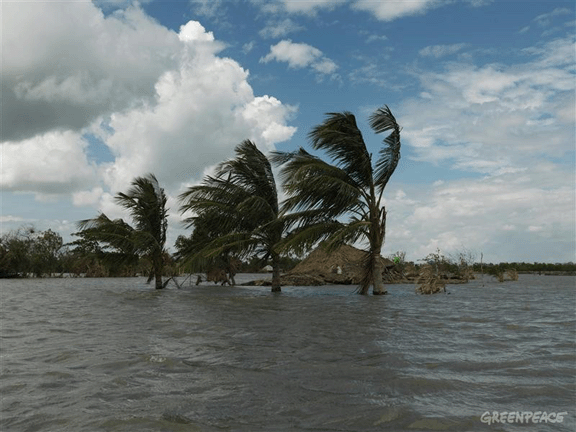
Carteret climate refugees seek homeA grassroots group in Bougainville is scrambling to relocate the Carteret Islanders before rising sea levels swallow their land forever. ABC News 7 Aug 16 By Lauren Beldi for Pacific BeatAt only 1.5 metres above sea level at their highest point, the Carteret Islands are some of the first to succumb to the rising ocean tides.
The grassroots Tulele Peisa group, which means “sailing the waves on our own” in the local Halia language, is hoping to relocate more than half of the population by 2020. They have secured land for new homes on the main island of the Autonomous Region of Bougainville, to the east of mainland Papua New Guinea.
Tulele Peisa formed in late 2006 after the Council of Elders on the islands decided to establish their own relocation program. The group’s chief executive, Ursula Rakova, says the encroaching tides on the islands have a major impact on people’s health. “We’re beginning to get more requests for people wanting to move because of the situation and the dire need for food,” she says.
The storm surges not only wash away houses, but also vegetable gardens, which are critical for the islanders’ survival.
With no cash economy on the Carterets, the only source of food is what people are able to grow for themselves……
Tulele Peisa has also provided thousands of mangrove seedlings to prevent the erosion of the coastline, and helped to build raised garden beds. But this will only stave off the inevitable for so long.
“Those are adaptation strategies, they aren’t really long-term solutions to containing the islands, because we know the islands are going, but we are looking at supporting our families,” Ms Rakova says.
She says the islanders want to maintain their independent way of living but that the international community should provide more support.
“The islanders on the Carterets are victims of what other people have caused and the international community needs to aid and support the work that we are doing,” she says.
6 August 2016. Congratulations on your appointment as minister for the environment and energy. The bringing together of these two portfolios for the first time could present a substantial opportunity for sound policy development in Australia.
It must be a considerable relief for you to emerge from the gloom of the resources portfolio, away from the problems of the decline of the fossil fuel sector and the return of the killer black lung disease, into the bright light of nature and our rivers, mountains, forests and reefs. Why, you could even be the minister who saves the Great Barrier Reef – but more of that later.
On July 28, Japan’s Supreme Court handed down its ruling in a case filed originally by the national government over tents pitched by anti-nuclear groups outside buildings of the Ministry of Economy, Trade and Industry (METI) in Kasumigaseki, Tokyo. It upheld an earlier order that the groups evacuate and pay for their use of the land.
The court’s petty bench, led by Judge Naoto Ohtani, rejected an appeal made by members of the groups against a lower court ruling. The Tokyo District Court is expected to carry out the forcible removal of the tents upon the request of the government, though members of the groups are expected to resist…….. The ruling includes an order that two defendants of the groups pay about JPY21,000 (USD206 at USD1 = JPY102) per day for use of the land, for a total of nearly JPY40 million (USD392,000) for the five-year period, plus interest. http://www.jaif.or.jp/en/japanese-government-wins-in-supreme-court-tents-of-anti-nuclear-groups-next-to-meti-ministry-building-to-be-forcibly-removed/
David Noonan will speak on public interest concerns over the new Roxby Downs Indenture Act 2026 on BHP copper-uranium mining and ore processing in SA, and on how AUKUS may face SA with a High-Level nuclear waste agenda.
Dr Jim Green will discuss international developments in the field of nuclear power including ‘small modular reactors’ and Generation 4 ‘advanced’ nuclear reactor concepts.