The rapid success of wind and solar power in America
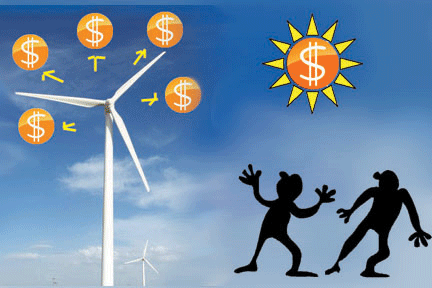 Wind and solar get cheaper and better, Energy Transition, 14 Sep 2016 by Ben Paulos
Wind and solar power have reached a tipping point in the US, as their prices become competitive with conventional electricity sources. Ben Paulos looks at the leaps and bounds in solar and wind, and what this means for the US energy transition.
In the cornfields of Iowa, thousands of wind turbines are spinning, supplying over 30 percent of the state’s power—the highest percentage of any US state. On especially windy days in the spring, there may be enough wind power to run the whole state.
The state’s largest utility, MidAmerican Energy—partly owned by billionaire investor Warren Buffett—aims to provide 100 per cent renewable energy. And with their plan toadd another 2000 MW recently approved, they’ll be getting 85 percent of their power from renewables, mostly wind.
While that number is impressive, even more impressive is the fact that MidAmerican won’t have to raise rates to do it. Thanks to the steady decline in prices and improvement in performance, wind energy is now the cheapest source of new electricity in some parts of the US.
Solar prices, too, are falling rapidly. California is the national leader by far, in both distributed and utility-scale systems. The state is now home to 14,000 MW of solar, including over 4000 MW installed on over 400,000 rooftops. Utilities are signing contracts for solar power for as low as 3 cents per kWh.
Reports released in August by the Lawrence Berkeley Lab, as well as other industry data, are showing that wind and solar prices and performance have reached a tipping point, putting renewable energy squarely in the mainstream.
Wind
What has changed? What is driving the growth of wind and solar power? While the price of wind turbines is certainly important to the cost of wind energy, the biggest price reductions in recent years have come from improved performance……..
Solar
Solar power has its own cost drivers, but it is similar to wind in one respect: the cost of the solar panels themselves is no longer the most important aspect.
Because panel prices have fallen so low—only 80 cents per watt—they now make up only one-fifth of the total cost of a residential rooftop system. Some of the costs are in the other hardware, like racks and electronics. But especially expensive are the “soft costs”—all of the other things needed to get those panels on your roof, like marketing, acquiring customers, and getting permits………
Utility-scale solar plants are increasingly using tracking systems that follow the sun across the sky, thus increasing output. Power contracts signed for new systems in 2015 were at or below $ 50 per MWh, with some as low as about $ 30 per MWh.
Overall, the US has 29.3 GW of solar installed, according to GTM Research. Utility-scale solar has been the fastest growing segment for the past few years, accounting for over half of the 7.5 GW installed in 2015.
California continues to dominate the market, with about half of all solar as of the end of 2015. But that share has been falling as other states grow.
Some US neighborhoods are seeing very high levels of saturation. In San Diego County, one in eight single family homes has solar, with some zip codes boasting double that rate. Hawaii, with very high electricity prices and excellent sunshine, has more solar power per capita than any state. In 2014, 6 percent of the state’s power came from the sun, and 17 percent of homes sported solar panels.
While this growth has been impressive, all signs point to even greater growth in coming years. At the end of 2015, there were at least 56.8 GW of utility-scale solar plants waiting to be interconnected across the nation, enough to triple current levels. And wind is expected to see at least 8 GW of growth per year: in the Midwest alone, there are 29 GW of wind projects waiting to be connected. We can expect to see even better, cheaper wind and solar soon.
Bentham Paulos is an energy consultant and writer based in California. http://energytransition.de/2016/09/wind-and-solar-get-cheaper-and-better/
1 Comment »
Leave a comment
1 This month.

Australians deserve the truth
about
AUKUS – https://aukuspublicinquiry.com/
23 July – Australian Premiere: ‘Our Planet, The People, My Blood’ documentary
Thu, 23 Jul, 10am – 12pm ACST
The Mercury
13 Morphett St, Adelaide SA 5000
Link to register and more information here. tickets free but you must register
30 July – WEBINAR (Free) – Is Nuclear Power the Solution to Climate Change? https://my.acaw.org.au/event/acaw-is-nuclear-power-the-solution-to-climate-change
18:30 – 19:45 ACST
19:00 – 20:15 AEST

PETITION – To: Prime Minister Anthony Albanese and the Australian Labor Government

of the week – Australians for War Powers Reform (AWPR)
To see nuclear-related stories in greater depth and intensity
 Antinuclear
The SA State-wide power failure is being either blamed on wind power generators (Nick Xenophon and his fellow-traveller radio shock-jocks) or used as an excuse to attack renewables in general ( Liberal Party in SA, Federal Coalition). ALP and the Greens have done well in responding to the latter.
Everybody seems to agree that it was the weather (a tornado) that was the problem but that doesn’t stop some from opportunistic attempts to confuse the public and to harness the public’s dissatisfaction with electricity supply in SA. It looks like there may have been a domino effect; a couple of transmission towers taken down by the wind and dragging 20 others with them.
Nick Xenophon claims that because wind power causes problems in producing alternating current (AC) at the standard frequency then it must have been wind power that caused the shutting down of the entire system. Nick’s a politician-lawyer and I suspect hasn’t a clue about wind turbines but is probably getting advice from a friendly “expert”.
Officially, there hasn’t yet been an independent explanation of why the whole system shut down but it’s highly doubtful that it was related to wind farms, for the simple reason that wind farms are turned off in gale-force wind. If something is not working, then its hard to see how it can cause problems with delivering electricity at the right frequency!
There is much confusion about wind turbines. The ABC is still saying that power shortages a couple of weeks ago were partly because the wind wasn’t blowing. In fact, it was just the opposite, the wind was too strong and the turbines were turned off.
This sort of misinformation is being exploited by ignorant journalists and politicians.
Dennis Matthews
LikeLike