Earthquake reinforces Japan’s anxieties about nuclear power plants
“I think we expect more of such readjusting plate movements and that has been reasonably predicted, and many volcanic activity and earthquakes have been rampant over the last five years,” said Mr. Kurokawa, an adjunct professor at the National Graduate Institute for Policy Studies. “So why are we continuing to restart nuclear plants?”
New Quake Tests Resilience, and Faith, in Japan’s Nuclear Plants, NYT, NOV. 22, 2016 TOKYO — There was no avoiding fearful memories of the Japanese nuclear disaster of 2011 on Tuesday morning after a powerful earthquake off the coast of Fukushima caused a cooling system in a nuclear plant to stop, leaving more than 2,500 spent uranium fuel rods at risk of overheating………
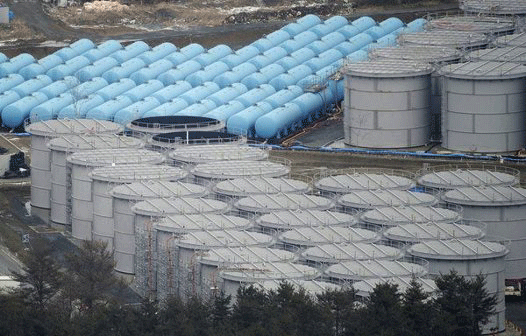 Regarding the longer-term situation, nuclear experts expressed concern about the safety of the cleanup operation at the Daiichi plant.
The melted cores of three reactors have yet to be removed as they are still too radioactive for workers to approach. Since the 2011 disaster, groundwater seeps into the reactors daily. The water, contaminated by the melted fuel rods, needs to be treated and stored on site. So far, Tepco has built more than 880 tanks of about 1,000 tons each.
The tanks are inspected four times a day to confirm that they do not leak, said Mr. Okamura of Tepco. And in an effort to halt the flood of groundwater into the damaged buildings, the company has built an underground wall of frozen dirt nearly a mile in length encircling the reactors. The wall is not yet fully frozen, though, and groundwater continues to flow into the reactors.
Critics worry that the sea walls or storage tanks might not withstand a more powerful earthquake or tsunami. And Tuesday’s incident at the Daini reactor showed that quakes can set off problems even at plants that are not operating.
Most of the country’s 54 plants remain closed since the 2011 disaster, but the administration of Prime Minister Shinzo Abe wants to restart most of them.
A majority of the Japanese public is opposed to such a move. Candidates for governor who ran campaigns opposed to the revival have won elections in recent months in two prefectures that host nuclear plants.
According to the Nikkei Shimbun, a Japanese daily, Fumio Sudo, the chairman of Tepco, and Naomi Hirose, the company’s president, were planning to meet on Tuesday with one of those governors, Ryuichi Yoneyama of Niigata, to try to persuade him to support a restart of the Kashiwazaki-Kariwa plant there. Mr. Sudo and Mr. Hirose returned to Tokyo after the earthquake.
Kiyoshi Kurokawa, who oversaw an independent investigation on the Fukushima nuclear accident for the Japanese Parliament, said that building walls and storage tanks failed to solve the underlying problem of an earthquake-prone country relying on nuclear power. Instead, he said, both the government and utility companies should invest in developing alternative sources of power like solar or wind technology.
“I think we expect more of such readjusting plate movements and that has been reasonably predicted, and many volcanic activity and earthquakes have been rampant over the last five years,” said Mr. Kurokawa, an adjunct professor at the National Graduate Institute for Policy Studies. “So why are we continuing to restart nuclear plants?”http://www.nytimes.com/2016/11/22/world/asia/japan-earthquake-tsunami-fukushima.html?_r=0
No comments yet.
1 This month
17 October, Free Public Talk on Nuclear Issues in South Australia
David Noonan will speak on public interest concerns over the new Roxby Downs Indenture Act 2026 on BHP copper-uranium mining and ore processing in SA, and on how AUKUS may face SA with a High-Level nuclear waste agenda.
Dr Jim Green will discuss international developments in the field of nuclear power including ‘small modular reactors’ and Generation 4 ‘advanced’ nuclear reactor concepts.


Help Aunty Sue Protect Her Land and Sacred Sites From Destructive Rocket Testing.
.

Australians deserve the truth
about
AUKUS – https://aukuspublicinquiry.com/

PETITION – To: Prime Minister Anthony Albanese and the Australian Labor Government

of the week – Australians for War Powers Reform (AWPR)
To see nuclear-related stories in greater depth and intensity


Leave a Reply