
 Fight To Stop Nuclear Waste Dump In Flinders Ranges , 11 Mar 17 SA Response of the office of South Australian State Liberal leader Steven Marshall, to query about Liberal opinion on the plan to import nuclear waste.
The State Liberal Team is united in its decision not to proceed with a nuclear waste dump.We have carefully considered the Royal Commission Report. We have taken note of the outcomes of the community consultation. We have actively participated in the parliamentary committee process. We have visited Finland, France and the United States to consider the technical aspects and financial risks.
It is clear that Premier Jay Weatherill’s plan to make South Australia the world’s nuclear dumping ground exposes taxpayers to unacceptable financial risks without knowing whether the project will even proceed.
For 70 years the State Liberal Party has demonstrated its commitment to creating realistic opportunities in the nuclear industry with the establishment of the Radium Hill mine and later the Olympic Dam Mine under Liberal Premiers Playford and Tonkin respectively……
The Premier, lacking support from his own Cabinet, had to establish a Citizen’s Jury at taxpayers’ expense, to progress his own agenda and with access to a wide range of advice, two-thirds of that jury has determined that this venture should not be pursued ‘under any circumstances’.
Appointed by the Premier, Royal Commissioner Kevin Scarce has acknowledged that it could take up to 10 years to secure vital public support and another 28 years to establish such a facility.
The advice to State Parliament shows it will cost taxpayers $600 million to continue the consultation and select a site without any guarantee of eventually securing investors or customers for the facility……The Weatherill Labor government is playing poker with your money and our state will be forced to place a blind bet of $600 million just to stay in the game…..
Nuclear Waste storage is a responsibility for those nations using nuclear power. It is not the instant fix for the South Australian economy as promised by the Premier. https://www.facebook.com/groups/344452605899556/
March 11, 2017
Posted by Christina Macpherson |
politics, South Australia |
Leave a comment
Dying robots and failing hope: Fukushima clean-up falters six years after tsunami
Exploration work inside the nuclear plant’s failed reactors has barely begun, with the scale of the task described as ‘almost beyond comprehension’, Guardian, Justin McCurry at Fukushima Daiichi nuclear power plant, 9 Mar 17. B
Barely a fifth of the way into their mission, the engineers monitoring the Scorpion’s progress conceded defeat. With a remote-controlled snip of its cable, the latest robot sent into the bowels of one of Fukushima Daiichi’s damaged reactors was cut loose, its progress stalled by lumps of fuel that overheated when the nuclear plant suffered a triple meltdown six years ago this week.
As the 60cm-long Toshiba robot, equipped with a pair of cameras and sensors to gauge radiation levels was left to its fate last month, the plant’s operator, Tokyo Electric Power (Tepco), attempted to play down the failure of yet another reconnaissance mission to determine the exact location and condition of the melted fuel.
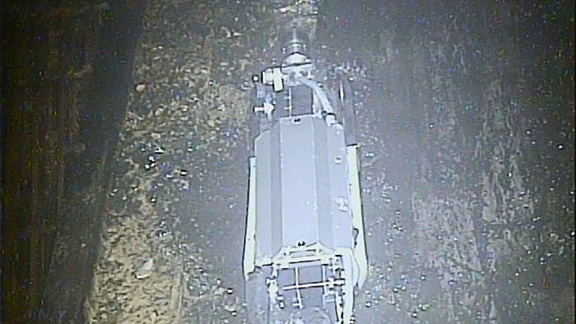
Even though its mission had been aborted, the utility said, “valuable information was obtained which will help us determine the methods to eventually remove fuel debris”.
The Scorpion mishap, two hours into an exploration that was supposed to last 10 hours, underlined the scale and difficulty of decommissioning Fukushima Daiichi – an unprecedented undertaking one expert has described as “almost beyond comprehension”.
Cleaning up the plant, scene of the world’s worst nuclear disaster since Chernobyl after it was struck by a magnitude-9 earthquake and tsunami on the afternoon of 11 March 2011, is expected to take 30 to 40 years, at a cost Japan’s trade and industry ministry recently estimated at 21.5tr yen ($189bn).
The figure, which includes compensating tens of thousands of evacuees, is nearly double an estimate released three years ago……
Developing robots capable of penetrating the most dangerous parts of Fukushima Daiichi’s reactors – and spending enough time there to obtain crucial data – is proving a near-impossible challenge for Tepco. The Scorpion – so called because of its camera-mounted folding tail – “died” after stalling along a rail beneath the reactor pressure vessel, its path blocked by lumps of fuel and other debris.
The device, along with other robots, may also have been damaged by an unseen enemy: radiation. Before it was abandoned, its dosimeter indicated that radiation levels inside the No 2 containment vessel were at 250 sieverts an hour. In an earlier probe using a remote-controlled camera, radiation at about the same spot was as high as 650 sieverts an hour – enough to kill a human within a minute.
Shunji Uchida, the Fukushima Daiichi plant manager, concedes that Tepco acquired “limited” knowledge about the state of the melted fuel. …
Robotic mishaps aside, exploration work in the two other reactors, where radiation levels are even higher than in reactor No 2, has barely begun. There are plans to send a tiny waterproof robot into reactor No 1 in the next few weeks, but no date has been set for the more seriously damaged reactor No 3………
‘The situation is not under control’
On the surface, much has changed since the Guardian’s first visit to Fukushima Daiichi five years ago. Then, the site was still strewn with tsunami wreckage. Hoses, pipes and building materials covered the ground, as thousands of workers braved high radiation levels to bring a semblance of order to the scene of a nuclear disaster.
Six years later, damaged reactor buildings have been reinforced, and more than 1,300 spent fuel assemblies have been safely removed from a storage pool in reactor No 4. The ground has been covered with a special coating to prevent rainwater from adding to Tepco’s water-management woes.
Workers who once had to change into protective gear before they approached Fukushima Daiichi now wear light clothing and simple surgical masks in most areas of the plant. The 6,000 workers, including thousands of contract staff, can now eat hot meals and take breaks at a “rest house” that opened in 2015.
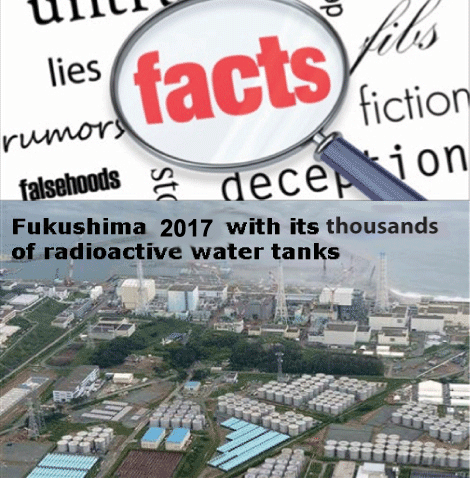
But further up the hill from the coastline, row upon row of steel tanks are a reminder of the decommissioning effort’s other great nemesis: contaminated water. The tanks now hold about 900,000 tons of water, with the quantity soon expected to reach 1m tons.

Tepco’s once-vaunted
underground ice wall, built at a cost of 24.5bn yen, has so far failed to completely prevent groundwater from leaking into the reactor basements and mixing with radioactive coolant water.
The structure, which freezes the soil to a depth of 30 metres, is still allowing 150 tonnes of groundwater to seep into the reactor basements every day, said Yuichi Okamura, a Tepco spokesman. Five sections have been kept open deliberately to prevent water inside the reactor basements from rising and flowing out more rapidly. “We have to close the wall gradually,” Okamura said. “By April we want to keep the influx of groundwater to about 100 tonnes a day, and to eliminate all contaminated water on the site by 2020.”
Critics of the clean-up note that 2020 is the year Tokyo is due to host the Olympics, having been awarded the Games after Abe assured the International Olympic Committee that Fukushima was “under control”.

Mitsuhiko Tanaka, a former Babcock-Hitachi nuclear engineer, accuses Abe and other government officials of playing down the severity of the decommissioning challenge in an attempt to win public support for the restart of nuclear reactors across the country.
“Abe said Fukushima was under control when he went overseas to promote the Tokyo Olympics, but he never said anything like that in Japan,” says Tanaka. “Anyone here could see that the situation was not under control.
March 11, 2017
Posted by Christina Macpherson |
Uncategorized |
Leave a comment
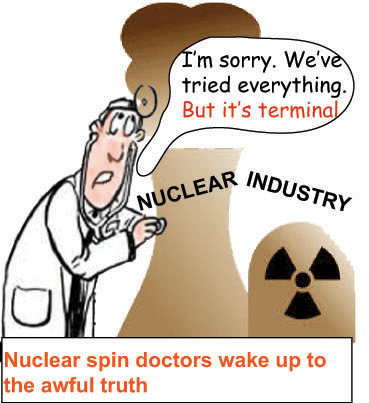
 Terminal decline? Fukushima anniversary marks nuclear industry’s deepening crisis, Ecologist, Nuclear Monitor 10th March 2017 With the sixth anniversary of the Fukushima disaster falling on 11 March , nuclear lobbyists are arguing over solutions to the existential crisis facing nuclear power, writes Jim Green
. Some favour a multinational consolidation of large conventional reactor designs, while others back technological innovation and ‘small modular reactors’. But in truth, both approaches are doomed to failure
Saturday March 11 marks the sixth anniversary of the triple-disaster in north-east Japan – the earthquake, tsunami and the Fukushima nuclear disaster.
And the news is not good. Scientists are wondering how on earth to stabilise and decontaminate the failed reactors awash with molten nuclear fuel, which are fast turning into graveyards for the radiation-hardened robots sent in to investigate them.
The Japanese government’s estimate of Fukushima compensation and clean-up costs has doubled and doubled again and now stands at ¥21.5 trillion (US$187bn; €177bn).
Indirect costs – such as fuel import costs, and losses to agricultural, fishing and tourism industries – will likely exceed that figure.
Kendra Ulrich from Greenpeace Japan notes in a new report that “for those who were impacted by the worst nuclear disaster in a generation, the crisis is far from over. And it is women and children that have borne the brunt of human rights violations resulting from it, both in the immediate aftermath and as a result of the Japan government’s nuclear resettlement policy.”
Radiation biologist Ian Fairlie summarises the health impacts from the Fukushima disaster: “In sum, the health toll from the Fukushima nuclear disaster is horrendous. At the minimum:
- Over 160,000 people were evacuated most of them permanently.
- Many cases of post-trauma stress disorder (PTSD), depression, and anxiety disorders arising from the evacuations.
- About 12,000 workers exposed to high levels of radiation, some up to 250 mSv
- An estimated 5,000 fatal cancers from radiation exposures in future.
- Plus similar (unquantified) numbers of radiogenic strokes, CVS diseases and hereditary diseases.
- Between 2011 and 2015, about 2,000 deaths from radiation-related evacuations due to ill-health and suicides.
- An, as yet, unquantified number of thyroid cancers.
- An increased infant mortality rate in 2012 and a decreased number of live births in December 2011.”
Dr Fairlie’s report was written in August 2015 but it remains accurate. More than half of the 164,000 evacuees from the nuclear disaster remain dislocated. Efforts to restore community life in numerous towns are failing. Local authorities said in January that only 13% of the evacuees in five municipalities in Fukushima Prefecture have returned home after evacuation orders were lifted.
As for Japan’s long-hyped ‘nuclear restart’: just three power reactors are operating in Japan; before the Fukushima disaster, the number topped 50……….http://www.theecologist.org/News/news_analysis/2988749/terminal_decline_fukushima_anniversary_marks_nuclear_industrys_deepening_crisis.html
March 11, 2017
Posted by Christina Macpherson |
Uncategorized |
Leave a comment

 Queensland govt slaps down LNP, Murdoch over renewable scareshttp://reneweconomy.com.au/queensland-govt-slaps-lnp-murdoch-renewable-scares-43765/ By Giles Parkinson on 8 March 2017
The Queensland government has attacked the LNP opposition and the Murdoch media for unfounded, baseless and “lazy” criticism of its plans to source 50 per cent of its electricity needs from renewable energy by 2030.
The conservative LNP has been getting a big run in the Murdoch press with a new anti-renewables campaign, which has wound up significantly since the start of the year with a host of new solar projects that will add 1GW of solar power to the state’s grid.
But Bailey wondered why the LNP hadn’t even bothered to make a submission to the government’s renewable energy review that it attacks so much. In total, 2,300 submissions were received, but none from the LNP or any of its MPs.
“Once again, all we’re hearing is anti-renewables doom and gloom, but of the 2023 submissions received by the Independent Panel following their public forums across the state, not one of them was from the LNP,” he said.
“On the leash of their Canberra mates, they run around the state, scaremongering and threatening to scrap Queensland’s RET if elected, but they were too lazy to do the work – to make a submission where it actually counts.
The LNP, in recent days, have been trying to make much of a report in The Australian which breathlessly announced in an “exclusive” story on its front page on Monday that it had acquired a “leaked” copy of an Australian Energy Market Operator submission into the Queensland government plans.
And while AEMO had warned that coal generators in Queensland may close earlier than expected, a line that the Murdoch media was keen to play up (it even wrote a follow-up story and an editorial the following day), Bailey pointed out that these generators were young, and most importantly, mostly government-owned.
That means that the Queensland government will not be in the same position as South Australia, which has had to watch with growing frustration as the private owners of the biggest gas plants in the state decide not to switch on during high demand periods, claiming they can find no economic incentive to help keep the lights on for their customers.
On the subject of South Australia, premier Jay Weatherill said the state had no intention of rowing back on its 2025 target of 50 per cent renewables, saying to do so it would have to effectively “physically prevent” developments in their tracks.
That much is true, because the build-out of the Hornsdale wind farm and the Tailem Bend solar project will take the state to 50 per cent wind and solar by the end of this year.
Weatherill says the biggest threat to power prices in South Australia is the lack of competition among generators, something that can addressed by having more renewable energy and other technologies such as battery storage.
Weatherill says the state will “soon” release” its planned intervention to ensure that no more rolling stoppages occur – as they did last month – while some gas generators sit idle. From that point of view, he must envy Queensland’s ownership of power generators.
Back in Queensland, Bailey also said Queensland has a high amount of (mostly government-owned) flexible gas-fired generation, which enables the system to ramp up quickly.
He said the government had confidence in the modelling, and in its conclusions that it would be broadly cost neutral to electricity consumers, and would not affect reliability.
Bailey also said the Palaszczuk Government is committed to transitioning to a clean energy future gradually and sustainably, while keeping affordability and network reliability front and centre.
“We’ve kick-started a renewable energy boom with more than 1GW of privately funded renewable energy projects currently in the works delivering more than $2 billion of new investment to Queensland and more than 1900 direct jobs, mostly in our regions,” he said.
“Energy is undergoing a transformational change in the way it is generated, transported and used – the former LNP government did nothing to prepare for this.
“Importantly, the benefits of the RET to the Queensland economy, particularly in regional areas will be largely driven by the additional $6 billion investment in renewable energy, and a projected increase of around 6,400-6,700 jobs per year on average between 2020 and 2030.
“The anti-renewables LNP have no credibility on energy policy. They oversaw the loss of 1300 renewable industry jobs while in government and inflicted 43 per cent electricity price hikes on consumers.”
March 11, 2017
Posted by Christina Macpherson |
media, politics, Queensland |
Leave a comment
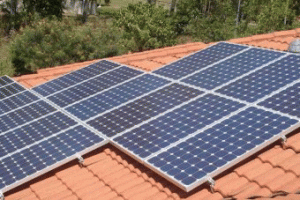 Rooftop solar installs up 43% in 2017, on back of power market woes, REneweconomyBy Sophie Vorrath on 10 March 2017
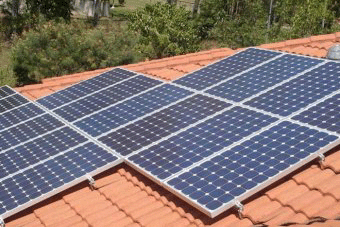
A summer of record high temperatures, heat waves and unplanned electricity outages appears to have put a rocket under the Australian rooftop solar market in 2017, with installations at end of February nearly 50 per cent up on the same time last year.
According to the latest monthly insights report from SunWiz – based on data from Solar Choice – February was an excellent month for solar PV growth, and registrations have been clocked at 43 per cent better than 2016 YTD, driven largely by residential installs.
The February rebound marks the second best month for solar PV installs in Australia since 2013 – the best month since 2013 being December 2016……..http://reneweconomy.com.au/rooftop-solar-installs-43-2017-back-power-market-woes-61166/
March 11, 2017
Posted by Christina Macpherson |
AUSTRALIA - NATIONAL, solar |
Leave a comment
NEW EPA boss says carbon dioxide not primary cause of climate change By New Scientist staff and Press Association, SHORT SHARP SCIENCE, 9 March 2017 The new chief of the US Environmental Protection Agency has said he does not believe that carbon dioxide is a primary contributor to global warming……..

Pruitt’s view is at odds with mainstream climate science, including NASA and the National Oceanic and Atmospheric Administration.
The two agencies reported in January that Earth’s 2016 temperatures were the warmest ever.
The planet’s average surface temperature has risen by about 2 degrees F since the late 19th century, “a change driven largely by increased carbon dioxide and other human-made emissions into the atmosphere”, the agencies said in a joint statement.
Environmental groups seized on Pruitt’s comments as evidence he is unfit for the office he holds.
“The arsonist is now in charge of the fire department, and he seems happy to let the climate crisis burn out of control,” said Sierra Club executive director Michael Brune.
Pruitt “is spewing corporate polluter talking points rather than fulfilling the EPA’s mission of protecting our air, our water, and our communities,” Brune said, noting that the EPA has a legal responsibility to address carbon pollution.
Senator Brian Schatz (Democrat, Hawaii) said the comments underscore that Pruitt is a “climate denier” and insisted politicians will stand up to him. “Anyone who denies over a century’s worth of established science and basic facts is unqualified to be the administrator of the EPA,” Schatz said in a statement.
Pruitt previously served as Oklahoma attorney general, where he rose to prominence as a leader in co-ordinated efforts by Republican attorneys general to challenge former president Barack Obama’s regulatory agenda.
He sued or took part in legal actions against the EPA 14 times……The Republican has previously cast doubt on the extensive body of scientific evidence showing that the planet is warming and man-made carbon emissions are to blame. https://www.newscientist.com/article/2124098-epa-boss-says-carbon-dioxide-not-primary-cause-of-climate-change/
March 11, 2017
Posted by Christina Macpherson |
Uncategorized |
Leave a comment
Toshiba’s troubled nuclear business Westinghouse is bringing in bankruptcy lawyers, City AM, Courtney Goldsmith, 9 Mar 17, Toshiba’s US nuclear business, Westinghouse, has hired bankruptcy attorneys, signalling to investors it is serious about the potential of a Chapter 11 filing.
The Japanese conglomerate brought in law firm Weil Gotshal & Manges to explore the option, but it had not yet taken a decision on a bankruptcy filing, sources told Reuters.

Toshiba’s shares closed down 7.2 per cent today.
The firm unexpectedly delayed its financial update last month as it announced it needed more time to probe its US nuclear business after revealing a multi-billion pound hole. It’s due to report earnings Tuesday, but a source has told Reuters the likelihood of Toshiba meeting this deadline was “fifty-fifty”.
If the firm fails to meet that deadline, it has until 27 March to file or could be delisted.
Although the troubled firm said it’s not aware of any intention for Westinghouse to file for Chapter 11 bankruptcy, sources have said it is one of several options being considered. The nuclear business faces cost overruns at two projects.
Toshiba has also hired a Japanese law firm to help estimate the how a US bankruptcy will impact the broader group, sources said…..
one issue may be financing guarantees given by the US government to help fund the construction of reactors at the Vogtle plant in Georgia, one of the two projects at the core of Westinghouse’s woes.
A 2014 statement on the US department of energy’s website says the loan guarantees totaled $8.3bn (£6.8bn)
Toshiba is also pursuing the sale of most, or even all, of its prized flash memory chip business, which will help protect it against future financial problems. Bids on the company, which Toshiba values at least 1.5 trillion yen, are due at the end of the month. http://www.cityam.com/260648/toshibas-troubled-nuclear-business-westinghouse-bringing
March 11, 2017
Posted by Christina Macpherson |
Uncategorized |
Leave a comment
Terminal decline? Fukushima anniversary marks nuclear industry’s deepening crisis, Ecologist, Jim Green / Nuclear Monitor 10th March 2017
“……..Small is beautiful?
 The four Third Way / Breakthrough Institute authors argue that nuclear power must become substantially cheaper – thus ruling out large conventional reactors “operated at high atmospheric pressures, requiring enormous containment structures, multiply redundant back-up cooling systems, and water cooling towers and ponds, which account for much of the cost associated with building light-water reactors.”
Substantial cost reductions will not be possible “so long as nuclear reactors must be constructed on site one gigawatt at a time. … At 10 MW or 100 MW, by contrast, there is ample opportunity for learning by doing and economies of multiples for several reactor classes and designs, even in the absence of rapid demand growth or geopolitical imperatives.”
Other than their promotion of small reactors and their rejection of large ones, the four authors are non-specific about their preferred reactor types. Any number of small-reactor concepts have been proposed.
Small modular reactors (SMRs) have been the subject of much discussion and even more hype. The bottom line is that there isn’t the slightest chance that they will fulfil the ambition of making nuclear power “substantially cheaper” unless and until a manufacturing supply chain is established at vast expense.
And even then, it’s doubtful whether the power would be cheaper and highly unlikely that it would be substantially cheaper. After all, economics has driven the long-term drift towards larger reactors.
As things stand, no country, company or utility has any intention of betting billions on building an SMR supply chain. The prevailing scepticism is evident in a February 2017 Lloyd’s Register report based on “insights and opinions of leaders across the sector” and the views of almost 600 professionals and experts from utilities, distributors, operators and equipment manufacturers.
The Lloyd’s Register report states that the potential contribution of SMRs “is unclear at this stage, although its impact will most likely apply to smaller grids and isolated markets.” Respondents predicted that SMRs have a “low likelihood of eventual take-up, and will have a minimal impact when they do arrive”.
The Third Way / Breakthrough Institute authors are promoting small reactors because of the spectacular failure of a number of large reactor projects, but that’s hardly a recipe for success. An analysis of SMRs in the Bulletin of the Atomic Scientists sums up the problems:
Without a clear-cut case for their advantages, it seems that small nuclear modular reactors are a solution looking for a problem. Of course in the world of digital innovation, this kind of upside-down relationship between solution and problem is pretty normal. Smart phones, Twitter, and high-definition television all began as solutions looking for problems.
“In the realm of nuclear technology, however, the enormous expense required to launch a new model as well as the built-in dangers of nuclear fission require a more straightforward relationship between problem and solution. Small modular nuclear reactors may be attractive, but they will not, in themselves, offer satisfactory solutions to the most pressing problems of nuclear energy: high cost, safety, and weapons proliferation.”
Small or large reactors, consolidation or innovation, Generation 2/3/4 reactors … it’s not clear that the nuclear industry will be able to recover – however it responds to its current crisis……..http://www.theecologist.org/News/news_analysis/2988749/terminal_decline_fukushima_anniversary_marks_nuclear_industrys_deepening_crisis.html
March 11, 2017
Posted by Christina Macpherson |
Uncategorized |
Leave a comment
 Goodall: Why Earth’s most intellectual creature is destroying its only home, The Independent, By Harold Reutter harold.reutter@theindependent.com 10 Mar 17 Jane Goodall, the world’s leading expert on chimpanzees, told a Grand Island audience Thursday night that she is constantly amazed at the intelligence of various species in the animal world, even the lowly bumblebee.
Through her 55-year study of chimpanzees in the Gombe Stream National Park in Tanzania, Goodall was the first to discover that chimpanzees could make and use tools. She described how she observed a chimpanzee place stalks of grass into termite holes. When the stalk was removed from the hole, it would be covered with termites, which the chimpanzee would then eat.
She also observed how chimpanzees would bend a twig and strip it of all leaves, effectively making that tool.
Goodall’s observations demolished long-held accepted scientific theory: That humans were the only species on earth that could make and use tools. Goodall said many other animal species have the capacity to learn; even bumblebees can learn how to retrieve nectar simply by observing another bumblebee.
Goodall, though, acknowledged the explosive development of the human brain gives humankind a capacity to do things far beyond the capacity of even the most intelligent animal. She noted only humans have the intelligence to send a spaceship to Mars and then remotely control a motorized vehicle to explore the surface.
“So isn’t it peculiar that this most intellectual creature to ever walk the planet is destroying its only home?” she asked……..
Goodall said it is very hard to deny climate change when people can observe the earth’s ice caps melting, when they can see people forced to leave their island homes because of rising ocean levels and to see sea levels rise on coastal beaches. She said humans cannot colonize Mars: “you’ve seen the pictures, it’s really not an option.”
“You know, this planet is very beautiful,” Goodall said. “There’s still a lot that is beautiful, so why are we consistently as a species harming it so badly?
“It seems to me there is a disconnect between the clever, clever, clever brain and the human heart,” she said.
Goodall said it seems there are too many people who only think about how an action affects them, while not considering how it affects their children and grandchildren. She said “we (the older generation) have not borrowed the future from our children. We have stolen it.”
She said it is now time for the generations to work together for the planet’s benefit.
One of the reasons that she founded Roots and Shoots is to give young people hope for the future. The organization’s message is “every single one of us matters and has some role to play. Every single one of us makes some impact on this planet. Every single day we have a choice about what kind of impact we’re going to make.”
March 11, 2017
Posted by Christina Macpherson |
Uncategorized |
Leave a comment
WikiLeaks posts huge CIA hacking trove | 08 March 2017 | The CIA has suffered what appears to be a massive security breach with WikiLeaks dumping thousands of confidential documents detailing the spy agency’s global hacking abilities. The CIA documents published by WikiLeaks show how the CIA has managed to read popular encrypted apps, signal and telegram by breaking into phones to intercept messages before the encryption is applied. WikiLeaks, headed by Australian Julian Assange, claimed that its leaked data includes hundreds of millions of line of code that includes the CIA’s “entire hacking capability.”
March 11, 2017
Posted by Christina Macpherson |
General News |
Leave a comment
Finance sector could face climate-risk testing, says Australian watchdog
Regulator says it may add climate change to the list of scenarios it asks institutions to run to check economic resilience, Guardian, Gabrielle Chan, 9 Mar 17, Australia’s financial institutions could be required to test climate-risk scenarios as international regulators continue to warn of the economic dangers posed by climate change.
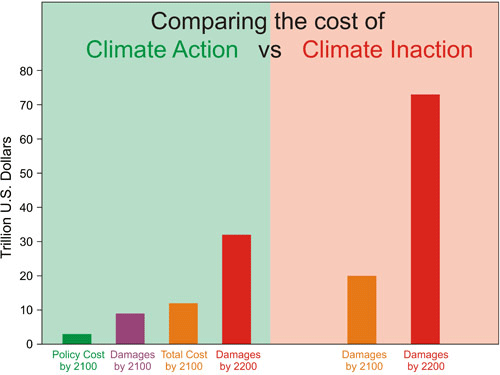
Geoff Summerhayes, executive board member of the Australian Prudential Regulation Authority (Apra), told a Senate committee that climate scenario testing could be added to the other common scenarios Apra requires financial institutions to face to ensure their systems are robust.
It’s been more than a year since the COP21 Paris climate change conference, when the former New York City mayor Michael Bloomberg was appointed to head a taskforce to provide investors, insurers, banks and consumers with more information. The move was part of plans for a voluntary industry-led code announced by the Financial Stability Board (FSB), the G20 body that monitors and makes recommendations about the financial system.
Last month Summerhayes warned climate change posed a material risk to the entire financial system and urged companies to start adapting. Apra is the regulator that oversees the $6tn industry made up of banks, building societies, superannuation, insurance companies and other financial institutions.
Summerhayes said Apra already sent out common scenarios for institutions to test. These scenarios have an economic factor, including an asset price shock and, in the case of the insurance industry, a potential liabilities scenario as well.
“It is possible in the future that climate could be such a risk that we would want to test,” Summerhayes said. “That is not in our current plans but it is possible as other emerging risks are, that we would scenario test.”
He acknowledged the Bank of England’s Prudential Regulatory Authority (PRA) had been very active on climate change. The bank’s governor, Mark Carney, has warned of financial crises and falling living standards unless corporations faced up to the risks. “Apra is not first prudential regulator to make statements about climate,” he said.
Emma Herd, the chief executive of Investor Group on Climate Change, told the committee the political debate in recent years had stopped companies speaking publicly about their strategic response to climate change…….
The Senate inquiry, initiated by Greens senator Peter Whish-Wilson and restarted after the federal election, is looking into carbon risk and disclosure in corporate Australia.https://www.theguardian.com/business/2017/mar/08/finance-sector-could-face-climate-risk-testing-says-australian-watchdog
March 11, 2017
Posted by Christina Macpherson |
AUSTRALIA - NATIONAL, business, climate change - global warming |
Leave a comment
March 8, 2017 (Mainichi Japan) “………The No. 1 and 3 reactors are thought to be in worse shape than the No. 2 reactor. The government and TEPCO are aiming to extract the fuel from all the reactors starting in 2021, but that is wildly optimistic. A drastic rethink of the entire decommissioning strategy and schedule — including the development of the robots that will take on much of the work — is likely needed.
The burdens placed on Japanese society by the nuclear disaster include the swelling financial cost of dealing with its aftermath.
The Ministry of Economy, Trade and Industry says that reactor decommissioning, victim compensation, decontamination and other nuclear disaster-related costs will hit 21.5 trillion yen — twice the initial estimate. However, even this figure does not include the cost of disposing of the melted nuclear fuel among other expenses, and is thus certain to rise.
We also cannot overlook the creation of a new system to charge third-party power suppliers to cover part of the compensation costs — a charge the power supply companies will pass on to their customers, thus effectively making a wide swath of Japanese society pay for TEPCO’s compensation liabilities. There are also apparently plans to implement a similar system to cover the decommissioning costs for Japan’s aged reactors.
It has been less than a year since the power supply market was opened to competition. Making not just the big utilities but also the new third-party electricity suppliers with no connection whatsoever to the nuclear power business pay for reactor decommissioning is a blow to the very heart of electricity market liberalization. The government’s insistence that “nuclear power is comparatively cheap even including accident countermeasure costs” no longer holds water.
If the government is to demand the Japanese people take on this financial burden, it must admit that the “cheap nuclear power” line doesn’t match the facts, and reroute Japan’s power generation plan to a nuclear-free future.
Looking at the harsh realities of dealing with the Fukushima nuclear disaster, we cannot consent to the ongoing string of reactor restarts. Utilities have applied to the Nuclear Regulation Authority (NRA) to restart 26 reactors at 16 plants under standards drawn up in the wake of the March 2011 Fukushima meltdowns. Just three reactors have been put back on line so far, but 12 more at six plants have or are expected to pass NRA inspections. Among them are three reactors that have been in operation for 40-plus years.
A majority of Japanese citizens are opposed to the restarts, conflicting with the government’s evident enthusiasm for getting reactors back on line despite its stated goal of reducing dependence on nuclear power.
Over the past six years, we have learned that Japan would not run short of electricity if it abandoned nuclear power. A more deeply rooted argument in favour of nuclear generation is that it is needed to combat global warming……..
Global investment in energy is shifting in force to renewables. According to the International Energy Agency (IAE), of the $420 billion U.S. invested in power generation in 2015, some $290 billion was put into renewables.
The prices of solar panels and wind turbines are falling fast, and offer a cheaper alternative to traditional thermal generation in an increasing number of cases.
The nuclear business is in decline in the developed world, as is evidenced by the deep troubles of Japan’s Toshiba Corp. and France’s Areva SA. At the same time, the renewable energy industry is growing by leaps and bounds.
If Japan shuts its eyes to this reality and continues to pour more of its resources into keeping nuclear power going than into renewable energy, it will likely be left behind by the rest of the world.
We have no choice but to carry the burden of the Fukushima nuclear disaster for decades to come. We will overcome this crisis, but we will need support.
To make sure we never have another nuclear disaster like the one in Fukushima, Japan should take the decision to abandon dependence on nuclear power. That would be the best support of all.http://mainichi.jp/english/articles/20170308/p2a/00m/0na/014000c
March 11, 2017
Posted by Christina Macpherson |
Uncategorized |
Leave a comment
Terminal decline? Fukushima anniversary marks nuclear industry’s deepening crisis, Ecologist, Jim Green / Nuclear Monitor 10th March 2017 “……..Michael Shellenberger  from the Breakthrough Institute argues that a lack of standardisation and scaling partly explains the “crisis that threatens the death of nuclear energy in the West”. The constant switching of designs deprives the people who build, operate and regulate nuclear plants of the experience they need to become more efficient.
Shellenberger further argues that there is too much focus on machines, too little on human factors:
“Areva, Toshiba-Westinghouse and others claimed their new designs would be safer and thus, at least eventually, cheaper, but there were always strong reasons to doubt such claims. First, what is proven to make nuclear plants safer is experience, not new designs. …
“In fact, new designs risk depriving managers and workers the experience they need to operate plants more safely, just as it deprives construction companies the experience they need to build plants more rapidly.”
Shellenberger has a three-point rescue plan:
1. ‘Consolidate or Die’: “If nuclear is going to survive in the West, it needs a single, large firm – the equivalent of a Boeing or Airbus – to compete against the Koreans, Chinese and Russians.”
2. ‘Standardize or Die’: He draws attention to the “astonishing” heterogeneity of planned reactors in the UK and says the UK “should scrap all existing plans and start from a blank piece of paper”, that all new plants should be of the same design and “the criteria for choosing the design should emphasize experience in construction and operation, since that is the key factor for lowering costs.”
3. ‘Scale or Die’: Nations “must work together to develop a long-term plan for new nuclear plant construction to achieve economies of scale”, and governments “should invest directly or provide low-cost loans.”
Wrong lessons
Josh Freed and Todd Allen from pro-nuclear lobby group Third Way, and Ted Nordhaus and Jessica Lovering from the Breakthrough Institute, argue that Shellenberger draws the wrong lessons from Toshiba’s recent losses and from nuclear power’s “longer-term struggles” in developed economies.
They argue that “too little innovation, not too much, is the reason that the industry is on life support in the United States and other developed economies”. They state that:
- The Westinghouse AP1000 represents a fairly straightforward evolution in light-water reactor design, not a radical departure as Shellenberger claims.
- Standardisation is important but it is not a panacea. Standardisation and building multiple reactors on the same site has limited cost escalation, not brought costs down.
- Most of the causes of rising cost and construction delays associated with new nuclear builds in the US are attributable to the 30-year hiatus in nuclear construction, not the novelty of the AP1000 design.
- Reasonable regulatory reform will not dramatically reduce the cost of new light-water reactors, as Shellenberger suggests.
They write this obituary for large light-water reactors: “If there is one central lesson to be learned from the delays and cost overruns that have plagued recent builds in the US and Europe, it is that the era of building large fleets of light-water reactors is over in much of the developed world.
“From a climate and clean energy perspective, it is essential that we keep existing reactors online as long as possible. But slow demand growth in developed world markets makes ten billion dollar, sixty-year investments in future electricity demand a poor bet for utilities, investors, and ratepayers.”
A radical break
The four Third Way / Breakthrough Institute authors conclude that “a radical break from the present light-water regime … will be necessary to revive the nuclear industry”. Exactly what that means, the authors said, would be the subject of a follow-up article.
So readers were left hanging – will nuclear power be saved by failed fast-reactor technology, or failed high-temperature gas-cooled reactors including failed pebble-bed reactors, or by thorium pipe-dreams or fusion pipe-dreams or molten salt reactor pipe-dreams or small modular reactor pipe-dreams? Perhaps we’ve been too quick to write off cold fusion?
The answers came in a follow-up article on February 28. The four authors want a thousand flowers to bloom, a bottom-up R&D-led nuclear recovery as opposed to top-down, state-led innovation.
They don’t just want a new reactor type (or types), they have much greater ambitions for innovation in “nuclear technology, business models, and the underlying structure of the sector” and they note that “a radical break from the light water regime that would enable this sort of innovation is not a small undertaking and will require a major reorganization of the nuclear sector.”
To the extent that the four authors want to tear down the existing nuclear industry and replace it with a new one, they share some common ground with nuclear critics who want to tear down the existing nuclear industry and not replace it with a new one.
Shellenberger also shares some common ground with nuclear critics: he thinks the UK should scrap all existing plans for new reactors and “start from a blank piece of paper“. But nuclear critics think the UK should scrap all existing plans for new reactors and not start from a blank piece of paper.http://www.theecologist.org/News/news_analysis/2988749/terminal_decline_fukushima_anniversary_marks_nuclear_industrys_deepening_crisis.html
March 11, 2017
Posted by Christina Macpherson |
Uncategorized |
Leave a comment
This summer saw record-breaking temperatures across New South Wales and most of eastern Australia. January 2017 recorded the highest monthly mean temperatures on record for Sydney.
The Bureau of Meteorology has confirmed the 2017 heatwave was the most severe since 1939, and since that time the frequency of such intense large-scale heatwaves has increased across spring, summer and autumn, and especially over the past 20 years. The maximum temperatures from the February 2017 heatwave now make up eight of the top 10 highest February temperatures for NSW ever.
What set this heatwave apart was the prolonged period of sweltering days and nights which impacted over one-third of the state. The people out at Moree suffered the most with 54 days in a row over 35 degrees. Walgett had 48 days above 35 degrees.
The heatwave contributed to almost 100 fires across NSW in February. Homes, stock and agricultural assets were lost.
NSW Health issued an air pollution alert and warning to those with asthma or respiratory problems on January 10, with ozone pollution made worse by the hot, still conditions. In Victoria, the heatwave was blamed for a large spike in deaths.
On the NSW South Coast, dairy farmers reported cattle dropping dead in the heat and humidity. Piles of dead turtle hatchlings were found on Queensland’s Mon Repos beach amid a heatwave which pushed the sand’s temperature to 75 degrees. This important breeding site for the Loggerhead turtle was turned into a baby turtle graveyard overnight.
Sydney Harbour suffered its first ever recorded coral bleaching last year and scientists predict more this year, with water temperatures exceeding 26 degrees at times.
Water temperatures have been more than 3 degrees warmer than average off parts of the NSW South Coast. It doesn’t sound like much when you’re enjoying mid 20s water on a 35 degree day, but marine life aren’t used to these spikes – these are signs that the ecological balance is at risk.
Of course, these heatwaves, fires, warming oceans and coral bleaching fit the predictions of climate change science about the impact of greenhouse gas emissions primarily by human activity.
New research released in February concluded that human activity was changing the climate 170 times faster than natural forces.
We are already seeing some key tipping points start to flip. In February, sea ice in Antarctica hit a record low. The melting permafrost in Siberia is causing craters to form on an ever-larger scale with the resulting methane release driving further global warming.
Before our very eyes the warnings of scientists are being realised. Climate change is not something off in the future – it is here and now – and given science has been right so far, their predictions about what happens next without action to drastically reduce emissions are truly frightening……..
The Greens, under Energy and Resources spokesperson Jeremy Buckingham have launched its ‘climate not coal’ policy. It sets out a 10-year framework for the phase out of thermal coal mining in NSW. This is a managed transition that calls for a 1 billion tonne cap on the amount of thermal coal that can be mined during the phase-out period while a supported exit of the industry occurs.
A $7 billion fund to assist impacted workers and communities would be created through the auctioning of permits to access the remaining coal allowance.
It is a bold plan but we need bold plans to respond to climate change. The Greens plan sits in stark contrast to no plan at all from the major parties in this state to deal with coal. https://newmatilda.com/2017/03/08/temps-rising-greens-plan-to-ban-coal-within-10-years-amid-record-heat-wave/
March 11, 2017
Posted by Christina Macpherson |
New South Wales, politics |
Leave a comment
No such thing as ‘clean coal’: WA premier http://www.heraldsun.com.au/news/breaking-news/no-such-thing-as-clean-coal-wa-premier/news-story/024ed06c5553067ecbc2c68361d1b7ff Tom Rabe, Australian Associated Press March 7, 2017
There’s no such thing as clean coal, says West Australian premier Colin Barnett, placing him at odds with his federal Liberal counterparts.
Mr Barnett dismissed the notion of clean coal when outlining the balance of energy production in WA, saying more than half of the state’s energy came from natural gas, which he described as a clean technology.
“I mean, all this stuff about clean coal, no such thing as clean coal,” Mr Barnett said. “Natural gas is cleaner, produces less than half of the emissions of a coal power station so it’s a good technology to use.”
Mr Barnett said if re-elected his Liberal government would move to balance energy production between gas, renewable and coal.
Mr Barnett’s comments on clean coal differ with those of his federal counterparts, who are working to finance new coal-fired power.
The federal government is exploring how it can allow the Clean Energy Finance Corporation to invest in the so-called ultra-supercritical coal-fired power plants and carbon capture and storage.
Prime Minister Malcolm Turnbull, who is currently in Indonesia, was unavailable for comment.
March 11, 2017
Posted by Christina Macpherson |
climate change - global warming, Western Australia |
Leave a comment









 Antinuclear