Australia unprepared for foreign policy making, in this era of America’s “mad king”
The arrival of what many on both sides of the aisle in Washington, now openly describe as the mad 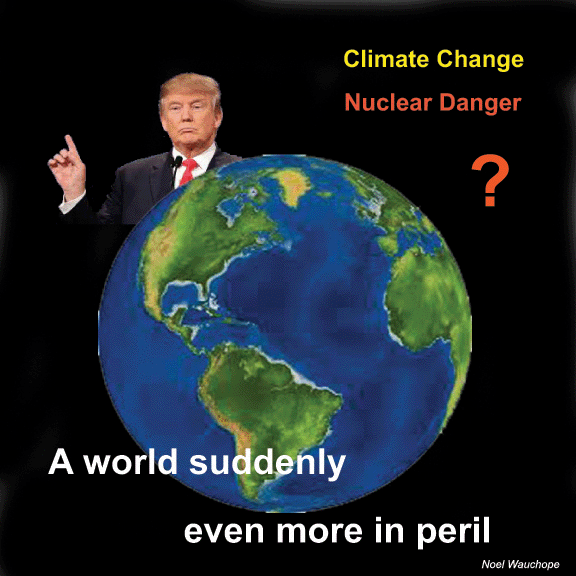 king, has left the foreign policy establishment struggling to even craft a considered response.
This is particularly so in Canberra, where none of this was predicted.
big global issues — large scale immigration, historic disparities between the haves and have nots, massive technology change led by ubiquitous networked platforms, not to mention climate change — are wreaking their consequences at warp speed. All while the US is consumed with its own political civil war, led by none other than the president himself.
 Tom Burton: mokita and the mad king, http://www.themandarin.com.au/77426-tom-burton-mokita-mad-king/ by Tom Burton 31.03.2017 The sudden and rapid collapse of US foreign policy administrative infrastructure has left Australia particularly exposed, leaving our diplomats scratching their heads about what to do.
Mokita is the word the people of the tiny New Guinea island of Kiriwina use to describe the “truth we all know, but agree not to talk about.” Mokita was on display big time this week when all of Australia’s ambassadors met in Canberra to consider the shape of the government’s foreign policy white paper.
The meeting was addressed by Minister Bishop who in a long, wide ranging speech, referenced the new US President Donald Trump and the profound impact of his election, in but a single line: “The United States has a new President, driving an economic nationalist agenda.”
The reference was in the context of the international windback of the global economic liberalism which has served Australia well since the end of World War II. But while the otherwise eloquent speech traversed some of the obvious implications of this shift, there was no further public mention of the sheer madness that has characterised the Trump presidency to date and the fundamental effect this is having on world geopolitical order.
Tyro US Ambassador, Joe Hockey, was in similar Chamberlain appeasement mode as he later advised Australians to not join the chorus of constant criticism of Trump, Continue reading
Australian govt commits $110m for Port Augusta solar towers
 Last year, Australia’s clean energy movement had a major victory, with South Australia’s resounding
  rejection of the plan for nuclear waste importation, (and later for, nuclear power). Some nuclear proponents also looked to Port August as the place for a nuclear power station.
The Liberal Coalition government now supports a solar power station instead. Of course, they were dragged kicking and screaming, into this, by a piece of deft politicking from Senator Nick Xenophon. But – so keen was PM Turnbull, to get new legislation on tax passed, that he had to swallow his aversion to non fossil-fuel energy. We wait to see how well the govt carries out this commitment
Coalition commits $110m for Port Augusta solar towers http://reneweconomy.com.au/coalition-commits-110m-for-port-augusta-solar-towers-11045/ By Giles Parkinson on 31 March 2017 The federal Coalition government has announced that it will provide $110 million in concessional loans to a solar tower and molten salt storage project in Port Augusta, as part of last minute negotiations with the Nick Xenophon Party to pass major tax cuts.
The commitment was announced by finance minister Mathias Cormann as part of a deal with the NXT to approve tax cuts for businesses with revenue of less than $50 million.
Senator Cormann says the Coalition will provide a confessional loan of $110 million in 3 per cent interest rate to an unspecified solar thermal project. He said the government will call for formal proposals via the Australian Renewable Energy Agency and the Clean Energy Finance Corp.
The front runner for the deal is the 110MW solar tower and molten salt storage project proposed by the US company SolarReserve. Other proposals are likely to come from Vast Solar and others.
“We welcome the announcement today from the Senate, and it is critical step in progressing the project – but the key outcome is to obtain a long term power purchase agreement,” said Daniel Thompson, the Australian development manager for SolarReserve.
Earlier, the energy minister Josh Frydenberg announced that the CEFC would invest $80 million in the 113MW Bodangora wind farm near Wellington in NSW.
“This investment in large-scale renewable energy projects such as Bodangora, is part of the Turnbull Government’s technology neutral, non-ideological approach to provide affordable, reliable electricity as we transition to a lower emission future,” he said in a statement.
The $236 million Bodangora wind farm is expected to be operational in the latter half of 2018.
Ambassador Joe Hockey to advise govt on foreign policy – with fulsome praise of Donald Trump!
How do I feel about Joe Hockey’s sycophantic normalisation of Trump? I am reminded of a famous line from a famous play – “I MAY VOMIT”
 Ambassador Joe Hockey praises ‘practical’ Trump administration and warns against ‘constant criticism’, The Age, Michael Koziol, 31 Mar 17 Australia’s ambassador to the US, former treasurer Joe Hockey, has praised the Trump administration as a “practical” and “credible” force that is finding its feet 70 days into its four-year term, and called for a halt to “constant” criticism of the White House.
In his first major speech to an Australian audience since Donald Trump took office, Mr Hockey said the Republican’s rise reflected a citizenry that felt “impotent” and heralded “the arrival of disruption into the mainstream of American politics”.
He implored critics to give the unorthodox but “practical” administration a fair go, noted many Americans backed the President’s unprecedented attacks on the media, and predicted the failure to repeal Obamacare would not harm Mr Trump.
We need to avoid the temptation to become constant critics of the new US administration because it is not a carbon copy of the previous administrations,” Mr Hockey told The Sydney Institute on Thursday night.
“The new Trump administration is very focused on practical policy outcomes. It is not beholden to ideology or tradition. It is not in the DNA of the administration to procrastinate or give undue deference to process.”
Mr Hockey praised Mr Trump’s “very credible cabinet”, which he said fulfilled an election commitment to “drain the swamp” by selecting fewer appointees with prior government experience.
In what he described as “an obvious break from past practice”, Mr Hockey noted none of Mr Trump’s cabinet members had a doctorate (PhD). Mr Hockey said the President’s hostility to the media, often delivered in late-night or early-morning Twitter bursts, was shared by many Americans. “His war against the media has public support,” Mr Hockey said…….
Mr Hockey is in Australia alongside nearly every overseas-based head-of-mission to help Foreign Minister Julie Bishop formulate a new foreign policy strategy, due to be delivered later this year.
In his 14 months as US ambassador, the former Abbott government treasurer witnessed one of the most extraordinary and divisive presidential elections in US history…….http://www.theage.com.au/federal-politics/political-news/ambassador-joe-hockey-praises-practical-trump-administration-and-warns-against-constant-criticism-20170330-gv9z9s.html
Record flood disasters in Eastern Australia, (but nobody mentions the climate change connection)
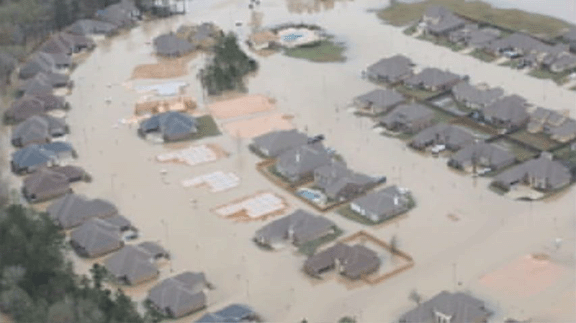 NSW floods: State added to insurance catastrophe declaration as waters rise, SMH Peter Hannam, 31 Mar 17, The widespread flooding in northern NSW has prompted the Insurance Council of Australia to add the region to its catastrophe declaration in the wake of Cyclone Debbie.
Flood waters were expected to peak on Thursday afternoon for rivers in the state’s north, with the Tweed, Wilsons and Richmond valleys of most concern.Lismore, a major centre on the Wilsons River, had its 10.6 metre levee breached, with flood waters expected to peak at about 11.8 metres, the Bureau of Meteorology said.
The Insurance Council’s declaration comes as some 7500 claims for damage had been lodged from Queensland alone after the category-four cyclone slammed into the coast near Bowen and the Whitsunday Islands on Tuesday.
“This is only the early stage of a natural disaster and I expect the insurance losses could reach into the hundreds of millions of dollars as householders and businesses return to their properties and lodge claims,” Rob Whelan, chief executive of the council, said.
“This level of catastrophe has not been seen since ex-tropical cyclone Oswald in 2014, when storms and flooding affected large parts of Queensland and NSW and caused insurance losses of almost $1.2 billion.”….A 2013 report in 2013 by Deloitte Access Economics for the Australian Business Roundtable for Disaster Resilience & Safer Communities found disasters were costing $560 million a year now in terms of economic and social disruption, a figure predicted to soar to $33 billion by 2050 in part because of climate change…….
“There is a predicted increase of rainfall intensity of 30-40 per cent in some areas so it means floods are going to be bigger and more frequent,” http://www.smh.com.au/environment/weather/nsw-floods-state-added-to-insurance-catastrophe-declaration-as-waters-rise-20170331-gvan9y.html
Thousands of homes evacuated as floods cause havoc in Australia, RTE 31 Mar 2017 Swollen rivers have flooded entire towns along Australia’s east coast, cutting roads and leaving residents clinging to roofs and floating down streets in boats after the remnants of a powerful cyclone swept through the region.
Answering deceptive arguments against a nuclear weapons ban
 Six deceptive arguments against a nuclear weapons ban, OPEN CANADA.org 31 Mar 17
 Should we still strive for a world without nuclear weapons, despite global security concerns? Absolutely, writes Cesar Jaramillo, as he debunks the justifications for not taking current negotiations seriously. BY: CESAR JARAMILLO MARCH 31, 2017
This year’s multilateral negotiations toward a legally binding prohibition on nuclear weapons reflect a growing global recognition that a nuclear-weapons ban is an integral part of the normative framework necessary to achieve and maintain a world free of nuclear weapons. For some observers of nuclear issues, in and out of government, they also constitute a welcome shock to an otherwise lethargic nuclear disarmament and nonproliferation regime.
UN Resolution L41, which calls for negotiations toward a new ban on nuclear weapons, was adopted by a wide majority at the General Assembly last December (123 for, 38 against, 16 abstentions). It epitomizes a new political reality in the nuclear disarmament realm: Founded on the humanitarian imperative for nuclear abolition, it bears witness to a widely held perception that the Nuclear Non-Proliferation Treaty (NPT), as currently implemented, does not constitute a credible path to abolition.
Negotiations stemming from L41 began this week at the United Nations in New York and, after the first round ends Friday, will continue June 15 to July 7. Continue reading
A plea to USA senators to keep the Iran nuclear agreement
Congress should be a voice of caution and restraint. Any marginal benefit of this legislation is outweighed by the risk of giving an impulsive president license to take steps that could undermine a deal that is working, isolate the United States, and put U.S. troops at risk.
Dear Senators: Push Back Against Iran, but Not at the Expense of the  Nuclear Deal, Foreign Policy, MARCH 31, 2017 – During our time in government, there were few issues on which it was easier to build a bipartisan consensus in Congress than the need to contend with the range of threats posed by Iran. Congress played a critical role in penalizing Iran for supporting terrorism, providing support to U.S. partners in the region threatened by Iran, and establishing the sanctions regime that, combined with tough diplomacy, led to a deal that prevents Iran from developing or acquiring nuclear weapons. Momentum is again building in Congress to impose additional sanctions on Iran, including with the introduction last week of the Iran’s Destabilizing Activities Act of 2017 by Sen. Bob Corker, the chairman of the Senate Foreign Relations Committee, and Sen. Robert Menendez. The bill has already garnered more than two-dozen cosponsors. Unfortunately, as currently drafted, this bill would do more harm than good.
New legislation in USA Congress would unravel the Iran nuclear deal
Why Give Trump The Keys To War With Iran? https://www.niacouncil.org/give-trump- keys-war-iran/ When Trump won the elections, many worried that it could lead to war between the United States and Iran, due to his desire to kill the Iran nuclear deal. Now, thanks to the U.S. Senate, we may be one step closer to this nightmare scenario: The Senate is poised to pass legislation that will place President Trump’s trigger-happy finger on the ignition switch of a deadly conflict with Iran.
Introduced to coincide with the annual American Israel Public Affairs Council (AIPAC) conference that concludes today, the Countering Iran’s Destabilizing Activities Act of 2017 (S. 722) would give Trump new tools to violate the Iran nuclear deal. Perhaps most shockingly, a small group of Senate Democrats have joined Republicans to grant Trump some of the most dangerous authorities that would put the U.S. and Iran back on the path to war. Continue reading
Thousands attend #StopAdani Roadshow
https://www.greenleft.org.au/content/thousands-attend-stopadani-roadshow
31 March 2017: “The #StopAdani Roadshow attracted thousands of supporters across the country, who oppose the federal and Queensland government’s support for Adani’s $22 billion Carmichael coal mine in central Queensland.
“About 1200 people in Brisbane on March 28 and 1000 in Sydney the next day heard from Indian environment campaigner Dr Vaishali Patil, Californian Clean Energy Fund director Danny Kennedy, SEED co-director Millie Telford and 350org CEO Blair Palese. … “
Toshiba shareholders angry at the nuclear financial debacle
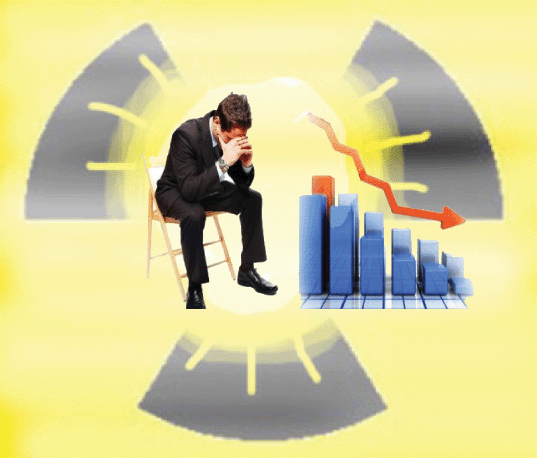 ‘You’re trash’: Investors hurl abuse at Toshiba managers after nuclear debacle, SMH, Pavel Alpeyev and Takako Taniguchi, 31 Mar 17, Toshiba shareholders have lashed out at management and lamented the downfall of the Japanese icon before approving the sale of its memory chips division to cover the billion-dollar costs resulting from its disastrous foray into nuclear energy.
Incensed investors took turns to hurl abuse at executives during a Thursday meeting convened to take a vote on the intended disposal of its prized semiconductor business. Toshiba is looking to sell a majority stake in the unit to mend a balance sheet ravaged by billions of dollars in writedowns related to cost overruns at its nuclear subsidiary Westinghouse Electric.
Westinghouse, which Toshiba bought for $US5.4 billion in 2006, filed for bankruptcy protection on Wednesday. The Japanese company said it may now book a loss of as much as 1.01 trillion yen ($11.8 billion) in the year ending March, a record for a Japanese manufacturer.
“Toshiba is now a laughing-stock to the whole world,” one shareholder said during a question-and-answer section, raising his voice. “I think all of you are incompetent as managers. Do you even know what’s happening?”
Another shareholder addressed the executives as “trash.”……. http://www.smh.com.au/business/world-business/youre-trash-investors-hurl-abuse-at-toshiba-managers-after-nuclear-debacle-20170330-gvah2j.html
Trump’s ignorance, especially on foreign affairs.
Trump has antagonized the leaders of allied countries like Mexico, Australia and Germany, and he has repeatedly demonstrated an extraordinary lack of knowledge about foreign affairs.
This is the president who faces what Warren Christopher, President Clinton’s first secretary of state, called problems from hell. A partial list, compiled by Project Syndicate, includes: intensifying conflicts and dissent within the European Union; the rise of illiberal forces, including welfare chauvinism and exclusionary nationalism; the danger to the continued independence of the buffer states surrounding Russia; a frayed consensus in support of western liberal democratic principles; aggression from a nuclear-armed North Korea and counter threats from the Trump administration of a pre-emptive strike; a foreign policy that The Economist reports has left America’s allies “aghast” — a policy that “seems determined to destroy many of the institutions and alliances created in the past half century.”
When the President Is Ignorant of His Own Ignorance, NYT Thomas B. Edsall MARCH 30, 2017 How prepared is our president for the next great foreign, economic or terrorist crisis?
Climate change affecting koalas? They are now seen to be drinking water
 Why Koalas Are Suddenly Drinking Extra Water, National Geographic, 30 Mar 17, Koalas usually get the water they need from their food—but hotter, drier weather is making some koalas desperate. March 31, 2017 – Koalas have been showing an uncharacteristic behavior: drinking water. Koalas typically meet most of their daily need for water just by eating leaves. But researchers from the University of Sydney have documented an increase in sightings of koalas looking for water. Cameras near watering spots around the New South Wales, Australia town of Gunnedah showed koalas coming to drink, a cute sight that nonetheless may signal increased pressure from climate change……..http://news.nationalgeographic.com/2017/03/koala-bears-water-eucalyptus-leaves-trees-australia/
Solar-storage hub proposed for Adelaide
 Carnegie teams with Samsung, Lend Lease for battery storage hub http://reneweconomy.com.au/carnegie-teams-with-samsung-lend-lease-for-battery-storage-hub-23948/ By Giles Parkinson on 31 March 2017
In a joint announcement with energy minister Tom Koutsantonis and premier Jay Weatherill in Adelaide on Friday morning, Carnegie CEO Michael Ottaviano said the company has teamed up with Lend Lease Services and South Korea’s Samsung for the proposal.
It proposes to build a 100MW/100MWh lithium-ion battery, using Samsung technology, and wants to do this in Adelaide in a centre that will evolve into a “battery storage” hub, building new battery systems and doing R&D and integration work.
“This is an opportunity to build an industry for the future,” Ottaviano told journalists in Adelaide. “This will be the first 100MW battery, not the last.”
Carnegie’s is just one of a number of proposals for the state government tender, which closed at 12 noon local time on Friday. Others include the $1 billion solar and battery storage project unveiled by Lyon Solar on Thursday, and rival offers from Zen Energy/Greensmith, Tesla, LG Chem, Adelaide-based silicon storage developer 1414 and many more.
Koutsantonis said the tender had elicited an “unprecedented” response with more than 200 downloads from nine different countries. Final numbers will be revealed on Monday. “It has captured international attention for people to see opportunities with our remarkable renewable energy power,” Koutsantonis said. “You can hand around lumps of coal, or you can move forward with new technologies. Storage will become the norm and we will be at the forefront of that.”
Ottaviano says the battery storage hub would be powered by a “multi-megawatt” rooftop solar system – and could employ 300 people to deliver the project, including electricians and engineers from sunset manufacturing industries in South Australia.
He said Carnegie would own the battery storage unit, and use it to trade energy, arbitraging opportunities in the market, and also playing in the FCAS (frequency and ancillary services) market when not being called upon by the government to provide grid support.
But he said such installations would rely on government support until market rules were changed that would level the playing field for battery storage.
“As renewable energy penetration inevitably increases across the country, the need for utility-scale energy storage will grow in lockstep,” Ottaviano said in a later statement.
“The deployment of utility-scale battery systems creates an opportunity for South Australia and Australia to develop a new local industry and export this capability throughout our region.”
Weatherill told journalists that battery storage was exciting because it sourced “free energy” from the wind and the sun, and would create the jobs of the future.
Adani coal project gets major setback as Government fails to pass Native Title Bill
Government fails to pass Native Title Bill: Major setback for Adani http://wanganjagalingou.com.au/govt-fails-to-pass-native-title-bill-major-setback-for-adani/~ Wangan and Jagalingou (W&J) Traditional Owners Council 31 March 2017:
“The Turnbull Government failed to push through its controversial Native Title Bill by the end of the Parliamentary sitting, despite the Labor Opposition’s readiness to negotiate on the amendments.
“The next opportunity for the Federal Senate to consider the Native Title Amendment Bill is the Budget Sitting in early May and, if not then, the next sittings are mid June. …
“Youth spokesperson for the W&J Traditional Owners Council, MsMurrawah Johnson, said,
““The Adani Board is reported to be set to make a decision within the next two weeks on whether to push on with the mine project. But it still faces our court actions. Right now their purported land use agreement is worthless. … “
Climate change, and tiny frogs in New Guinea’s tropical mountains
Tiny frogs face a troubled future in New Guinea’s tropical mountains, ABC News, The Conversation, 30 Mar 17, By Paul Oliver and Michael Lee At night, the mountain forests of New Guinea come alive with weird buzzing and beeping calls made by tiny frogs, some no bigger than your little fingernail.
These little amphibians — in the genus Choerophryne — would shrivel and dry up in mere minutes in the hot sun, so they are most common in the rainy, cooler mountains.
Yet many isolated peaks, especially along northern New Guinea, have their own local species of these frogs.
So how did localised and distinctive species of these tiny frogs come to be on these isolated peaks, separated from each other by hotter, drier and rather inhospitable lowlands?
Our new study of their DNA, published this week in the open access journal PeerJ, reveals how they achieved this feat. It reveals a dynamic past, and more worryingly it highlights the future vulnerability of tropical mountain forests and their rich biodiversity………
During past phases of global cooling (glacial periods), the colder, wetter, mountainous habitats of New Guinea expanded downhill, a process termed elevational depression.
If depression was extensive enough, the frogs on one mountain might have been able to travel across tracts of cool, wet lowlands to colonise other mountains.
Later, a warming climate would wipe out the lowland populations, leaving two isolated mountain populations, which might eventually become new species………
The little frogs and the future
Why does it matter how the tiny frogs moved to their mountain habitats? Because it could be a warning to their future survival……..
As we’ve shown, the global cooling in past glacial periods allowed the mountain-dwelling frogs to move down across the lowlands to find new mountain peaks.
But today, as global temperatures soar to levels not seen for millions of years, their habitable cool zones are heading in the other direction: shrinking uphill.
We have no idea how quickly these frogs will respond to these changes, but recent research elsewhere in New Guinea has found birds are already shifting upslope rapidly.
We don’t yet know what could happen to these cute little amphibians should temperatures continue to climb, and they in turn run out of mountainside to climb……… http://www.abc.net.au/news/2017-03-31/tiny-frogs-face-a-troubled-future-in-new-guineas-mountains/8403936
Clean Energy Finance Corporation’s new boss focusses on distributed energy, and certainly not on “clean coal”
 New CEFC boss sees focus on distributed energy, REneweconomy, By Giles Parkinson on 31 March 2017 The new head of the Clean Energy Finance Corporation, Ian Learmonth, says distributed energy – including solar, battery storage and demand management – will be one of his main focuses when he takes the reigns of the $10 billion institution in May.
“The CEFC is very broad ranging – and we’re agnostic about clean energy technologies – but I’m particularly interested in the way that distributed energy is emerging in Australia,” he told RenewEconomy in an interview on Friday after his appointment was announced. “There are 1.5 million solar households in Australia, battery technology is emerging, there is demand management, and some very interesting opportunities.
“We are seeing those already coming to the CEFC. There is an incredible entrepreneurial spirit.”
Many in the energy industry expect a rapid shift in the energy market from one that focuses on large, centralised fossil fuel generators, to a “distributed” system where much of the power required is sourced from household and business consumers.
These technologies, mostly rooftop solar and battery storage, will dovetail with smart software that can integrate the systems, demand response, trading and back-up power.
It also fits in with his recent work as the head of impact investing at Social Ventures Australia, where the focus was on helping disadvantaged households.
“At Social ventures, we have been looking at reducing costs to government and employment benefits, hopitalisation and prison costs – and we’ve also been working on affordable housing,” he said.
“Government is increasingly looking at private capital to build out the shortfall in affordable housing – and if that can be done in an energy efficient way, that is even better.”
Learmonth said he was not worried about the political debate around the CEFC, which the Coalition has tried to dismantle, has widely criticised and then tried to push towards non-renewable technologies such as “clean” coal.
“I’d like to think that lot of the challenges of the past are behind the organisation, and it is seen as an important participant in this market. I think the government has a huge amount of respect for the organisaiton. I am not troubled by (the past).”
However, he agreed with outgoing CEO Oliver Yates, another former Macquarie banker, that there is virtually no investment interest in clean coal technology.
“They are not opportunities that have been presenting themselves; for various reasons they have enormous challenges about them. They are not investable projects – for many reasons that are unlikely to change.”
Learmonth said he had had a big involvement with renewable energy financing whilst at Macquarie’s London base, financing wind projects in Germany, solar projects in Italy and offshore wind in the UK…….http://reneweconomy.com.au/new-cefc-boss-sees-focus-distributed-energy-30097/
1 This month
7 April – WEBINAR – Australia and the Doomsday Clock – Preventing nuclear war through NoFirstUse and other policies
Online | Tuesday April 7, 4:00-5:30pm, Australian Eastern Time / 8:00-9:30am Central Europe Time
– Access the registration link
15 April – Zoom –Nuclear Power is Not the Solution
Apr 15, 2026 01:00 AM in Canberra, Melbourne, Sydney

Join the International Physicians for the Prevention of Nuclear War (IPPNW) on Tuesday, April 14th for a timely webinar exploring the risks associated with nuclear power and challenging the myth that it offers a simple, safe, carbon-free solution to the climate crisis

21 April Webinar: No Nuclear Weapons in Australia
Start: 2026-04-21 18:00:00 UTC Canberra, Melbourne, Sydney (GMT+10:00)
End: 2026-04-21 19:30:00 UTC Canberra, Melbourne, Sydney (GMT+10:00)
Event Type: Virtual
A virtual link will be communicated before the event.
Host Contact Info: australia@icanw.org

of the week – Australians for War Powers Reform (AWPR)
To see nuclear-related stories in greater depth and intensity
 Antinuclear