Fossil fuel scare campaign backfires – renewed boom in solar rooftops
February recorded more capacity than November. And now March capacity has shot 16 per cent higher than December.
This has got us thinking at Green Energy Markets that more fundamental and longer term drivers are potentially supporting this increased capacity.
it doesn’t quite work out the way the fossil fuel industry that dreamed up the PR campaign intended. Households and businesses start worrying and think I need to take things into my own hands – and that happens to mean a solar system.
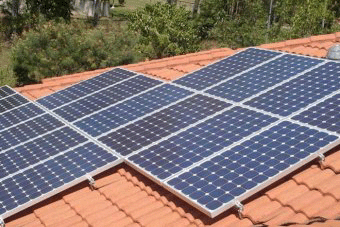 Rooftop solar enjoys second boom as fossil fuel scare campaign backfires, REneweconomy By Tristan Edis on 7 April 2017 It appears the fossil fuel industry’s scare campaign over renewable energy driving up the price of electricity is having the same desired effect that it had back in 2011, when they campaigned against placing a penalty on polluting the atmosphere with global warming gases.
Yep you guessed it – households and businesses are flocking to install solar on their rooftops.
Green Energy Markets’ Solar Report assessment of STC creation data shows that March hit levels of capacity not seen since the days of 45c to 60c premium feed-in tariffs in 201, when there was also an STC rebate that was twice to five times its current level.
All up, we estimate almost 92MW (92,000 kilowatts) of rooftop solar PV capacity created certificates in March………. Continue reading
Australia’s big banks scrutinising business customers for exposure to climate change risks
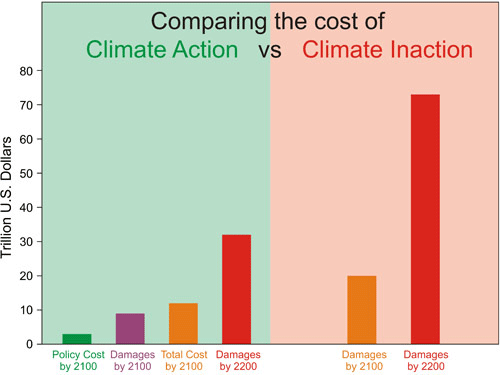 Climate change: three of Australia’s big four banks reviewing exposure to fossil fuels https://www.theguardian.com/australia-news/2017/apr/07/climate-change-three-of-australias-big-four-banks-reviewing-exposure-to-fossil-fuels
Commonwealth, NAB and ANZ are each analysing the financial position of business customers in sectors exposed to climate change, Guardian, Gareth Hutchens, 7 Apr 17, Three of Australia’s big four banks are reviewing their exposure to fossil fuels, including their lending practices to households and farmers, in response to climate change.
The Commonwealth Bank is conducting a “detailed climate policy review” that will be released publicly pending board approval, and NAB has a working group reviewing the risks from global temperatures rising two degrees.
ANZ is conducting portfolio analysis to identify changes in the financial position of business customers in sectors “most exposed” to climate change. It is also working with the Bureau of Meteorology to understand variability in average annual rainfall over recent decades to understand how climate change is affecting Australia’s traditional farming areas.
Executives from the three banks shared this information with the House of Representatives’ standing committee on economics, as part of a review of the four major banks. The revelations, written in response to questions on notice from the committee, were published on the federal parliamentary website on Friday afternoon.
It comes two months after the banking regulator warned climate change posed a material risk to Australia’s financial system, and urged companies to start adapting.
He pointed to the Paris Climate Agreement, ratified by Australia in November, as a significant policy moment for all governments, including Australia’s.
Summerhayes said the Paris Agreement provided an “unmistakable signal” about the future direction of policy and adjustments that companies, markets and economies “will need to make”.
The revelations from CBA and NAB come after ANZ’s chief executive, Shayne Elliott, said last month he was examining the impact of sea level rise and other climate impacts on housing mortgage risk.
Adam Bandt, the Greens’ climate and energy spokesman, has welcomed the revelations. He also questioned why Westpac has not ruled out funding Adani’s giant Carmichael coalmine in Queensland given its competitors’ concerns about climate change.
“Following ANZ’s revelation that sea-level rises might make it tougher to grant a mortgage, CBA and NAB seem to be examining whether to follow suit,” Bandt said. “The penny doesn’t seem to have fully dropped, because banks like Westpac still think they can commit to a two degree target but leave the door open to expanding coal mines.
“Westpac’s refusal to rule out funding Adani is especially concerning; as the bank seems to think it can have its climate cake and eat it too. But the days of dealing with climate change simply by putting a polar bear in your ad are long gone.”
Last year, financial activists Market Forces said Australia’s big four banks could act on their stated ambition to help achieve a 2C warming target simply by giving no new loans to coal projects.
1 This month
7 April – WEBINAR – Australia and the Doomsday Clock – Preventing nuclear war through NoFirstUse and other policies
Online | Tuesday April 7, 4:00-5:30pm, Australian Eastern Time / 8:00-9:30am Central Europe Time
– Access the registration link
15 April – Zoom –Nuclear Power is Not the Solution
Apr 15, 2026 01:00 AM in Canberra, Melbourne, Sydney

Join the International Physicians for the Prevention of Nuclear War (IPPNW) on Tuesday, April 14th for a timely webinar exploring the risks associated with nuclear power and challenging the myth that it offers a simple, safe, carbon-free solution to the climate crisis

21 April Webinar: No Nuclear Weapons in Australia
Start: 2026-04-21 18:00:00 UTC Canberra, Melbourne, Sydney (GMT+10:00)
End: 2026-04-21 19:30:00 UTC Canberra, Melbourne, Sydney (GMT+10:00)
Event Type: Virtual
A virtual link will be communicated before the event.
Host Contact Info: australia@icanw.org

of the week – Australians for War Powers Reform (AWPR)
To see nuclear-related stories in greater depth and intensity
 Antinuclear