Australian government about to secretly sign up to participate in developing new nuclear reactors
 Under the radar: Parliamentary Committee preparing for Australia to sign up to more participation in developing new nuclear reactors
Inquiry Homepage: Submissions close 28 th April 2017 Inquiry Homepage: http://www.aph.gov.au/Parliamentary_Business/Committees/Joint/Treaties/NuclearEnergy
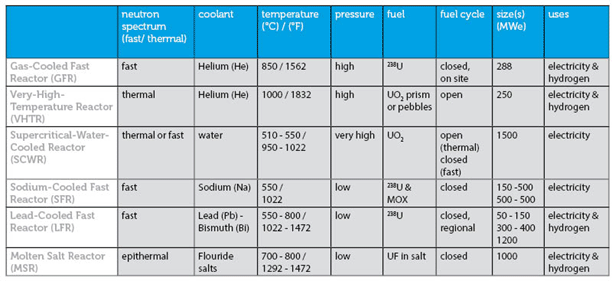
Governments policy position on nuclear power and is inconsistent with Australian laws which prohibit the use of this technology is astounding.
 What the Gov’t said in 2016 in relation to joining GIF: Christopher Pyne, said:
 “Australia’s invitation to join this important global project marks an exciting opportunity to be at the forefront of global innovation in the nuclear industry.” He added, “Inclusion in the GIF further strengthens Australia’s position as a nation that has the research muscle to deliver innovations on the global stage. It reinforces the governments 1 $billion National Innovation and Science Agenda, encouraging our best and brightest researchers to collaborate with international experts.”
 Julie Bishop said in relation to joining GIF
Pine Gap critically involved in USA – North Korea antagonism
 Pine Gap ‘on standby’ as tensions rise between the US and North Korea, debra.killalea@news.com.auIF Kim Jong-un is planning a missile attack, one strategic military and intelligence facility should know all about it. And it’s in the centre of our country.
IF Kim Jong-un is planning to launch a missile at Australia or US interests there’s one strategic intelligence facility that should know all about it.
And it’s right in the centre of our own country.
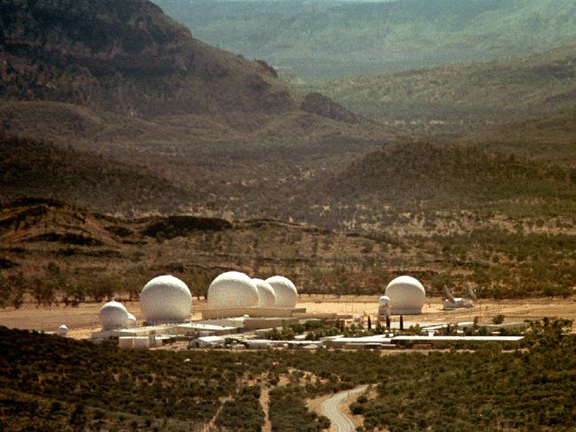
The secretive Pine Gap spy base has a vast array of signals intelligence capabilities and you can bet it will be monitoring Kim Jong-un’s every word.
Run by both Australia and the United States, the Joint Defence Facility Pine Gap is located about 20km from Alice Springs.
The remote site is considered strategically vital by both the US and Australian governments and it is used to collect a wide range of signals intelligence as well as providing information on early warning of ballistic missile launches. The flat landscape away from any city ensures the secretive site has a lack of interference.
It also contributes to and collects data used for US drones in the Middle East and Pakistan and it has access to satellites that could spy on most continents, bar the Americas and Antarctica
And while personnel based there are always searching for intelligence, they are now understood to be on standby following escalating tensions between North Korea and the US, according to the NT News.
According to the report, the US has notified Australia that it’s prepared to shoot down any missiles launched as North Korea escalates its threats. Continue reading
Heightened tensions North Korea versus USA

 North Korea warns of nuclear strike if provoked; Trump ‘armada’ steams on Reuters . 13 Apr 17 By Sue-Lin Wong and David Brunnstrom | PYONGYANG/WASHINGTON
North Korean state media warned on Tuesday of a nuclear attack on the United States at any sign of American aggression, as a U.S. Navy strike group steamed toward the western Pacific – a force U.S. President Donald Trump described as an “armada”.
Trump, who has urged China to do more to rein in its impoverished ally and neighbor, said in a tweet that North Korea was “looking for trouble” and the United States would “solve the problem” with or without Beijing’s help.
Tension has escalated sharply on the Korean peninsula amid concerns that reclusive North Korea may soon conduct a sixth nuclear test and after Washington said at the weekend it was diverting the aircraft carrier strike group Carl Vinson toward the Korean peninsula in a show of force.
“We are sending an armada. Very powerful,” Trump told Fox Business Network. “We have submarines. Very powerful. Far more powerful than the aircraft carrier. That I can tell you.”
Referring to North Korean leader Kim Jong-un, Trump said: “He is doing the wrong thing.” Asked if he thought Kim was mentally fit, Trump replied: “I don’t know. I don’t know him.”
North Korea said earlier it was prepared to respond to any U.S. aggression…..
The strike group heading toward Korea includes the nuclear-powered flagship aircraft carrier USS Carl Vinson, two destroyers and a cruiser. Such a strike group is generally accompanied by submarines, although the Pentagon does not normally publicize this…… http://www.reuters.com/article/us-northkorea-nuclear-idUSKBN17D0A4
Kimba South Australia: Neighbours still opposed to nominated nuclear waste facility sites
 Mrs Woolford said she and other members of the No Radioactive Waste on Agricultural Land in Kimba or SA group had tried to organise a community forum with all sides represented but said the government did not want to participate.
“A debate with everyone represented would be a fair way for the government to allow people in the community to make up their minds, not just a continuous sell of the alleged benefits.
“People should have the right for their government to provide all sides not just one to suit its purpose,” Mrs Woolford said. .
Neighbours in Kimba are still opposed to nominated nuclear waste facility sites, Eyre Tribune, 10 Apr 2017, DISTRUST in the federal government and the process of nominations in the search for a national low to intermediate radioactive waste site are just some of the reasons Austin Eatts is against the facility being placed at Kimba.
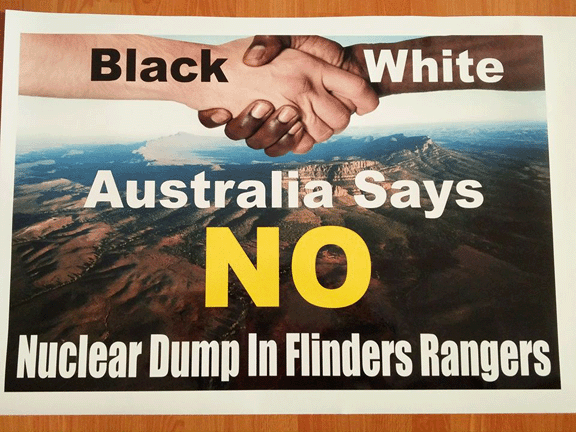
Mr Eatts is a direct neighbour to one of the newly nominated sites in the Kimba district and said the national nuclear waste facility was not something rural or regional people should be responsible for.
He said Eyre Peninsula had a long memory for the impact of politicians’ “dishonesty” during and after nuclear bombs were tested at Maralinga, to the north west of Eyre Peninsula “There is a long history of dishonesty about politicians, they told us then and after that Maralinga was safe. “This is the same message they are giving us now, things will be safe, why should we believe them?“My feelings about Eyre Peninsula and the state having anything nuclear has not changed since then,” Mr Eatts said.
He said he did not want the responsibility of making a decision that would impact generations for hundreds of years not only for Kimba or Eyre Peninsula residents but statewide.
“Once we accept this site here, we have opened the door to further nuclear activity.”
Mr Eatts said the vote to be undertaken by the South Australian Electoral Commission would settle the issue for him however he was concerned if the vote was against further progression it would not be the end of the matter.
“Will it be the end of it for those who want it? “They have already brought it back once after we settled it as a community we didn’t want it,” he said. “Two million dollars (offered to the community by the government) is a lot of money to you and I but for a community it is not much and no amount of money will fix the division in the community.” Continue reading
Petition: No high level nuclear waste dump in South Australia
 Say no to Jay’s high-level waste dump http://www.dumpthedump.com.au/

 In 2015, the Weatherill Labor Government announced a Royal Commission into expanding South Australia’s participation in the nuclear industry. The Royal Commission recommended further investigation into the development of a high-level nuclear waste industry in South Australia.
The Weatherill Labor Government established a Citizens’ Jury in the hope of getting a ‘Yes’ vote. But the jury voted by a two-thirds majority not to pursue his proposal ‘under any circumstances.’ So Jay Weatherill has come up with an expensive referendum to get the answer he wants.
Jay Weatherill’s plan for an international waste dump exposes South Australian taxpayers to unacceptable financial risks while they wait at least 40 years before knowing whether the project will proceed. It is not only economically risky but poses significant safety concerns, will taint our valuable ‘clean green’ brand and will leave a terrible legacy for future generations to deal with.
The overseas experience is that without community consensus, the investment needed for a waste facility will not be forthcoming.
It is the role of government to unite its community around achievable goals, not divide people over something that is not supported, not affordable and not achievable.
#StopAdani National Week of Action
– Webinar Thursday, 27 April at 6pm https://www.acf.org.au/stopadani-nwoa-webinar ~ Australian Conservation Foundation (ACF) https://www.acf.org.au/
“In just two months the government could handover a $1billion of public money to Adani for their giant polluting megamine.
That’s a $1 billion of our hard-earned public funds to a dodgy company for a climate-wrecking project with a dead end future. It’s a disgrace. And we won’t stand for it.
“Join us for a national week of action from15-19 May to escalate the pressure on our elected representatives.
For 5 days, we’ll write to them, phone them, meet with them, turn up at their events and protest outside their offices.
We won’t give up until they rule out public funding for Adani’s disastrous mine.
“Sign to the webinar and chat with our team about how you can get involved.We’ll give you the lowdown on the strategy, talk you through the week of action
and answer any questions you have.”
The amazing #StopAdani Roadshow
mobilises 4000 people in four days
“From 28-31 March, 4000 people turned out to tell Adani, Prime Minister Turnbull and Premier Palaszczuk thatAustralians don’t want a coal mine in the Galilee basin. … “https://www.acf.org.au/amazing_stopadani_roadshow
Adani coal mine could become a massive stranded asset, lawyers warn
 Loaning $900m for Adani’s central Queensland coal railway too risky, environmental lawyers say The World Today By Katherine Gregory Environmental lawyers have warned directors of the Northern Australia Infrastructure Facility (NAIF) to not fund Adani’s proposed coal railway in central Queensland because it is in breach of their duties.
Key points:
- Environmental Justice Australia writes to the Northern Australia Infrastructure Facility, calling for its directors to not fund Adani’s coal railway
- Lawyer says taxpayers exposed to financial risk if $900 million is loaned
- Minister for Northern Australia Matt Canavan calls letter a bullying tactic
Indian coal miner Adani has been seeking a $900-million loan to build the railway line from its proposed mine site in the Galilee Basin to the Abbot Point coal port.
Not-for-profit legal group Environmental Justice Australia (EJA) said the Federal Government’s NAIF directors need to consider the financial risks associated with climate change and he warned the investment was not commercially viable.
Environmental lawyer David Barnden said EJA sent a letter to NAIF’s directors on Tuesday outlining the duty. “The risks to the Adani rail project in the Galilee basin are too great,” Mr Barnden said.
“And there is a massive risk of it being a stranded asset and we think that if NAIF officials are to comply with their duties, then they cannot fund it.”
Mr Barnden said the directors were bound by statutory duties, according to the public governance and performance accountability act, which all Commonwealth public officials need to comply with.He said if they do decide to use taxpayer funds for Adani’s project, then “it would be a breach of law and a breach of a legal standard”.
Mr Barnden also said the Australian taxpayer would also be exposed to financial risk if NAIF decided to fund the project. “If there is no market for this coal, there’ll be no payment to the rail project and project couldn’t replay any loan to it,” Mr Barnden said.
The Australian Conservation Foundation (ACF) commissioned the environmental lawyers’ advice on the issue.
The ACF has been using all avenues, including legal options, to stop Adani’s coal mine, fearing it will contribute to climate change and also further damage the Great Barrier Reef……say http://www.abc.net.au/news/2017-04-12/adani-queensland-coal-mine-railway-$900m-loan-too-risky/8439582
Watch the trailer: Guarding the Galilee Documentary
 Watch the trailer: Guarding the Galilee Documentary
“The Guarding the Galilee documentary launches in April 2017 and is available at no cost for community screenings. To host a screening in your community, stay tuned and we’ll share the resources. … https://www.acf.org.au/guarding_the_gailee_tralier
~ Australian Conservation Foundation (ACF) https://www.acf.org.au/
Generation IV reactors – false promises that are not going to save the nuclear industry
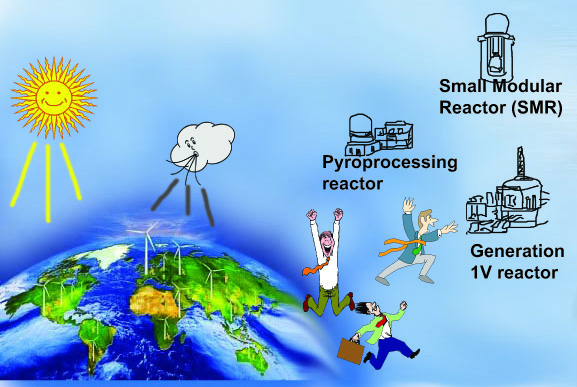 Generation IV reactors to the rescue?
Given these problems, some look to new ‘Generation IV’ designs. They are basically new versions of the old designs looked at in the 1950s, 60s and 70s in the USA and elsewhere – and abandoned as unviable, or after accidents.
They include fast neutron plutonium breeders, High Temperature Reactors (HTRs) and Molten Salt Reactors (MSR) possibly using thorium as a fuel and possibly also in scaled down Small Modular Reactor (SMR) format.
The message from the past is not promising……
False promise: nuclear power: past, present and (no) future http://www.theecologist.org/News/news_analysis/2988856/false_promise_nuclear_power_past_present_and_no_future.html David Elliott 12th April 2017
Nuclear power was originally sold on a lie, writes Dave Elliott. While we were being told it would make electricity ‘too cheap to meter’, insiders knew it cost at least 50% more than conventional generation. Since then nuclear costs have only risen, while renewable energy prices are on a steep decline. And now the nuclear behemoths are crumbling … not a moment too soon. Continue reading
The little known nuclear wasteland in the Sahara
 In the Sahara, a Little-Known Nuclear Wasteland, “There’s nothing nuclear in what I do. It’s just rocks we dilute into powder.”, Catapult, Hannah Rae Armstrong Apr 12, 2017 Activist Azara Jalawi lives with her mother, a nomad; her daughter Amina, who watches Mexican soap operas and dates a local human trafficker; her son Doudou, nicknamed “Slim Shady,” and a lean girl, probably a slave, in the town of Arlit, Niger, a mining hub of about forty thousand set deep within the Tuareg Sahara, a slow-baking proto-Chernobyl, a little-known nuclear wasteland.
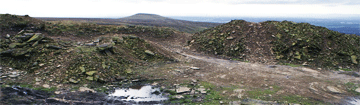
Around Arlit, prehistoric volcanoes and petrified forests rise from the sand. Beneath it lie the skulls of giant crocodiles who preyed on dinosaurs a hundred million years ago. Within the rocky plateaus are havens like the oasis at Timia, where orange, grapefruit, and pomegranate groves ripen and flower in the desert. For forty years, the French nuclear-energy giant Areva has mined uranium here, and milled it into yellowcake, the solid concentrate that is the first step towards enriching uranium for nuclear fuel or weapons. Three miles outside the town, fifty million tons of radioactive tailings—a waste byproduct containing heavy metals and radon—sit in heaps that resemble unremarkable hills. In strong winds and sandstorms, radioactive particles scatter across the desert. “Radon daughters,” odorless radioactive dust, blanket the town. Public health and the environment exhibit strange symptoms of decay—mysterious illnesses are multiplying; grasses and animals are stunted. The people of Arlit are told that desertification and AIDS are to blame. ………..
Living atop an open-pit uranium mine has made the people ill, in ways they do not understand. Breathing radioactive dust, drinking contaminated well water, and sleeping between walls stitched from radioactive scrap metal and mud, the people tell stories to fill the gaps in their knowledge. ………
At her brother Doudou’s high school, funded by the mining company, students are told not to do drugs or set things on fire. Teachers tell Doudou nothing about the contaminated well water he consumes daily. At lunch on my first day in Arlit, I ask nervously about the source of the water in a chilled glass bottle on the table. “Don’t worry, it’s the well water,” they assure me. “We drink it all the time.” I learn later that well water readings reveal contamination one hundred times beyond the World Health Organization’s threshold for potable water.
………. a dim awareness of the contamination risks was just beginning. Almoustapha Alhacen, a yellowcake miller and environmental activist, recognizes himself on the cover of a 2012 book I’ve brought with me: “Being Nuclear: Africans and the Global Uranium Trade.” He is the man wearing a gas mask and gloves. “The problem with Areva is it never informed people that radioactivity exists and that it is dangerous,” he says. An NGO called the Commission for Independent Research and Information on Radioactivity (CRIIRAD), created by a French EU deputy after the 1986 Chernobyl catastrophe, equipped him with a device and trained him to take readings. Once, he recalls, he saw a pregnant woman eating mud next to the road that leads from the mine to the town. This road is often tamped down with clay from the mines, and the tires that cross it regularly give it a fresh, invisible wash of radon. Almoustapha took a reading there and found radioactivity twenty-four times higher than the safe level. At markets selling scrap metal used for building houses, and at the community taps where people draw water, he took readings that were off the charts.
“Arlit was built around uranium. And humanity needs uranium,” Almoustapha says, speaking quickly and with rage. “But what happens next for us, when the uranium runs out, Areva leaves, and we are left with 50 million tons of radioactive waste?” As an activist, he ponders the future and the environment with seriousness. But these become abstract concerns before the fact of his job, which he needs right now. In a white turban and sunglasses, with sequined leather jewelry adorning his chest, he protests: “There’s nothing nuclear in what I do. It’s just rocks we dilute into powder, powder we dilute into liquid. It’s just mechanics, like for any car.” …….
If any state benefits from the distraction counter-terrorism provides from these underlying issues, it is France. Insecurity shields the mines from environmental scrutiny. Threats justify deepening militarization, an ongoing erosion of Nigerien sovereignty and independence. And the French mines still face no real obstacle to radiating the radiant desert. In fact, they’re expanding. A new mine—Africa’s largest—is being built near Arlit, at a site called Imouraren. There, a “security belt” encircles 100,000 acres, marking the land off limits to nomads.
https://catapult.co/stories/in-the-sahara-a-little-known-nuclear-wasteland#
ERA boss pushes nuclear power as energy source for Australia
 Top End uranium miner pushes nuclear power into Australia’s future energy mix as supply debate continues, ABC Rural By Carl Curtain “….Energy Resources Australia (ERA), which operates a uranium mine near Jabiru, held its annual general meeting in Darwin on Wednesday.
With Australia in the grip of a so-called energy crisis as a major gas shortage looms in 2018, chairman Peter Mansell did not miss the opportunity to press his company’s view on the national debate underway.
While he made it clear any future expansion of Ranger uranium mine depended on economic viability, he said a national discussion on nuclear power would provide a boost to the sector.
Although mining ceased at the site in 2012, stockpiled ore continues to be processed, with the operating lease due to expire in 2021.
ERA also holds an option to expand underground via its mothballed Ranger 3 Deeps project, but would face resistance from traditional owners……..http://www.abc.net.au/news/2017-04-12/energy-resources-australia-uranium-mining-nuclear-power-agm/8438800
Broken Hill’s giant leap – from mining hub to solar centre
 Renewables roadshow: how Broken Hill went from mining to drag queens and solar farms The home of BHP and Mad Max can now take credit for kickstarting the large-scale solar industry in Australia, Guardian, Michael Slezak, 13 Apr 17, “…….Broken Hill gave birth to one of the least renewable industries on Earth, but it can now claim to be the Australian birthplace of one of the most renewable.
Officially opened in January 2016, the plants were built with subsidies from the federal government through the Australian Renewable Energy Agency (Arena), as well as support from the NSW government.
With that funding, AGL was able to jump into the large-scale solar industry, and in doing so, create a supply chain that is bringing down the cost of solar farms around the country.
For example, Mackett says a manufacturing plant in the struggling car industry retooled to provide the frames for the solar panels, and is now able to do that for the whole industry. Continue reading
New rules flag big switch in energy markets to cheaper, smarter grid
 By Giles Parkinson on 12 April 2017 New rules flag big switch in energy markets to cheaper, smarter grid
AEMC indicates its support for switch to 5-minute settlement period, albeit with a 3-year transition period, and to a new rule that could allow alternatives to investment in more poles and wires. Both offer incentives to storage, demand response, and local renewables, and herald a more …
http://reneweconomy.com.au/new-rules-flag-big-switch-in-energy-markets-to-cheaper-smarter-grid-19663/
The 10 most-absurd things about the Adani mine.
Australia’s climate bomb: the senselessness of Adani’s Carmichael coal mine https://theconversation.com/australias-climate-bomb-the-senselessness-of-adanis-carmichael-coal-mine-76155 Senior Lecturer, Communications and Media Studies, Monash University April 12, 2017 Veteran environmental campaigner and former Greens senator Bob Brown has previously pointed to Adani’s proposed Carmichael coal mine as the new Franklin River of environmental protest in Australia. Yet the future of this “climate bomb” hangs in the balance.
The ongoing contest over the mine’s approval is about to get very heated. Some of the final decisions are to be made very soon.
On Wednesday, Prime Minister Malcolm Turnbull declared that native title claims would not impede the approval process, and that Adani would press ahead with its plans to seek A$1 billion in funding for the rail line needed to transport coal to Abbot Point for export.
The consequences of going ahead with the mine are almost incalculable. This is not simply because of the emissions it will produce, but from the fact it promotes and normalises the insanity that coal can still be “good for humanity”.
Here’s my list of the ten most-absurd things about the Adani mine. Continue reading
The Parkinson Report: Rooftop solar now Queensland’s biggest power station
 Rooftop solar now Queensland’s biggest power station http://reneweconomy.com.au/rooftop-solar-now-queenslands-biggest-power-station-14848/By Giles Parkinson on 12 April 2017 One Step Off The Grid
The 1,805MW of solar PV capacity on the rooftops of Queensland homes and business now amount to be the biggest power station by capacity in the state, overtaking the 1,780MW of the Gladstone coal fired power station.
The milestone was reached after homeowners and business owners in Queensland added 25MW of rooftop solar capacity in the month of March, the highest since the premium feed-in tariffs of 2012, when households were offered 46c/kWh for their solar power.
Now, they get around 6c/kWh (some smaller retailers offer 10c/kWh) for their exports back to the grid, but the falling costs of rooftop solar, the prospect of competitive battery storage, and the soaring costs of grid power appear to be driving another solar boom.
The likely passing of the milestone was flagged last month by energy minister Mark Bailey, who told a battery storage conference in Brisbane that:
“The combined solar rooftops are now the second largest power generator, just behind the 1680 MW Gladstone Power Station – which emits approximately 11.8 million tonnes of greenhouse gas each year, versus zero from the sun and our second biggest generator.
“So Queensland, as a significant renewables market, is on the transition path. We see our role as a state government as being a facilitator in that transition.”
Queensland is not actually the only state or territory where rooftop solar is the biggest power station. In the ACT, there is 59MW of rooftop solar, but the only competition within the boundaries of the ACT is the 20MW Royalla large-scale solar farm.
There are no gas or coal-fired generators within the boundaries of the national capital, and the ACT is now well on its way to sourcing the equivalent of 100 per cent of its electricity needs from renewable energy by 2020, after contracting a series of new solar and wind farms across South Australia, Victoria and NSW.
In Western Australia, there is 696MW of rooftop solar, but it falls short of the 854MW of the ageing Muja power station, while in South Australia there is 722MW of rooftop solar, still well short of the Torrens Island gas fired generator of 1280MW, although half of that capacity comes from the Torrens Island A, which is 50 years old and tipped for retirement some time soon.
This article was originally published on RenewEconomy’s sister site, One Step Off The Grid, which focuses on customer experience and ambitions with distributed generation. To sign up to One Step’s free weekly newsletter, please click here.
1 This month

of the week – Australians for War Powers Reform (AWPR)
To see nuclear-related stories in greater depth and intensity
 Antinuclear