Antinuclear

Australian news, and some related international items

May 12 Energy News

geoharvey's avatargeoharvey

Opinion:

¶ “Think windfarms are ugly? It’s not only a matter of perception, but policy too” • The Australian landscape is changed by words on paper. The renewable energy target as a mechanism for building zero-carbon technologies has worked brilliantly. It incentivizes mainly windfarms, as they’re the cheapest, most readily deployable technology. [The Guardian]

Capital windfarm (Photo: Bloomberg via Getty Images)

¶ “Coal And Nuke Investors Think Trump Just Saved Their Bacon. They’re Naïve.” • Once again, the Trump administration is being hailed by investors in coal and nuclear power. But a skeptical message may be more appropriate. If you’re an energy investor, be afraid. You may be picking up pennies in front of Trump’s regulatory steamroller. [Forbes]

¶ “Important Year For Microgrids In Remote Countries” • This year could be big for microgrid developments in remote and non-electrified regions and countries. Storage companies and technology…

View original post 739 more words

May 12, 2017 Posted by | Uncategorized | Leave a comment

12 May – Australian nuclear and climate news

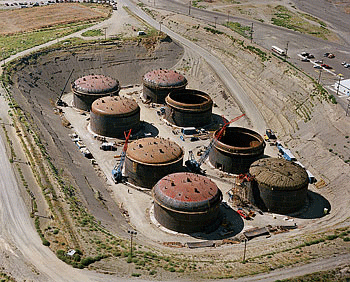
The most headline-grabbing nuclear story of the week was the collapse of  a tunnel at America’s Hanford nuclear site. While authorities stressed that no-one was injured, and no radiation was released, this accident highlighted the unsafe storage of America’s nuclear weapons waste.

In international politics, the elections of Emmanuel Macron, in France, and of Moon Jae-in, in South Korea, are unwanted blows to the global nuclear industry. Moon Jae-in also signals a trend away from alliance with USA, and a willingness to work with China.

Record-Thin Sea Ice Faces Big Predicted Arctic Warm-up This Week.

AUSTRALIA

NUCLEAR Today, the Parliamentary Inquiry into Australia  on Australia joining the Framework Agreement for International Generation IV Nuclear Reactor Development published the submissions that it received. As this Inquiry has been kept quite secret from the media and the public, it is not surprising that nearly all of the submissions have come from companies and individuals with either a very clear, or a vested, interest in the nuclear industry.

2017 – Federal Budget – nuclear issues SUMMARY.

Finally, recognition for Australia’s atomic veterans. Help for Aboriginal victims of nuclear bomb testing “60 years too late” says Yami Lester.

In South Australia, a Forum was held very recently, to examine the question: What is driving the nuclear industry to dump its nuclear waste in South Australia? Some insights from the forum. 

Australia to buy anti-radiation missiles from the United States. (should please Donald Trump, as he’s  a shareholder in Raytheon, which makes these).

Australia keen to get involved in nuclear fusion research? (despite the fact that nuclear fusion is prohibitively costly, impractical and dangerous) 

Stalemate in Australian govt’s effort to change Native Title Act.

CLIMATE and RENEWABLE ENERGY  Malcolm Turnbull has now dropped all pretense of acting on climate change. Federal budget 2017: Funding boost for expanding gas sector, but little for renewable sector. Australia likely to lose National Climate Change Adaptation Research Facility.

Australian renewable energy news. Queensland 20,000 jobs in solar power proposalNews on fracking in Australia.

May 12, 2017 Posted by | Christina reviews | Leave a comment

The continued push for Small Modular Nuclear Reactors in Australia

The Parliamentary Committee Inquiry on Australia joining the Framework Agreement for International Collaboration on Research and Development of Generation IV Nuclear Energy Systems has now published the submissions that it received.

As this Inquiry has been kept quite secret from the media and the public, it is not surprising that nearly all of the submissions have come from companies and individuals with either a very clear, or a vested, interest in the nuclear industry.

For the moment, I will just single out one that particularly interested me. This is from SMR Nuclear Technology Pty Ltd .  They don’t actually have much to say about Small Modular Nuclear Reactors, but just go on to fulsome praise of Generation IV nuclear reactors in general, and of ANSTO.:

…….SMR Nuclear Technology Pty Ltd is an independent Australian specialist consultancy established to advise on the siting, development and operation of safe nuclear power generation technologies, principally Small Modular Reactors (SMRs). Two of SMR-NT’s directors were senior managers at ANSTO and have a good understanding of the facilities and capabilities of ANSTO…..

SMR Nuclear Technology Pty Ltd most warmly supports Australia acceding to the Framework Agreement for International Collaboration on Research and Development of Generation IV Nuclear Energy Systems as extended by the Agreement extending the Framework Agreement for International Collaboration on Research and Development of Generation IV Nuclear Energy Systems” more http://www.aph.gov.au/Parliamentary_Business/Committees/Joint/Treaties/NuclearEnergy/Submissions

SMR Nuclear Technologies sounds pretty much like ANSTO in disguise.

They dropped a little hint of what ANSTO is up to, in their previous, (rather weak and contradictory) submission to the Nuclear Fuel Cycle Royal Commission, in which they stated: “Thorium is now being revisited, particularly in China. Australia (ANSTO) is assisting with this work” –  http://nuclearrc.sa.gov.au/app/uploads/2016/03/SMR-Nuclear-Technology-Pty-Ltd-30-07-2015.pdf

We didn’t know that the Australian tax-payer was funding thorium nuclear reactor development in China, did we?


May 12, 2017 Posted by | AUSTRALIA - NATIONAL, politics, technology | Leave a comment

What is driving the nuclear industry to dump its nuclear waste in South Australia

By Annie McGovern. 23rd April 2017  (this is an extract from the Adelaide Forum held very recently, to discuss this question) “….ENDNOTE  These observations have been gleaned from a fairly random search for relevant information which was also confined by the time available to process and present these findings. These are offered at this time as an additional body of information that may help fill some of the gaps in the thrust to force further nuclear energy production and waste disposal on the people of S. A.

Amongst the many recommendations of the Nuclear Fuel Cycle Royal Commission there were 3 major points which raise concerns regarding the possible imminent changes to Legislation in S.A. The Royal Commission has urged the State Government to fast-track these Legislative changes, even though there are no current viable plans for any nuclear industry developments in S.A. at this time.

  1. Modification of the State Waste Dump Prohibition Laws. This Legislation was almost immediately amended following presentation of the Royal Commission’s findings, to allow Government spending on proposals for the Waste Dumps. The further question of approval of nuclear waste dumps in S.A. was put to the Labour State Conference and became a stalemate to which no decision could be made. Progress of changes to Legislation on this proposal was interrupted.
  1. Legislation that would allow contracts of Uranium sales to be tied to obligations on S.A. taking back the resultant waste. The Royal Commission sees this possibility as an enhancement to capture sales of Uranium, despite there being no approval for waste disposal in S. A. at this time, and, the fact that no such facility would be capable of fulfilling the contract until well into the future. The Royal Commission appears to be determined to place the people of S.A. into an intractable situation where industry is forcing obligation through contractual arrangements. However, a caveat might be placed on such contracts that are not plausible…an explicit caveat and the risk is borne by the signing parties. A letter of advice is provided to the signatory and the Annual AGM of companies involved informed of this unethical business practice.
  2. Legislative changes to allow Nuclear Power production. Despite there being no overt plans for these developments within the foreseeable future, the Royal Commission is encouraging making changes now for future development. The absence of a ready nuclear waste disposal dump has historically been a constraint on Australia and the world in the development of greater Nuclear ambitions. Reports of illegal dumping and covert placement of radioactive waste abound both here and across the world. Reports of French waste being held at Lucas Heights and American wasteat Pine Gap are recent additions to these claims.Despite peoples’ efforts over many generations to call for and act on Peaceful Principles in our World, Environmental Sustainability and Productivity based on Need rather than Greed, capitalism and its theory of perpetual growth continues to drive forward in an overtly destructive manner.

    The continued focus on South Australia to perpetuate the nuclear travesty on our planet is acknowledged through this Forum and collectively we stand against this invasion. We walk with the Protectors of Country with Respect for Life.

May 12, 2017 Posted by | legal, politics, South Australia | Leave a comment

Australia to buy anti-radiation missiles from the United States

Donald Trump, as a shareholder in Raytheon, maker of anti-radiation missiles, should be pleased about this.
Australia seeking to spend $180 million on US anti-radiation missiles, Australia is looking to buy anti-radiation missiles from the United States worth about $183.7 million, according to the US Defense Security Cooperation Agency.

Source: AAP 29 APR 2017 

 Australia is looking to spend about $183.7 million on anti-radiation missiles for its Growler aircraft fleet, according to a US defence agency.

The US State Department has approved the possible sale and Congress has been notified, a news release from the country’s Defense Security Cooperation Agency says.

The sale would include up to 70 high speed anti-radiation missiles, 40 advanced anti-radiation guided missiles and training missiles as well as other support equipment.

The total estimated cost is $US137.6 million, or $183.7 million.

“Australia is requesting these missiles for its Electronic Attack EA-18G Growler aircraft,” it says about the missiles, which are designed for attacking ground-based radar.

“Australia will use this capability as a deterrent to regional threats and to strengthen its homeland defense.”

The notice is only of potential sale, not that the sale has concluded.

If it goes ahead, the “sale will contribute to the foreign policy and national security” of the US, by “helping to improve the security of a major contributor to political stability, security, and economic development in the Western Pacific”.

“Australia is an important major non-NATO ally and partner that contributes significantly to peacekeeping and humanitarian operations around the world,” the notice reads.

“It is vital to the US national interest to assist our ally in developing and maintaining a strong and ready self-defense capability.” http://www.sbs.com.au/news/article/2017/04/29/australia-seeking-spend-180-million-us-anti-radiation-missiles

May 12, 2017 Posted by | AUSTRALIA - NATIONAL, weapons and war | Leave a comment

Australia keen to get involved in nuclear fusion research?

ANU partner with China on nuclear fusion technology for power supply, The Age,  Georgina Connery , 5 May 17, ANU has handed over the keys to its $35 million nuclear fusion stellarator as part of a technology exchange with China aimed at creating a new viable base-load power source by 2050.

Many nations, scrambling to find a solution to the energy crisis, view nuclear fusion as a sustainable solution…….ANU Australian Plasma Fusion Research Facility director Dr Cormac Corr said a memorandum of understanding signed with University of South China in April underpinned the exchange…..

In September 2016, Australia became the first non-member state to enter a formal collaborative agreement with ITER –  set to be the world’s largest Tokamak fusion reactor and the first to create net power.

China, the European Union, India, Korea, Russia, Japan and the United States are jointly funding the construction of the $30 billion nuclear fusion demonstration facility in France.

Australia is trying to position itself as a major player in the ITER project by providing the technology to see volatile plasma, which is otherwise invisible when it reaches temperatures of 150 million degrees inside the reactor…..

ANU professor John Howard and fellow fusion science experts are lobbying, through the Australian Nuclear Science and Technology Organisation, for a $30 million federal program over the next three decades to further plasma fusion capabilities.

“We want to get an instrument that Australia owns on ITER in prime core space, so we are not relegated to a side show,” Professor Howard said…..

Research conducted at the ANU facility would feed into Australia’s materials and monitoring advice to the ITER project…..http://www.theage.com.au/act-news/anu-partner-with-china-on-nuclear-fusion-technology-for-power-supply-20170505-gvz7qc.html

May 12, 2017 Posted by | AUSTRALIA - NATIONAL, technology | Leave a comment

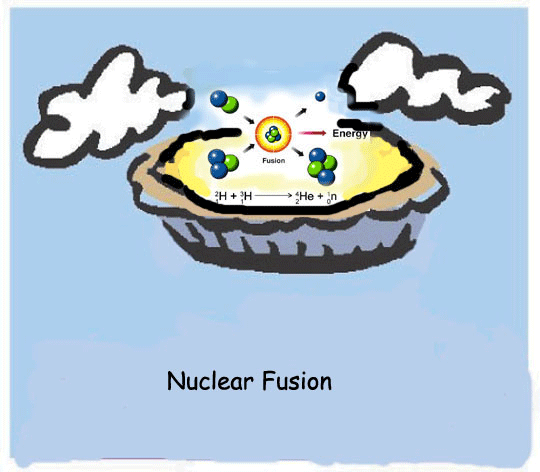
Fusion nuclear reactors? -expensive and unworkable pie in the sky

These impediments—together with colossal capital outlay and several additional disadvantages shared with fission reactors—will make fusion reactors more demanding to construct and operate, or reach economic practicality, than any other type of electrical energy generator.

The harsh realities of fusion belie the claims of its proponents of “unlimited, clean, safe and cheap energy.” Terrestrial fusion energy is not the ideal energy source extolled by its boosters, but to the contrary: Its something to be shunned.


Fusion reactors: Not what they’re cracked up to be http://thebulletin.org/fusion-reactors-not-what-they%E2%80%99re-cracked-be10699  
Daniel Jassby, 19 Apr 17 Daniel Jassby was a principal research physicist at the Princeton Plasma Physics Lab until 1999. For 25 years he worked in areas of plasma physics and neutron production related to fusion energy research and development. He holds a PhD in astrophysical sciences from Princeton University.

Fusion reactors have long been touted as the “perfect”energy source. Proponents claim that when useful commercial fusion reactors are developed, they would produce vast amounts of energy with little radioactive waste, forming little or no plutonium byproducts that could be used for nuclear weapons. These pro-fusion advocates also say that fusion reactors would be incapable of generating the dangerous runaway chain reactions that lead to a meltdown—all drawbacks to the current fission schemes in nuclear power plants.

And, a fusion-powered nuclear reactor would have the enormous benefit of producing energy without emitting any carbon to warm up our planet’s atmosphere.

But there is a hitch: While it is, relatively speaking, rather straightforward to split an atom to produce energy (which is what happens in fission), it is a “grand scientific challenge” to fuse two hydrogen nuclei together to create helium isotopes (as occurs in fusion). Our sun constantly does fusion reactions all the time, burning ordinary hydrogen at enormous densities and temperatures. But to replicate that process of fusion here on Earth—where we don’t have the intense pressure created by the gravity of the sun’s core—we would need a temperature of at least 100 million degrees Celsius, or about six times hotter than the sun. In experiments to date the energy input required to produce the temperatures and pressures that enable significant fusion reactions in hydrogen isotopes has far exceeded the fusion energy generated.

But through the use of promising fusion technologies such as magnetic confinement and laser-based inertial confinement, humanity is moving much closer to getting around that problem and achieving that breakthrough moment when the amount of energy coming out of a fusion reactor will sustainably exceed the amount going in, producing net energy. Collaborative, multinational physics project in this area include the International Thermonuclear Experimental Reactor (ITER) joint fusion experiment in France which broke ground for its first support structures in 2010, with the first experiments on its fusion machine, or tokamak, expected to begin in 2025.

As we move closer to our goal, however, it is time to ask: Is fusion really a “perfect”energy source? After having worked on nuclear fusion experiments for 25 years at thePrinceton Plasma Physics Lab, I began to look at the fusion enterprise more dispassionately in my retirement. I concluded that a fusion reactor would be far from perfect, and in some ways close to the opposite.

Scaling down the sun. As noted above, fusion reactions in the sun burn ordinary hydrogen at enormous density and temperature sustained by an effectively infinite confinement time, and the reaction products are benign helium isotopes. Artificial (terrestrial) fusion schemes, on the other hand, are restricted to much lower particle densities and much more fleeting energy confinement, and are therefore compelled to use the heavier neutron-rich isotopes of hydrogen known as deuterium and tritium—which are 24 orders of magnitude more reactive than ordinary hydrogen. (Think of the numeral one with 24 zeroes after it.) This gargantuan advantage in fusion reactivity allows human-made fusion assemblies to be workable with a billion times lower particle density and a trillion times poorer energy confinement than the levels that the sun enjoys. The proponents of fusion reactors claim that when they are developed, fusion reactors will constitute a “perfect” energy source that will share none of the significant drawbacks of the much-maligned fission reactors.

But unlike what happens in solar fusion—which uses ordinary hydrogen—Earth-bound fusion reactors that burn neutron-rich isotopes have byproducts that are anything but harmless: Energetic neutron streams comprise 80 percent of the fusion energy output of deuterium-tritium reactions and 35 percent of deuterium-deuterium reactions.

Now, an energy source consisting of 80 percent energetic neutron streams may be the perfect neutron source, but it’s truly bizarre that it would ever be hailed as the idealelectrical energy source. In fact, these neutron streams lead directly to four regrettable problems with nuclear energy: radiation damage to structures; radioactive waste; the need for biological shielding; and the potential for the production of weapons-grade plutonium 239—thus adding to the threat of nuclear weapons proliferation, not lessening it, as fusion proponents would have it.

In addition, if fusion reactors are indeed feasible—as assumed here—they would share some of the other serious problems that plague fission reactors, including tritium release, daunting coolant demands, and high operating costs. There will also be additional drawbacks that are unique to fusion devices: the use of fuel (tritium) that is not found in nature and must be replenished by the reactor itself; and unavoidable on-site power drains that drastically reduce the electric power available for sale.

All of these problems are endemic to any type of magnetic confinement fusion or inertial confinement fusion reactor that is fueled with deuterium-tritium or deuterium alone. (As the name suggests, in magnetic confinement fusion, magnetic and electrical fields are used to control the hot fusion fuel—a material that takes an unwieldy and difficult-to-handle form, known as a plasma. In inertial confinement, laser beams or ion beams are used to squeeze and heat the plasma.) The most well-known example of magnetic confinement fusion is the doughnut-shaped tokamak under construction at the ITER site; inertial confinement fusion is exemplified by the laser-induced microexplosions taking place at the US-based National Ignition Facility.

Tritium fuel cannot be fully replenished. The deuterium-tritium reaction is favored by fusion developers because its reactivity is 20 times higher than a deuterium-deuterium fueled reaction, and the former reaction is strongest at one-third the temperature required for deuterium-only fusion. In fact, an approximately equal mixture of deuterium and tritium may be the only feasible fusion fuel for the foreseeable future. While deuterium is readily available in ordinary water, tritium scarcely exists in nature, because this isotope is radioactive with a half-life of only 12.3 years. The main source of tritium is fission nuclear reactors.

If adopted, deuterium-tritium based fusion would be the only source of electrical power that does not exploit a naturally occurring fuel or convert a natural energy supply such as solar radiation, wind, falling water, or geothermal. Uniquely, the tritium component of fusion fuel must be generated in the fusion reactor itself.

The tritium consumed in fusion can theoretically be fully regenerated in order to sustain the nuclear reactions. To accomplish this goal, a lithium-containing “blanket” must be placed around the reacting medium—an extremely hot, fully ionized gas called a plasma. The neutrons produced by the fusion reaction will irradiate the lithium, “breeding”tritium.

But there is a major difficulty: The lithium blanket can only partly surround the reactor, because of the gaps required for vacuum pumping, beam and fuel injection in magnetic confinement fusion reactors, and for driver beams and removal of target debris in inertial confinement reactors. Nevertheless, the most comprehensive analyses indicate that there can be up to a 15 percent surplus in regenerating tritium. But in practice, any surplus will be needed to accommodate the incomplete extraction and processing of the tritium bred in the blanket.

Replacing the burned-up tritium in a fusion reactor, however, addresses only a minor part of the all-important issue of replenishing the tritium fuel supply. Less than 10 percent of the injected fuel will actually be burned in a magnetic confinement fusion device before it escapes the reacting region. The vast majority of injected tritium must therefore be scavenged from the surfaces and interiors of the reactor’s myriad sub-systems and re-injected 10 to 20 times before it is completely burned. If only 1 percent of the unburned tritium is not recovered and re-injected, even the largest surplus in the lithium-blanket regeneration process cannot make up for the lost tritium. By way of comparison, in the two magnetic confinement fusion facilities where tritium has been used (Princeton’s Tokamak Fusion Test Reactor, and the Joint European Torus), approximately 10 percent of the injected tritium was never recovered.

To make up for the inevitable shortfalls in recovering unburned tritium for use as fuel in a fusion reactor, fission reactors must continue to be used to produce sufficient supplies of tritium—a situation which implies a perpetual dependence on fission reactors, with all their safety and nuclear proliferation problems. Because external tritium production is enormously expensive, it is likely instead that only fusion reactors fueled solely with deuterium can ever be practical from the viewpoint of fuel supply. This circumstance aggravates the problem of nuclear proliferation discussed later.

Huge parasitic power consumption. In addition to the problems of fueling, fusion reactors face another problem: they consume a good chunk of the very power that they produce, or what those in the electrical generating industry call “parasitic power drain,”on a scale unknown to any other source of electrical power. Fusion reactors must accommodate two classes of parasitic power drain: First, a host of essential auxiliary systems external to the reactor must be maintained continuously even when the fusion plasma is dormant (that is, during planned or unplanned outages). Some 75 to 100 MWe (megawatts electric) are consumed continuously by liquid-helium refrigerators; water pumping; vacuum pumping; heating, ventilating and air conditioning for numerous buildings; tritium processing; and so forth, as exemplified by the facilities for the ITER fusion project in France. When the fusion output is interrupted for any reason, this power must be purchased from the regional grid at retail prices.

The second category of parasitic drain is the power needed to control the fusion plasma in magnetic confinement fusion systems (and to ignite fuel capsules in pulsed inertial confinement fusion systems). Magnetic confinement fusion plasmas require injection of significant power in atomic beams or electromagnetic energy to stabilize the fusion burn, while additional power is consumed by magnetic coils helping to control location and stability of the reacting plasma. The total electric power drain for this purpose amounts to at least 6 percent of the fusion power generated, and the electric power required to pump the blanket coolant is typically 2 percent of fusion power. The gross electric power output can be 40 percent of the fusion power, so the circulating power amounts to about 20 percent of the electric power output.

In inertial confinement fusion and hybrid inertial/magnetic confinement fusion reactors, after each fusion pulse, electric current must charge energy storage systems such as capacitor banks that power the laser or ion beams or imploding liners. The demands on circulating power are at least comparable with those for magnetic confinement fusion.

The power drains described above are derived from the reactor’s electrical power output, and determine lower bounds to reactor size. If the fusion power is 300 megawatts, the entire electric output of 120 MWe barely supplies on-site needs. As the fusion power is raised, the on-site consumption becomes an increasingly smaller proportion of the electric output, dropping to one-half when the fusion power is 830 megawatts. To have any chance of economic operation that must repay capital and operational costs, the fusion power must be raised to thousands of megawatts so that the total parasitic power drain is relatively small.

In a nutshell, below a certain size (about 1,000 MWe) parasitic power drain makes it uneconomic to run a fusion power plant.

The problems of parasitic power drain and fuel replenishment by themselves are significant. But fusion reactors have other serious problems that also afflict today’s fission reactors, including neutron radiation damage and radioactive waste, potential tritium release, the burden on coolant resources, outsized operating costs, and the increased risks of nuclear weapons proliferation.

Radiation damage and radioactive waste. To produce usable heat, the neutron streams carrying 80 percent of the energy from deuterium-tritium fusion must be decelerated and cooled by the reactor structure, its surrounding lithium-containing blanket, and the coolant. The neutron radiation damage in the solid vessel wall is expected to be worsethan in fission reactors because of the higher neutron energies. Fusion neutrons knock atoms out of their usual lattice positions, causing swelling and fracturing of the structure. Also, neutron-induced reactions generate large amounts of interstitial helium and hydrogen, forming gas pockets that lead to additional swelling, embrittlement, and fatigue. These phenomena put the integrity of the reaction vessel in peril.

In reactors with deuterium-only fueling (which is much more difficult to ignite than a deuterium-tritium mix), the neutron reaction product has five times lower energy and the neutron streams are substantially less damaging to structures. But the deleterious effects will still be ruinous on a longer time scale.

The problem of neutron-degraded structures may be alleviated in fusion reactor concepts where the fusion fuel capsule is enclosed in a 1-meter thick liquid lithium sphere or cylinder. But the fuel assemblies themselves will be transformed into tons of radioactive waste to be removed annually from each reactor. Molten lithium also presents a fire and explosion hazard, introducing a drawback common to liquid-metal cooled fission reactors.

Bombardment by fusion neutrons knocks atoms out of their structural positions while making them radioactive and weakening the structure, which must be replaced periodically. This results in huge masses of highly radioactive material that must eventually be transported offsite for burial. Many non-structural components inside the reaction vessel and in the blanket will also become highly radioactive by neutron activation. While the radioactivity level per kilogram of waste would be much smaller than for fission-reactor wastes, the volume and mass of wastes would be many times larger. What’s more, some of the radiation damage and production of radioactive waste is incurred to no end, because a proportion of the fusion power is generated solely to offset the irreducible on-site power drains.

Materials scientists are attempting to develop low-activation structural alloys that would allow discarded reactor materials to qualify as low-level radioactive waste that could be disposed of by shallow land burial. Even if such alloys do become available on a commercial scale, very few municipalities or counties are likely to accept landfills for low-level radioactive waste. There are only one or two repositories for such waste in every nation, which means that radioactive waste from fusion reactors would have to be transported across the country at great expense and safeguarded from diversion.

To reduce the radiation exposure of plant workers, biological shielding is needed even when the reactor is not operating. In the intensely radioactive environment, remote handling equipment and robots will be required for all maintenance work on reactor components as well as for their replacement because of radiation damage, particle erosion or melting. These constraints will cause prolonged downtimes even for minor repairs.

Nuclear weapons proliferation. The open or clandestine production of plutonium 239 is possible in a fusion reactor simply by placing natural or depleted uranium oxide at any location where neutrons of any energy are flying about. The ocean of slowing-down neutrons that results from scattering of the streaming fusion neutrons on the reaction vessel permeates every nook and cranny of the reactor interior, including appendages to the reaction vessel. Slower neutrons will be readily soaked up by uranium 238, whose cross section for neutron absorption increases with decreasing neutron energy.

In view of the dubious prospects for tritium replenishment, fusion reactors may have to be powered by the two deuterium-deuterium reactions that have substantially the same probability, one of which produces neutrons and helium 3, while the other produces protons and tritium. Because tritium breeding is not required, all the fusion neutrons are available for any use—including the production of plutonium 239 from uranium 238.

It is extremely challenging to approach energy breakeven with deuterium-deuterium reactions because their total reactivity is 20 times smaller than that of deuterium-tritium, even at much higher temperatures. But a deuterium-fueled “test reactor” with 50 megawatts of heating power and producing only 5 megawatts of deuterium-deuterium fusion power could yield about 3 kilograms of plutonium 239 in one year by absorbing just 10 percent of the neutron output in uranium 238. Most of the tritium from the second deuterium-deuterium reaction could be recovered and burned and the deuterium-tritium neutrons will produce still more plutonium 239, for a total of perhaps 5 kilograms. In effect, the reactor transforms electrical input power into “free-agent” neutrons and tritium, so that a fusion reactor fueled with deuterium-only can be a singularly dangerous tool for nuclear proliferation.

A reactor fueled with deuterium-tritium or deuterium-only will have an inventory of many kilograms of tritium, providing opportunities for diversion for use in nuclear weapons. Just as for fission reactors, International Atomic Energy Agency safeguards would be needed to prevent plutonium production or tritium diversion.

Additional disadvantages shared with fission reactors. Tritium will be dispersed on the surfaces of the reaction vessel, particle injectors, pumping ducts, and other appendages. Corrosion in the heat exchange system, or a breach in the reactor vacuum ducts could result in the release of radioactive tritium into the atmosphere or local water resources. Tritium exchanges with hydrogen to produce tritiated water, which is biologically hazardous. Most fission reactors contain trivial amounts of tritium (less than 1 gram) compared with the kilograms in putative fusion reactors. But the release of even tiny amounts of radioactive tritium from fission reactors into groundwater causes public consternation.

Thwarting tritium permeation through certain classes of solids remains an unsolved problem. For some years, the National Nuclear Security Administration—a branch of the US Energy Department—has been producing tritium in at least one Tennessee ValleyAdministration-owned fission power reactor by absorbing neutrons in lithium-containing substitute control rods. There has been significant and apparently irreducible leakage of tritium from the rods into the reactor cooling water that’s released to the environment, to the extent that the annual tritium production has been drastically curtailed.

In addition, there are the problems of coolant demands and poor water efficiency. A fusion reactor is a thermal power plant that would place immense demands on water resources for the secondary cooling loop that generates steam as well as for removing heat from other reactor subsystems such as cryogenic refrigerators and pumps. Worse, the several hundred megawatts or more of thermal power that must be generated solely to satisfy the two classes of parasitic electric power drain places additional demand on water resources for cooling that is not faced by any other type of thermoelectric power plant. In fact, a fusion reactor would have the lowest water efficiency of any type of thermal power plant, whether fossil or nuclear. With drought conditions intensifying in sundry regions of the world, many countries could not physically sustain large fusion reactors.

Numerous alternative coolants for the primary heat-removal loop have been studied for both fission and fusion reactors, and one-meter thick liquid lithium walls may be essential for inertial confinement fusion systems to withstand the impulse loading. However, water has been used almost exclusively in commercial fission reactors for the last 60 years, including all of those presently under construction worldwide. This circumstance indicates that implementing any substitute for water coolant such as helium or liquid metal will be impractical in magnetic confinement fusion systems.

And all of the above means that any fusion reactor will face outsized operating costs.

Fusion reactor operation will require personnel whose expertise has previously been required only for work in fission plants—such as security experts for monitoring safeguard issues and specialty workers to dispose of radioactive waste. Additional skilled personnel will be required to operate a fusion reactor’s more complex subsystems including cryogenics, tritium processing, plasma heating equipment, and elaborate diagnostics. Fission reactors in the United States typically require at least 500 permanent employees over four weekly shifts, and fusion reactors will require closer to 1,000. In contrast, only a handful of people are required to operate hydroelectric plants, natural-gas burning plants, wind turbines, solar power plants, and other power sources.

Another intractable operating expense is the 75 to 100 megawatts of parasitic electric power consumed continuously by on-site supporting facilities that must be purchased from the regional grid when the fusion source is not operating.

Multiple recurring expenses include the replacement of radiation-damaged and plasma-eroded components in magnetic confinement fusion, and the fabrication of millions of fuel capsules for each inertial confinement fusion reactor annually. And any type of nuclear plant must allocate funding for end-of-life decommissioning as well as the periodic disposal of radioactive wastes.

It is inconceivable that the total operating costs of a fusion reactor will be less than that of a fission reactor, and therefore the capital cost of a viable fusion reactor must be close to zero (or heavily subsidized) in places where the operating costs alone of fission reactors are not competitive with the cost of electricity produced by non-nuclear power, and have resulted in the shutdown of nuclear power plants.

To sum up, fusion reactors face some unique problems: a lack of natural fuel supply (tritium), and large and irreducible electrical energy drains to offset. Because 80 percent of the energy in any reactor fueled by deuterium and tritium appears in the form of neutron streams, it is inescapable that such reactors share many of the drawbacks of fission reactors—including the production of large masses of radioactive waste and serious radiation damage to reactor components. These problems are endemic to any type of fusion reactor fueled with deuterium-tritium, so abandoning tokamaks for some other confinement concept can provide no relief.

If reactors can be made to operate using only deuterium fuel, then the tritium replenishment issue vanishes and neutron radiation damage is alleviated. But the other drawbacks remain—and reactors requiring only deuterium fueling will have greatly enhanced nuclear weapons proliferation potential.

These impediments—together with colossal capital outlay and several additional disadvantages shared with fission reactors—will make fusion reactors more demanding to construct and operate, or reach economic practicality, than any other type of electrical energy generator.

The harsh realities of fusion belie the claims of its proponents of “unlimited, clean, safe and cheap energy.” Terrestrial fusion energy is not the ideal energy source extolled by its boosters, but to the contrary: Its something to be shunned.

May 12, 2017 Posted by | Uncategorized | Leave a comment

Stalemate in Australian govt’s effort to change Native Title Act

Native Title Act changes stuck amid stand-off between major parties, ABC News By political reporter Dan Conifer, 11 May 17, Native Title Act changes the Government declared urgent in February will not pass Parliament until at least mid-June, amid a stand-off between the major parties.

Key points:

  • Coalition moved to amend native title laws after major deal with WA Government and traditional owners scuttled in court
  • Federal Court ruling threw hundreds of agreements around the country into doubt
  • Coalition proposed legislation that would allow ILUAs to be registered with consent from most claimants

The Coalition moved to amend the law months ago after a court scuttled a major deal between the West Australian Government and traditional owners.

The Federal Court ruling overturned years of established law, throwing doubt over more than 100 agreements nationwide, including one covering Adani’s proposed multi-billion-dollar Queensland coal mine. The decision meant Indigenous land use agreements (ILUAs) needed to be signed by all native title claimants before coming into force. The Coalition proposed legislation that would allow ILUAs to be registered with consent from most claimants.

Since February, the bill has been repeatedly amended, with two revisions coming just this week……. The Upper House next sits on June 13. http://www.abc.net.au/news/2017-05-11/native-title-act-changes-wont-pass-until-mid-june/8519174

May 12, 2017 Posted by | aboriginal issues, AUSTRALIA - NATIONAL, politics | Leave a comment

America’s unsafe storage of nuclear wastes

Nuclear Waste From the Cold War Is Being Stored in Unsafe Conditions. Time to Fix the Problem is Running Out, TIME, Nicholas K. Geranios and Manuel Valdes / AP, May 11, 2017 (RICHLAND, Wash.) “………Officials said they detected no release of radiation and no one was injured in the collapse, though thousands of workers were forced to take shelter for several hours as a precaution. The cause of the collapse was not immediately known.

A gravel road was built to the collapse site, and workers wearing protective suits and breathing masks planned to fill the hole with 50 truckloads of dirt, the Energy Department said.

The rail tunnel was built in 1956 out of timber, concrete and steel, topped by 8 feet of dirt. It was 360 feet long (110 meters). Radioactive materials were brought into the tunnel by railcars. The tunnel was sealed in 1965 with eight loaded flatbed cars inside.

Gerry Pollet, a Washington state legislator and longtime Hanford critic, said the collapse of a waste storage tunnel at Hanford had been feared for years.”This disaster was predicted and shows the federal Energy Department’s utter recklessness in seeking decades of delay for Hanford cleanup,” he said.

He noted the Energy Department last year received permission to delay removing waste from the tunnels until 2042. The waste was supposed to be gone by 2024, Pollet said.

The radiation levels of the waste in the tunnel that collapsed would be lethal within an hour, Pollet said.

Hanford, a 500-square-mile expanse in remote interior Washington about 200 miles from Seattle, was created during World War II as part of the Manhattan Project to build the atomic bomb.

Hanford made most of the plutonium for the nation’s nuclear weapons, including the bomb dropped on Nagasaki, Japan, during the war. It now contains the nation’s greatest volume of radioactive waste left over from the production of weapons plutonium.

The cleanup there has cost $19 billion to date and is not expected to be finished until 2060, at an additional cost of $100 billion. The most dangerous waste at Hanford is 56 million gallons stored in 177 underground tanks, some of which have leaked.

Plans to embed the toxic stew in glass logs for burial have floundered. Construction of a $17 billion glassification factory has stopped because of design and safety issues.

The plan is to bury the glass logs at a nuclear waste dump carved inside Nevada’s Yucca Mountain, a project that has been on the drawing board for three decades but has run into resistance from Nevada politicians, including former U.S. Sen. Harry Reid.

President Donald Trump has proposed $120 million to restart the licensing process for the dump.Associated Press writers Susan Montoya Bryan in Los Alamos, New Mexico, and Matthew Daly in Washington contributed to this story. http://time.com/4775268/tunnel-collapse-nuclear-waste-hanford/

May 12, 2017 Posted by | Uncategorized | Leave a comment

Malcolm Turnbull has now dropped all pretense of acting on climate change

Turnbull abandons fig leaf and stands naked on climate policy, REneweconomy, By Giles Parkinson on 10 May 2017 You would think that with all the hoo-ha about the scandalous increases in electricity prices that it would have rated some sort of mention in the budget. You know, one of the biggest cost inputs for business being addressed in the government’s economic centrepiece.

But no. The 2nd Morrison/Turnbull fiscal document blithely ignores the issue, despite the fact that their lack of policy direction in the last few years has been the major contributor to the price surges that are scorching household and business budgets.

There’s some pointless extra money for coal seam gas, the removal of some funds for carbon capture (finally) and some previously promised funds for solar thermal (about time), and even another thought bubble on Snowy Hydro – this time to buy it out from the state governments. See Matt Rose’s article for more details.

But there is nothing on climate change, no grand vision on energy. There are no new funds for the Direct Action policy that Turnbull had once ridiculed as a fig leaf for a climate action, and nothing on what might take Australia along the path to the pledge it signed in the Paris deal – effectively to reach zero net emissions by 2050.


As Labor’s Mark Butler noted this morning, the Coalition’s climate change policy has officially gone from that fig-leaf to a non-existent farce.

Nearly three years after celebrating the dumping the carbon price (above), slashing the RET and ignoring expert advice (CCA and the Climate Council), the Coalition government has no actual policy, on energy or climate, and its negligence is adding to the stunning rise in electricity prices it is trying to blame on everything and everyone else.

“Malcolm Turnbull, the Prime Minister who once said he didn’t want to lead a Liberal Party that didn’t feel as strongly about climate change as he did, is now the Prime Minister who has completely dropped any pretence of attempting to combat climate change,” Butler says in his statement, noting that climate change did not rate a single mention in the Budget speech.

“As the central pillar of the Direct Action policy, the Emission Reduction Fund, runs out of funds, this budget delivers ZERO new policies or funding to drive down pollution and combat climate change. This budget allocates more new money to the Department of the House of Representatives than it does to tackling climate change.

“Budgets are about choices and priorities, and this budget makes it perfectly clear the Turnbull government isn’t choosing a safe climate because they don’t think it is a priority. This budget finally makes official what we already know; this Liberal government is failing all future generations of Australians.”

We took big slabs of Butler’s comments because we don’t think we could say it any better……. http://reneweconomy.com.au/turnbull-abandons-fig-leaf-and-stands-naked-on-climate-policy-79879/

May 12, 2017 Posted by | AUSTRALIA - NATIONAL, climate change - global warming | Leave a comment

New South Korean leader talks with China over North Korea’s nuclear tests

Xi, new South Korean leader talk nuclear, THE AUSTRALIAN, 11 May 17  Chinese President Xi Jinping and new South Korean President Moon Jae-in have discussed nuclear tensions, with the latter addressing the raft of problems posed by the North’s defiance.

Xi told Moon China had always upheld the denuclearisation of the Korean peninsula and that the nuclear issue should be resolved through talks, which were in everyone’s interests, according to a state television report.

China was willing to keep working hard with all parties, including South Korea, for the peace and prosperity of the Korean peninsula, he said.

Despite its anger at North Korea’s repeated nuclear and missile tests, China remains the isolated state’s most important economic and diplomatic backer even with Beijing signing up for tough UN sanctions against Pyongyang.

Beijing also has its own issues with Seoul. China has vigorously opposed the deployment of a US anti-missile system in South Korea, saying it threatens Chinese security and will do nothing to resolve tensions with North Korea……..

Moon said in his first speech as president on Wednesday he would immediately begin efforts to defuse security fears on the Korean peninsula and would negotiate with Washington and Beijing to ease tensions over the deployment of the Terminal High Altitude Area Defense anti-missile system in the South…..http://www.theaustralian.com.au/news/latest-news/xi-new-south-korean-leader-talk-nuclear/news-story/3ba4f6e5585d7cf577d29f2505a1e332

May 12, 2017 Posted by | Uncategorized | Leave a comment

French President-elect plans renewables boom

New Energy Update, French President-elect set to boost sluggish solar growth

Emmanuel Macron’s victory in France’s presidential election on May 7 is set to usher in a new wave of renewable energy development, according to his campaign pledges.

Macron pledged to double solar and wind capacity and close all of France’s coal-fired power stations by the end of his five-year term in 2022. He has also pledged to retain laws introduced in 2015 which aim to cut the share of nuclear power from 75% to 50% by 2025. This could equate to the closure of 25 GW of nuclear power capacity and shutdown dates will depend on growth in solar and wind capacity.

French solar capacity currently stands at 7 GW while wind capacity is around 12 GW. Solar and wind development has been hampered by regulatory and administrative hurdles and Macron plans to simplify the authorization process.

The closure of 25 GW of nuclear power capacity would require around 75 GW of new renewable energy capacity, Jefferies analysts Ahmed Farman and Oliver Salvesen said in a research note April 24.

“That looks quite challenging given that in the last 10 years only 18 GW of wind and solar was installed in France,” the analysts said in their note.

Market analysts have highlighted the challenge of shutting down an estimated 25 GW of nuclear power capacity over such a short timeframe while maintaining grid stability. While Macron supports the 2025 nuclear phase-out law, he has not set out a firm position on the phase-out date.

“The lack of a firm position on this issue may be because Mr Macron is well aware that the 2025 target is highly ambitious,” Farman and Salvesen said in their research note.

The 50% nuclear target may instead be reached between 2030 and 2033, a Macron adviser told Bloomberg in a report published April 26. The 50% objective could be reached sooner if ASN, the French nuclear safety authority, imposes tough conditions to extend reactor lifespans from 40 to 50 years, the adviser told Bloomberg.

Some 34 of EDF’s 58 reactors will soon reach 40 years of operations and the ASN will publish its safety report on the proposed lifespan extensions in around 2018.

Macron has said he would decide on the future of these reactors following the ASN’s report. http://analysis.newenergyupdate.com/pv-insider/google-brings-solar-rooftop-mapping-europe-french-president-elect-plans-renewables-boom?utm_campaign=NEP+PV+10MAY17+Newsletter&utm_medium=email&utm_source=Eloqua&elqTrackId=0da3b745bbf445b4a26a08b119c0eb1a&elq=3285a40f49eb42f0a3f4e6cb9d0a3898&elqaid=27829&elqat=1&elqCampaignId=13168

May 12, 2017 Posted by | Uncategorized | Leave a comment

Senate frustrates Government’s push to pass Native Title Bill

Traditional Owners fighting Adani heartened by Senate’s defence of native title,
deferred vote on changes  
http://wanganjagalingou.com.au/senate-frustrates-governments-push-to-pass-native-title-bill/~ Wangan and Jagalingou (W&J) wanganjagalingou.com.au 11 May 2017:

“Despite the Prime Minister recently reassuring billionaire Gautam Adani that he will ‘fix’ native title laws to enable Adani’s controversial mine to go ahead, the Turnbull Government failed in the Senate again today, with its Native Title Amendment Bill being pushed off to June.

Senior spokesperson for the Wangan and Jagalingou (W&J)Traditional Owners Council, Burragubba, said “The Senate blew the Government’s cover on the false urgency it has been relying on to push the Bill through. It is clear that there is no immediate threat to Indigenous Land Use Agreements (ILUAs) from the recent Federal Court McGlade decision.

““The Wangan and Jagalingou Council are heartened that our right to object to a land use agreement over our lands, because our common law native title is threatened with extinguishment, has gained recognition in the Federal Parliament.

““Opposition and Greens Senators spoke clearly and strongly about the need to put the native title rights of Traditional Owners ahead of all other interests, including mining, when making changes to the Native Title Act. …

Youth spokesperson for the W&J Traditional Owners Council, MsMurrawah Johnson, said, “The Government has again failed to pass the changes to the Native Title Act
it has been seeking in its clamour to back the Adani mine.”  “The Coalition has worked furiously to fast-track these amendments to overturn the recent McGlade decision in the Federal Court, which render Adani’s purported land use agreement incapable of registration.

““The Turnbull government has treated our native title as worthless and ignored the wishes of the Australian people in trying to push through this bill. We have had immense support from thousands of Australians who have implored the Parliament not to mess with our rights and those of Traditional Owners around the country.

““This reflects a recent national poll which showed that nearly two-thirds of Australians
believe that where Traditional Owners are opposed to Adani’s mine being being built on their lands,
State and Federal governments should wait for consent rather than push ahead with the mine. … “

May 12, 2017 Posted by | aboriginal issues, AUSTRALIA - NATIONAL, politics | Leave a comment

Steady disappearance of glaciers

Glaciers rapidly shrinking and disappearing: 50 years of glacier change in Montana https://phys.org/news/2017-05-glaciers-rapidly-years-glacier-montana.html#jCphttp://phy.so/413641276  May 10, 2017 The warming climate has dramatically reduced the size of 39 glaciers in Montana since 1966, some by as much as 85 percent, according to data released by the U.S. Geological Survey and Portland State University. On average, the glaciers have reduced by 39 percent and only 26 glaciers are now larger than 25 acres, which is used as a guideline for deciding if bodies of ice are large enough to be considered glaciers. Continue reading

May 12, 2017 Posted by | Uncategorized | Leave a comment

Federal budget 2017: Funding boost for expanding gas sector, but little for renewable sector

ABC Rural By Babs McHugh, 11 May 17   The Federal budget includes a number of multi-million-dollar measures to ensure more gas is available and shore up east-coast supplies.

Investment, environmental research, pipeline feasibility studies and other semi-regulatory bodies are at the heart of the spend.

It also is very pointed in its inference that states and territories with moratoria in place on gas drilling, exploration or fracking will not have access to funds…….http://www.abc.net.au/news/rural/2017-05-10/federal-budget-2017-gives-gas-a-boost/8513832

May 12, 2017 Posted by | AUSTRALIA - NATIONAL, energy, politics | Leave a comment