to 11 June Nuclear and Climate News Australia
 of interest: Radiological and nuclear incidents – the IAEA database
In the anglophone world, nuclear and climate are not top of the news at the moment, but are lurking not far beneath it. Terrorism events enhance the concern about radiation – “dirty bombs” etc. Theresa May’s unsatisfactory result at the British election makes it harder for her to negotiate the exit from the European Atomic Community (“Euratom”). In America the unfolding saga of the the sacked FBI director Comey, and the investigation into Michael Flynn and the Trump election campaign, has now revealed Flynn’s involvement in a truly weird nuclear marketing scheme.
As for climate change action – well, China is taking over the leadership. China and California are setting up their own climate accord. A joint commitment to fight climate change – European Union and China. America is really “still in it” as More than 1,000 U.S. governors, mayors, investors, universities, and companies pledge to meet the goals of the Paris agreement.
AUSTRALIA
Chief Scientist Dr Alan Finkel released his report on future energy planning. I think that the report is good. It is real realpolitik, in the light of all of Australia’s political conflicts about energy. The report just might let PM Malcolm Turnbull actually get some energy planning happening – nothing extreme in its promotion of renewable energy, nothing that would promote the coal power industry, while allowing it to die quietly. Nuclear is not mentioned, nor is it condemned.
NUCLEAR. South Australian Premier Jay Weatherill declares the nuclear waste importing plan “dead”
ANSTO’s Dr Adi Paterson signed Australia up to New Nuclear club with NO Parliamentary discussion! Senator Scott Ludlam asked inconvenient questions at Senate Estimates Committee about Australia’s role in nuclear weapons ban negotiations. Australia’s diplomats called “weasels” on Australia’s stand against nuclear weapons ban treaty
Senator Scott Ludlam asked inconvenient questions at Senate Estimates Committee on the cleanup of the Ranger uranium mine
ENERGY
- The ABC explains Australia’s new major energy review – the Finkel Report. Giles Parkinson analyses the Finkel Energy Report – and finds it mediocre at best. Dr Finkel says that clean energy target will benefit households and businesses. Pro-coal Liberals oppose Finkel energy report, Greens not happy either.
- Australians overwhelmingly want govts to favour renewable energy, even if it costs more.
- South Australia reaches its renewable energy target 8 years in advance.
CLIMATE CHANGE. Traditional Owners fighting Adani mine query Labor’s support for Native Title Bill Adani announces “green light” for expanded coal mine, but still hasn’t got the finance. Adani ‘investment decision’ meaningless without Indigenous consent. Religious leaders in active opposition to Adani coal mine project.
Senator Scott Ludlam asks inconvenient questions about Australia’s role in nuclear weapons ban negotiations
Senator LUDLAM: …I want to turn to the opening day of the nuclear weapons ban treaty negotiations, 27 March this year. Having failed to prevent these negotiations occurring, the Trump administration’s ambassador to the UN held a protest outside the UN General Assembly Hall. Did Australia participate in the protest?
Senator LUDLAM: So we just stood there in mute solidarity with the Trump administration? As 130 UN member states started serious work on negotiating a nuclear weapons ban treaty, we were outside the room in a protest?
It is a shame that there will be no Australian representatives at the UN because these talks are scheduled to conclude at the end of June or early July
 FOREIGN AFFAIRS, DEFENCE AND TRADE LEGISLATION COMMITTEE, UN – Nuclear Weapons Ban, 31st May 2017 http://parlinfo.aph.gov.au/parlInfo/download/committees/estimate/0a6ef7dd-2f88-423a-a01b-23b5c5b4e4c0/toc_pdf/Foreign%20Affairs,%20Defence%20and%20Trade%20Legislation%20Committee_2017_05_31_5055.pdf;fileType=application/pdf
Pg- 20
Senator LUDLAM: Can I speak to someone on the UN Conference to Negotiate a Legally Binding Instrument to Prohibit Nuclear Weapons?
Senator LUDLAM: Can I speak to someone on the UN Conference to Negotiate a Legally Binding Instrument to Prohibit Nuclear Weapons?
Mr Sadleir: Yes, Senator.
Senator LUDLAM: It is good that you are here, Mr Sadleir, because I want to ask a couple of questions about a meeting that occurred between 4 and 8 July 2016 that I understand you were present at. You and Ms Jane Hardy travelled to Washington, DC to meet with a range of, I understand, quite senior State Department and National
Pg – 21
Security Council people to discuss what was then referred to as the UN open-ended working group on nuclear disarmament. Can you confirm for us on the record that that meeting occurred and that you were in attendance?
[Here it took an extraordinarily long time for Mr Sadleir to admit that he was at this meeting]
‘……..Senator LUDLAM: I have not asked what you discussed yet. Were you in attendance at that meeting? Mr Sadleir
? Mr Sadleir: I was certainly in Washington. I would need to check my diary to get the precise dates but I was certainly there around that time.
Senator LUDLAM: I think that what will happen when you check the dates is that you will come back and confirm that you were in fact there. I will let you check the record. I would appreciate that. What was the purpose of those meetings? Continue reading
Giles Parkinson analyses the Finkel Energy Report – and finds it mediocre at best
the conservatives will protest anyway, and it is difficult to see how Labor can endorse a plan that undercuts renewable energy so comprehensively, and completely ignores the Paris climate agreement

 Finkel decoded: The good, the bad, and the very disappointing http://reneweconomy.com.au/finkel-decoded-the-good-the-bad-and-the-very-disappointing-84273/By Giles Parkinson on 9 June 2017
Our coverage of the main Finkel findings can be found here, along with the reaction, and a look at his modelling. Here is our initial take on what the final Finkel Review all means.
This is not Grid 2.0
In the first draft of the Finkel Review, chief scientist Dr Alan Finkel spoke of an “unstoppable” energy transition, driven by new technologies and the role of the consumer.
But but he may just have found a way for skittish politicians and incumbent utilities to throw a spanner in the works and slow it down. This report had the opportunity to redefine the energy markets. But, to borrow an expression, it reads more like history ++ at best, rather than Grid 2.0.
That’s because Finkel has been focused on trying to find a pathway through the toxic energy politics in Australia, and accommodating the Coalition’s modest climate targets, rather than seizing the moment and outlining what can and should happen, and what Australia would need to do to meet the Paris climate targets.
That it only modeled the Coalition’s initial down-payment for the Paris climate deal. It shows it a path to reach that, but not its likely obligations in a world that vowed to cap average global warming at “well below 2°C” and so can be seen as a huge victory for the incumbents.
We need a plan
Finkel emphasises there is no plan right now, and one is needed to manage the scale of the transition. “We need a plan,” he says.
So he has recommended a whole series of actions, including the Clean Energy Target and only because of opposition to the emissions intensity target. Other options such as a high renewable energy target were not considered, even though its is clear that wind and solar are the cheapest forms of new energy, Continue reading
Dr Finkel says that clean energy target will benefit households and businesses
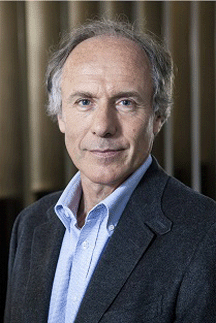 Finkel review: Households, businesses better off long-term with clean energy target, chief scientist says http://www.abc.net.au/news/2017-06-09/finkel-report-households-better-off-under-clean-energy-target/8605734 By political reporter Louise Yaxley, 9 June 17, Chief scientist Alan Finkel says households would be about $90-a-year better off under a clean energy target.
The target is a key recommendation in the report Dr Finkel handed to the Prime Minister and state and territory leaders today.
It is aimed at helping Australia reduce its greenhouse emissions while keeping power prices down.
Dr Finkel said his plan would mean households would be 10 per cent better off over 30 years, and heavy industrial power users would be 20 per cent better off.
The nation’s energy ministers will now consider the plan and report in August on the detail of the recommendations. Continue reading
Pro-coal Liberals oppose Finkel energy report, Greens not happy either
Finkel review: Government backbenchers question clean energy target 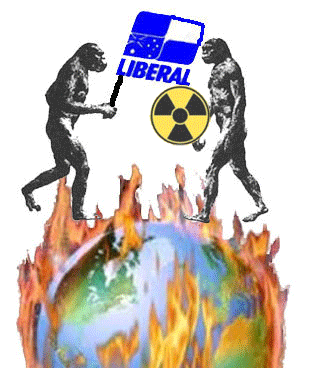 report, ABC News, 9 June 17 By political reporters Matthew Doran and Tom Iggulden Pro-coal backbenchers within the Liberal Party have already begun undermining a report from the chief scientist Alan Finkel, as Labor foreshadows pulling support for the proposal if new coal-fired power stations are built.
Key points:
- Senator Eric Abetz accusing Finkel of using “creative assumptions” to come up with recommendations
- MP Craig Kelly calling for another report, different attempts at modelling
- Australian Energy Council says Dr Finkel’s report presents “less political” option
Dr Finkel’s report proposes a clean energy target (CET) to help reduce carbon emissions and lower electricity prices for households by about $90 per year.
Tasmanian Liberal senator Eric Abetz is accusing the chief scientist of using “creative assumptions” to come up with his recommendations for a CET.
Western Sydney Liberal backbencher Craig Kelly is calling for another report to be done into the economic effect of setting aggressive emissions reduction targets.
He said he would not support a benchmark emission target of 0.6 tonnes of carbon dioxide per megawatt hour, which is the level Dr Finkel has used in his report to model economic effects. …….http://www.abc.net.au/news/2017-06-10/pro-coal-backbenchers-undermining-finkel-report-labor-threats/8606652
Radioactive trash from 1979 Three Mile Island nuclear disaster now an urgent problem
Federal officials currently have nowhere to send it.
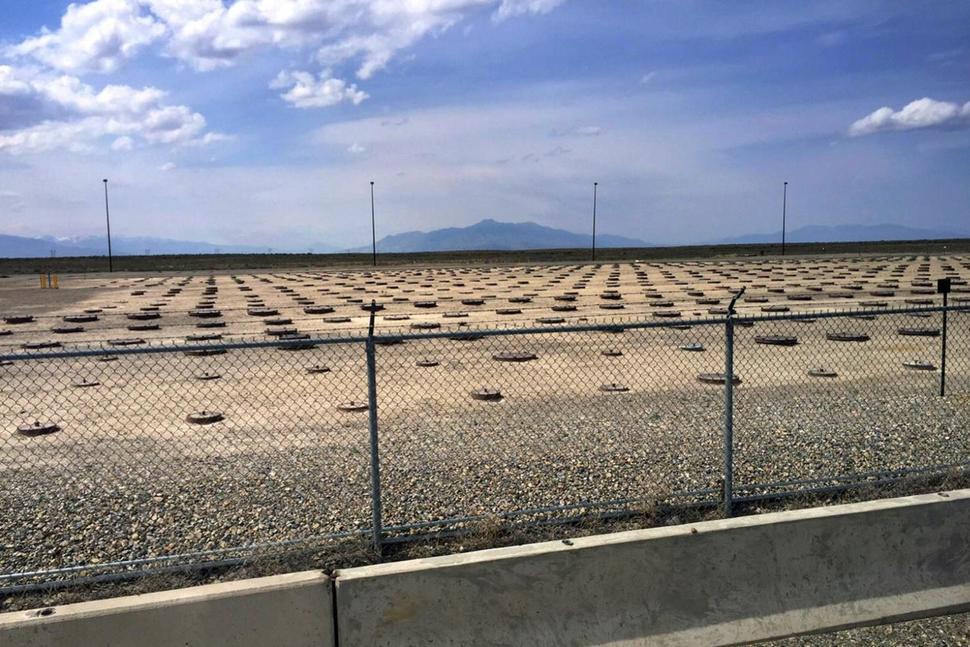
Extension Sought for Storing Three Mile Island Debris https://www.usnews.com/news/best-states/idaho/articles/2017-06-09/extension-sought-for-idaho-storing-nuclear-meltdown-debris Federal officials requested a 20-year extension involving the storage in Idaho of reactor core debris from the partial meltdown at the Three Mile Island nuclear power plant. June 9, 2017,By KEITH RIDLER, Associated Press BOISE, Idaho (AP) — Federal officials requested a 20-year extension involving the storage in Idaho of reactor core debris from the partial meltdown at the Three Mile Island nuclear power plant. Continue reading
Traditional Owners fighting Adani mine query Labor’s support for Native Title Bill
 http://wanganjagalingou.com.au/traditional-owners-fighting-adani-mine-query-labors-support-for-native-title-bill/ “Responding to reports that Labor has come to an agreement with the Turnbull government which will see passage of the contentious Native Title Bill in the Senate next week, Traditional Owners fighting Adani’s mine are calling on Opposition Leader Bill Shorten to outline what consultation has occurred with Indigenous people which makes his party satisfied the Bill should now become law.
“Shadow Minister Assisting for Resources, Mr Tim Hammond, is reported to have told a Perth resources conference today there was now a “settled position” with the Government and that the Opposition envisaged the bill would be passed next week.
“Senior spokesperson for the Wangan and Jagalingou (W&J) Traditional Owners Council, Adrian Burragubba, says ““Labor made a bunch of noise about the failure of the Attorney General to conduct proper grassroots consultation with Aboriginal people on these important changes to native title laws.
““People deserve to hear from Labor what, if anything, has changed since mid May when it refused to vote for Adani’s Native Title Bill because consultation had been so shabby and amendments were all over the shop.
““Until Labor has been provided with evidence by the Turnbull government of appropriate consultation,
and the Senate has seen the Bill as proposed, it should refuse to back it,” Mr Burragubba said.
17 June Tasmanians will join the global movement towards banning nuclear weapons
All in Tasmania who feel strongly that we should ban these weapons are welcome to gather together for an hour in a “Ban the Bomb” vigil on Parliament House lawns from 11am to noon on Saturday, next weekend.
Talking Point: Tasmanians can join UN bid to ban nuclear weapons http://www.themercury.com.au/news/opinion/talking-point-tasmanians-can-join-un-bid-to-ban-nuclear-weapons/news-story/8e297a3b9b847e957f4c5903469388fa?nk=ba26857f63080120cbd5fc74c94d3959-1497069675, June 10, 2017 WHEN I was a child an atomic bomb was dropped on Hiroshima and a few days later, a second on Nagasaki.
Just two bombs killed about 80,000 people in Hiroshima and 40,000 in Nagasaki.
I felt sick then. It still shocks me.
Thereafter, we saw photos and film of people, including children, running screaming, their clothes torn off and their skin hanging in strips.
We saw photos of hospitals full of innocent people dying of radiation, their devastated cities and surrounding farming land irradiated 70 years ago and still unusable.
In 1956, a series of British nuclear tests at Maralinga in South Australia also left an area of our great nation contaminated. Australians then said: “Never again.”
The Australian Government was at the forefront of countries that established the United Nations, with the main task of preventing war, in particular nuclear war.
However, since then, the world has experienced one war after another, with increasingly sophisticated weapons, plus an underlying dependence on violence rather than justice, education, negotiation and compromise to solve the thorny issues.
There are nearly 15,000 nuclear weapons worldwide, each one of which can cause devastation like that of Hiroshima and thereafter cause a nuclear winter sufficient to destroy all human life. Nine countries have these weapons and more, such as North Korea, are trying to make them.
No one should have them. Continue reading
New Zealand supports Nuclear Weapons Ban Treaty: public event in Auckland Domain, June 11th.
People from all walks of life are joining together to form a giant human peace symbol. Its intention is to convey a unified message of world peace supporting a world free of nuclear weapons.
This may be the first time for the younger generation to celebrate our historic New Zealand Nuclear Free Zone and take part in creating a message of world peace.
New Zealand supports Nuclear Weapons Ban Treaty: public event in Auckland Domain, June 11th.
30th Anniversary of Nuclear Free New Zealand http://www.scoop.co.nz/stories/PO1706/S00132/30th-anniversary-of-nuclear-free-new-zealand.htm 10 June 2017, New Zealand Peace Foundation On Sunday 11 June at 12.00 midday in Auckland Domain The Peace Foundation is organising a public peace event to mark the thirty year anniversary of New Zealand saying “no” to nukes in the Nuclear Free Zone, Disarmament, and Arms Control Act 1987 statute. Continue reading
1 This month
7 April – WEBINAR – Australia and the Doomsday Clock – Preventing nuclear war through NoFirstUse and other policies
Online | Tuesday April 7, 4:00-5:30pm, Australian Eastern Time / 8:00-9:30am Central Europe Time
– Access the registration link
15 April – Zoom –Nuclear Power is Not the Solution
Apr 15, 2026 01:00 AM in Canberra, Melbourne, Sydney

Join the International Physicians for the Prevention of Nuclear War (IPPNW) on Tuesday, April 14th for a timely webinar exploring the risks associated with nuclear power and challenging the myth that it offers a simple, safe, carbon-free solution to the climate crisis

21 April Webinar: No Nuclear Weapons in Australia
Start: 2026-04-21 18:00:00 UTC Canberra, Melbourne, Sydney (GMT+10:00)
End: 2026-04-21 19:30:00 UTC Canberra, Melbourne, Sydney (GMT+10:00)
Event Type: Virtual
A virtual link will be communicated before the event.
Host Contact Info: australia@icanw.org

of the week – Australians for War Powers Reform (AWPR)
To see nuclear-related stories in greater depth and intensity
 Antinuclear