Torres Strait islanders affected by climate change – evacuation eventually needed
‘The island is being eaten’: how climate change is threatening the Torres Strait
In Boigu, part of Australia but just six kilometres from Papua New Guinea, roads are being washed into the sea, Guardian, Ben Doherty and Michael Slezak, 13 July 17, Torres Strait residents face being forced from their homes by climate change, as their islands are lost to rising seas.
On Boigu Island, the most northerly inhabited island in Australia, just six kilometres from Papua New Guinea, the community’s cemetery faces inundation and roads are being washed into the sea. A seawall installed to protect the community is already failing.
Boigu elder Dennis Gibuma says the situation is worsening every season.
“Our seawall is no longer any good,” he says. “When the high tide and strong winds come together, it breaks. We pray we don’t lose our homes. We don’t want to leave this place.”
Masig Island, to the south-east of Boigu, is less than three kilometres long, and just 800m across at its widest point. Also known as Yorke Island, the low-lying coral cay is steadily being lost to the waves.
“In the short term, we can do what we can. We can’t stop the erosion, our hope is to slow it down.”
But he says he has to face the possibility that his people may have to abandon their ancestral home.
“Long term, we may have to evacuate the island,” he says. “But I am not going. Slowly, I see Masig Island getting out of something I can control.”………
The precise sea level rise around the Torres Strait, and the projected inundation, has not been calculated but low-lying islands are expected to experience a much greater flooding risk than mainland Australia. The department identifies the remote islands of the Torres Strait as some of the most vulnerable, as does the Intergovernmental Panel on Climate Change (IPCC), which warns communities they may be forced to relocate………
Displacement caused by climate change is forecast to be a driver of massive forced migration movements in the 21st century.
Low-lying islands in the Pacific – and Torres Strait islands like Masig and Boigu – are likely to be at the forefront of forced displacement but large and densely populated countries such as Bangladesh also face widespread inundation.
Some forecasts have predicted up to 150 million people could be forcibly displaced by climate change by 2040 – larger than the record number of people already forced from their homes globally.
The US and other militaries have said that climate change poses the greatest security threat to the Asia-Pacific.
But the global legal framework for resettling people displaced from their homes lost to natural disasters or climate change is unclear. The refugee convention – established in 1951 to regularise the resettlement of those displaced by the second world war – does not recognise someone forced from their home by rising seas, or natural disaster, as requiring protection.
Already, more than a dozen Pacific Islanders have attempted to claim refugee status in New Zealand on the grounds that their homes are uninhabitable because of rising seas or climate-related disaster. All have had their claims rejected.
On Masig Island, Hilda Mosby says climate change is already affecting the marine ecosystems on which communities depend for their livelihoods. Climate changeis already affecting her community “big time”, she says.
But the greater existential threat for her home lies ahead….https://www.theguardian.com/environment/2017/jul/13/the-island-is-being-eaten-how-climate-change-is-threatening-the-torres-strait
Crazy for Australia to subsidise coal – says Al Gore
 Al Gore: Australian government subsidising coal power would be ‘crazy’
Former US vice president and climate change campaigner says providing funding for infrastructure to support Adani coal mine is ‘just nuts’, Guardian, Calla Wahlquist, 12 July 17, Any move by the Australian government to subsidise coal-fired power would be “crazy” and providing funding for infrastructure to support the Adani coal mine is “just nuts,” former US vice president and climate change campaigner Al Gore has said.
“Globally, the world is moving rapidly away from subsidies to fossil fuels,” he said. “It would be odd if Australia went in the opposite direction and subsidised coal. It’s impolitic of me to say it, but it would be crazy.”
The Adani Group’s proposed $16bn Carmichael coal mine in Queensland’s Galilee Basin, which is yet to get finance but has been promised $1bn from the Australian government to build a rail line to port, was particularly unwise, Gore said.
“The Adani mine doesn’t have its financing, I hope it never gets its financing,” he said. “It’s not my place to meddle with your politics, but truly, this is nuts.”
Gore made the comments at the end of a presentation to the Investor Group on Climate Change, in a Q&A with Guardian Australia editor Lenore Taylor………
Without policy levers in favour of coal, Gore said the declining cost of both renewable energy and battery storage made it “now the dominant reality in energy markets”.
“Most people assume that the coal industry is in a terminal decline,” he said. “The market capitalisation of the global coal industry has declined … I think the figure is almost 90% in the last seven our eight years. It’s quite dramatic. The world is turning away from coal.”
Federal policy leadership was helpful and would provide additional certainty for investors, but it was not necessary, he said. Earlier, Gore said the United States was working towards its Paris Agreement targets through actions taken at a state and local level, despite US President Donald Trump opting out.
“And if there’s another president elected, please God … the new president within 30 days can come back in,” he said…….. https://www.theguardian.com/us-news/2017/jul/12/al-gore-australian-government-subsidising-coal-power-would-be-crazy
14 July More REneweconomy news
-
As Tesla prepares to deliver its potentially game-changing mass market EV, Australia goes into meltdown about the very idea of improving vehicle efficiency.
-
Australia needs to cut electricity sector emissions by 60% by 2030Renewables must play key role in ramping up the abatement from the electricity sector in Australia.
-
AEMO: Politics needs to catch up with falling cost of wind, solar, storageAEMO chief Audrey Zibelman says politics needs to deal with falling cost of wind, solar and batteries, and customer preference around rooftop solar.
-
AES, Siemens combine to tackle Tesla, dominate battery storage marketTwo of biggest energy companies in the world join forces to dominate global battery storage market, at least at grid scale. Australia is high on their list of targets, with a series of projects that could dwarf Tesla’s newly announced project.
-
Genex solar/storage project shortlisted for funds from NAIFSolar PV and pumped hydro project proposed for abandoned gold mine in north Queensland shortlisted for funding by Northern Australia Infrastructure Facility.
-
Frydenberg says storage ratio for wind/solar to be decided by AEMOFederal energy minister says AEMO is best placed to assess what storage levels are needed to stabilise Australia’s grid.
-
New Energy Security Taskforce prepares Queensland for summerSecuring Queensland’s future energy supply was the number one agenda item when the newly commissioned Queensland Energy Security Taskforce met for the first time today.
-
Conservative billionaire building biggest wind farm in heart of coal countryA conservative billionaire is building the country’s largest wind farm. Republican lawmakers want to raise the tax on wind.
-
Clean energy spending hits 43% share of total supply investmentGlobal spending on energy fall by 12% overall in 2016 but clean energy spending is on the up.
Massive iceberg breaks away from Larsen C ice self in Antarctica
 Larsen C: Giant iceberg breaks away from ice shelf in Antarctica, http://www.abc.net.au/news/2017-07-12/huge-iceberg-breaks-away-from-antarctica-larsen-c-shelf/8703238 One of the biggest icebergs on record has broken away from Antarctica, scientists have said, creating an extra hazard for ships around the continent as it breaks up. What happens now Antarctica’s ice shelf has cracked?
A massive crack in one of Antarctica’s largest ice shelves creates an iceberg bigger than Kangaroo Island. So, what impact will it have?
The 1-trillion-tonne iceberg, measuring 5,800 square kilometres, calved away from the Larsen C ice shelf in Antarctica sometime between July 10 and 12, scientists at the University of Swansea and the British Antarctic Survey said.
The iceberg has been close to breaking off for a few months. Throughout the Antarctic winter, scientists monitored the progress of the rift in the ice shelf using the European Space Agency satellites.
“The iceberg is one of the largest recorded and its future progress is difficult to predict,” said Adrian Luckman, professor at Swansea University and lead investigator of Project MIDAS, which has been monitoring the ice shelf for years.
“It may remain in one piece but is more likely to break into fragments. Some of the ice may remain in the area for decades, while parts of the iceberg may drift north into warmer waters,” he added.
The ice will add to risks for ships now it has broken off.
The peninsula is outside major trade routes but is the main destination for cruise ships visiting from South America.
In 2009, more than 150 passengers and crew were evacuated after the MTV Explorer sank after striking an iceberg off the Antarctic peninsula.
The iceberg, which is likely to be named A68, was already floating before it broke away so there is no immediate impact on sea levels, but the calving has left the Larsen C ice shelf reduced in area by more than 12 per cent.
The Larsen A and B ice shelves, which were situated further north on the Antarctic Peninsula, collapsed in 1995 and 2002, respectively.
“This resulted in the dramatic acceleration of the glaciers behind them, with larger volumes of ice entering the ocean and contributing to sea-level rise,” said David Vaughan, glaciologist and director of science at British Antarctic Survey.
“If Larsen C now starts to retreat significantly and eventually collapses, then we will see another contribution to sea level rise,” he added. Big icebergs break off Antarctica naturally, meaning scientists are not linking the rift to manmade climate change.
The ice, however, is a part of the Antarctic peninsula that has warmed quickly in recent decades.
“In the ensuing months and years, the ice shelf could either gradually regrow, or may suffer further calving events which may eventually lead to collapse — opinions in the scientific community are divided,” Professor Luckman said.
“Our models say it will be less stable, but any future collapse remains years or decades away.”
World’s unstoppable movement on climate change action – explained at Ecocity 2017 World Summit in Melbourne
 Ecocity 2017 World Summit: Cities forge ahead on climate change action http://www.heraldsun.com.au/news/ecocity-2017-world-summit-cities-forge-ahead-on-climate-change-action/news-story/586aeb5ddd424192ca4643f81aad3f6a IAN ROYALL, Herald Sun July 12, 2017 THE great cities of the world are forging ahead with action on climate change despite US President Donald Trump’s stance on the issue, a global conference in Melbourne has been told.
Al Gore at Melbourne’s energy summit
Former US vice president Al Gore speaks at Melbourne summit, ANDREW JEFFERSON, CASSIE ZERVOS, Herald Sun July 13, 2017 “.. Victoria’s energy minister Lily D’Ambrosio announced the state will grow renewable energy by 40 per cent by 2025.
Latst news from REneweconomy
-
Vehicle emissions standards: Why Australia needs them, and why they’re NOT a carbon taxLight vehicle emissions standards is good public policy that will deliver savings for motorists and cut Australia’s carbon emissions. No Elvis comeback required.
-
Another 1GW solar pipeline flagged, with eye to Australian coal hubsGerman Wirsol Energy partners with Australian Renew Estate to announce 1GW+ solar pipeline, including battery ready projects.
-
Cutting Edge grid controls could kill need for coalOne of the fiercest defenders of brown coal generators now says they can be replaced with wide adoption of voltage regulation technologies that can make there grid more efficient.
-
Canergie’s Grant funding update on wave, microgrid projectsOver the past weeks, Carnegie received approximately $850,000 of grant funding from ARENA and the European Regional Development Fund.
-
States threaten to go it alone on clean energy as Coalition loses plotStates threaten to go it alone on clean energy target as influential Coalition MP warns “people will die” because of renewable energy, and conservatives harden opposition to wind and solar and demand Australia returns to 19th century technologies.
-
Clean Energy Award finalists leading change in the energy sectorA community mini grid in Victoria which helped customers to halve their power bills over summer, an innovative approach to project finance, and electricity billing based on mobile phone plans are some of the finalists announced today in the 2017 Clean Energy Council Awards.
-
Unlocking the potential of Australia’s tidal energyAustralia’s tidal energy resource will be mapped in unprecedented detail in a new study funded by the Commonwealth Government through the Australian Renewable Energy Agency (ARENA).
Australian Energy Market Operator warns on over-loading storage on wind, solar
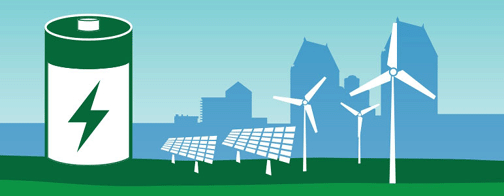 AEMO cautious about over-loading storage on wind, solar farms http://reneweconomy.com.au/aemo-cautious-about-over-loading-storage-on-wind-solar-farms-18966/, By Sophie Vorrath & Giles Parkinson on 11 July 2017 The head of the Australian Energy Market Operator, Audrey Zibelman, has expressed caution about suggestions that new wind and solar farms should have to match their entire capacity with an equivalent amount of battery storage.
The need for wind and solar farms to include battery storage was raised by chief scientist Alan Finkel in his recently released review, although it left such requirements at the discretion of the AEMO.
However, energy minister Josh Frydenberg has been arguing, in both the Coalition party room and in public lectures, that the ratio should approximate one megawatt hour for every megawatt of installed capacity.
Although many wind and solar farms, both new and existing, are considering adding storage to shift their load or provide network services, the requirement of matching each MW for MWh is seen as overkill, and an attempt to turn wind and solar into baseload generators, when flexibility and reliability is the key.
“This is a dynamic issue. So having generators purchase a certain amount (of storage) and thinking (in terms of) once that is done, is probably not going to be the optimal way forward.
“Is that the optimal way to get resources in – in other words to have a static approach – or should we create a dynamic approach where AEMO identifies the amount of reliability that’s required; there’s a mechanism to procure it in the system; and we do it in the most economic way?” Zibelman said.
“We need to make sure the system remains reliable. …The concern I have… is that if you leave it and we set a static number, there’s only one thing that we can be clear about, and that is that it is probably going to be wrong. It’s either going to be too much or too little.
“So we’re going to want think about how do we approach this in a much more dynamic way, with changing the nature of the system.
”So, while I get the desire, I think we would like an opportunity to explore, is that the best result for consumers.”
The CSIRO and Energy Networks Australia have pointed out that most Australian grids will likely not need significant amounts of storage anytime soon because anything less than 30-50 per cent penetrations is “trivial”.
South Australia, however, is reaching saturation, which is why the world’s biggest lithium-ion battery storage project will be located there, followed by others which will allow more wind and solar farms.
Zibelman, speaking at a CEDA conference in Melbourne, said her organisation and others wanted to “get on with it” and implement some of the much needed reforms in the energy market, including some of those identified in the Finkel Review.
“100 per cent of people I have talked to across the industry are saying ‘we’ve got to get on with it,” she said.
“Paula and John and I want to get on with it. … we’ve got to make these changes. We don’t want to waste this crisis.”
Zibelman said she was looking forward to the COAG meeting on Friday and wants them to endorse broad recommendations of Finkel.
“(We’re not only solving issues for Australia) …we’re solving issues for the rest of the world,” she said. “We have to remember that economics is driving all of this. It’s not just about policy.”
Greenhouse gas emissions of Australian States; – Queensland’s the worst
Queensland remains Australia’s biggest greenhouse gas emitter, Brisbane Times, Tony Moore, 12 July 17
Queensland is still Australia’s biggest emitter of greenhouse gasses, according to the latest research released by the federal government.
Those emissions come mainly from coal and gas burned for electricity generation, transport and from land clearing, according to the annual National Greenhouse Accounts. The information, released in May, shows Queensland contributes 28.3 per cent of Australia’s national greenhouse emissions.
Queensland’s carbon emissions increased 0.8 per cent between 2014 and 2015 to 152.1 million tonnes of carbon dioxide equivalent greenhouse gas emissions.
On Tuesday, the Queensland government announced two plans to reduce carbon emissions by 30 per cent by 2030 and to a “net zero” by 2050 compared with 2005 levels.
Australia’s carbon emitters
- Queensland – 28.3 per cent of the nation’s emissions (up 0.8 per cent).
- New South Wales – 24.8 per cent (down 11.6 per cent).
- Victoria – 22.3 per cent (up 2 two per cent).
- Western Australia – 16.1 per cent (up 30.5 per cent).
- South Australia – 5.6 per cent (down 2 per cent).
- Northern Territory – 2.4 per cent (down 24.7 per cent).
- Australian Capital Territory – 0.3 per cent (up 11.2 per cent).
- Tasmania – 0.2 per cent (down 95.4 per cent).
- External territories – 0.01 per cent (up by 151 per cent). Australia’s external territories include Norfolk Island, Christmas Island, Cocos (Keeling) Islands, Heard and McDonald Islands and the Coral Sea Islands…….
The statistics show the biggest contributor to Queensland’s 152 million tonnes of greenhouse gas emissions in 2015 came from stationary energy sources, including electricity generation and manufacturing. Land use changes came a far third.
Overall in Queensland, the greenhouse gas figures showed 55 million tones of greenhouse gas emissions (26.1 per cent) came from energy industries………..http://www.brisbanetimes.com.au/queensland/queensland-remains-australias-biggest-greenhouse-gas-emitter-20170711-gx951t.html
Peter Martin on the role of gas in causing Australia’s high electricity prices
It’s not the wind, it’s the gas. Why power prices are going berserk http://www.brisbanetimes.com.au/comment/it-not-the-wind-its-the-gas-why-power-prices-are-going-berserk-20170712-gx9lxe.html, Peter Martin, 12 July 17
Prepare for a shock. On July 1 electricity prices jumped 15 to 20 per cent in NSW, 16 to 20 per cent in South Australia, 19 per cent in the Australian Capital Territory and 11 per cent in Western Australia.
All this, three years to the day since the Coalition axed the carbon tax.
Victoria gets six months’ grace, with increases of about the same size due in January.
And those are just the retail prices. Wholesale prices and those charged to businesses that buy directly are up an extraordinary 60 to 70 per cent. It’s renewables that are doing it, along with the closure of Victoria’s giant Hazelwood coal-fired power generator, according to Tony Abbott.
The truth is simpler, and speaks volumes about the appalling way we’ve handled energy planning.
In his latest emissions audit prepared for the Australia Institute, the Australian National University’s Hugh Saddler graphs the South Australian wholesale price since 1999 alongside the share of its electricity output produced by wind. There’s no relationship. As the share of wind has climbed to 45 per cent, the wholesale electricity price has moved both up and down in real terms, and even now is slightly below the peak reached in the days when wind powered just 5 per cent of the state.
His second graph shows an ultra-clear relationship. The electricity price has moved up and down in tandem with the gas price, almost exactly.
“The correlation is striking,” Saddler says. “It confirms that higher wholesale electricity prices, and hence higher retail prices, are almost entirely caused by higher gas prices.”
“A similar, though less stark effect is seen in the other mainland eastern states – this is not a malfunction of the National Electricity Market, but precisely how it was expected to operate.”
Gas is the swing fuel. Although it doesn’t supply a particularly large portion of Australia’s electricity, it usually provides the last bit when nothing else is available, and at those moments it determines the price.
Things were set up that way because back in the 1980s and 1990s electricity suppliers around the world realised they would need to transition to low-emission fuels. They wouldn’t go straight away to zero emissions because that would be expensive and low emissions weren’t yet required by law. Instead they met the future halfway, knowing that if instead of building new coal-fired power stations they built new gas-fired ones, they would be better able to deal with the carbon price or carbon rules when they came.
It helped that gas was ridiculously cheap.
But then at about the same time they moved towards a carbon tax, the Rudd and Gillard governments approved massive gas export terminals in Queensland with the ability to suck up gas from as far afield as Bass Strait and ship it to Japan.
For a while, gas prices actually fell as production ramped up in anticipation of the export deals, but couldn’t leave the country. Then, when the terminals were complete and exports began, prices went berserk. Whereas once it had cost gas-fired power stations very little to come in as the swing supplier, suddenly it cost them and their customers big-time.
And there are few other swing suppliers. Coal-fired plants usually can’t do it. They are either on or off, and they take a long time to turn on. Wind can’t do it. The blades are either turning or they’re not. Same with the sun. Only hydro-electricity is as good as gas at rapidly responding to peaks (better, actually) but when the water that turns the turbines is used up, it can’t turn them again until it rains.
Elon Musk and the South Australian government have begun to find a way out. The 100-megawatt battery farm the Tesla chief has promised South Australia (the biggest in the world) will indeed be tiny compared to South Australia’s needs, as Josh Frydenberg, Barnaby Joyce and all manner of Coalition MPs have been quick to point out. But, as the central role of gas has made clear, you don’t need to produce the bulk of the power in order to determine the price for power. What’s needed is to be able to provide the last bit, very quickly, when all alternatives have been exhausted. Far from creating the problem of high prices, South Australia may be able to help solve it.
And it’ll do something else. Its lights went out on September 28 when its gas and wind generators shut down during a storm. Most of them stayed off even after the storm was over because, just like gas cooktops, they can’t be started without electricity. Musk and South Australia are about to gift us a battery.
Shortcomings of the Finkel Energy Review
Finkel: Let’s not be railroaded into a bad deal on clean energy http://reneweconomy.com.au/finkel-lets-not-be-railroaded-into-a-bad-deal-on-clean-energy-77145/, By John Grimes on 13 July 2017 The last decade of climate wars has ground everyone down. People, understandably, want to see a resolution. They want to see a consensus on climate and energy policy and they have looked to the Finkel Review to provide that consensus.
Some have even gone so far as to say that a bad deal is better than no deal at all.
But a bad deal IS a bad deal and neither industry nor the community should put up with a climate change or energy agreement that locks in poor climate change and energy outcomes.
A false consensus has emerged over the Finkel Review and it is important to point out the significant weaknesses with this approach.
It is particularly important that State and Federal Energy Ministers, meeting tomorrow, do not lock in poor climate change and energy outcomes and continue to push for energy market reform.
The Australian Solar Council and Energy Storage Council, as peak national bodies for the solar and energy storage industries, strongly supported the Finkel Review as an independent exercise and we appreciated and applauded the consultation process undertaken by the Review.
The preliminary Finkel Review report stated “we have a once in a generation opportunity to reform the national electricity market” and we agreed.
We expected a blueprint for energy market reform, but the final Finkel Review report fell well short of that mark.
Instead of a blueprint, the Finkel Review delivered a set of piecemeal recommendations that do not represent a design for a 21st century electricity market or pathways to the necessary transformation of our electricity system.
The Finkel Review has five major shortcomings:
- Ignoring the evidence demonstrating the need for major cuts in greenhouse emissions from the electricity sector to meet current and future international greenhouse gas emission targets;
- Underestimating the transformation that is occurring and accelerating in the electricity sector and downplays the likely uptake of household batteries and smart energy systems and fails to recognise the capacity to integrate these systems by a transition to a distributed energy storage system, as envisaged by the CSIRO-ENA Energy Transformation Roadmap;
- Seeking to impose unfair obligations on new renewable energy generation whilst imposing no obligations on existing coal or gas-fired generators – requiring energy storage to be attached to specific projects rather than taking a network systems approach to energy storage will drive up the cost of new renewable energy projects;
- Recommending a Clean Energy Target and proposing emission levels which would lock in higher emissions, when its own evidence indicates the cheapest and most efficient option for the electricity sector are the ‘lowest’ emissions renewable technologies; and
- Recommending an additional regulatory body and giving existing energy regulators additional responsibilities rather than consolidating the number of regulators and reforming the regulatory environment.
- Greenhouse gas emissions
The Finkel Review has modelled the Federal Government’s emissions reduction target of a 26-28% reduction in Australia’s emissions by 2030, rather than responding to the recognised emissions reductions required to meet Australia’s current international treaty obligations.
Further the Review has recommended that the electricity sector targets should be proportional at 28% – ignoring that worldwide the electricity sector offers a greater opportunity for emissions reduction using existing commercial technologies and systems.
It is widely recognised that electricity generation is one of the easiest and lowest cost means of reducing emissions and that the electricity sector can contribute much more than a simplistic proportional share to achieve emissions reductions.
The Climate Change Authority has suggested the electricity sector could reduce its emissions by 66 per cent by 2030 to meet Australia’s international climate change commitments.
The Finkel Review should have modelled significantly greater reductions in electricity sector emissions and drawn its conclusions and recommendations from that.
Transformation of the electricity sector
The Finkel Review states “battery storage is poised to be the next major consumer-driven deployment of energy technology. Upfront costs for solar photovoltaic systems with storage are currently high, with long payback periods for most consumers.
Bloomberg expects the average payback period for residential consumers to fall below 10 years in the early 2020s, with around 100,000 battery storage systems to support rooftop solar photovoltaic generation predicted to be installed by 2020.”
The Australian Solar Council and Energy Storage Council is currently undertaking a comprehensive analysis of the Australian energy storage market and we estimate 120,000-500,000 battery storage systems are likely to be installed in Australia by 2020.
CSIRO and Energy Networks Australia have forecast there could be almost eight gigawatt hours of storage in Australia by 2020.
It is likely the Finkel Review will significantly underestimate the uptake of battery storage and the capacity to integrate residential and small business energy storage systems into a much larger peoples power plant or virtual power station.
This is not simply a large missed opportunity, it is a failure to plan for the likely reality.
The history of solar technology deployment shows us that cost reductions and uptake have always exceeded forecasts. Bloomberg itself draws attention to the innate and consistent conservatism in its new energy technology forecasts.
Generator Reliability Obligations on new renewable energy plants
The Finkel Review’s recommendation to require all new generators to have energy storage could significantly increase the number of large-scale energy storage projects up to and beyond 2020, although it may also artificially drive up the cost of large-scale renewable energy projects, reducing their viability.
This is a requirement not imposed on current generators of any technology. Coal and other fossil fuel generators, are intermittent generators: they provide firm power only when they are generating– and in Australia that is around 85% of the time. The other 15% is provided by providing additional capacity into the network.
The proposed Generator Reliability Obligation (GRO) will almost certainly be a higher cost approach than a market-based approach to firm capacity in the network.
It is discriminatory ultimately at the customers’ expense and ignores the engineering and network systems-based solutions that are being implemented world-wide to meet the outcomes sought.
The GRO may also ignore the potential for off-river pumped hydro to provide a range of services to the network including firm power to the grid complementary to variable renewable generators.
The Review has proposed a backward-looking engineering solution when it should have simply defined the outcomes desired.
The world is moving to transform grids to intelligent distributed two-way energy flow systems because they offer increased security, reliability and quality of supply at a lower cost than new fossil fuel or nuclear based generation.
There are more effective ways to add storage to the national electricity market through a system-wide approach.
One option would be to encourage the market to develop proposals through reverse auctions, which would determine the price and locations of energy storage systems. Another option would be through a capacity market.
Evidence was given to the Review on the importance of demand response and demand management tools and the critical role of digitisation and software management which it appears has not been understood.
Closure of coal-fired power stations
The Finkel Review has suggested there be a minimum notification period of at least three years for the intention to close coal-fired power stations.
This is an administrative arrangement with no financial or planning signals for closure and is not as efficient as a market mechanism. It provides no mechanism for the orderly closure of coal-fired power stations.
All this proposal does is to provide a small amount of certainty over a three-year period. It provides no means of ensuring continued operation, or operation on demand, and provides no specific incentive for new generation.
It also fails to match closures to emissions reductions. Less polluting power stations could close before more emissions intensive power stations.
We urge COAG Energy Ministers to take a different approach and develop a plan for the orderly closure of coal-fired power stations. We believe the model from the ANU, developed by Professor Frank Jotzo and others, offers a better path using market based mechanisms.
Clean Energy Target
The proposal for a Clean Energy Target appears to be a political solution to a political problem, rather than an attempt to introduce the most effective mechanisms for reducing emissions and encouraging renewable energy generation and energy storage.
The Australian Solar Council and Energy Storage Council support the continuation of current state government reverse auction programs in the absence of a national reverse auction scheme for renewable energy or a national price on carbon.
If the Government proceeds with a less efficient Clean Energy Target, the emissions intensity threshold must be set at a level that helps deliver Australia’s international climate change commitments and must be flexible enough that it can be changed to capture Australia’s future climate change commitments.
Governance
The National Electricity Market is not functioning effectively and the multitude of agencies responsible for the NEM adds to the confusion and inefficiency. Australia is the only country where the two energy market functions sit in separate bodies.
In its 2012 report on network regulation, the Productivity Commission was particularly critical of what it saw as the unusual role of AEMC in setting policy, rather than serving policy makers.
Unfortunately, the Finkel Review increases this complexity by recommending a new body, the Energy Security Board, and giving new responsibilities to existing agencies.
Governance arrangements need to be streamlined, with the Australian Energy Market Operator and the Australian Energy Market Commission merged. The new body should be led by someone who understands the extraordinary transformation that the electricity sector is going through globally and in Australia.
We believe that Energy Ministers need to take responsibility for preparing a national energy plan that takes a broader view of the changes needed for the future and puts implementation in the hands of governments as far as possible. The previous issues caused by outsourcing policy making to the AEMC should be avoided.
Other Matters
The Australian Solar Council and Energy Storage Council calls on all Energy Ministers to endorse the following measures:
- Establish a plan for the orderly closure of coal-fired power stations;
- Make action on climate change a key objective of the National Electricity Market and ensure that all climate change and energy policies are consistent with Australia’s international climate change obligations;
- Commit to at least 50 per cent renewables by 2030;
- Introduce a 5-minute settlement rule;
- Enable markets in peer to peer trading and demand response; and
- Replace the Australian Energy Regulator and Australian Energy Market Commission with a new combined energy market rule maker and regulator.
A bad deal is not better than no deal at all.
A bad deal locks in poor climate change and energy outcomes.
Energy Ministers still have a “once in a generation opportunity to reform the national electricity market” and we urge them to continue that work.
1 This month

of the week – Australians for War Powers Reform (AWPR)
To see nuclear-related stories in greater depth and intensity
 Antinuclear