
This article raises the question of what the authorities are doing in Woomera, South Australia with weapons wastes?
More than three decades ago, Congress banned American industries and localities from disposing of hazardous waste in these sorts of “open burns,’’ concluding that such uncontrolled processes created potentially unacceptable health and environmental hazards.
That exemption has remained in place ever since, even as other Western countries have figured out how to destroy aging armaments without toxic emissions.
Federal environmental regulators have warned for decades that the burns pose a threat to soldiers, contractors and the public stationed at, or living near, American bases.
“They are not subject to the kind of scrutiny and transparency and disclosure to the public as private sites are,”
 How The Pentagon’s Handling Of Munitions And Their Waste Has Poisoned America
Many nations have destroyed aging armaments without toxic emissions. The U.S., however, has poisoned millions of acres. Huffington Post, 20/07/2017 Co-published with ProPublica 20 July 17 RADFORD, Va. — Shortly after dawn most weekdays, a warning siren rips across the flat, swift water of the New River running alongside the Radford Army Ammunition Plant. Red lights warning away boaters and fishermen flash from the plant, the nation’s largest supplier of propellant for artillery and the source of explosives for almost every American bullet fired overseas.
Along the southern Virginia riverbank, piles of discarded contents from bullets, chemical makings from bombs, and raw explosives — all used or left over from the manufacture and testing of weapons ingredients at Radford — are doused with fuel and lit on fire, igniting infernos that can be seen more than a half a mile away. The burning waste is rich in lead, mercury, chromium and compounds like nitroglycerin and perchlorate, all known health hazards. The residue from the burning piles rises in a spindle of hazardous smoke, twists into the wind and, depending on the weather, sweeps toward the tens of thousands of residents in the surrounding towns.
Nearby, Belview Elementary School has been ranked by researchers as facing some the most dangerous air-quality hazards in the country. The rate of thyroid diseases in three of the surrounding counties is among the highest in the state, provoking town residents to worry that emissions from the Radford plant could be to blame. Government authorities have never studied whether Radford’s air pollution could be making people sick, but some of their hypothetical models estimate that the local population faces health risks exponentially greater than people in the rest of the region. Continue reading →
July 21, 2017
Posted by Christina Macpherson |
Uncategorized |
Leave a comment
 Correspondence with Rowan Ramsay MP (2014-present) https://www.righttoknow.org.au/request/correspondence_with_rowan_ramsay/new
Dan Monceaux made this Freedom of Information request to Australian Nuclear Science and Technology Organisation
Currently waiting for a response from Australian Nuclear Science and Technology Organisation, they must respond promptly and normally no later than August 21, 2017 (details).
From: Dan Monceaux Delivered July 20, 2017
Dear Australian Nuclear Science and Technology Organisation,
I wish to receive electronic copies of all correspondence between ANSTO and Rowan Ramsey MP from the years 2014 to present (inclusive).
I am making this request under the Freedom of Information Act 1982.
Yours sincerely,
Dan Monceaux
July 21, 2017
Posted by Christina Macpherson |
AUSTRALIA - NATIONAL, wastes |
Leave a comment
Thawing permafrost poses even greater global warming threat than previously thought, suggests study As the world warms, methane trapped underneath the frozen tundra could be released, increasing the rate of warming in a vicious circle, The Independent, Ian Johnston Environment Correspondent @montaukian 19 July 17 Runaway global warming is, without a doubt, a nightmare scenario for humanity.
As the temperature rises, it has knock-on effects that drive the mercury higher still in a vicious circle that the likes of Professor Stephen Hawking have warned could turn the Earth into a planet like Venus, where it’s a balmy 250 degrees Celsius and the rain is made of sulphuric acid.
One of the most feared of these feedback loops is the vast amount of organic material currently trapped in permafrost, which would release methane and other greenhouse gases in large amounts given the right conditions.
And now a team of researchers has discovered another significant source of emissions that would result from the thawing of the tundra. For the frozen ground acts as a cap on much more ancient gas deposits, preventing them from escaping into the atmosphere.
These seeps were known about, but just how important they would be was poorly understood.
The new study, of 10,000 square kilometres of the Mackenzie Delta in Canada, found that the seeps there were responsible for 17 per cent of the total emissions from the land even though they were only found in about one per cent of the area, according to a paper in the journal Scientific Reports……..
the thawing of permafrost in places like the coastal plains of North Alaska and the major river basins of Siberia could open up new methane seeps.
By studying the Mackenzie Delta, Professor Sachs said the researchers had opened “a window into the future”.
How big an effect this new source of methane would be was “speculative”, he added, adding that further study was needed to try to work this out. http://www.independent.co.uk/news/science/thawing-permafrost-global-warming-climate-change-glaciers-antarctic-threat-mackenzie-delta-a7849211.html
July 21, 2017
Posted by Christina Macpherson |
Uncategorized |
Leave a comment
 If Turnbull’s plan becomes law – and the prospects of the Opposition stopping anything to do with ‘fighting terrorism’ are remote – we can expect a terrorist attack to trigger an emergency response from the Special Operations Command, whose officers will have to be trained to shoot to kill other Australians.
As Australia becomes increasingly militarised, it is possible that the Tactical Assault Group could be called out for an anti-war demonstration, anti-mining protest, or industrial strike, and may be told that the people it confronts are enemies of the state and therefore terrorists. It makes me think of those signs you see on American suburban lawns: ‘Beware, Armed Response.’
ALISON BROINOWSKI. Beware, armed response. http://johnmenadue.com/alison-broinowski-beware-armed-response/ 19 July 2017
Now that we have concrete bollards in Martin Place and Swanston Street and on Capital Hill, as well as fences to stop citizens strolling or rolling over the Parliament House grass, you’d think that in exchange for the aesthetic damage inflicted on us we must be safe. After all, Australia has had only five fatal terrorist attacks since the mysterious Hilton Hotel bombing in 1978. The risks we face from lightning strikes, sharks and crocodiles, or indeed bee-stings and falling furniture, are incomparably greater.
But terrorism is serious political business and once the threat of an attack is officially listed as ‘probable’, no government is brave enough to reduce it. Politicians have to be seen to be responding robustly to the danger. Continue reading →
July 21, 2017
Posted by Christina Macpherson |
AUSTRALIA - NATIONAL, civil liberties, safety |
Leave a comment
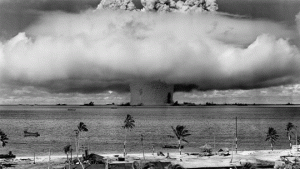 Narratively, by Zoë Carpenter , 20 July 17 After a series of military experiments devastated their homeland, Marshall Islands residents were permitted to immigrate to the U.S. But they didn’t know their American dream came with a catch
Lately, Terry Mote has been going to a lot of funerals. There were at least five in the early spring, sometimes on consecutive weekends. The elderly get sicker when the weather changes, he’s noticed – though the friends dying lately aren’t all that old, and they aren’t dying just because of the weather.
One breezy evening in April, on a weekend with no funeral, Mote’s kitchen filled with steam and the snapping sound of hot oil. He’d driven a hundred miles the previous day, to Oklahoma City, to buy bitter melon and small fish that he placed delicately into the frying pan with a pair of tongs. They were among the things he missed from the Marshall Islands, where he grew up. Fresh seafood is hard to find in the dry, windy city where he lives now – Enid, Oklahoma, a hunkered-down prairie town at the eastern edge of the Great Plains…….
Many leave the islands in search of the same things as other migrants – work, education, health care. But an unusual shadow trails the Marshallese. Following the Second World War, the United States used the islands as a testing ground for its nuclear weapons program, detonating more than 60 bombs over a dozen years. The largest, the “Castle Bravo” test, blew a crater 6,510 feet wide in the lagoon of Bikini Atoll and ignited a fireball visible from 250 miles away. Children on neighboring islands played in the ashy fallout, which fell like snow from the sky.
Today, thanks to a treaty signed when the Marshall Islands gained independence from the U.S. in 1986, Marshallese citizens are allowed to live and work in the States. Between 2000 and 2010, the number here grew by 237 percent. This mass migration is driven in part by poverty and lack of services in the islands. But it’s also a legacy of the U.S. occupation and the various damages it left behind. And it’s accelerated by climate change, which has started to drown the low-lying archipelago……
Mote and many other Marshallese in the U.S. live in a precarious state of in-between. Granted residency but not citizenship, the Marshallese have virtually no political influence and rank as the single poorest ethnic group in the U.S. In 1996, the Personal Responsibility and Work Opportunity Reconciliation Act of 1996 (or welfare reform) eliminated federal health care funding for Marshallese by excluding them from the group of “qualified aliens” who are eligible for benefits. That means that Marshallese citizens who live, work and pay taxes in the U.S. are ineligible for Medicaid and Medicare unless states opt to provide it. Oklahoma has not done so.
Mote loves Enid, but life is more difficult than he anticipated. Rent and groceries are expensive, and there is the problem of the funerals. Few of the elderly Marshallese in the city live into their 70s, according to Mote and other residents I spoke with. Instead, they’re dying young – of diabetes, kidney failure and heart disease, illnesses they might have been able to manage under other circumstances. Often they leave behind families saddled with medical debt.
Mote described the struggle in his community as part of a legacy of broken promises made by the U.S. – promises that the islanders displaced by the nuclear program would be able to return; that those relocated or sickened would be provided for; that the testing was for “the good of mankind.” America tested 67 nuclear bombs in the islands, Mote reminded me. “Then they’re just going to let us die over here?” Continue reading →
July 21, 2017
Posted by Christina Macpherson |
Uncategorized |
Leave a comment
 ‘Almost exponential’: Green bank eyes rapid renewables growth as doubts linger, SMH Peter Hannam, 20 July 17 Investments by the government’s $10 billion clean energy fund are growing at an “almost exponential” rate but growth could shudder to a halt if the industry’s post-2020 policy is not settled, according to the agency’s new head, Ian Learmonth.
Mr Learmonth, who took on the role of chief executive of the Clean Energy Finance Corp, said the fund had about 50 transactions in the pipeline worth about $4 billion of its own funds. Based on previous years’ results, partners joining the CEFC would lift the total investment value to $10 billion.
In the year to June 30, the CEFC committed to 35 projects in wind, solar, storage and energy efficiency projects worth almost $2.1 billion, more than double the previous year’s tally and close to five times the size of its first-year investments in 2014-15.
“We feel like we’ve gone mainstream these days,” Mr Learmonth told Fairfax Media on the sidelines of the Clean Energy Summit in Sydney, adding that Prime Minister Malcolm Turnbull and Environment and Energy Minister Josh Frydenberg had trumpeted the fund’s activities. “I don’t have any concerns about the political issues around the organisation.”……
Mr Frydenberg said “appointments to the Clean Energy Finance Corporation will be announced before the next scheduled board meeting in August”. He did not say if any of the four, including chair Jillian Broadbent, would have their terms extended. http://www.smh.com.au/environment/climate-change/almost-exponential-green-bank-eyes-rapid-renewables-growth-as-doubts-linger-20170717-gxd7pj.html
July 21, 2017
Posted by Christina Macpherson |
AUSTRALIA - NATIONAL, energy |
Leave a comment
Smaller businesses are installing rooftop solar at unprecedented rates (which explains why solar is by far the most popular technology choice)
 Business slowly wakes up to reality that renewables are cheap http://reneweconomy.com.au/business-slowly-wakes-reality-renewables-cheap-32040/, By Giles Parkinson on 19 July 2017 One Step Off The Grid Consider these two propositions: The top reason cited by Australian business for using more renewables it that it costs less. The top reason cited by Australian business for not using renewables it that it costs more.
As Ivor Frischknecht, the head of the Australian Renewable Energy Agency observes, both propositions cannot be right. It is pretty obvious now that the right answer is that renewables cost less, but ignorance is hurting business, as well as Australia’s policy debate.
Less than half of Australian businesses – according to a new ARENA report – actually source any renewable energy at all, and when they do it assumes only a minor role (less than 10 per cent of the needs of the user).
The lack of knowledge is perhaps understandable – the arrival of cheap renewables is not something that gathers much mainstream media attention, despite the soaring cost of grid power to its current ridiculously high levels.
Two of the biggest corporate investments in renewable energy have received little or no mainstream media coverage.
These include the Sun Metals investment in a 116MW solar farm to underpin the expansion of its zinc refinery in north Queensland; and the commitment by Nectar Farms to power the country’s largest glasshouse for vegetable crops with just wind and battery storage, preventing a project from heading overseas due to high energy costs in Australia.
Telstra got a lot of publicity for its recent commitment to a 70MW solar farm in Queensland, but as Nada Kalam, an electrical engineer for Telstra Energy says, it was no easy job.
“The economics for a solar PPA speaks for itself,” Kalam said. “Financially it totally makes sense.” But, Kalam added, it was hard work to get it through the system.
“It took a while but it set a precedent,” she said at the Clean Energy Summit on Tuesday. “We showed it is very doable and we built trust about the process. This is something we can do more of and at a faster pace.” Continue reading →
July 21, 2017
Posted by Christina Macpherson |
AUSTRALIA - NATIONAL, business, energy |
Leave a comment
-
Queensland energy minister stands down amid email investigation
A blow to the state-based renewable energy and climate effort as Queensland energy minister Mark Bailey is sidelined by allegations of corruption.
-
Hazelwood gone today – Liddell gone tomorrow. Are we ready?
Early action on transmission should be at the top of the new Energy Security Board’s agenda if we are to connect enough wind and solar and hydro to replace retiring coal generators.
EnergyAustralia signs PPA for 150MW Neoen solar farm in NSW
EnergyAustralia has agreed to buy 100MW of output from planned Neoen solar farm in NSW – its 5th renewables PPA in seven months.
Rooftop solar shock for consumers, installers as rebate price falls by one-third
Price of rooftop solar to jump 10%, and catch many installers unawares, due to sudden fall in price of rebate certificates after record amounts of new solar in past 6 months.
-
Former Wallaby player and European energy veteran joins Wirsol Energy Pty Ltd
WIRSOL Energy, part of the WIRCON Group, has appointed Bill Calcraft as non-executive director of its Australian operations, to focus on expanding WIRSOL Energy’s relationships in Australia, bringing a wealth of experience in the European energy sector to WIRSOL Energy’s thriving business.
-
GreenSync awarded CEC innovation award
GreenSync has won the 2017 Clean Energy Council Innovation Award in conjunction with AusNet Services and Power Tech for their work on the Mini Grid project in Mooroolbark, Victoria.
-
Photon Energy mandates Pottinger as financial advisors for Australian project pipeline
Global solar power solutions provider Photon Energy NV has mandated financial and strategic advisory firm Pottinger Co Pty Limited, to advise on a capital raising for a solar PV project pipeline with a total generation capacity of over 1 GW in Australia.
-
Transgrid: 100% renewables is feasible and affordable
Network operator Transgrid says 100 per cent renewable energy is both feasible and affordable, and says only incremental increases in renewable energy will not achieve potential falls in the cost of electricity.
-
July 21, 2017
Posted by Christina Macpherson |
AUSTRALIA - NATIONAL, energy |
Leave a comment
Cuts proposed by Australia’s CSIRO in monitoring of the Southern Ocean stirred similar concerns last year before a public outcry prompted the Turnbull government to step in to create a special climate centre with longer-term funding guaranteed.

 ‘Frightening’: Senior climate scientist warns of potential Donald Trump damage http://www.smh.com.au/environment/climate-change/frightening-senior-climate-scientist-warns-of-potential-donald-trump-damage-20170719-gxe3xm.html, Peter Hannam, 20 July 17 Budget cuts to key US climate programs proposed by President Donald Trump are “frightening” for the global science community, threatening to set back recent advances, a leading international researcher says.
Valerie Masson-Delmotte, co-chair of the Intergovernmental Panel on Climate Change working group, said the planned cuts were “a major worry” given America’s outsized contribution to the global research.
“I cannot hide the huge anxieties about the strength of research capacities in the US in the coming years,” Dr Masson-Delmotte said.
Geosciences, including climate research, face cuts of as much as 40 per cent, including the scrapping for four climate-related satellites. “It’s a major worry given the weight of the US scientific communities” in this field, she said.
US work includes as much as 30 per cent of ocean climate research, and running core data centres used by international researchers. Such cuts, if applied, would be difficult for US universities – or other nations – to fill. Continue reading →
July 21, 2017
Posted by Christina Macpherson |
Uncategorized |
Leave a comment
-
Lawyer Steven Skala named new chair of Clean Energy Finance Corp
Lawyer and ABC director Steven Skala named chair of $10 billion CEFC, three women appointed to board.
-
Australia becomes 35th member of International Solar Alliance
Launched in Paris during the COP21 summit, the International Solar Alliance, spearheaded by India and France, has this week welcomed Australia to the fold.
July 21, 2017
Posted by Christina Macpherson |
AUSTRALIA - NATIONAL, energy |
Leave a comment








 Antinuclear