 Australia records hottest July, Bureau of Meteorology says ABC News, 2 Aug 17 By Kristian Silva, Lucy Marks and staff Australia has had its warmest July on record, the Bureau of Meteorology (BOM) has said. A BOM report released today shows the country’s average July temperature was at its highest in more than 100 years of weather recording.
BOM forecaster David Crock said the warmest parts had been through Queensland, the Northern Territory, northern Western Australia and New South Wales. Mackay, in central Queensland, had its hottest July day on record at 28.9C on July 19, beating the previous record set only the year before.
“The month has been dominated — at least in eastern Australia — by a ridge of high pressure which has seen very clear skies and a warm air mass sit over the country for days and weeks at a time,” he said.”The inland areas have certainly been warmer away from the cooling influence of the ocean … but certainly some of the temperature anomalies extend right across northern Australia.
“Queensland had its warmest July on record for both maximum and minimum temperatures across the whole state — parts of Queensland have been very dry.” Mr Crock said temperatures had remained warm because the high-pressure system prevented cold fronts moving north from Victoria and NSW.
BOM meteorologist Greg Browning said it was “basically this background warming signal that we’re seeing right across the globe associated with global warming”.
“It seems like the warming conditions we’ve seen right across the globe are just becoming commonplace, and we’re seeing them in monthly temperatures on a regular basis.”
In the Northern Territory, the mean maximum temperature was 3 degrees Celsius above average — the mercury was the highest it had been in July since records began more than 100 years ago. Those in Darwin also sweltered through the nights with only six overnight lows under 20C, while the average for July is 18.5 nights below 20C.
New South Wales recorded the second month in a row of rainfall in the lowest 10 per cent of years since records began in 1910. The hottest July days ever recorded were in Brewarrina, Sydney, Bathurst, Dubbo and Scone.
BOM senior climatologist Blair Trewin said quite a few sites were also showing up as the highest average daytime temperature for July. “It is likely that overall this year the state of New South Wales as a whole will record in the top three years for the highest average daytime temperature for July,” Mr Trewin said.
Mr Trewin said a number of centres in the Riverina also recorded their lowest rainfall figures ever.”Following on from June, which was also very dry pretty well everywhere west of the ranges, it has been pretty dry through much of the state, particularly in the southern and central inland,” he said.
Research published in Nature Climate Change last week indicated the hot and dry climate system would increase in frequency if global warming was kept to the Paris Climate Summit target of 1.5C…. http://www.abc.net.au/news/2017-08-01/australia-records-hottest-july-on-record-bom-says/8762560
August 2, 2017
Posted by Christina Macpherson |
AUSTRALIA - NATIONAL, climate change - global warming |
Leave a comment
 Dahr Jamail | Scientists Warn of “Biological Annihilation” as Warming Reaches Levels Unseen for 115,000 Years, July 31, 2017By Dahr Jamail, Truthout | Report Camp 41, Brazilian Amazon –– Less than 30 years ago, the Earth’s tropical rainforests held the carbon equivalent of half of the entire atmosphere. But as atmospheric CO2 has escalated along with the deforestation of so much of the tropics, that is no longer the case. Nevertheless, carbon stored in tropical rainforests is still significant. According to NASA, “In the early 2000s, forests in the 75 tropical countries studied contained 247 billion tons of carbon. For perspective, about 10 billion tons of carbon is released annually to the atmosphere from combined fossil fuel burning and land use changes.” This is one of the countless reasons why losing them would be catastrophic to life on Earth.
I’m writing this dispatch just having emerged from the heart of the Amazon, the most biodiverse place on the planet. I was fortunate enough to spend some time with Tom Lovejoy, known as the “Godfather of Biodiversity,” at the famous Camp 41, which is filled with researchers and scientists. Throughout our conversations, Lovejoy emphasized the staggering amount of biological diversity in the Amazon, which has thousands upon thousands of species of trees, fish, birds, plants and astronomical numbers of insect species.
“We’ve only scratched the surface, and are discovering new species of birds all the time,” said Lovejoy, who was the first person to use the term “biological diversity” in 1980 and made the first projection of global extinction rates in the “Global 2000 Report to the President” that same year……..
Lovejoy warns that as anthropogenic climate disruption (ACD) progresses and temperature limits continue to be exceeded, we are losing parts of the biosphere that we don’t even know exist……..
Having long since warned that the Sixth Mass Extinction event is already well underway, in a study recently published in the journal, Proceedings of the National Academy of Sciences, researchers said that billions of populations of animals have already disappeared from Earth, amid what they called a “biological annihilation,” and admitted that their findings revealed a situation that was worse than they’d previously thought. The study showed that more than 30 percent of all vertebrates are experiencing declining populations, and the prime drivers of the annihilation are human overpopulation and overconsumption, especially by the rich, as well as habitat destruction, pollution and of course, ACD…..
recently published research generated at Cornell University revealed that by 2100, a staggering 2 billion people, or one-fifth of the total global human population, could become ACD refugees due to rising seas alone.
“We’re going to have more people on less land and sooner than we think,” lead author Charles Geisler, professor emeritus of development sociology at Cornell, said. “The future rise in global mean sea level probably won’t be gradual. Yet, few policy makers are taking stock of the significant barriers to entry that coastal climate refugees, like other refugees, will encounter when they migrate to higher ground.”…..
Water: As usual, there is ample evidence of ACD’s impacts across the watery realms…..
Air: Hot temperature records and extreme heat waves continue to be the norm, and they are intensifying…..http://www.truth-out.org/news/item/41425-biological-annihilation-trillion-ton-icebergs-warming-levels-unseen-for-115-000-years
August 2, 2017
Posted by Christina Macpherson |
General News |
Leave a comment
Climate change will almost certainly heat the world so much it can never recover, major study finds There’s only a 10 per cent chance we’ll avoid widespread drought, extreme weather and dangerous increases in sea level, The Independent, Andrew Griffin @_andrew_griffin 1 Aug 17, The world will almost certainly reach a tipping point and bring about unstoppable, destructive climate change, according to a new study.

There is a 90 per cent chance that the world’s temperature will rise 2C, to 4.9C above pre-industrial levels by the end of the century, despite measures to reduce greenhouse gas emissions.
It’s at that point that scientists think the world will fall into disastrous effects like widespread drought, extreme weather and dangerous increases in sea level. Experts have suggested that 2C of warming is the “tipping point” at which that change becomes unstoppable.
The world will almost certainly fail to keep warming to the 1.5C target that was set as part of the Paris climate agreement, according to the same research. There’s a 99 per cent chance that climate change will break through that limit.
Dr Dargan Frierson, from the University of Washington, said: “Countries argued for the 1.5C target because of the severe impacts on their livelihoods that would result from exceeding that threshold. Indeed, damages from heat extremes, drought, extreme weather and sea level rise will be much more severe if 2C or higher temperature rise is allowed.
Our results show that an abrupt change of course is needed to achieve these goals.”The scientists looked at 50 years of data on world population and economic activity to come up with their forecast. One factor taken into account was “carbon intensity”, the amount of carbon emitted for each dollar of economic activity.
The approach is different from that taken by the Intergovernmental Panel on Climate Change (IPCC), whose most recent report included future warming rates based on four carbon emission scenarios……
The findings are published in the journal Nature Climate Change.A separate study in the same journal found that even if all fossil fuel emissions were halted this year, global temperatures were very likely to be 1.3C higher than pre-industrial levels by the end of the century.There was a 13% chance that the Earth was already committed to 1.5C warming by 2100, said the authors led by Dr Thorsten Mauritsen, from the Max Planck Institute for Meteorology in Germany. http://www.independent.co.uk/environment/climate-change-global-warming-tipping-point-degree-temperature-study-a7869641.html
August 2, 2017
Posted by Christina Macpherson |
Uncategorized |
Leave a comment
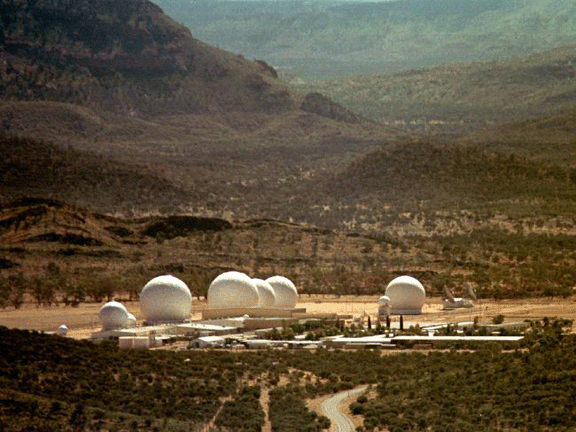
What is more pressing for the Canberra apparatchiks is what a base like Pine Gap does in the context of spats with other powers which Australia shares ties with. The China rise is particularly problematic, given the teeth-gnashing belligerence being shown over maritime disputes.
Even as Chinese nationals purchase Australian real estate, tremors between Washington and Beijing can be felt as the base celebrates its half-century. A happy birthday it would have been, but only for some.
The Alice Spring News Online described it, not inaccurately, as a “stealth party.” The Convention Centre hosting the dinner was tight lipped throughout the week about the guest list. “Unfortunately the details of this weekend’s event are not available for public release.” Not for residents in Alice Springs; not for the electors, or even the politicians. This would be an imperial, vetted affair.
A sense about how the base functions in a defiant limbo, one resistant to Australian sovereignty, can be gathered in various ways. The local federal member, Chansey Paech, whose constituency hosts the base, was not invited. Senator Nigel Scullion’s query about the exclusion of media from the event was rebuffed by the Defence department, with the Defence Minister keen to hold the line against her own colleague.
The Institute for Aboriginal Development (IAD), charged with supplying the indigenous “welcome to country” gathering at such bashes, seemed less than pleased to supply details. When the intrepid Alice Springs News Online dared ask, the CEO Kerry Le Rossignol responded with a dismissive “No comment.”
On July 25, a Defence spokesperson insisted that, “The Joint Defence Facility Pine Gap is proud to commemorate its 50th anniversary. However, celebrations are restricted to site personnel and invited guests only.” Power without perusal; might, without scrutiny. Continue reading →
August 2, 2017
Posted by Christina Macpherson |
AUSTRALIA - NATIONAL, politics international, weapons and war |
Leave a comment
 Sen. Lindsey Graham: Trump Says War With North Korea an Option, NBC News 2 Aug 17, by ERIK ORTIZ
There will be war between the United States and North Korea over the rogue nation’s missile program if it continues to aim intercontinental ballistic missiles at America, Sen. Lindsey Graham, R-S.C., said President Donald Trump has told him.
“He has told me that. I believe him,” the lawmaker said Tuesday on TODAY. “If I were China, I would believe him, too, and do something about it.”
Graham said that Trump won’t allow the regime of Kim Jong Un to have an ICBM with a nuclear weapon capability to “hit America.”
“If there’s going to be a war to stop [Kim Jong Un], it will be over there. If thousands die, they’re going to die over there. They’re not going to die here. And He has told me that to my face,” Graham said.
“And that may be provocative, but not really. When you’re president of the United States, where does your allegiance lie? To the people of the United States,” the senator said.
Military experts have said there are no good options for peacefully stopping North Korea, although the National Security Council has previously presented Trump with possibilities that could include putting American nukes in South Korea or killing Kim Jong Un.
Graham said military experts are “wrong” that no good options exist.
“There is a military option to destroy North Korea’s program and North Korea itself,” he added. Ultimately, a conflict in the region that would likely ensnare China and South Korea could claim millions of lives……..http://www.nbcnews.com/news/north-korea/sen-lindsey-graham-trump-says-war-north-korea-option-n788396
August 2, 2017
Posted by Christina Macpherson |
Uncategorized |
Leave a comment
Trump at times vowed during the 2016 presidential election campaign to withdraw from the agreement, which was signed by the United States, Russia, China and three European powers to curb Iran’s nuclear program in return for lifting most Western sanctions.
Trump has preserved the deal for now, although he has made clear he did so reluctantly after being advised to do so by Tillerson.
“He and I have differences of views on things like JCPOA, and how we should use it,” Tillerson said at a State Department briefing, using the acronym for the deal, formally called the Joint Comprehensive Plan of Action (JCPOA).
Tillerson said that Washington could “tear it up and walk away” or stay in the deal and hold Iran accountable to its terms, which he said would require Iran to act as a “good neighbor.”
Critics say the deal falls short in addressing Iran’s support for foreign fighters in Iraq and Syria, arms shipments around the Middle East and ballistic missile tests.
The White House did not immediately respond to a request for comment on Tillerson’s remarks.
Trump said in an interview with the Wall Street Journal last month that he predicts Iran will be judged “noncompliant” with the Iran deal at the next deadline in October, and that he would have preferred to do so months ago.
Tillerson expressed a more nuanced view of the deal’s potential benefits on Tuesday.
“There are a lot of alternative means with which we use the agreement to advance our policies and the relationship with Iran, and that’s what the conversation generally is around with the president as well,” Tillerson said.
European officials would likely be reluctant to re-impose sanctions, especially the broader measures that helped drive Iran to negotiate over its nuclear program in the first place, he said.
New U.S. sanctions on Iran in July were a breach of the nuclear deal and Tehran had lodged a complaint with the body that oversees the pact’s implementation, a senior Iranian politician said.
Tillerson acknowledged that the United States is limited in how much it can pressure Iran on its own and said it was important to coordinate with the other parties to the agreement.
“The greatest pressure we can put to bear on Iran to change the behavior is a collective pressure,” he said. Reporting by Yeganeh Torbati; editing by Grant McCool
August 2, 2017
Posted by Christina Macpherson |
General News |
Leave a comment
Last Friday, landowners who volunteered a site for the National Radioactive Waste Management Facility made a trip to Australia’s home of nuclear science, the Australian Nuclear Science and Technology Organisation (ANSTO).
Brett and Michelle Rayner, who volunteered part of their property for consultation on the national facility, toured ANSTO, meeting with ANSTO’s CEO and the local Mayor.
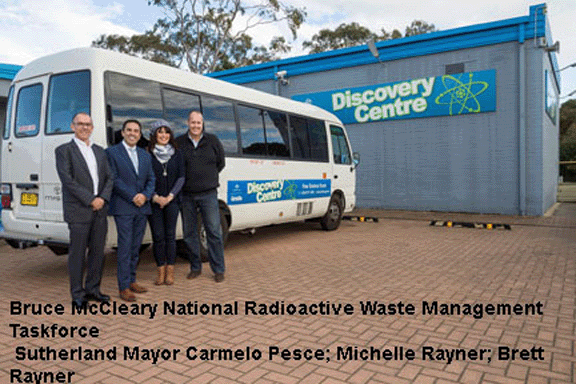
Brett said that the experience showed him that the waste was even safer than he thought.
“I was originally against the proposal, but after attending the community meetings I got the information and could see that there are no safety risks and there is opportunity for our community,” he said
“Based on that I volunteered my land, but coming to ANSTO and seeing this operation in person has really confirmed for me that this waste can and is being safely managed,” he said.
Being able to walk up to the intermediate level waste and touch the container it’s stored in, and to hear and see the different ways that the waste is treated to make it safe, was amazing.
“There is so much more done with this one reactor than I even imagined, so it was great to be able to come, see the way things are done here, and ask all your questions.”
 Michelle said that she really enjoyed the opportunity to come and see the reality of what waste storage looks like.
“What’s done at ANSTO is just mind-blowing, and what stood out is the wide variety of research that goes on here, that people maybe don’t realise the huge contribution nuclear science makes.”
Michelle said that she really enjoyed the opportunity to come and see the reality of what waste storage looks like.
“It has been extremely informative, it’s really opened our eyes to how safe the waste is – in many ways it is no scarier than a garbage bin,” she said.
“What’s done at ANSTO is just mind-blowing, and what stood out is the wide variety of research that goes on here, that people maybe don’t realise the huge contribution nuclear science makes.”
August 2, 2017
Posted by Christina Macpherson |
AUSTRALIA - NATIONAL, Federal nuclear waste dump |
Leave a comment
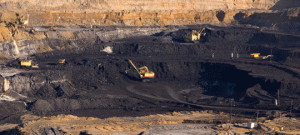 Adani loan too much of a risk for taxpayers according to independent study, The Age, Mark Kenny, 31 July 17,
A $1 billion concessional loan to the controversial Adani Carmichael mine project in Queensland’s Galilee Basin could expose taxpayers to a high risk of losing their money, according to an independent business analysis.
The economic assessment of the troubled project’s outlook found the collapsing coal price, the uncertain global picture for thermal coal, and the $21.7 billion project’s heavy reliance on external financing contributed to a high risk for taxpayers.
Among the problems was Adani’s hope of using the Northern Australia Infrastructure Facility to fund a key part of the project – a rail link to Abbot Point – while relying extensively for security on the availability of other, as yet unsecured, debt and equity financing.
The assessment was done by the business consulting firm, ACIL Allen, and commissioned by the Australian Conservation Foundation. The study was fully independent of both the ACF and Adani, and forms the basis of a submission from the environmental group to a Senate Economics References Committee currently examining the “Governance and Operation of the Northern Australia Infrastructure Facility”.
Noting that a number of unknown commercial factors made definitive third-party assessment problematic, ACIL Allen found there were multiple reasons why a public loan from the Northern Australia Infrastructure Facility appeared risky……..
ACIL Allen also highlighted a contradiction between the Infrastructure Facility’s rationale, which is to provide finance to economy enhancing infrastructure projects that are unable to secure private capital funding, while also relying on the project principals’ assurances that adequate private investment will become available for the mine to go ahead.
“It is not clear how the Northern Australia Infrastructure Facility could meet the direction from government that there be an expectation of full repayment of the loan with interest, while providing support only if commercial financiers do not provide sufficient finance for the project to proceed. It seems that the expectation could not be high if sufficient private sector finance is not forthcoming.”….
ACIL Allen said amid the uncertainties, “one thing is clear” about the project. “The substantial decline of thermal coal prices since 2011 has stripped in excess of $A40 per tonne from profit (after adjusting much larger US$ price declines for depreciation of the $A). This has raised doubts about the likelihood of any significant surplus of revenue over full costs (including a reasonable risk-adjusted rate of return on investment) in medium- and long-term timeframes.”http://www.theage.com.au/federal-politics/political-news/adani-loan-too-much-of-a-risk-for-taxpayers-according-to-independent-study-20170731-gxmarj.html
August 2, 2017
Posted by Christina Macpherson |
AUSTRALIA - NATIONAL, business, politics |
Leave a comment
Climate change linked to suicides of 59,000 farmers in India, finds report, Researchers 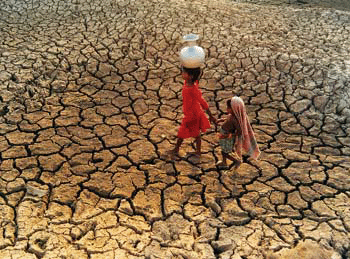 find extra 67 people take their own lives for every one degree Celsius of warming, The Independent, 1 Aug 17 Tom Batchelor @_tombatchelor Scorching temperatures, drought, storms and famine triggered by climate change have led to thousands of extra suicides in India, a report has found.
During the south Asian nation’s growing season, every one degree Celsius of warming above 20°C sees an average of 67 more people take their own lives, according to the study.
Experts said the findings, published in the Proceedings of the National Academy of Sciences (PNAS), are particularly alarming as India’s average temperatures are expected to rise another 3°C by 2050, meaning hundreds of extra deaths.India’s farmers are already regularly hit by extreme weather events, including strong storms and heat waves, and some still rely on natural rainfall to water their crops.
Scientists have shown that those weather patterns are already increasing as the planet warms.
Tamma Carleton, who conducted the research, said nearly 60,000 suicides over the past 30 years may be linked to climate change.
Looking at suicide data from India’s National Crime Records Bureau between 1967 and 2013, along with data on agricultural crop yields and on temperature change, she estimated that “warming temperature trends over the last three decades have already been responsible for over 59,000 suicides throughout India”.
“We may not be able to stop the world from warming, but that doesn’t mean we can’t do something to address suicide,” said Vikram Patel, an Indian psychiatrist and mental health expert with Harvard Medical School in Boston, who was not involved in the study.
There are many factors that can contribute to suicide, including poor crop yields, financial problems, access to easy methods of self-harm, or a lack of community support.In India, many farmers will drink toxic pesticides as a way out of backbreaking debt.
For the past month, hundreds of farmers – some carrying human skulls they say are from farmers who committed suicide in the drought-stricken southern state of Tamil Nadu – have been staging what they say will be a 100-day protest in New Delhi to “prevent the suicide of farmers who feed the nation”.
Parts of western and north-eastern India have been hit by floods that have washed away villages and crops.
Heavy rains have caused rivers in states such as Gujarat, Assam and Rajasthan to burst their banks, killing 130 people……..http://www.independent.co.uk/news/world/asia/climate-change-india-suicide-59000-global-warming-report-farmer-deaths-a7870496.html
August 2, 2017
Posted by Christina Macpherson |
General News |
Leave a comment
-
Soaring power prices caused by “decade of policy instability”
Report says fundamental failure to deliver national, coordinated, stable energy and climate policy a major factor in pushing up electricity prices.
-
Innovation: Wind, solar grid integration technologies win state, federal govt grants
Two Australian-made renewables grid integration and stabilisation technologies have won government grants: Clean Technology Partners’ e-cube; and NOJA Power’s smart “switchgear.”
-
Wind output curtailed again in South Australia
Wind output in South Australia was heavily constrained again over the weekend because not enough gas generators were online.
-
Tesla has its “iPhone moment”, but Australia left in slow lane for EVs
Australia is in danger of missing the iPhone moment in electric vehicles. The country known as land of burning climate and energy policies has left a market hungry for EVs without any affordable products.
-
Know your NEM: Showdown looms on CET
A lot of wind and solar projects are getting approved, but no so many with PPAs and finance. Meanwhile, as the company reporting season starts, a showdown looms over energy policy and the CET.
-
Politically charged: do you know where your batteries come from?
People are excited about batteries are forgetting one important issue: the raw materials needed to build this technology – where they come from and their environmental cost.
August 2, 2017
Posted by Christina Macpherson |
AUSTRALIA - NATIONAL, energy |
Leave a comment
Australia and New Zealand are both relatively unpolluted compared with countries in the Northern Hemisphere. Therefore, both ozone and fine particle pollution currently cause relatively few deaths in both countries. However, we found that under climate change the risk will likely increase.
This paper highlights that climate change will increase human mortality through changes in air pollution. These health impacts add to others that climate change will also cause, including from heat stress, severe storms and the spread of infectious diseases. By impacting air quality, climate change will likely offset the benefits of other measures to improve air quality.
Climate change set to increase air pollution deaths by hundreds of thousands by 2100 The Conversation, Guang Zeng,Atmospheric Scientist, National Institute of Water and Atmospheric Research, Jason West Associate Professor, Department of Environmental Sciences and Engineering , University of North Carolina – Chapel Hill August 1, 2017 Climate change is set to increase the amount of ground-level ozone and fine particle pollution we breathe, which leads to lung disease, heart conditions, and stroke. Less rain and more heat means this pollution will stay in the air for longer, creating more health problems.
Our research, published in Nature Climate Change, found that if climate change continues unabated, it will cause about 60,000 extra deaths globally each year by 2030, and 260,000 deaths annually by 2100, as a result of the impact of these changes on pollution.
This is the most comprehensive study to date on the effects of climate change on global air quality and health. Researchers from the United States, the United Kingdom, France, Japan and New Zealand between them used nine different global chemistry-climate models.
Most models showed an increase in likely deaths – the clearest signal yet of the harm climate change will do to air quality and human health, adding to the millions of people who die from air pollution every year.
Stagnant air
Continue reading →
August 2, 2017
Posted by Christina Macpherson |
General News |
Leave a comment

 Nuclear labs endanger public with radioactive mail, USA Today Patrick Malone, Center for Public Integrity, 1 Aug 17, At least 25 times in the past five years, nuclear weapons contractors have improperly packaged or shipped plutonium capable of being used in a nuclear weapon, conventional explosives and highly toxic chemicals, according to government documents.
While the materials were not ultimately lost, the documents reveal repeated instances in which hazardous substances vital to making nuclear bombs and their components were mislabeled before shipment. That means those transporting and receiving them were not warned of the safety risks and did not take required precautions to protect themselves or the public, the reports say.
The risks were discovered after regulators conducted inspections during transit, when the packages were opened at their destinations, during scientific analysis after the items were removed from packaging, or — in the worst cases — after unwary recipients released radioactive contaminants, the Center for Public Integrity’s investigation showed.
Only a few, slight penalties appear to have been imposed for these mistakes. Continue reading →
August 2, 2017
Posted by Christina Macpherson |
General News |
Leave a comment
 Extent of A-bomb dust inhalation in 1945 underestimated: researchers https://mainichi.jp/english/articles/20170731/p2a/00m/0na/004000cJuly 31, 2017 (Mainichi Japan)HIROSHIMA — The prevalence of acute symptoms among teenage soldiers exposed to dust particles as they helped out with relief operations in the aftermath of the 1945 U.S. atomic bombing of Hiroshima has been found to be at least 10 times higher than those who were unexposed, it has been learned.
The findings came to light following a questionnaire conducted in February last year by a team of researchers including Megu Otaki, a professor emeritus of statistics at Hiroshima University, covering 142 former army cadets aged between 15 and 19 at the time of the atomic bombing.
The army cadets were gathered together outside Hiroshima on the day the bomb was dropped — Aug. 6, 1945 — before venturing into the city to assist with relief operations between noon and around 5 p.m. In the 2016 questionnaire, the former cadets were asked questions about operation content and locations, inhalation of dust particles, as well as their subsequent health conditions — eliciting responses from 64 of them in total.
In its decision on the effects of internal exposure from inhaling dust particles tainted with radioactive materials, the Japan-U.S. research organization Radiation Effects Research Foundation said that, “The amount in this case is low enough to be ignored.” This decision has been used by the Japanese government in recognizing A-bomb survivors as suffering from A-bomb related diseases.
However, Otaki states that, “It is very likely that the acute symptoms and the disorders that A-bomb victims later developed were mainly caused by internal exposure to radiation (from dust particles). The impact (of the dust particles) has been underestimated.”
The survey found that the frequency of acute symptoms such as hair loss and diarrhea was 11.7 times higher in the group (21 people) exposed to dust particles while operating within a 2-kilometer radius of the bomb’s hypocenter than those who weren’t exposed at locations 2 kilometers or more away (22 people, including some unknown). Similarly, the frequency of acute symptoms was also found to be 5.5 times higher among those who were exposed to dust particles more than 2 kilometers away from ground zero (9 people) than those who weren’t exposed. In addition, there were more cases of people developing cancer and leukemia among the groups exposed to the dust particles.
Commenting on these results, Otaki says, “Although the sample size is small, the conditions of the subjects such as age, health conditions, and the length of relief operation time are almost the same, meaning the data is very reliable.”
In addition, upon re-examining data released by the foundation in 2001 — which showed the relationship between estimated radiation dose and the frequency of chromosomal abnormalities in 3,042 atomic bomb victims — it has become clear that the radiation dose received by victims who were indoors is possibly 30 percent higher than initially thought. Based on this, the team of researchers has concluded that, “It is very likely that people developed chromosomal abnormalities after being exposed to radiation by inhaling dust particles upon going back into damaged buildings.”
With regard to residual radiation and internal exposure to radiation, the foundation has previously concluded that compared to the initial levels of radiation emitted at the time of the explosion, the residual radiation values are lower, making residual radiation “less of a threat to people’s health.” Based on this conclusion, the foundation devised a formula for calculating the estimated exposed dosage deriving only from the initial radiation, which the government has used to recognize “A-bomb related diseases.”
However, there has been a string of judicial rulings determining that the extent of internal exposure has been underestimated, based on examinations of symptoms and experiences of plaintiffs involved in “A-bomb related disease” certification lawsuits.
With this kind of reality in mind, Otaki says, “There are concerns that atomic bomb victims who should have been supported have actually been abandoned. We must reconsider the calculation method.”
August 2, 2017
Posted by Christina Macpherson |
General News |
Leave a comment
 Al Gore: ‘The rich have subverted all reason’, Guardian, Carole Cadwalladr, 30 July 17
With the sequel to his blockbuster documentary An Inconvenient Truth about to be released, Al Gore tells Carole Cadwalladr how his role at the forefront of the fight against climate change consumes his life, Guardian, In the ballroom of a conference centre in Denver, Colorado, 972 people from 42 countries have come together to talk about climate change. It is March 2017, six weeks since Trump’s inauguration; eight weeks before Trump will announce to the world that he is withdrawing America from the Paris Climate Agreement.
These are the early dark days of the new America and yet, in the conference centre, the crowd is upbeat. They’ve all paid out of their own pockets to travel to Denver. They have taken time off work. And they are here, in the presence of their master, Al Gore. Because Al Gore is to climate change… well, what Donald Trump is to climate change denial……
It’s the reason why we are all here – his foundation, the Climate Reality Project, an initiative that grew out of the film, provides intensive training in talking about climate change, combating climate change denial – and the tone might be described as “activist upbeat”. This is a crisis that is solvable, we’re told. Trump is just another hitch, another hurdle to overcome. And it will be overcome. Only occasionally does a sliver of despair leak around the edges. You have to stay positive, a man called David Ellenberger tells the audience. Though sometimes, he admits: “There’s not enough Prozac to get through the day.”….
The war on the mainstream media may capture the headlines currently, but the war on climate change science has been in play for years. And it’s this that is one of the most fascinating aspects of Gore’s new film, An Inconvenient Sequel: Truth to Power. Because if the US had a subtitle at the moment, it might be that, too, and the struggle to overcome fake facts and false narratives funded by corporate interests and politically motivated billionaires is one that Gore has been at the frontline of for more than a decade.
The film runs through a host of facts – that 14 of the 15 hottest years on record have occurred since 2001 is just one. And the accompanying footage is biblical, terrifying: tornadoes, floods, “rain bombs”, exploding glaciers. We see roads falling into rivers and fish swimming through the streets of Miami.
The nightly news, Gore says, has become “a nature hike through the Book of Revelations”. But what his work has shown and continues to show is that evidence is not enough. The film opens with clips from Fox News ridiculing global warming. In recent weeks, the New York Times has started describing the Trump administration as waging a “war on science”, a full-on assault against evidence-based science that runs in parallel with his attacks on evidence-based reporting. And Gore is in something of a unique position to understand this. What becomes clear over the course of several conversations is how entwined he believes it all is – climate change denial, the interests of big capital, “dark money”, billionaire political funders, the ascendancy of Trump and what he calls (he’s written a book on it) “the assault against reason”. They are all pieces of the same puzzle; a puzzle that Gore has been tracking for years, because it turns out that climate change denial was the canary in the coal mine.
“In order to fix the climate crisis, we need to first fix the government crisis,” he says. “Big money has so much influence now.” And he says a phrase that is as dramatic as it is multilayered: “Our democracy has been hacked.”
“I mean that those with access to large amounts of money and raw power,” says Gore, “have been able to subvert all reason and fact in collective decision making. The Koch brothers are the largest funders of climate change denial. And ExxonMobil claims it has stopped, but it really hasn’t. It has given a quarter of a billion dollars in donations to climate denial groups. It’s clear they are trying to cripple our ability to respond to this existential threat.”
One of Trump’s first acts after his inauguration was to remove all mentions of climate change from federal websites. More overlooked is that one of Theresa May’s first actions on becoming prime minister – within 24 hours of taking office – was to close the Department for Energy and Climate Change; subsequently donations from oil and gas companies to the Conservative party continued to roll in. And what is increasingly apparent is that the same think tanks that operate in the States are also at work in Britain, and climate change denial operates as a bridgehead: uniting the right and providing an entry route for other tenets of Alt-Right belief. And, it’s this network of power that Gore has had to try to understand, in order to find a way to combat it……
what becomes clear if you Google “climate change” is how effective the right has been in owning the subject. YouTube’s results are dominated by nothing but climate change denial videos. This isn’t news for Gore. ….. https://www.theguardian.com/us-news/2017/jul/30/al-gore-interview-our-crumbling-planet-the-rich-have-subverted-all-reason-al-gore
August 2, 2017
Posted by Christina Macpherson |
General News |
Leave a comment








 Antinuclear