Australia faces potentially disastrous consequences of climate change, inquiry told
Former defence force chief decries Australia’s response to climate challenge as a ‘manifest failure of leadership’, Guardian, Ben Doherty and Michael Slezak, 11 Aug 17.
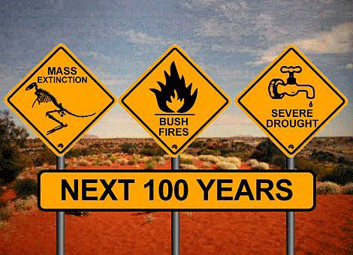
Military and climate experts, including a former chief of the defence force, have warned that Australia faces potential “disastrous consequences” from climate change, including “revolving” natural disasters and the forced migration of tens of millions of people across the region, overwhelming security forces and government.
Former defence force chief Adm Chris Barrie, now adjunct professor at the strategic and defence studies centre at the Australian National University, said in a submission to a Senate inquiry that Australia’s ability to mitigate and respond to the impacts of climate change had been corrupted by political timidity: “Australia’s climate change credentials have suffered from a serious lack of political leadership”.
The inquiry into the security ramifications of climate change also heard from some of the country’s leading climate scientists, who warned the security threats posed by climate change had been underestimated, and complained Australia had been “walking away” from exactly the type of research that would help the country prepare……
Barrie said the security threat of climate change was comparable to that posed by nuclear war, and said the Australian continent would be most affected by changing climate.
“We will suffer great effects from these changes, such as new weather patterns; droughts, sea-level rises and storm surges, because we have substantial urban infrastructure built on the coastal fringe; ravages of more intense and more frequent heatwaves and tropical revolving storms.”
But he said the existential impacts of climate change were likely to be first, and most severely, felt across Australia’s region, the Asia-Pacific rim, the most populous region in the world, and one that will be home to seven billion people by 2050……..
The Australian Defence Force has been examining the potential insecurities caused by climate change for a decade. Within Defence, there are serious concerns over the vulnerability of military bases to climate impacts, and the military’s reliance on fossil fuels.
But Barrie said political action lagged far behind and Australia’s hyper-politicised debate over climate had hampered decisive government action.
“Our current posture is a manifest failure of leadership,” he said……..
“Disasters become disasters on steroids: more frequent and more intense. Climate change is also a process. Slow-onset impacts such as sea-level rise or desertification take place over time, resulting in a gradual deterioration of living conditions that ultimately renders land uninhabitable.”……
McAdam said most displacement and migration would occur within countries, not across national borders.
“Longer-term movement will generally be gradual rather sudden, and movement that is sudden (for instance, in the aftermath of a disaster) will often require temporary relief rather than permanent migration. There is scant evidence to justify claims that there will be mass outflows of people across international borders which will threaten international, regional or national security, or generate new risks of Islamist terrorism or fundamentalism.”……https://www.theguardian.com/environment/2017/aug/11/australia-potentially-disastrous-consequences-of-climate-change-inquiry-told
Tony Abbott calls for Australia to urgently consider missile defence shield, The Age, Peter Hartcher, 11 Aug 17, Tony Abbott has called for Australia urgently to consider a missile defence shield to protect against attack by nuclear-armed North Korea.
This means that Australia’s two most recent former leaders – one Labor and one Liberal – have now made such a call in the last four weeks. Australia has no defence against intercontinental ballistic missiles. The government has yet to indicate any interest in acquiring one.
After US President Donald Trump this week said he would deal with Pyongyang’s threats with “fire and fury”, North Korea said that “only absolute force can work on him”….
Foreign Affairs Minister Julie Bishop said on Wednesday that a North Korean ICBM capability posed “an unacceptable existential threat to our country” although she said Australia was “not a primary target”.
She said that Australia’s strategy was to deter North Korea through international solidarity and called on “all sides” to step back.
But Kevin Rudd and Tony Abbott separately are urging defensive steps:…..
This week the US Defence Intelligence Agency estimated that North Korea already has a miniaturised nuclear warhead to put atop the missiles, according to US media reports.
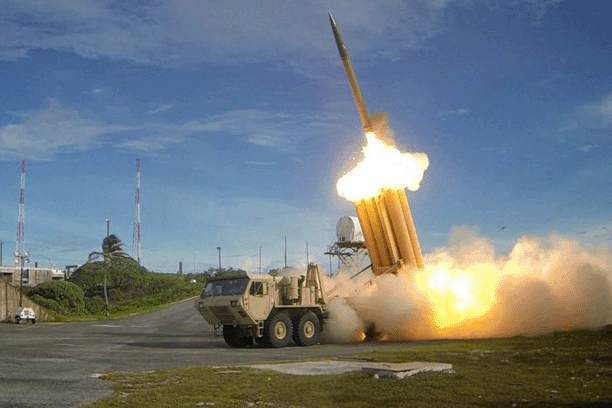
Mr Abbott said: “We should upgrade the capability of the air warfare destroyers so they’re not just able to track incoming missiles but shoot them down.”
“And we should look at the sort of system the US is installing in South Korea,” the Terminal High Altitude Area Defence system. Mr Abbott said that the main argument against a missile defence was cost.
“Some would say that it would contribute to an arms race, but it’s a race that others are already running,” he added.
Experts point out that neither system nominated by Mr Abbott is designed for intercepting intercontinental ballistic missiles but for shorter-range missiles.
Will Australia join in the war if Trump’s USA attacks North Korea?
Australia will join the conflict if North Korea attacks the US: Malcolm Turnbull, SMH Fergus Hunter, 11 Aug 17, Prime Minister Malcolm Turnbull has declared Australia would invoke the ANZUS security treaty for only the second time in its history in response to any attack by North Korea against the United States.
Mr Turnbull also pushed back against calls – including from former prime ministers Tony Abbott and Kevin Rudd – for Australia to develop a missile defence shield to protect the mainland from the threat of North Korea’s nuclear weapons and long-range missile program.
The Prime Minister’s commitment to assist the US caps off days of escalating tensions, with US President Donald Trump threatening to unleash “fire and fury” on the rogue state and the North Korean regime warning it would attack the US Pacific territory of Guam.”The United States has no stronger ally than Australia. We have an ANZUS agreement and if there is an attack on Australia or the United States … each of us will come to the other’s aid,” Mr Turnbull told Melbourne radio station 3AW on Friday……
After invoking ANZUS in 2001, Mr Howard said Australia would consult with the US and consider any requests “within the limits of its capability”.
A month later, the government committed Australian troops to the US-led invasion of Afghanistan.
Opponents have criticised the treaty, arguing it unnecessarily places Australia’s security at risk.
Greens leader Richard Di Natale said: “The last thing we need here is a Prime Minister backing an unhinged and paranoid leader into a conflict that could potentially end life on Earth as we know it.”
He accused Mr Turnbull of putting a target on Australia’s back and called on him to tell the US President to “back off”.
“If there was ever a clearer example of why Australia needs to ditch the US alliance and forge an independent, non-aligned foreign policy, this is it. Malcolm Turnbull now needs to pick up the phone, he needs to talk to Donald Trump and urge him to de-eascalate.”
In previous standoffs, Trump’s predecessors knew when to hold back. Now there is no such certainty, Irish Times, Jonathan Freedland, 1o Aug 17, his was the moment many Americans, along with the rest of the world, feared. This – precisely this – was what alarmed us most about the prospect of Donald Trump becoming president of the US. Not that he would hire useless people or that he would tweet all day or use high office to enrich himself and his family or that he’d be cruel, bigoted and divisive – though those were all concerns. No, the chief anxiety provoked by the notion of Trump in the White House was this: that he was sufficiently reckless, impulsive and stupid to bring the world to the brink of nuclear war.
‘Fire and fury’ wasn’t tough enough – Trump on North Korea
Of course, cooler heads might soon prevail. China might find the diplomatic back-channel that persuades North Korea to step back from the current clash with Washington. The Pyongyang regime might calculate for itself that, despite its latest threat to attack the US airbase in the Pacific island of Guam, further escalation risks its own survival. Or the generals that now flank Trump – John Kelly as chief of staff, Jim Mattis as defence secretary – might succeed in talking their boss down from the ledge.
But make no mistake. Trump’s remarks on Tuesday have pushed the US to the precipice of nuclear confrontation with North Korea. We have to hope that both parties will step back, but be under no illusion that the brink is where we stand. And Trump put us there.
The form of words the president used made the critical difference. Threatening Kim Jong-un with “fire and fury” was bellicose enough. But adding the words “the likes of which this world has never seen before” left no doubt that he was talking about a nuclear strike against North Korea.
It is worth pausing to consider the obvious consequences of such an action. About 75 million people live on the Korean peninsula. There are also 30,000 US servicemen and women stationed there. How many would die if Trump made good on his threat? And that is to reckon without further retaliation and escalation, as Russia or China unleashed their own nuclear arsenals. This is why all previous US presidents have used only the most sober language when speaking of North Korea. They have understood the human stakes. They have sought to reduce tension, not ratchet it up……..
The point is that since the dawn of the atomic age the world’s leaders have understood that these weapons have to be handled with the greatest delicacy. Nuclear standoffs happen, but each side has always understood where the brink lies and were careful not to overstep it. That means, especially, understanding the need not to say anything that the other side might misinterpret as a cue for war.
Both Washington and Moscow understood that throughout the cold war; it’s what stopped the Cuban missile crisis turning into Armageddon. Most analysts believe the regime in Pyongyang, for all its brutality, understands that too: it is not suicidal. But the question hanging over the world today is one that has never had to be asked before: does the US president understand this most essential point, one on which the fate of the world depends? Jonathan Freedland is a Guardian columnist https://www.irishtimes.com/opinion/trump-has-taken-us-to-the-brink-of-nuclear-war-can-he-be-stopped-1.3182374
http://www.enn.com/climate/article/52119Heatwaves amplified by high humidity can reach above 40°C and may occur as often as every two years, leading to serious risks for human health. If global temperatures rise with 4°C, a new super heatwave of 55°C can hit regularly many parts of the world, including Europe.
A recently published study by the Joint Research Centre (JRC) – the European Commission’s science and knowledge service – analyses the interaction between humidity and heat. The novelty of this study is that it looks not only at temperature but also relative humidity to estimate the magnitude and impact of heat waves.
It finds out that the combinations of the two, and the resulting heatwaves, leave ever more people exposed to significant health risks, especially in East Asia and America’s East Coast.
Warm air combined with high humidity can be very dangerous as it prevents the human body from cooling down through sweating, leading to hyperthermia. As a result, if global warming trends continue, many more people are expected to suffer sun strokes, especially in densely populated areas of India, China and the US.
“Throughout the history of the church, people have always found ways to use God and scripture to justify empire, to justify oppression and exploitation,” Kyle Meyaard-Schaap, an organizer with a pro-environmental Christian group called Young Evangelicals for Climate Action (YECA), told me. “It’s a convenient theology to hold, especially when we are called to drastic, difficult action.”
How Fossil Fuel Money Made Climate Change Denial the Word of God Brendan O’Connor, Splinter , 8 Aug 17 In 2005,at its annual meeting in Washington, D.C., the National Association of Evangelicals was on the verge of doing something novel: affirming science. Specifically, the 30-million-member group, which represents 51 Christian denominations, was debating how to advance a new platform called “For the Health of a Nation.” The position paper—written the year before An Inconvenient Truth kick-started sense of public urgency around climate change—included a call for evangelicals to protect God’s creation, and to embrace the government’s help in doing so. The NAE’s board had already adopted it unanimously before presenting it to the membership for debate. Continue reading →
Nuclear not the answer, as consumers pay for abandoned reactors, REneweconomy, By Giles Parkinson on 9 August 2017 Barnaby Joyce and other pro-nuclear members of the Coalition – and the numerous conservative commentators calling for nuclear instead of renewables – should take note:
The so-called “nuclear renaissance” in the United States has had another major setback, with another two reactors under construction in South Carolina abandoned after costs spiralled out of control, leaving consumers holding the bill for plants that will never be completed.
The plug was pulled on the V.C. Summer nuclear project last week after $US9 billion had already already spent, and after it became clear that the original $US11.5 billion bill for the whole project would more than double to at least $US25 billion ($31 billion).
South Carolina consumers will be left holding the bill, and 20 per cent of their electricity rates will go to pay for something that will never be completed.
Critics say the decision heralds the demise of new nuclear in the US, and expect the Vogtle nuclear reactor project in Georgia to also collapse as its costs also surge.
New Generation Nuclear Reactors Unlikely to Deliver on Design, EcoWatch, By Paul Brown, 9 Aug 17
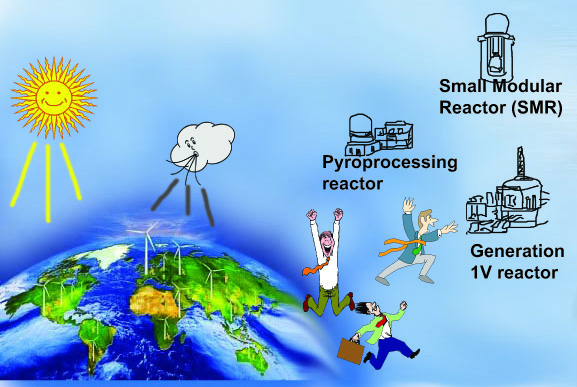
New generation nuclear reactors, promised for the last 18 years by the U.S. Office of Nuclear Energy (NE) as a way to provide cheap and plentiful supplies of electricity, are unlikely to be fulfilled any time in the next 30 years.
That is the conclusion of university researchers who have used the Freedom of Information Act to obtain the program’s budget history to find out what designs the government has spent $2 billion of public money on supporting.
Researchers from the University of California San Diego and Carnegie Mellon University described the research program as “incoherent” and said the government was “unlikely” to deliver on its mission to develop and demonstrate an advanced nuclear reactor by mid-century.
The study, published in the journal Environmental Research Letters, said much of the money that was supposed to be spent on civilian reactors was spent instead on supporting infrastructure, where the main focus was defense programs and not commercial opportunities……..
Overall, the technology’s prospects appear grim, with implications that go beyond energy.
“Without a sense of urgency among NE and its political leaders,” Abdulla warned, “the likelihood of advanced reactors playing a substantial role in the transition to a low-carbon U.S. energy portfolio is exceedingly low…..
These reported failings in the U.S. research program come at a difficult time for the industry when across the world the current “new” generation of large nuclear reactors is proving difficult to build on time and on budget, and some projects are being abandoned mid-way through construction…….
Most of the money now being spent on research into new generations of nuclear power stations is being provided by nuclear weapon states. Most countries that have never had nuclear weapons but have invested in nuclear power stations are now phasing them out and putting their development money into cheaper renewables. https://www.ecowatch.com/new-generation-nuclear-2471347067.html
The destruction of Hiroshima and Nagasaki was a war crime worse than any that Japanese generals were executed for in Tokyo and Manila. If Harry Truman was not a war criminal, then no one ever was.
The most spectacular episode of Harry Truman’s presidency will never be forgotten but will be forever linked to his name: the atomic bombings of Hiroshima on August 6, 1945, and of Nagasaki three days later. Probably around two hundred thousand persons were killed in the attacks and through radiation poisoning; the vast majority were civilians, including several thousand Korean workers. Twelve US Navy fliers incarcerated in a Hiroshima jail were also among the dead.1
Great controversy has always surrounded the bombings. ……. Continue reading →
AGL Energy has continued to rubbish suggestions from members of the Coalition, as well as the Murdoch media and the ABC, that Australia should invest in new baseload generation, particularly in coal plants.
“We just don’t see the development of a new coal-fired power plant as economically rational, even before carbon costs,” AGL Energy CEO Andy Vesey told analysts and journalists at a briefing on Thursday, to mark the release of its annual profit results.
And nor would the company consider extending the life of existing coal-fired generators, such as the Liddell plant in the NSW Hunter Valley, which is scheduled to close in 2022.
AGL made a point in its presentation that the most economic option to replace the 2000MW Liddell would not be coal, or baseload gas, but a mix of energy from wind and solar, and various load shaping and firming capacity from other sources.
This could include battery storage, pumped hydro, demand response mechanisms, and gas peaking plants. It confirmed it is looking at all possibilities but it highlights the shift from reliance on “baseload” power, which as we saw last summer does not equate to reliability, and dispatchable generation.
Already, the 200MW Silverton wind farm is under construction near Broken Hill, and the 465MW Coopers Gap wind farm in Queensland is expected to begin construction soon. Vesey said this would provide “clean reliable energy” for the grid.
AGL also reproduced its estimates of the current cost of wind and solar PV. Both renewable energy technologies delivered energy at a lower cost than brown or black coal, and were still competitive even after adding “firming costs”.
These estimates do not include carbon risk, and the only thing stopping increased investment in those technologies was the lack of policy certainty, Vesey said.
“The challenge is that we are at a point where the lack of certainty around carbon policy is preventing people from investing in the right options, which we think is wind, solar, and storage,” he said. Asked if the company would extend Liddell, built in 1973, particularly given the windfall earnings from the ageing and fully depreciated coal plants in its portfolio given the high wholesale prices, Vesey said no.
Even without factoring in the carbon risk, it would require significant investment in an asset that would be less reliable and have higher cost than other possibilities, such as renewables.
Indeed, Liddell only operated at a capacity factor of 50 per cent in the last financial year, barely above the best performing wind farms.
Executives also tell prime minister that policy uncertainty is contributing to rise in power prices, Katherine Murphy, Guardian, 9 Aug 17 Senior energy executives have taken the opportunity of a face-to-face meeting with Malcolm Turnbull to argue policy certainty is required to help lower power prices for consumers – and to signal they are not interested in prolonging the life of coal plants……..
Government backbenchers report being under huge pressure from their constituents over soaring power bills but internal divisions have prevented the Turnbull government, thus far, from resolving whether it wants to adopt the Finkel recommendation of a new clean energy target.
The message the executives delivered to the top echelons of the government was the country needed policy action that would lower or stabilise wholesale electricity prices, not just a focus on retail prices.
Executives told the prime minister, the energy minister, Josh Frydenberg, the treasurer, Scott Morrison, and the deputy prime minister, Barnaby Joyce, that they were interested in running businesses that were intent on reducing their climate risk, so they weren’t interested in maintaining the lifespan of existing coal-fired plants, like Liddell in New South Wales………
After the talks, the prime minister was asked whether he would deliver a full response to the Finkel review by the end of the year.
Turnbull hedged, saying the government was waiting on additional information from the Australian Energy Market Operator about the amount of dispatchable power required to stabilise the grid after the departure of major coal plants which are coming to the end of their operating life.
He said the government would receive that information on 1 September…….
The government will hold another meeting with the same group of executives on 18 August to hear progress.
The Grattan report pointed out that consumers struggle to find better deals to reduce their power bills because they find the market too complicated. It also argued that, if energy retailers failed to clean up their act, political pressure would increase for price regulation given the rapid escalation in energy costs.
Turnbull “eyeballs” energy bosses, kids himself on solution
Big energy retailers didn’t so much blink, as wink in face of Turnbull’s “eyeballing” episode. Here’s why they will be high fiving each other in the Qantas lounge at Canberra airport.
Turnbull has failed to axe Australia’s power price “laziness” tax
The PM only had to push energy reforms slightly further to make a world of difference, and protect consumers from the “laziness tax” exploited by utilities.
Australia’s biggest solar retailer forced to replace non-compliant panels
Euro Solar forced to surrender STCs or replace PV modules after being found to have installed non-compliant solar panels, as part of a Clean Energy Regulator crackdown on Australia’s rooftop solar industry.
AGL says solar, wind, storage cheapest way to replace coal
AGL says new coal plants not economically rational; facilities like Liddell will be replaced by wind, solar, batteries, pumped hydro and other firming capacity.
AGL cashes in on coal splurge, renewable investment drought
AGL’s multi-billion investment in coal generators, and the recent investment drought in new wind and solar plants, have delivered windfall gains to the country’s biggest generator. It also increased its margins from consumers, despite its offer of discounts.
Guardian, 9 Aug 17 Interview with UN Special Rapporteur Victoria Tauli-Corpuz to mark the International Day of the World’s Indigenous Peoples Today is the United Nations’ (UN) International Day of the World’s Indigenous Peoples, numbering an estimated 370 million in 90 countries and speaking roughly 7,000 languages. To mark it, the Guardian interviews Kankanaey Igorot woman Victoria Tauli-Corpuz about the UN’s Declaration on the Rights of Indigenous Peoples, which she calls “historic” and was adopted 10 years ago.
Tauli-Corpuz, from the Philippines, was Chair of the UN Permanent Forum of Indigenous Issues when the Declaration was adopted, and is currently the UN Special Rapporteur on the Rights of Indigenous Peoples. In this interview, conducted via email, she explains why the Declaration is so important, argues that governments are failing to implement it, and claims that the struggle for indigenous rights “surpasses” other great social movements of the past:
DH: Why is the UN Declaration so important?
VTC: [It’s] so important because it enshrines and affirms the inherent or pre-existing collective human rights of Indigenous Peoples, as well as the individual human rights of indigenous persons. It is a framework for justice and reconciliation between Indigenous Peoples and states, and applies international human rights standards to the specific historical, cultural, social and economic circumstances of Indigenous Peoples. The Declaration is a standard-setting resolution of profound significance as it reflects a wide consensus at the global level on the minimum content of the rights of indigenous peoples. It is a remedial tool which addresses the need to overcome and repair the historical denial of the fundamental human rights of indigenous peoples, and affirms their equality to all other members of society.
DH: How significant an achievement was it?
VTC: In the 1970s Indigenous Peoples had brought to the UN’s attention the problems and issues they were facing, which led the UN to establish the Working Group on Indigenous Populations in 1982. ……..
DH: What do you think of the mainstream media’s portrayal of indigenous peoples?
VTC: I think that there has been an increase in media coverage over the years. I’m glad to see less coverage that portrays us as primitive, but sometimes the media fails to capture the fact that we are not anti-development. We are also seeing more media coverage – but still not enough – on the contributions of Indigenous Peoples to global goals on climate, poverty and peace. If Indigenous Peoples’ rights are not secured and protected, it will be impossible for the world to deliver on the promises of the Paris Agreement and the Sustainable Development Goals. Secure land rights for Indigenous Peoples is a proven climate change solution, and denying indigenous land rights and self-determination is a threat to the world’s remaining forests and biodiversity. It is also a primary cause of poverty. Many indigenous communities face intractable poverty despite living on resource-rich lands because their rights are not respected and their self-determined development is not supported. Protecting the rights of indigenous women, who are often responsible for both their communities’ food security and for managing their forests, is particularly important. Finally, undocumented land rights are a primary cause of conflict and a threat to investment in developing countries. Securing their rights can help mitigate these conflicts and create a more peaceful world.
DH: Finally, do you think the struggle for indigenous peoples’ rights and territories is comparable to any of the other great social movements in the past?
VTC: I think the Indigenous Peoples’ movement surpasses other social movements. They have struggled against colonisation for more than 500 years and continue against forms of colonisation and racism. At the same time, they continue to construct and reconstruct their communities and practice their cultural values of collectivity, solidarity with nature, and reciprocity even amidst serious challenges. Many still fight to protect their territories, which makes their movement different from others. https://www.theguardian.com/environment/andes-to-the-amazon/2017/aug/09/indigenous-peoples-are-the-best-guardians-of-the-worlds-biodiversity
By AUDREY McAVOY, 11 Aug 17, HONOLULU (AP) — The small U.S. territory of Guam has become a focal point after North Korea’s army threatened to use ballistic missiles to create an “enveloping fire” around the island. The exclamation came after President Donald Trump warned Pyongyang of “fire and fury like the world has never seen.” Here’s a look at the U.S. military’s role on the island, which became a U.S. territory in 1898.
WHAT INSTALLATIONS ARE ON GUAM AND HOW SIGNIFICANT ARE THEY? There are two major bases on Guam: Andersen Air Force Base in the north and Naval Base Guam in the south. They are both managed under Joint Base Marianas. The tourist district of Tumon, home to many of Guam’s hotels and resorts, is in between.
The naval base dates to 1898, when the U.S. took over Guam from Spain after the Spanish-American War. The air base was built in 1944, when the U.S. was preparing to send bombers to Japan during World War II.
Today, Naval Base Guam is the home port for four nuclear-powered fast attack submarines and two submarine tenders.
Andersen Air Force Base hosts a Navy helicopter squadron and Air Force bombers that rotate to Guam from the U.S. mainland. It has two 2-mile (3-kilometer) long runways and large fuel and munitions storage facilities.
Altogether, 7,000 U.S. military personnel are stationed on Guam. Most are sailors and airmen. The military plans to move thousands of U.S. Marines to Guam from Okinawa in southern Japan.
Guam’s total population is 160,000.
___
WHAT ROLES DO THE BASES PLAY IN THE REGION
Guam is strategically located a short flight from the Korean peninsula and other potential flashpoints in East Asia. Seoul is 2,000 miles (3,200 kilometers) to the northwest, Tokyo is 1,500 miles (2,400 kilometers) north and Taipei is 1,700 miles (2,700 kilometers) west.
Because Guam is a U.S. territory, the U.S. military may launch forces from there without worrying about upsetting a host nation that may object to U.S. actions.
The naval base is an important outpost for U.S. fast-attack submarines that are a key means for gathering intelligence in the region, including the Korean peninsula and the South China Sea where China has been building military bases on man-made islands.
___
HOW HAS THE U.S. USED GUAM TO ADDRESS THE THREAT FROM NORTH KOREA?
The U.S. military began rotating bombers — the B-2 stealth bomber as well as the B-1 and B-52 — to Andersen in 2004. It did so to compensate for U.S. forces diverted from other bases in the Asia-Pacific region to fight in the Middle East. The rotations also came as North Korea increasingly upped the ante in the standoff over its development of nuclear weapons.
In 2013, the Army sent a missile defense system to Guam called Terminal High Altitude Area Defense or THAAD.
It’s designed to destroy ballistic missiles during their final phase of flight. A THAAD battery includes a truck-mounted launcher, tracking radar, interceptor missiles and an integrated fire control system.
___
WHAT’S THE HISTORY OF THE U.S. MILITARY ON GUAM?
The U.S. took control of Guam in 1898, when Spanish authorities surrendered to the U.S. Navy. President William McKinley ordered Guam to be ruled by the U.S. Navy. The Navy used the island as a coaling base and communications station until Japan seized the island on Dec. 10, 1941. The U.S. took back control of Guam on July 21, 1944.
During the Vietnam War, the Air Force sent 155 B-52 bombers to Andersen to hit targets in Southeast Asia. Guam was also a refueling and transfer spot for military personnel heading to Southeast Asia. Many refugees fleeing Vietnam were evacuated through Guam.
Ghillar, Michael Anderson, Sovereign Union, 4 August 2017
Recently there has recently been a lot of social media chatter in the Eastern States about the pros and cons of Native Title that has created a lot of angst for many people. It is difficult to get the message across to our people in respect to Native Title, because Native Title in itself is a relatively new, very complex and difficult concept to understand, let alone master………
‘But I can say that, if people were to read The Art of War by Sun Tzu, the most significant aspect of the Native Title Act is the fact that it creates division within the clans and the Nations.
‘Moreover, it creates conflict between environmentalists, First Nations Peoples, mining companies and other extractive industries.
The government and the mining executives sit idly by watching our people tear themselves apart over ideological beliefs,
without our people realising that this is, in fact, a very deliberate process to cause internal conflict between all proponents of opposition to the extractive industries.
Apr 15, 2026 01:00 AM in Canberra, Melbourne, Sydney
Join the International Physicians for the Prevention of Nuclear War (IPPNW) on Tuesday, April 14th for a timely webinar exploring the risks associated with nuclear power and challenging the myth that it offers a simple, safe, carbon-free solution to the climate crisis
21 April Webinar: No Nuclear Weapons in Australia
Start: 2026-04-21 18:00:00 UTC Canberra, Melbourne, Sydney (GMT+10:00)
End: 2026-04-21 19:30:00 UTC Canberra, Melbourne, Sydney (GMT+10:00)
Event Type: Virtual A virtual link will be communicated before the event.













 Antinuclear