Climate Denial in Australia and USA: the Differences
 The Madhouse Effect: this is how climate denial in Australia and the US compares, The Conversation, Professor of Environmental Politics and Co-Director Sydney Environment Institute, University, August 14, 2017 Michael Mann is well known for his classic “hockey stick” work on global warming, for the attacks he has long endured from climate denialists, and for the good fight of communicating the environmental and political realities of climate change.
Mann’s work, including his recent book The Madhouse Effect, has helped me, as a dual US-Australian citizen, think about the similarities and differences between the US and Australia as we respond to what has been called the climate change denial machine.
In both countries, the denialists and distortionists have undermined public knowledge, public policy, new economic development opportunities, and the very value of the environment. Climate policy is being built upon alternative facts, fake news, outright lies, PR spin and industry-written talking points.
From the carbon industry capture of the two major parties, to the Abbott-Turnbull government parroting industry talking points, to coal industry lobbyists as government energy advisers, to the outright idiotic conspiracy pronouncements of senators funded and advised by the US- based denial machine, the Madhouse Effect is in full force in Australia.
How we can expose and counter this denialist machine? To partly lay out the task, I will discuss three points of contrast between the US and Australia.
Political culture
There is a key difference between the two countries’ political cultures. As much as the denialists have determined Australian energy and climate policy, they have not been as successful, yet, at undermining deep-seeded respect in Australian culture for the common good, for science, for expertise and knowledge…….
Last year, when the government fired climate scientists at CSIRO, there was another huge public backlash. The government had to step back a bit, both on the actual science to be done and the radical agenda change away from science for the public good.
And again, when the government wanted to support the dubious work of Bjorn Lomborg, that caused an outcry from both the university sector and the public. Even though the government wound up paying more than A$600,000 on what The Australian called his “vanity book project”, they couldn’t import him and plant him at any Australian university.
As Mann says, the main issue in implementing good, sound climate policy is no longer simply the science. The main issue is the cultural understanding of, and respect for the role of science in informing political decisions.
That’s not to say there are no attacks on science – clearly, these continue (such as the recent challenges to normal Bureau of Meteorology practices). But, overall, climate denialists and their enablers are outnumbered outliers in Australia, rather the norm.
The power of the carbon industry
My second point of comparison is not quite as positive.
The problem in Australia is less a culture turning against the Enlightenment, and more the direct political power and influence of the carbon industry. ……
even here I think there is some hope. We have seen, over the last few years, an incredible coalition grow – one focused on the end of carbon mining, on protecting communities, on creating real jobs, and on supporting renewables.
Once-unthinkable coalitions of farmers and Aboriginal communities are fighting new mines, new attacks on sacred and fertile land and water.
We have intensive household investment in rooftop solar – and as the feed-in tariffs are undermined, those folks will increasingly invest in battery storage. And we’re finally seeing states move in this direction, with increasing development of utility-scale renewable and storage projects. As hard as the federal government and its allies resist, renewables are growing and the public supports this – even conservative voters. https://theconversation.com/the-madhouse-effect-this-is-how-climate-denial-in-australia-and-the-us-compares-81822
South Australian Premier announces Solar thermal power plant for Port Augusta
Solar thermal power plant announced for Port Augusta ‘biggest of its kind in the world’, ABC, 15 August 17, A 150-megawatt solar thermal power plant has been secured for Port Augusta in South Australia, State Premier Jay Weatherill has announced.
Construction of the $650 million plant will start in 2018.
Concentrated Solar Power Simple Explanation
Aurora facts:
- 150-megawatt solar thermal power with eight hours of storage
- Plant will deliver 495 gigawatt hours of power annually, or 5 per cent of SA’s energy needs
- Equivalent to powering more than 90,000 homes
- Located 30 kilometres north of Port Augusta
- Company says it is “completely emission free”
Mr Weatherill said the Aurora Solar Energy Project would be ready to go in 2020 and would supply 100 per cent of the State Government’s needs.
The Government will pay a maximum of $78 per megawatt hour.
Mr Weatherill said the solar thermal plant was “the biggest of its kind in the world”.
“Importantly, this project will deliver more than 700 jobs, with requirements for local workers,” he said…….
A 150-megawatt solar thermal power plant has been secured for Port Augusta in South Australia, State Premier Jay Weatherill has announced.
Construction of the $650 million plant will start in 2018.
Mr Weatherill said the Aurora Solar Energy Project would be ready to go in 2020 and would supply 100 per cent of the State Government’s needs.
The Government will pay a maximum of $78 per megawatt hour.
Mr Weatherill said the solar thermal plant was “the biggest of its kind in the world”.
“Importantly, this project will deliver more than 700 jobs, with requirements for local workers,” he said.
Mirrors to direct sunlight onto tower
Solar thermal uses heliostats, or mirrors, to concentrate sunlight onto a tower that heats molten salt. The heat created is then used to generate steam.
Solar Reserve said the plant will be able to provide between eight and 10 hours of storage and had no requirement for gas or oil generated electricity as a backup.
It is expected to employ 50 full-time workers on an ongoing basis once it is operational.
The company said the power station will operate in a similar fashion to a coal or gas station, meaning many of the jobs would “require the same skill sets”.
Mr Smith said he looked forward to supporting “federal and state renewable energy targets”. http://www.abc.net.au/news/2017-08-14/solar-thermal-power-plant-announcement-for-port-augusta/8804628
China pleads for restraint in words and actions, from USA and North Korea
 China urges all sides to put out fire, not add to flames, in North Korea standoff, https://www.reuters.com/article/us-northkorea-missiles-china-idUSKCN1AV0N5?il=0, Reporting by Ben Blanchard; Writing by Philip Wen; Editing by Nick Macfie, BEIJING (Reuters) AUGUST 15, 2017– China on Tuesday reiterated calls for restraint on the Korean peninsula, saying it hoped all sides could put out the flames, not add oil to the fire, with their words and actions.
Speaking at a daily press briefing in Beijing, Foreign Ministry spokeswoman Hua Chunying urged a peaceful resolution of the standoff.
North Korean leader Kim Jong Un has delayed a decision on firing missiles towards Guam while he waits to see what the United States does next, the North’s state media said on Tuesday, as South Korea’s president said Seoul would seek to prevent war by all means.
Parliament passes Bill accusing government of failing to protect Australia’s iconic Great Barrier Reef
 Australian government can’t be trusted with Great Barrier Reef, says parliament
Climate Home, 15/08/2017, Government loses vote on bill noting the government’s ‘failure to protect’ reef on day of chaos in Canberra, By Karl Mathiesen
Australia’s parliament has passed a bill admonishing the government for failing to protect the Great Barrier Reef from climate change.
In a rare event in Australia’s ultra-partisan parliament, the government failed to vote down its own bill on Tuesday evening, after the opposition Labor party attached the amendment.
Labor’s amendment read:
“…the House notes that:
(1) the Government is failing to protect Australia’s iconic Great Barrier Reef by:
(a) failing to act on climate change;
(b) supporting the Liberal National Party in Queensland in blocking reef protections aimed at halting the broad scale clearing of trees and remnant vegetation; and
(c) winding back ocean protection, put in place by Labor, around Australia and specifically in the Coral Sea; and
(2) this Government cannot be trusted to protect the Great Barrier Reef and fight for Australia’s unique environment.”
The original bill, to which Labor attached the highly-politicised language, was a technical amendment to the act that established the Great Barrier Reef Marine Park.
The reef, which stretches 2,300km down the northeastern coastline of the continent, has been severely damaged by consecutive bleaching events in the past two years. The death of 22% of corals in 2016 was followed this year by a second bleach, leaving scientists questioning the survival of the wonder.
Coral bleaching is caused by elevated water temperatures, which is why climate change is seen as an existential threat to coral reef systems around the world. But the recovery of bleached reefs can be assisted by management of other pressures, including overfishing and pollution.
The Australian and Queensland governments have been criticised by Unesco, the UN body that oversees the World Heritage site, for failing to stop agricultural runoff from impacting the ecosystem. A draft report released in June noted with “serious concern” that “progress toward achieving water quality targets has been slow”.
The Department of Environment and Energy press office did not immediately respond to a request for comment on the Labor amendment…….http://www.climatechangenews.com/2017/08/15/australian-government-cant-trusted-protect-great-barrier-reef-says-parliament/
Donald Trump has rekindled fears of nuclear war – and the moral case for disarmament
 Trump’s apocalyptic threats demand a moral case for disarmament, Guardian, Daniel José Camacho, 14 Aug 16, It’s easy to understand why Trump is potentially one of the worst people to be in charge of our nation’s nuclear codes. Yet, the problem runs much deeper. M
Martin Luther King Jr once said: “When scientific power outruns moral power, we end up with guided missiles and misguided men.” Now, it appears Donald Trump might be the man who makes us pay for our country’s moral gap.
Trump has rekindled fears of war and nuclear strikes by threatening North Korea, saying: “They will be met with fire and fury like the world has never seen.” True to form, Trump’s words flew out of his mouth without much thought or preparation. In turn, the North Korean government has threatened to fire missiles near the US territory of Guam.
It’s easy to understand why Trump is potentially one of the worst people to be in charge of our nation’s nuclear codes. Yet the problem runs much deeper. Trump’s apocalyptic threat is a reminder that we need to revive the moral argument for disarmament and against militarism.
If the road to hell is paved with good intentions, then the road to this moment has been paved with the consensus of the foreign policy establishment. Both neocons and hawkish Democrats have pushed for an aggressive posture that has US special operations forces operating in 137 countries. US defense spending consistentlydwarfs the rest of the world.
King also said: “A nation that continues year after year to spend more on military defense than on programs of social uplift is approaching spiritual death.” Based on our record, it looks like this nation has been beyond spiritually dead for some time.
King was someone who acutely understood the danger of American militarism and nuclear weapons. In his 1967 Christmas Sermon on Peace, he said: “If somebody doesn’t bring an end to this suicidal thrust that we see in the world today, none of us are going to be around, because somebody’s going to make the mistake through our senseless blundering of dropping a nuclear bomb somewhere.”
Recovering King’s political vision can help us today…….
As long as war remains a business profiting a few, peace will remain a low priority. The problem is not simply Trump or the preceding presidential administrations, but an entire system that profits from violent conflicts and war.
The former president Dwight D Eisenhower understood this when he described the grave implications of the “military-industrial complex” in his 1961 farewell address. According to him: “The total influence – economic, political, even spiritual – [of an immense military establishment and arms industry] is felt in every city, every state house, every office of the federal government.”…..

Far from being idealistic, it is King’s framework which has regained relevance in the Trump era. As he wrote towards the very end of his life: “We still have a choice today: nonviolent coexistence or violent co-annihilation. This may well be mankind’s last chance to choose between chaos and community.” https://www.theguardian.com/commentisfree/2017/aug/11/trump-apocalyptic-threats-moral-case-disarmament
In India, Customs Department accuses Adani of fraud, as Adani bids forAustralian coal loan
 If true, one effect of the alleged scheme would have been to move vast sums of money from the Adani Group’s domestic accounts into offshore bank accounts where it could no longer be taxed or accounted for.
Adani mining giant faces financial fraud claims as  it bids for Australian coal loan, Exclusive: Allegations by Indian customs of huge sums being siphoned off to tax havens from projects are contained in legal documents but denied by company, Guardian, Michael Safi in Delhi, 16 Aug 17, A global mining giant seeking public funds to develop one of the world’s largest coal mines in Australia has been accused of fraudulently siphoning hundreds of millions of dollars of borrowed money into overseas tax havens.
Indian conglomerate the Adani Group is expecting a legal decision in the “near future” in connection with allegations it inflated invoices for an electricity project in India to shift huge sums of money into offshore bank accounts.
The directorate of revenue intelligence (DRI) file, compiled in 2014, maps out a complex money trail from India through South Korea and Dubai, and eventually to an offshore company in Mauritius allegedly controlled by Vinod Shantilal Adani, the older brother of the billionaire Adani Group chief executive, Gautam Adani.
Vinod Adani is the director of four companies proposing to build a railway line and expand a coal port attached to Queensland’s vast Carmichael mine project.
The proposed mine, which would be Australia’s largest, has been the source of years of intense controversy, legal challenges and protests over its possible environmental impact.
Expanding the coal port to accommodate the mine will require dredging an estimated 1.1m cubic metres of spoil near the Great Barrier Reef marine park. Coal from the mine will also produce annual emissions equivalent to those of Malaysia or Austria according to one study.
One of the few remaining hurdles for the Adani Group is to raise finance to build the mine as well as a railway line to transport coal from the site to a port at Abbot Point on the Queensland coast.
To finance the railway Adani hopes to persuade the Northern Australia Infrastructure Facility (Naif), an Australian government-backed investment fund, to loan the Adani Group or a related entity about US$700m (A$900m) in public money.
While it awaits the decision on the loan, in Delhi the company is also expecting the judgment of a legal authority appointed under Indian financial crime laws in connection to allegations it siphoned borrowed money overseas.
The Adani Group fully denies the accusations, which it has challenged in submissions to the authority.
The investigation
News of the investigation was first reported in India three years ago, but the full customs intelligence document reveals forensic details of the workings of the alleged fraud which have not been publicly revealed.
The 97-page file accuses the Adani Group of ordering hundreds of millions of dollars’ worth of equipment for an electricity project in western India’s Maharashtra state using a front company in Dubai.
To read the pdf click here. Continue reading
Port Augusta local community welcome greenlighting of solar thermal power plant
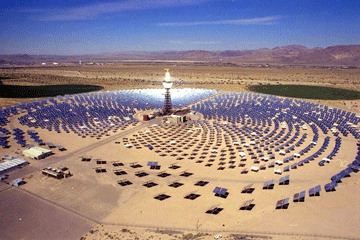 Solar thermal power plant supporters and locals welcome greenlighting of Port Augusta project, ABC North and West , By Khama Reid 14 Aug 17 The Port Augusta community and its clean energy supporters have welcomed the news that the world’s largest solar thermal power station will be built in the region.
It was announced yesterday that US operator Solar Reserve would build the 150 megawatt power station known as the Aurora Solar Energy Project at Carriewerloo Station, about 330 kilometres north of Adelaide……
The Government and company attended a public meeting at Port Augusta where they were met with applause and cheering…..
Local Aboriginal leader Malcolm ‘Tiger’ McKenzie said he could see many opportunities in the project to boost employment for Aboriginal people.
“We’re 30 per cent of the population but we don’t participate in the workforce as much,” he said.
Mr McKenzie said he wanted to work with the Government and Solar Reserve to get the best employment outcomes.
“It’s a modern Australia now. We as Aboriginal people have got to maximise opportunities to live in this country and that’s having a job, having an education and contribute.”……
http://www.abc.net.au/news/2017-08-15/port-augusta-welcomes-solar-thermal-power-plant-announcement/8810394
Renewed possibility of diplomatic solution to USA- North Korea nuclear crisis
Korean leaders, US open door to diplomacy in nuclear crisis, Yahoo News, The Canadian Press, August 16, 2017 SEOUL, Korea, Republic Of — North Korea’s military on Tuesday presented leader Kim Jong Un with plans to launch missiles into waters near Guam and “wring the windpipes of the Yankees,” even as both Koreas and the United States signalled their willingness to avert a deepening crisis, with each suggesting a path toward negotiations.
The tentative interest in diplomacy follows unusually combative threats between President Donald Trump and North Korea amid worries Pyongyang is nearing its long-sought goal of being able to send a nuclear missile to the U.S. mainland. Next week’s start of U.S.-South Korean military exercises that enrage the North each year could make diplomacy even more difficult.
During an inspection of the North Korean army’s Strategic Forces, which handles the missile program, Kim praised the military for drawing up a “close and careful plan” and said he would watch the “foolish and stupid conduct of the Yankees” a little more before deciding whether to order the missile test, the state-run Korean Central News Agency said. Kim appeared in photos sitting at a table with a large map marked by a straight line between what appeared to be northeastern North Korea and Guam, and passing over Japan — apparently showing the missiles’ flight route.
The missile plans were previously announced. Kim said North Korea would conduct the launches if the “Yankees persist in their extremely dangerous reckless actions on the Korean Peninsula and its vicinity,” warning the United States to “think reasonably and judge properly” to avoid shaming itself, the news agency said.
The Trump administration had no immediate comments on Kim’s declaration……..
Kim’s conditional tone, however, hinted the friction could ease if the U.S. offered a gesture that Pyongyang sees as a step back from “extremely dangerous reckless actions.”
That could refer to the U.S.-South Korean military drills set to begin Aug. 21, which the North claims are rehearsals for invasion. It also could mean the B-1B bombers that the U.S. occasionally flies over the Korean Peninsula as a show of force…….
South Korean President Moon Jae-in, meanwhile, a liberal who favours diplomacy, urged North Korea to stop provocations and to commit to talks over its nuclear weapons program……..
North Korea’s military said last week it would finalize the plan to fire four ballistic missiles near Guam, which is about 3,200 kilometres (2,000 miles) from Pyongyang. It would be a test of the Hwasong-12, a new missile the country flight-tested for the first time in May. The liquid-fuel missile is designed to be fired from road mobile launchers and has been described by North Korea as built for attacking Alaska and Hawaii. https://ca.news.yahoo.com/top-us-military-officer-warns-094455727.html
16 August More REneweconomy news
-
How solar tower and storage won on costsSolarReserve says its winning solar tower and molten salt storage project can deliver dispatchable, renewable power at just $78/MWh. Why so low?
-
Senvion installs first prototype of 3.4M140 EBCSuccessful completion of optimised turbine for low wind sites.
-
Younicos-designed WEMAG battery park successfully “black starts” grid on first attemptProject partners for Europe’s first commercial battery plant to bring innovative black start concept to market maturity/Younicos software manages reliable re-establishment of power grid.
World first: shareholders sue Commonwealth Bank of Australia for misleading shareholders over climate risks
 Climate change is a financial risk, according to a lawsuit
 against the CBA The Conversation, August 16, 2017 , Anita Foerster, Senior Research Fellow, University of Tasmania, Professor of Environmental and Climate Law, University of Melbourne The Commonwealth Bank of Australia has been in the headlines lately for all the wrong reasons. Beyond money-laundering allegations and the announcement that CEO Ian Narev will retire early, the CBA is now also being sued in the Australian Federal Court for misleading shareholders over the risks climate change poses to their business interests.
This case is the first in the world to pursue a bank over failing to report climate change risks. However, it’s building on a trend of similar actions against energy companies in the United States and United Kingdom.
Adelaide Advertiser (!) applauds decision for Port Augusta solar thermal power plant
The Advertiser Editorial, August 15, 2017: Solar plant can take heat off our power http://www.adelaidenow.com.au/news/opinion/the-advertiser-editorial-august-15-2017-solar-plant-can-take-heat-off-our-power/news-story/6387fb2661ae5f0795d675d893e22b7c?nk=ba26857f63080120cbd5fc74c94d3959-1502867091
For Japan’s new energy plan, phasing out nuclear power is a “must”
Editorial.Phasing out nuclear power a must for Japan’s new energy plan, Asahi Shimbun, August 14, 2017, The industry ministry has opened discussions for reviewing Japan’s Strategic Energy Plan, which defines a grand framework for how the country will consume, and cover the demand for, electric power, heat and other forms of energy.
Industry minister Hiroshige Seko has said the core part of the plan will remain basically unchanged. Minor adjustments alone, however, would simply not suffice under current circumstances.
The ongoing edition of the plan is questionable in many respects, including in the way it defines nuclear energy as a mainstay power source despite broad public opposition to restarts of nuclear reactors.
A big wave of change is occurring on a global scale. For example, there are moves, mostly in advanced industrialized nations, for pulling the plug on nuclear power. There is also a trend for moving from coal-fired thermal power generation, given that the Paris Agreement has now taken effect for fighting global warming. Renewable energy options, such as wind and solar power, are spreading rapidly.
Japan should also redraw the image of its future self. First and foremost, a phase-out of nuclear power should define the foundation of the country’s new future perspective…….
nuclear energy is falling out of favor with the times both in Japan and abroad following the Fukushima disaster. For example, the public has grown more skeptical about the use of nuclear power, and the costs of implementing required safety measures have soared.
The question of how to dispose of radioactive waste from nuclear power reactors remains unlikely to be solved any time soon in most of the countries that have such reactors, including Japan. Efforts are spreading, mostly in advanced nations, for seeking to scrap all, or a considerable part, of a national fleet of nuclear reactors.
The forthcoming edition of Japan’s Strategic Energy Plan should no longer define atomic energy as a mainstay source of power. Minimizing dependency on nuclear power should be designated a priority issue instead of being left as a hollow promise. Discussions should be made on what efforts are necessary for achieving that goal, and a road map should be presented in a concrete manner.
PHASE OUT NUCLEAR, FIGHT GLOBAL WARMING
Intensive power-saving efforts, combined with a substantial growth in renewable energy options, will represent a solution to the question of how to phase out nuclear power and fight global warming at the same time. It has been pointed out that such measures are costly and have other disadvantages, but possibilities have been opening up for them in recent years………
Renewable energy sources have already replaced thermal energy and nuclear energy as the leading destinations of global investments into the electric power sector.
Japan should quickly switch its energy policy instead of turning its back on the international trend. http://www.asahi.com/ajw/articles/AJ201708140020.html
16 August REneweconomy news

-
Coal rift? Coalition sends mixed message on new coal powerFederal treasurer says cheap new coal power a “myth”, federal energy minister says it must be considered – even if the market disagrees.
-
Tesla Tiny House goes on tourPowerwall, as part of the newly created Tesla Tiny House is hitting the road and making its way around Australia.
-
CommBank to face new shareholder resolution after climate policy failMarket Forces will lodge a new shareholder resolution against Commonwealth Bank after its climate change position statement released today fell well short of its publicly-made 2 degree commitments.
-
Victorian EV conversion company secures CEFC backingSEA Electric says $5m CEFC loan will help meet growing demand for technology that converts commercial trucks and vans to electric vehicles.
-
Failed experiment: Now it’s retail arms gaming energy consumersFirst it was the networks, then generators. Now it’s the retail arms gouging consumers. A bipartisan review of Victoria’s retail electricity market reveals a failed experiment that has delivered the most inflated power bills in Australia.Mount Emerald Wind Farm reaches major construction milestoneConstruction at the $360 million Mount Emerald Wind Farm near Mareeba reached an important milestone last week when the first of 53 turbine foundations was put in place.First Solar Awarded 241MW module supply contract for edify energy solar projects in AustraliaCompany to deliver more than 500MW in Australia over the next 12 Months
1 This month

of the week – Australians for War Powers Reform (AWPR)
To see nuclear-related stories in greater depth and intensity
 Antinuclear