Dying Navy Sailors Push for Trial on Fukushima Meltdown


SAN DIEGO (CN) – Representing cancer-ridden Navy service members who say they were exposed to radiation on a humanitarian mission in Fukushima, former Sen. John Edwards urged a federal judge Thursday to set a date for trial.
Over a decade after serving as John Kerry’s running mate in the 2004 presidential election, Edwards now represents hundreds of Navy sailors who were aboard the USS Ronald Reagan as part of a humanitarian mission trip to Fukushima, Japan — bringing food and supplies to the city in March 2011 after it was devastated by an earthquake and ensuing tsunami.
“We have all these sailors whose case is now five years old, who have died or are in the process of dying right now,” said Edwards, whose firm Edwards Kirby is based in North Carolina.
Edwards noted that some of his other clients have seen their children born with birth defects. He…
View original post 592 more words
Battling nuclear demons: Mental health issues haunt those who were the first line of defense after 3/11
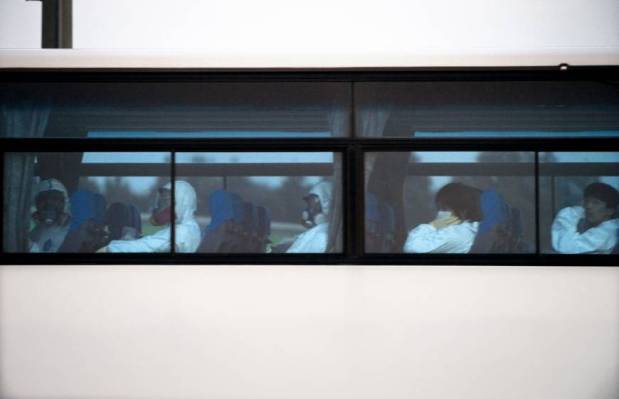 Workers from Tokyo Electric Power Co. travel by bus toward the power plant in April 2011.
Ryuta Idogawa traces the onset of his battle with mental illness to a moment not long after his parents had been relocated to Saitama from their hometown of Futaba, Fukushima Prefecture, in the spring of 2011.
Idogawa recalls with almost claustrophobic clarity how, as he boarded a train to travel to Tokyo, a sense of panic set in when the carriage walls seemed to close in and fellow passengers in the rush-hour squash started to stare — piercing, even accusatory stares, he thought.
“I was sweating, but I felt really cold and my heart was racing, faster and faster,” says Idogawa, 33. “I could hardly breathe. I thought, ‘Oh My God! I’m going to die.’”
Today, Idogawa continues to suffer from such panic attacks, although their frequency has decreased. To mitigate the problem…
View original post 2,832 more words
Tokyo’s Tap Water Contaminated
Via Kaye Nagamine
A Japanese local magazine gives the list of prefectures where Cesium 134 and Cesium 137 have been detected in their tap water !
The left column gives the name of the prefecture. The central column gives the Cesium 134 detected and the right column the Cesium 137 : in white with three Chinese characters reads “not detected” while in black the white figures indicates the level of bq detected.
The third line from the bottom is Tokyo. Cesium 134 and Cesium 137 have both been detected in its tap water at high levels!
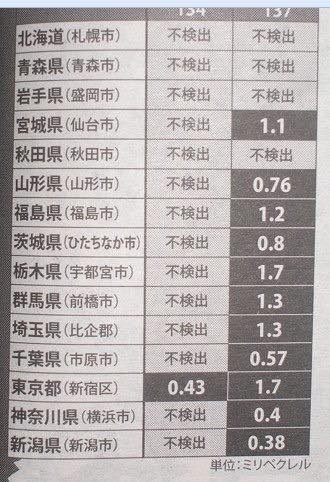
Source: https://jisin.jp/serial/%E7%A4%BE%E4%BC%9A%E3%82%B9%E3%83%9D%E3%83%BC%E3%83%84/disaster/26165
Current Fukushima Kids Situation
Via Kaye Nagamine
I’ve heard that the video reveals the information that has never been disclosed before and it’s ONE and ONLY video that documented the true reality of the current Fukushima kids situation presented by a Japanese medical scientist in an academic conference internationally.
Mr. Suzuki, the lecturer in this video, is the one who have operated 125 child thyroid cancer patients in Fukushima. He had been trying to voice the plight situation but he was muted by some political intention.
Here’s the story I’ve heard: He has been verbally and attacked and insulted by Mr. Shibuya of Fukushima Health Committee during its committee assembly, and his false accusation made Mr. Suzuki leave his position of committee member. The conscientious one always has to leave.
I don’t get it. Shibuya malevolently accused Mr. Shuzuki that the doctor must have even operated the case of trifling and unnecessary cases, padding…
View original post 69 more words
Debris to be removed from side of Fukushima reactors
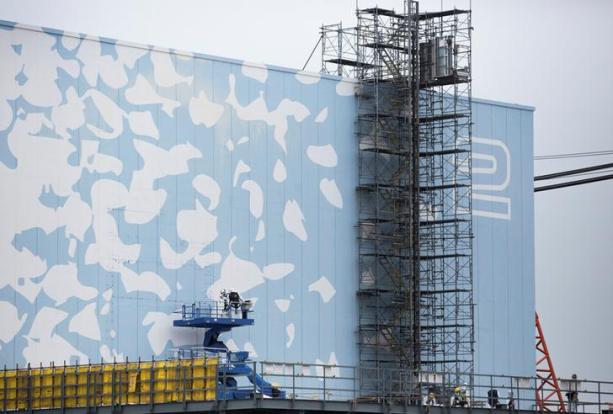 Workers wearing protective suits and masks work on the No. 2 reactor building at the Fukushima Daiichi nuclear power plant.
TOKYO – A state-backed entity tasked with supporting the decommissioning of the Fukushima nuclear power station proposed Thursday that melted fuel be removed from the side of three of the crippled reactors as part of the process to scrap the complex.
Based on a formal proposal, the government and the plant operator Tokyo Electric Power Company Holdings Inc (TEPCO) will determine specific approaches to carry out the process on each reactor next month and update the plant decommissioning road map.
Under its strategic plan for 2017, the Nuclear Damage Compensation and Decommissioning Facilitation Corp called for the removal of the fuel by partially filling the three reactors with water to cover some of the nuclear debris while allowing access to carry out the work.
The entity also pointed out that…
View original post 299 more words
Elimination of Fukushima evacuees from list slammed
 This woman in her 30s lives in Tokyo with her young children after fleeing her home in Fukushima Prefecture following the accident at the Fukushima No. 1 nuclear power plant in March 2011. Her husband remains in Fukushima Prefecture for his job.
The central government has made a large number of people who voluntarily fled the Fukushima area after the 2011 nuclear disaster disappear by cutting them from official lists of evacuees.
Critics are now condemning the move, which went into effect last April, saying it prevents government officials from fully grasping the picture of all who remain displaced to evaluate their future needs.
“Accurate data on Fukushima evacuees is essential in gaining a better understanding of their current circumstances and crafting measures to address their problems,” said Shun Harada, a sociology researcher at Rikkyo University in Tokyo, who contributes as an editor for an information publication for evacuees…
View original post 496 more words
Muscle robots’ being developed to remove debris from Fukushima reactors
Hitachi-GE testing variety of simply structured, radiation-resistant equipment
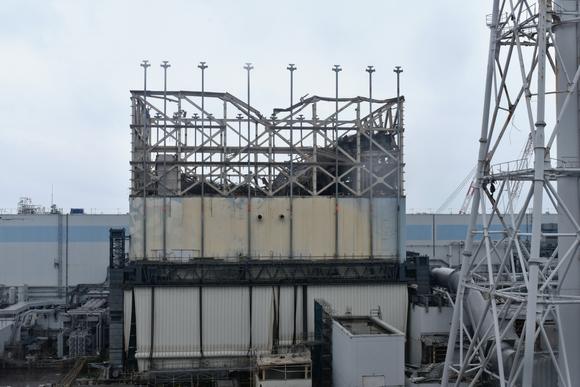 The Unit 1 reactor building at the Fukushima Dai-ichi nuclear power plant of the Tokyo Electric Power Co. (TEPCO) in Okuma town, Fukushima prefecture, June 21, 2017.
TOKYO — A joint venture between Japanese and American high-technology power houses Hitachi and General Electric is developing special robots for removing nuclear debris from the Fukushima Daiichi nuclear power plant, the most difficult task in decommissioning the plant’s six reactors, three of which suffered core meltdowns in the March 2011 accident.
The machines under development by Hitachi-GE Nuclear Energy are called “muscle robots,” as their hydraulic springs operate like human muscles. The company, based in Hitachi, Ibaraki Prefecture, is stepping up efforts to complete the development project in time for the start of debris removal in 2021.
Hitachi-GE is testing the arms of the robots at a plant of Chugai Technos, a Hiroshima-based engineering…
View original post 290 more words
1 This month

of the week – Australians for War Powers Reform (AWPR)
To see nuclear-related stories in greater depth and intensity
 Antinuclear