James Hansen is wrong on Generation IV nuclear reactors – not safe, not waste-free, not cheap
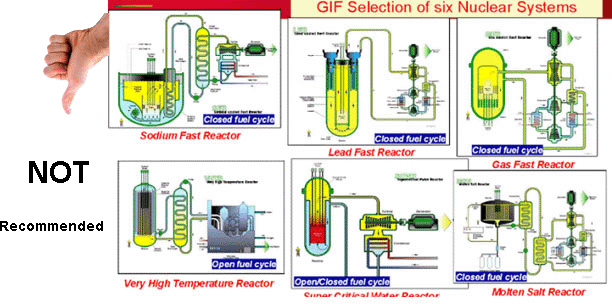
The risks……..in fact, thorium has been used to produce fissile material (uranium-233) for nuclear weapons tests.
Waste…. “Even integral fast reactors (IFRs), which recycle most of their waste, leave behind materials that have been contaminated by transuranic elements and so cannot avoid the need to develop deep geologic disposal.”
Generation IV economics…..The US Government Accountability Office’s 2015 report noted that technical challenges facing SMRs and advanced reactors may result in higher-cost reactors than anticipated, making them less competitive with large light-water reactors or power plants using other fuels.
James Hansen’s Generation IV nuclear advocacy: a deconstruction of nuclear fallacies and fantasies http://www.theecologist.org/News/news_analysis/2989318/james_hansens_generation_iv_nuclear_advocacy_a_deconstruction_of_nuclear_fallacies_and_fantasies.html, Dr Jim Green, 3rd October, 2017
Climate scientist James Hansen’s claims about Generation IV nuclear concepts simply don’t stack up, argues JIM GREEN Dr James Hansen is rightly admired for his scientific and political work drawing attention to climate change. His advocacy of nuclear power ‒ and in particular novel Generation IV nuclear concepts ‒ deserves serious scrutiny.
In a nutshell, Dr Hansen (among others) claims that some Generation IV reactors are a triple threat: they can convert weapons-usable (fissile) material and long-lived nuclear waste into low-carbon electricity. Let’s take the weapons and waste issues in turn.
The risks
Dr Hansen says Generation IV reactors can be made “more resistant to weapons proliferation than today’s reactors” and he claims that “modern nuclear technology can reduce proliferation risks”.
But are new reactors being made more resistant to weapons proliferation and are they reducing proliferation risks? In a word: No.
Fast neutron reactors have been used for weapons production in the past (e.g. by France) and will likely be used for weapons production in future (e.g. by India).
India plans to produce weapons-grade plutonium in fast breeder reactors for use as driver fuel in thorium reactors. Compared to conventional uranium reactors, India’s plan is far worse on both proliferation and security grounds. To make matters worse, India refuses to place its fast breeder / thorium program under IAEA safeguards.
Dr Hansen claims that thorium-based fuel cycles are “inherently proliferation-resistant”. But in fact, thorium has been used to produce fissile material (uranium-233) for nuclear weapons tests. Again, India’s plans provide a striking real-world refutation of Hansen’s claims.
Dr Hansen claims that integral fast reactors (IFR) ‒ a non-existent variant of fast neutron reactors ‒ “could be inherently free from the risk of proliferation”. Unfortunately, that isn’t true. Dr George Stanford, who worked on an IFR R&D program in the US, notes that proliferators “could do [with IFRs] what they could do with any other reactor − operate it on a special cycle to produce good quality weapons material.”
Safeguards
Dr Hansen acknowledges that “nuclear does pose unique safety and proliferation concerns that must be addressed with strong and binding international standards and safeguards.”
There’s no doubting that the safeguards systems needs strengthening ‒ even some nuclear advocates acknowledge the problem. Dr Hansen says he was converted to the cause of Generation IV nuclear technology by Tom Blees, whose 2008 book ‘Prescription for the Planet‘ argues the case for IFRs.
But Dr Hansen doesn’t seem to have paid much attention to those sections of the book where Blees argues for radically strengthened safeguards including the creation of an international strike-force on standby to attend promptly to any detected attempts to misuse or to divert nuclear materials.
Waste
Dr Hansen claims that “modern nuclear technology can … solve the waste disposal problem by burning current waste and using fuel more efficiently” and he states that nuclear waste “is not waste, it is fuel for 4th generation reactors!”
But even if IFRs ‒ Dr Hansen’s favoured Generation IV concept ‒ worked as hoped, they would still leave residual actinides, and long-lived fission products, and long-lived intermediate-level waste in the form of reactor and reprocessing components … all of it requiring deep geological disposal.
UC Berkeley nuclear engineer Prof. Per Peterson states: “Even integral fast reactors (IFRs), which recycle most of their waste, leave behind materials that have been contaminated by transuranic elements and so cannot avoid the need to develop deep geologic disposal.”
So if IFRs don’t obviate the need for deep geological repositories, what problem do they solve? They don’t solve the WMD proliferation problem associated with nuclear power. They would make more efficient use of uranium … but uranium is plentiful.
In theory, IFRs would gobble up nuclear waste and convert it into low-carbon electricity. In practice, the EBR-II reactor in Idaho ‒ an IFR prototype, shut down in 1994 ‒ has left a legacy of troublesome waste. This saga is detailed in a recent article and a longer report by the Union of Concerned Scientists’ senior scientist Ed Lyman.
Dr Lyman states that attempts to treat IFR spent fuel with pyroprocessing have not made management and disposal of the spent fuel simpler and safer, they have “created an even bigger mess”.
Dr Lyman concludes: “Everyone with an interest in pyroprocessing should reassess their views given the real-world problems experienced in implementing the technology over the last 20 years at [Idaho National Laboratory].
“They should also note that the variant of the process being used to treat the EBR-II spent fuel is less complex than the process that would be needed to extract plutonium and other actinides to produce fresh fuel for fast reactors. In other words, the technology is a long way from being demonstrated as a practical approach for electricity production.”
Generation IV economics
Dr Hansen claimed in 2012 that IFRs could generate electricity “at a cost per kW less than coal.” A complex, novel reactor coupled to a complex, novel reprocessing system will be cheaper than shovelling coal into a burner? Not likely.
The US Government Accountability Office’s 2015 report noted that technical challenges facing SMRs and advanced reactors may result in higher-cost reactors than anticipated, making them less competitive with large light-water reactors or power plants using other fuels.
A 2015 report by the International Energy Agency (IEA) and the OECD’s Nuclear Energy Agency (NEA) said that “generation IV technologies aim to be at least as competitive as generation III technologies … though the additional complexity of these designs, the need to develop a specific supply chain for these reactors and the development of the associated fuel cycles will make this a challenging task.”
The late Michael Mariotte commented on the IEA/NEA report: “So, at best the Generation IV reactors are aiming to be as competitive as the current − and economically failing − Generation III reactors. And even realizing that inadequate goal will be “challenging.” The report might as well have recommended to Generation IV developers not to bother.”
The idea of reactors converting weapons material and nuclear waste into low-carbon power is attractive to even the most hardened nuclear critics. But unfortunately, the claims made by advocates of these Generation IV concepts simply don’t stack up.
This Author
Dr Jim Green is the national nuclear campaigner with Friends of the Earth Australia and editor of the Nuclear Monitor newsletter, where a longer and fully referenced version of this article can be found.
5 Comments »
Leave a reply to Christina MacPherson Cancel reply
1 This month
Chernobyl: The Lost Tapes – A good documentary on Chernobyl on SBS available On Demand for the next 3 weeks– https://www.sbs.com.au/ondemand/tv-program/chernobyl-the-lost-tapes/235274195556

21 April Webinar: No Nuclear Weapons in Australia
Start: 2026-04-21 18:00:00 UTC Canberra, Melbourne, Sydney (GMT+10:00)
End: 2026-04-21 19:30:00 UTC Canberra, Melbourne, Sydney (GMT+10:00)
Event Type: Virtual
A virtual link will be communicated before the event.
Host Contact Info: australia@icanw.org

of the week – Australians for War Powers Reform (AWPR)
To see nuclear-related stories in greater depth and intensity
 Antinuclear
How do you plan to keep China, Russia, India and Brazil from developing and selling advanced nuclear power systems?
Folks like you are going to consign the Western Democracies to the dustbin of history.
LikeLike
That is a reasonable question. I am surprised that people don’t ask it more often. China and Russia are developing advanced nuclear power entirely at the public’s expense. It’s all State-owned. They are betting on selling it at a profit. That’s a dodgy bet. In the end, it will be stopped, not by me or by other opponents, but by financial failure – the same mechanism that is killing nuclear power in the West.
India is already benefiting from a boom in renewable energy, is racing ahead in solar power (as China is, too). It’s only subservience to America and to the weapons industry that keeps India’s problematic nuclear power projects going. For Brazil – I don’t know.
Probably the countries that get out of nuclear first, will do best, except for America’s massive radioactive waste problem.
Anyway, it will take a worldwide publicity campaign to get advanced nuclear power happening. Perhaps, linked with space exploration and weapons development, they will succeed, but only with huge taxpayer subsidy. It will still be uneconomic and unattractive to investors.
LikeLike
Wonderful points on state-owned nuclear and renewables. India is getting reactors from French and Russian state owned companies too. And Holtec is privately owned by Kris Singh who was India born and educated and the treaty to let the US nuclear in and reduced liability, etc., was negotiated by Richard Verma who I think was born in Canada to migrants from India. There is a Holtec India – maker of concrete – which predates Holtec in the US. Westinghouse is Japanese Toshiba. Is French state owned Areva American too? They have facilities in the US. To talk American nuclear, IMO, you have to get into companies like GE, Fluor, Bectel, etc. I think in India and Japan GE is part of long-standing joint ventures. GE nuclear US is almost half owned by Hitachi. In Japan it is Hitachi GE nuclear. Holtec has benefitted from affirmative action subsidies meant for black people and women because immigrants from India get these subsidies as minorities even though they are majority in the world. Singh is a major donor, friend and probably relative to Republican Nikki Haley – UN Amb. Her father is from the same village and migrated via Canada. Singh brings in lots of foreign workers on H1B visas – many from India but also eastern Europeans, mostly via Canada but his biggest expert is from the German nuclear industry. Democrat Norcross’ brother sits on his board so both parties are poisoned. The Norcross’ are part of a major Democratic machine in NJ. Now Singh’s probably too rich to stop. Needless to say I hold a very narrow view of what “American” is. I think that only refugees and spouses of Americans should have been let into the country and not economic migrants who came simply to get economic benefits including from affirmative action. Letting people from India and China get affirmative action is a racist policy since most, though not all, American racists prefer light skinned people from India and China to black African Americans. Instead, since 1970, over 90% of the 1 million per year legal immigrants are non-refugees like Singh, though refugees have been involved in mafia. And, efforts should be made to stop creating refugees through mining, agricultural land grabs and warfare. India agribusiness is even land-grabbing in Africa, but no one talks about it. The legal economic migrants also include British and Europeans, btw. Most Euro countries don’t allow right of return for Euro Americans but they continue to send people to America. I think that most black Americans consider themselves Americans after 400 years and don’t wish to return to Africa. British and Australian mining companies have sent Australian uranium to India, as you know, – to the detriment of Australia. Having had my academic funding and my university position taken by less qualified new immigrants I don’t care to be blamed for all of the problems of the world too.
LikeLike
Reblogged this on AGR Daily 60 Second News Bites.
LikeLike
I failed to say that the dustbin of history is those countries getting nuked to death from radioactive discharges. Also, most of those having invented US nuclear were the product of German universities – first anti-Nazis and then former Nazis. The Curies were products of French universities. US universities at the time tended to have practical focus – agricultural and mechanical colleges, with some focused more on human sciences, i.e.philosphy and religion, and law. Even up until recently the French have mocked US social science for its practical focus.
LikeLike