Nuclear/Climate Newsletter Australia
 The 2017 Nobel Peace Prize has just been awarded to the International Campaign to Abolish Nuclear Weapons (ICAN). This global campaign began in Melbourne 10 years ago, and look where it went from there! Retrieving Australia’s past reputation for work towards nuclear disarmament, ICAN’s dedicated team just kept going. Today, I can feel proud to be Australian, despite the Australian government’s present craven record on disarmament.
Contrasting with that positive news, we have Donald Trump’s latest ominous utterance – “the calm before the storm”. https://www.youtube.com/watch?v=rU62DZ_Xf0M Who knows what he means? At least in the 1979 Peter Sellers film “Being There” that particular dimwitted President knew that he was talking about gardening.
AUSTRALIA
NUCLEAR. Could Australia be the target of a North Korean missile? Former Liberal Party leader John Hewson call on the Australian government to stop being subservient to American foreign policy, especially now in the Trump era. Gareth Evans says Australia should not blindly follow USA on foreign policy.
Tony Abbott calls on Turnbull govt to change laws, and develop nuclear and coal power. Former Labor leader Mark Latham urges Australia to “go nuclear”. Glamour nuclear spruiker Brian Cox – in Cumbria, then Australia. Pro nuclear shilling group on the move in New South Wales, but Premier Gladys Berejiklian has ruled out nuclear power. Nuclear Reactor for Burrinjuck Dam – says Rob Parker of Nuclear For Climate Australia.
South Australia- lots of sick-making propaganda from the nuclear waste gang – National Radioactive Waste Management Facility – they seem to have unlimited tax-payer money for this stuff. It’s available on their Facebook page.
CLIMATE. Australia must prepare for super-hot days. That’s if you believe the research of scientists at the Australian National University. On the other hand, that could all be nonsense, if you believe Australia’s (highly unpopular) former PM Tony Abbott. Australia’s farmers need action on climate change, and for renewable energy. Scientists race to try to save the Great Barrier Reef.
Adani Carmichael coal mine:-Indian coal miner Adani facing income crash – desperate to get Australian tax-payer funding Former Indian minister sounds alarm on Adani’s track record, mega-mine’s viability– -Adani’s tax havens – the Queensland coal mine plan’s connection with corruption. Market Forces list COMPANIES THAT COULD MAKE OR BREAK THE ADANI CARMICHAEL COAL PROJECT. In India, police action targeted ABC journalists researching Adani’s dubious dealings.
Minerals Council of Australia – a wealthy lobby works on behalf of foreign corporations
2017 Nobel Peace Prize goes to International Campaign to Abolish Nuclear Weapons (ICAN)
 Anti-nuclear campaign ICAN wins 2017 Nobel Peace PrizeNerijus Adomaitis, Stephanie Nebehay http://www.reuters.com/article/us-nobel-prize-peace/anti-nuclear-campaign-ican-wins-2017-nobel-peace-prize-idUSKBN1CB0XR OCTOBER 6, 2017 OSLO/GENEVA (Reuters) – The Norwegian Nobel Committee, warning of a rising risk of nuclear war, awarded the 2017 Nobel Peace Prize on Friday to a little-known international campaign group advocating for a ban on nuclear weapons.
The International Campaign to Abolish Nuclear Weapons (ICAN) describes itself as a coalition of grassroots non-government groups in more than 100 nations. It began in Australia and was officially launched in Vienna in 2007.
“We live in a world where the risk of nuclear weapons being used is greater than it has been for a long time,” said Berit Reiss-Andersen, the leader of the Norwegian Nobel Committee.
In July, 122 nations adopted a U.N. Treaty on the Prohibition of Nuclear Weapons, although the agreement does not include nuclear-armed states such as the United States, Russia, China, Britain and France.
“This award shines a needed light on the path the ban treaty provides toward a world free of nuclear weapons. Before it is too late, we must take that path,” ICAN said in a statement on its Facebook page.
“This is a time of great global tension, when fiery rhetoric could all too easily lead us, inexorably, to unspeakable horror. The specter of nuclear conflict looms large once more. If ever there were a moment for nations to declare their unequivocal opposition to nuclear weapons, that moment is now.” (Graphics on ‘Nobel laureates’ – here)
The Nobel prize seeks to bolster the case of disarmament amid nuclear tensions between the United States and North Korea and uncertainty over the fate of a 2015 deal between Iran and major powers to limit Tehran’s nuclear program.
The Iran deal is seen as under threat after U.S. President Donald Trump called it the “worst deal ever negotiated”. A senior administration official said on Thursday that Trump is expected to announce soon that he will decertify the pact, a step toward potentially unwinding it.
The committee raised eyebrows with its decision to award the prize to an international campaign group with a relatively low profile, rather than giving it to the architects of the Iran deal, who had been widely seen as favorites after hammering out a complex agreement over years of high-stakes diplomacy.
“Norwegian Nobel Committee has its own ways, but the nuclear agreement with Iran achieved something real and would have deserved a prize,” tweeted Carl Bildt, a former Swedish prime minister who has held top posts as an international diplomat.
The leader of the Norwegian Nobel committee denied that the prize was “a kick in the leg” for Trump and said the prize was a call to states that have nuclear weapons to fulfill earlier pledges to work toward disarmament.
“The message is to remind them to the commitment they have already made that they have to work for a nuclear free world,” Reiss-Andersen told Reuters.
The United Nations said the award would help bolster efforts to get the 55 ratifications by countries for the U.N. Treaty on the Prohibition of Nuclear Weapons to come into force.
“I hope this prize will be conducive for the entry into force of this treaty,” U.N. Chief Spokeswoman Alessandra Vellucci told a news briefing.
International Campaign to Abolish Nuclear Weapons (ICAN) started in Melbourne
Nobel peace prize awarded to Melbourne-born International Campaign to Abolish Nuclear Weapons http://www.theage.com.au/victoria/nobel-peace-prize-awarded-to-melbourneborn-international-campaign-to-abolish-nuclear-weapons-20171006-gyw4wh.html Melissa Cunningham
During a time when the risk of nuclear conflict is imminent, the prestigious Nobel peace prize has been awarded to a Melbourne-born advocacy group that pushed to establish the first treaty to ban nuclear weapons.
The Nobel Committee honoured the now Geneva-based group, the International Campaign to Abolish Nuclear Weapons, “for its work to draw attention to the catastrophic humanitarian consequences of any use of nuclear weapons and for its ground-breaking efforts to achieve a treaty-based prohibition of such weapons.”
The group worked to advance the negotiations that led to the Treaty on the Prohibition of Nuclear Weapons, which was passed earlier this year at the United Nations.
In July, 122 nations voted to pass the treaty, but nuclear-armed states including the United States, Russia, China, Britain and France stayed out of the talks.
Australia is also yet to sign the treaty.
Ominous (?nuclear) statement by Donald Trump
Text of Nobel Peace Prize award to anti-nuclear campaign ICAN,
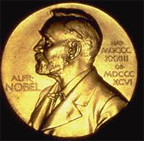 https://au.news.yahoo.com/a/37375277/text-of-nobel-peace-prize-award-to-anti-nuclear-campaign-ican/ OSLO (Reuters) (Reporting By Alister Doyle), 6 Oct 17 – Following is the text of the Nobel Peace Prize award on Friday to the International Campaign to Abolish Nuclear Weapons:
The Norwegian Nobel Committee has decided to award the Nobel Peace Prize for 2017 to the International Campaign to Abolish Nuclear Weapons (ICAN).
The organization is receiving the award for its work to draw attention to the catastrophic humanitarian consequences of any use of nuclear weapons and for its ground-breaking efforts to achieve a treaty-based prohibition of such weapons.
We live in a world where the risk of nuclear weapons being used is greater than it has been for a long time. Some states are modernizing their nuclear arsenals, and there is a real danger that more countries will try to procure nuclear weapons, as exemplified by North Korea.
Nuclear weapons pose a constant threat to humanity and all life on earth. Through binding international agreements, the international community has previously adopted prohibitions against land mines, cluster munitions and biological and chemical weapons. Nuclear weapons are even more destructive, but have not yet been made the object of a similar international legal prohibition.
Through its work, ICAN has helped to fill this legal gap. An important argument in the rationale for prohibiting nuclear weapons is the unacceptable human suffering that a nuclear war will cause. ICAN is a coalition of non-governmental organizations from around 100 different countries around the globe.
The coalition has been a driving force in prevailing upon the world’s nations to pledge to cooperate with all relevant stakeholders in efforts to stigmatize, prohibit and eliminate nuclear weapons. To date, 108 states have made such a commitment, known as the Humanitarian Pledge.
Furthermore, ICAN has been the leading civil society actor in the endeavor to achieve a prohibition of nuclear weapons under international law. On 7 July 2017, 122 of the UN member states acceded to the Treaty on the Prohibition of Nuclear Weapons.
As soon as the treaty has been ratified by 50 states, the ban on nuclear weapons will enter into force and will be binding under international law for all the countries that are party to the treaty.
The Norwegian Nobel Committee is aware that an international legal prohibition will not in itself eliminate a single nuclear weapon, and that so far neither the states that already have nuclear weapons nor their closest allies support the nuclear weapon ban treaty.
The Committee wishes to emphasize that the next steps towards attaining a world free of nuclear weapons must involve the nuclear-armed states. This year’s Peace Prize is therefore also a call upon these states to initiate serious negotiations with a view to the gradual, balanced and carefully monitored elimination of the almost 15,000 nuclear weapons in the world.
Five of the states that currently have nuclear weapons – the USA, Russia, the United Kingdom, France and China – have already committed to this objective through their accession to the Treaty on the Non-Proliferation of Nuclear Weapons of 1970.
The Non-Proliferation Treaty will remain the primary international legal instrument for promoting nuclear disarmament and preventing the further spread of such weapons.
It is now 71 years since the UN General Assembly, in its very first resolution, advocated the importance of nuclear disarmament and a nuclear weapon-free world. With this year’s award, the Norwegian Nobel Committee wishes to pay tribute to ICAN for giving new momentum to the efforts to achieve this goal.
The decision to award the Nobel Peace Prize for 2017 to the International Campaign to Abolish Nuclear Weapons has a solid grounding in Alfred Nobel’s will.
The will specifies three different criteria for awarding the Peace Prize: the promotion of fraternity between nations, the advancement of disarmament and arms control and the holding and promotion of peace congresses. ICAN works vigorously to achieve nuclear disarmament.
ICAN and a majority of UN member states have contributed to fraternity between nations by supporting the Humanitarian Pledge. And through its inspiring and innovative support for the UN negotiations on a treaty banning nuclear weapons, ICAN has played a major part in bringing about what in our day and age is equivalent to an international peace congress.
It is the firm conviction of the Norwegian Nobel Committee that ICAN, more than anyone else, has in the past year given the efforts to achieve a world without nuclear weapons a new direction and new vigor.
Australia must prepare for super-hot days
 Dehydration, death and power cuts: What 50C days would look like in Australia ABC NEWS, 6 OCT 17, The Conversation By Liz Hanna, Australian National University Australia is hot. But future extreme hot weather will be worse still, with new research predicting that Sydney and Melbourne are on course for 50 degrees Celsius summer days by the 2040sif high greenhouse emissions continue.
That means that places such as Perth, Adelaide and various regional towns could conceivably hit that mark even sooner.
This trend is worrying, but not particularly surprising given the fact that Australia is setting hot weather records at 12 times the pace of cold ones. But it does call for an urgent response.
Most of us are used to hot weather, but temperatures of 50℃ present unprecedented challenges to our health, work, transport habits, leisure and exercise.
Humans have an upper limit to heat tolerance, beyond which we suffer heat stress and even death. Death rates do climb on extremely cold days, but increase much more steeply on extremely hot ones.
While cold weather can be tackled with warm clothes, avoiding heat stress requires access to fans or air conditioning, which is not always available……….
Preparing ourselves
Last year, the Australian Summit on Extreme Heat and Health warned that the health sector is underprepared to face existing heat extremes.
The health sector is concerned about Australia’s slow progress and is responding with the launch of a national strategy for climate, health and well-being.
Reinstating climate and health research, health workforce training and health promotion are key recommendations.
There is much more to be done, and the prospect of major cities sweltering through 50C days escalates the urgency.
Two key messages arise from this. The first is that Australia urgently needs to adapt to the extra warming.
Heat-wise communities (or “heat-safe communities” in some states) — where people understand the risks, protect themselves and look after each other — are vital to limit harm from heat exposure.
The health sector must have the resources to respond to those who succumb. Research, training and health promotion are central.
The second message is that nations across the world need to improve their efforts to reduce greenhouse emissions, so as to meet the Paris climate goal of holding global warming to 1.5C.
If we can do that, we can stave off some of the worst impacts. We have been warned.
Liz Hanna is an honorary senior fellow at the Australian National University.
Originally published in The Conversation http://www.abc.net.au/news/2017-10-06/50-degree-days-what-would-sydney-and-melbourne-look-like/9024914
Hypocrisy of Gareth Evans – supposedly promotes nuclear disarmament, but now plugging for nuclear waste importing
Nuclear power and nuclear weapons are intrinsically connected. The shonky 2016 South Australian plan to import nuclear wastes was intended to promote the global nuclear industry, as Gareth Evans well knows
Paul Waldon Fight To Stop Nuclear Waste Dump In Flinders Ranges SA, 7 Oct 17 Thursdays Advertiser story: Gareth Evans calling to resuscitate the dead program of South Australia being the worlds nuclear waste dump with desire to debate on something that should remain buried, or is he a “Mass Debater” trying to satisfy himself. However he has condemned the “NIMBY’s”, who he has claimed employed arguments by activists for their roll in the death of a program he supports.https://www.facebook.com/groups/344452605899556/
Australia’s choice: renewable energy superpower or Asian Pacific rust belt
 It’s our choice: renewable energy superpower or Asian Pacific rust belt, Guardian
Pat Conroy, 6 Oct 17,
If we stop fighting change, Australia can be the land of endless energy powering generations of manufacturing industries The shift to decarbonise our economy is portrayed by opponents of such a shift as the death of Australia as an energy superpower.
Nothing can be further from the truth.
As the world decarbonises, if we plan well, Australia can not only continue to be an energy exporting superpower, we should also enjoy a manufacturing boom.
We need to acknowledge that exports of coal for power generation, that is thermal coal, will decline significantly over the next few decades. We will continue to export metallurgical coal, which makes up 65% of our coal exports by value, for a long time to come as there is no other way of manufacturing steel. However, we are in position to replace the thermal coal exports with liquid sunlight.
Around the world, scientists and policymakers are working on the concept of “Power2gas”. Power2gas is driven by a simple issue: how to store and transport solar and wind power for later use.
This is a great way of using solar or wind power when there is a surplus of electricity supply in the grid, for example in the middle of the night, when the wind might be blowing hard but people and factories don’t need the power. The electricity is practically free, and it is a very cost-effective way of producing hydrogen from water.
This hydrogen can then be used to fuel cars or to bulk out natural gas to be burned to create electricity; both options are completely carbon neutral……..
The shift to renewables also offers Australia the opportunity to revitalise the manufacturing sector.
As the world decarbonises its electricity supply, the nations that can transform into manufacturing powerhouses are those with the cheapest energy, which will be the nations with the best renewable energy resources.
Australia has the highest average solar radiation per square metre of any continent in the world.
This power can be made reliable and despatchable when coupled with gas peaking plants initially and then pumped hydro and battery storage.
In this scenario Australia can be the land of cheap and endless energy which could power generations of metal manufacturing and other energy intensive manufacturing industries.
We are also well poised to be the capital of mining and processing of key inputs for the renewables revolution. We are the second largest producer of rare earths, we supply 41% of the world’s lithium and we have 12.4% of global copper reserves. These are all crucial materials for clean energy and battery manufacture.
At the moment Australia as a renewable energy export superpower, land of energy intensive manufacturing and home of “renewable metals” processing is merely one of many potential outcomes.
If we continue to bury our heads in the sand and fight change, another outcome is almost assured. In this scenario, we will become the rust belt economy of the Asia Pacific. The home of high electricity prices, the home of broken down, old power plants, the home of unrealised potential and the home of a very gloomy future. It is our choice.
- Pat Conroy is the federal member for Shortland and shadow assistant minister for climate change and energy and shadow assistant minister for infrastructure https://www.theguardian.com/commentisfree/2017/oct/05/its-our-choice-renewable-energy-superpower-or-asian-pacific-rust-b
9 October REneweconomy news
 RenewEconomy
-
California rejects gas peaker plant, seeks clean energy alternativesCalifornia regulator rejects proposal to refurbish a gas peaking plant, paving the way for a solar plus storage solution instead.
-
Carnegie turns wave energy focus to Albany after winning W.A. grantCarnegie wins WA tender for wave energy project, switching focus to Albany for a potential 100MW facility but apparently delaying deployment of first 1MW unit.
-
Disasters must force insurers into climate actionIf ever you needed to quantify the cost of a decade of toxic debate around energy policy, insurance industry earnings would be a good place to start.
-
New Energy Solar to acquire 130MW portfolio of PV plants from Cypress Creek RenewablesFourteen plants will serve customers in North Carolina and Oregon.
-
General Motors pledge for “all EV future” will keep Big Oil up at nightGM, Ford, and China strongly embrace electric cars, signaling trouble for Big Oil.
-
Why are we still pursuing the Adani Carmichael mine?Why, if Adani’s gigantic Carmichael coal project is so on-the-nose for the banks and so environmentally destructive, are the federal and Queensland governments so avid in their support of it?
-
EVs and storage: Lithium’s wild ride and why it will be bigger than LNGThe market for lithium, storage and gigafactories will rival that of Australia’s LNG boom. It will be a wild ride, particularly for Australian lithium companies, but Australian policies remain a disgrace because the government wants to censor talk about carbon.
-
Australia Defence looks to solar power to cut costs, lift securityDefence Department seek solar power to reduce costs and improve energy security at satellite tracking base, in first major push into solar power.
1 This month
To see nuclear-related stories in greater depth and intensity
– go to https://nuclearinformation.wordpress.com/


 Antinuclear