Nuclear propagandist Michael Shellenberger hated ABC interview, loved shock jock Alan Jones
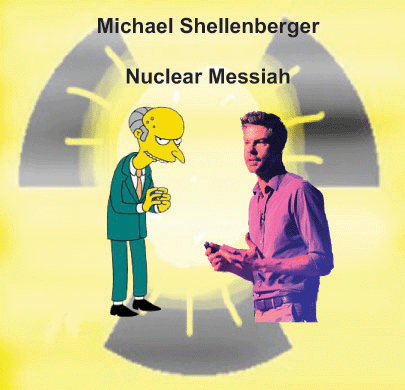
6 Nov 17 The pro nuclear Twittersphere was alive with angry comments about the ABC’s interview with  nuclear propagandist Michael Shellenberger.
I missed that interview, but apparently the ABC interviewer asked some hard questions.
Shellenberger commented: “fighting to survive a brutal interview by a tough young reporter in Oz On ABC (the Aussie BBC)”
Australia’s own nuclear propagandist, Ben Heard, commented: “Shabby interview. Host evidently unfamiliar with topic”
However, those pro nuclear spinners were happy with shock jock Alan Jones on 2GB Alan Jones Breakfast Show. Jones said:
“Michael has turned on wind and solar with a passion: he’s now advocating for an all-atomic energy future, simply because the latter provides reliable power, whereas the former are a childish nonsense…..
the Finkel review totally ignored nuclear power as an option and pushed harder for more and more renewable energy. So Victoria’s looking at 25% renewables by 2025, South Australia 50%, the ACT 100%, Queensland 50%……
one of the world’s leading new-generation environmental thinkers has said the renewable energy experiment with wind and solar has failed. Michael Shellenberger is a former renewables advocate and adviser to Barack Obama when he was President. [ed. not true. Shellenberger sent an unsolicited submission to President Obama] He is now global champion for nuclear energy, which he said was the only option to replace coal and gas on a global scale. ……”
Shellenberger said:
every major study for the last 40 years finds that nuclear power is the safest way to make reliable electricity. You don’t have the risks that come with coal and fossil fuels, both in terms of mine collapses and air pollution, and the accidents themselves that everyone worries so much about hardly have any impact on people’s lives…
Wind and solar – They’re the worst. Really, all renewables are. The reason is easy to understand, in the sense that the fuels are very dilute, they’re very diffuse, and so you have to cover a huge amount of land with wind and solar……. solar produces huge quantities of toxic waste…… They produce two to three hundred times more toxic waste than nuclear plants, which are the only way of producing electricity that contain all of their potentially harmful waste. Of course it’s been contained so well that nobody has ever been harmed by the radiation from nuclear power waste, ever……
The other problem is that you just end up getting too much wind energy when you don’t need it, like the middle of the night. Solar and wind, it’s like they’re almost set up to destroy cheap, clean, reliable energy.
What happened was that there was a smaller group of anti-human so-called environmentalists that opposed nuclear precisely because it allowed for so much cheap and abundant power, and they thought, “Well, if we’re going to stop the human cancer, we have to cut off its energy supplies.” …..
You’ve got some really crazy anti-nuclear people down there…..
Alan Jones: “I’ll tell you something, when you arrive in this country, Michael we’ll have you on again. We can’t hear enough of you. It’s time we had a good healthy dose of common sense”
Pacific Islands leaders will pressure Australia at UN climate meeting
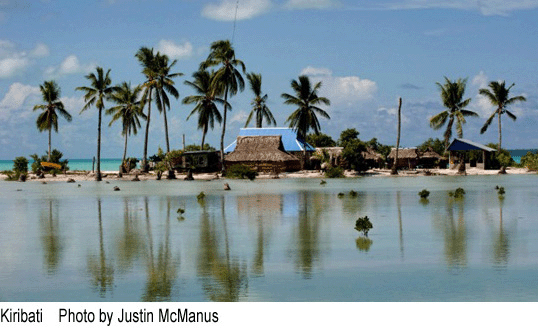 UN climate meeting: Pacific Islands leaders set to put heat on Australia http://www.sbs.com.au/news/article/2017/11/04/un-climate-meeting-pacific-islands-leaders-set-put-heat-australia Germany is hosting UN climate talks this week, but the main focus will be the front line of global warning – the Pacific region. By Rosemary Bolger
The world is watching South Australia’s record consumer-powered electricity grid
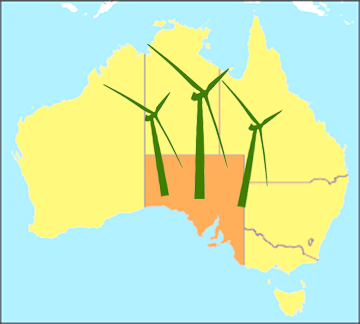 “South Australia gets half of its electricity from wind and solar …. and they are
 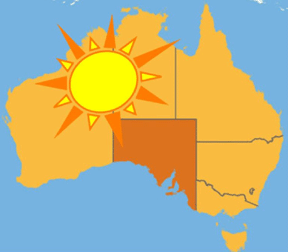 in the process of overcoming their problems and making systems of high penetration of renewables work,” Garnaut said. That is of international interest.”
Battery storage will also play an interesting role. South Australia has the Tesla big battery under construction – and due to be in operation in three weeks – as well as two other grid-scale batteries at Wattle Point wind farm, and proposed for Whyalla.
 South Australia’s stunning transition to consumer-powered grid http://reneweconomy.com.au/south-australias-stunning-transition-to-consumer-powered-grid-20463/ [good graphs] By Giles Parkinson on 6 November 2017 South Australia is already being hailed – or in some quarters demonised – for its leadership on renewable energy technology. But a new report from the Australian Energy Market Operator highlights how far out front it is in the tradition to a consumer-powered grid.
The new AEMO report highlights that 9.2 per cent of the electricity generated in the state over the last financial year came from small-scale (sub 100kW) of solar PV on the rooftops of households and businesses in the state.
That level of rooftop solar penetration is a record for any major grid in the world, and the contribution of rooftop solar is likely to have been well over 10 per cent in the last year when larger rooftop solar installations of more than 100kW are included.
The total will likely at least double over the next 10 years – according to AEMO forecasts – to more than 20 per cent, at which time rooftop solar will be pushing “minimum demand” from the grid to zero on occasions.
It’s already having an impact. As we report here, rooftop PV sent grid demand to a new record low of 554MW on Sunday, just six weeks after a previous low – which had in turn beaten the earlier low set a week earlier than that by nearly 25 per cent.
It’s a taste of what is to come. Major studies by the likes of the CSIRO and the networks association predict that by 2050, half of all demand will be met by what they describe as “distributed generation” – a mix of rooftop solar, battery storage, and “localised” generation.
This represents a major shift from the recent and current state of the industry from centralised energy controlled by major corporations, to local supply and demand – leading to new players and new business models.
But in South Australia – as is the case with so much of the energy transition – it could come quicker than that. By 2025/26, AEMO says rooftop solar could generate 2,500GWh a year. That would be around 22 per cent of total demand in the state.
Add in the proposals by the Liberty OneSteel, the new owners of the Whyalla steelworks, and more than one third of the state’s demand could be met by such distributed solar, and possibly up to half if its plans for 600MW of solar – for itself and other business users – comes to fruition. Continue reading
USA bipartisan members of Congress and Senate speak out against invading North Korea
 Veterans in Congress speak out against invading North Korea, Veterans in Congress are concerned about the possibility of a ground invasion of North Korea, which they said could kill millions of people. They have asked President Trump to tone down his rhetoric.
USA Defence Department says that Invasion is ‘only way’ to destroy Kim Jong-un’s military threat
 North Korea: Invasion is ‘only way’ to destroy Kim Jong-un’s military threat, Pentagon official says http://www.abc.net.au/news/2017-11-06/north-korea-pentagon-joint-chiefs-invasion-only-way-to-disarm/9121092 A ground invasion of North Korea is “the only way” to locate and destroy with complete certainty Kim Jong-un’s nuclear weapons program, the Pentagon Joint Chiefs of Staff have said.
Key points:
- US officials requested a detailed assessment of the consequences of a North Korean war
- The assessment says an invasion is the only way to disarm North Korea with certainty
- The statement says millions could die in days and that chemical weapons may be used
- The Joint Chief of Staffs directly advise the US President on military matters
Australian Institute of Company Directors finds that corporate leaders want renewable energy growth
 What Australia’s corporate leaders really think about renewable energy https://arena.gov.au/blog/company-directors/ @DanielSilkstone 6 Nov 17, Renewable energy is so hot right now.
That’s the key message that emerges from a new study of corporate Australia, undertaken by the Australian Institute of Company Directors.
The Director Sentiment Index, released twice each year, maps the thoughts and priorities of the nation’s company directors. It provides an excellent window into the issues and concerns that are cropping up in boardrooms around the country.
There has been plenty of speculation in recent times about whether the political disagreement that has sometimes accompanied debates around the nation’s energy needs was acting as a handbrake on investment.
But the survey makes clear that the nation’s corporate leaders both want and expect the growth of renewable energy to continue. Continue reading
Record low electricity demand in South Australia, due to rooftop solar
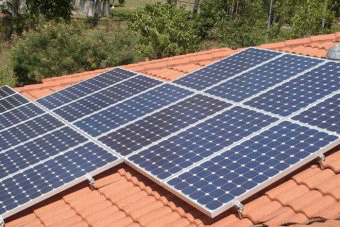
 Rooftop solar pushes South Australia to record low demand (again) http://reneweconomy.com.au/rooftop-solar-pushes-south-australia-to-record-low-demand-again-47836/By Giles Parkinson on 6 November 2017
The combination of growing rooftop solar installations, mild temperatures and sunny weather has pushed South Australia’s grid demand to yet another record low, this time shaving around 6 per cent off the previous low set just six weeks ago.
The new low was set just before 1.30pm in South Australia (just before 2pm on National Electricity Market time) when the minimum grid demand hit 554MW.
This shaved some 33MW off the previous low of 587MW set on September 17,which itself was nearly 200MW or 25 per cent the previous record low demand of 786MW set just a week earlier.
For six hours, according to the APVI solar map, rooftop solar PV provided more than 30 per cent of the state’s demand. For nearly three hours, rooftop solar provided more than 40 per cent of the state’s demand. As we explore in this article here, rooftop solar provided 9.2 per cent of the state’s local generation in 2016/17 and would likely be more than 10 per cent if larger rooftop solar installations were included.
Within a decade, that share is expected to double to more than 20 per cent, at which times on days like this Sunday, minimum demand may actually fall to zero because of the amount of solar being generated.
The Australian Energy Market Operator, which includes these forecasts in a new report into the South Australia grid, suggests that by that time it will be necessary to store some of that excess solar for use later in the day.
The same situation may occur in West Australia, too, because of the amount of rooftop solar being installed in a small grid. The uptake of rooftop solar is accelerating because of high grid prices and the falling cost of solar technology, and grid demand fell in W.A. to an 8-year low last week.
“At these times, South Australia could store or export its excess generation to the rest of the NEM via the interconnectors, provided they are in service,” AEMO notes in its report.
“This, in turn, will provide market participants with greater opportunity to manage their energy use.”
AEMO noted, as it has previously, that South Australia is the first region in the NEM in which high rooftop PV penetration has caused minimum demand to shift from overnight to near midday – a transition that occurred five years ago.
Many argue this is a good reason to shift the “controlled load” of electric hot water systems from the night-time to the mid-day hours, particularly since the closure of the coal fired generators which could not be switched off at night and needed something to power during the night time.
However, problems with the nature of the metering, and the potential expense of the shift, are barriers to the migration of hot water systems to the day-time hours.
6 November More REneweconomy news
 RenewEconomy
-
New solar investment fund seeks up to $300 million in ASX listingNew Energy Solar is hoping to bankroll big solar buy up in US, and Australia and other markets, with $300m IPO.
-
South Australia’s stunning transition to consumer-powered gridRooftop solar expected to provide more than 20% of local generation by 2025, ushering in transition to consumer focused grid in South Australia. Meanwhile, S.A. begins to benefit from renewables, with prices so far in 2017/18 lower than coal-dominated Victoria and NSW.
-
China wind giant buys 100MW wind project in NSWBeijing Jingneng Clean Energy adds Biala wind farm, approved for development in NSW Southern Tablelands, to growing Australian portfolio.
-
Garnaut says NEG may do little for prices, certainty or competitionGarnaut says proposed National Energy Guarantee may fail on price reductions, emissions, and reliability, and may serve to simply reinforce the power of the big energy incumbents.
-
Council approves 350MW PV farm, stage 1of massive solar and storage hubFirst phase of 1GW+ solar and battery storage hub in Gympie approved for development by local council.
-
Germany’s solar, wind generation hits high in OctoberPV and wind power systems generated 15 billion kWh of electricity in Germany in October, with renewables accounting for 44.1% of demand
-
Bonn voyage: climate diplomats head into another round of talksAt the Bonn climate talks that start today, Australia will cop some flak for its lack of reductions ambition, and action.
Coal, nuclear lobbies want to kill off renewable energy, says physics expert

 “……University of Johannesburg professor of
  physics Hartmut Winkler – Winkler has postulated that two powerful lobbies against renewable energy were at work. “One is pro-coal, the other pro-nuclear. This has made the success of the renewable energy projects a target for attacks from interested parties in both,” said Winkler.
“Disrupting the renewable energy sector would ensure that the coal sector remains dominant. And that, over time, it is gradually displaced by nuclear,” he wrote.
“The lobby groups attached to coal and nuclear appear to have had powerful allies on the [South African] state utility’s board. There is mounting evidence that they have been furthering the interests of a group linked to the Gupta family,” Winkler claimed…. Amanda Watson 5 Nov 16 https://citizen.co.za/news/south-africa/1715920/coal-nuclear-lobbies-want-to-kill-off-renewable-energy-says-physics-expert/
Federal Minister For Coal, Matt Canavan, says that Adani Coal megamine project is now in jeopardy
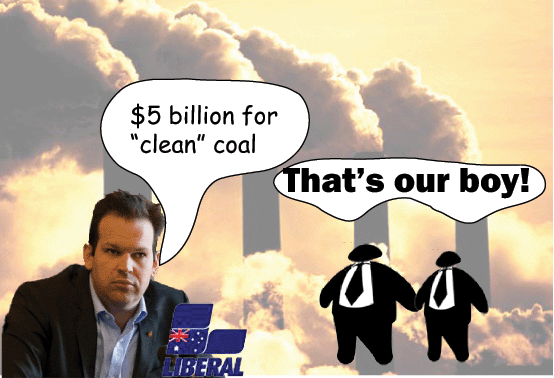 Adani mine: Annastacia Palaszczuk’s loan veto decision ‘jeopardises mine project and jobs’ ABC, AM By Katherine Gregory, 6 Nov 17, The Queensland Premier’s announcement that Labor would not support a concessional Federal Government loan for the Adani coal mine could stop the multi-billion-dollar project and jeopardises the thousands of jobs it would create, the Federal Coalition says.
Annastacia Palaszczuk made the shock announcement last night to eliminate any perceived conflict of interest after it was revealed her partner had links to the loan application.
Ms Palaszczuk has revealed her partner, Shaun Drabsch, worked on Adani’s application to the Northern Australia Infrastructure Fund (NAIF) with his employer, PricewaterhouseCoopers (PwC), which acted for the Indian mining company.
She said he worked on the project after it had received government approvals and although she had followed advice of the Integrity Commissioner, she said it was her decision to exercise her government’s “veto” to not support the loan.
The Indian mining giant is seeking $1 billion from the NAIF to build a rail link for its planned Carmichael coal mine in north Queensland.
The Premier, fighting for re-election on November 25, said she made the announcement because the Liberal National Party (LNP) in Canberra was poised to launch a smear campaign against her……..
Federal Northern Australia Minister Matt Canavan said the Premier’s decision could jeopardise the mine.
“The rules are clear here that for a loan to be made under the Northern Australia infrastructure facility, a state government must sign the project’s finance documents and co-operate with us……… http://www.abc.net.au/news/2017-11-04/palaszczuks-adani-loan-veto-decision-jeopardises-mine-project/9118054
6 November REneweconomy news
RenewEconomy-
Defence seeks 12.5MW solar for Darwin barracks, RAAF baseDefence department seeks 15.5MW of solar for Darwin barracks, RAAF base to cut energy costs and boost energy security. More are planned.
-
Know your NEM: NEG’s windfall for big three power utilitiesThe proposed NEG is already delivering big gains for the big three gentailers, as Adani emerges as major Queensland issue, and REC prices fall.
-
Future-driven show heads to clean-energy hub AdelaideThe Australian Energy Storage Conference and Exhibition (AES 2018) is heading to the nation’s clean-energy leader, Adelaide, in 2018. Registrations to exhibit and sponsor are now open.
-
Rooftop solar pushes South Australia to record low demand (again)Rooftop solar – along with sunny weather and mild temperatures – push grid demand in South Australia to yet another record low.
-
Herbert Smith Freehills advises New Energy Solar on its ASX listing and A$300 million public offeringThe IPO is expected to be priced at between A$1.45 and A$1.55 per stapled security, which will raise between A$100 million and A$300 million for a projected market capitalisation of between A$387.4 million and A$587.4 million.
-
Redflow aims for 250 batteries per month from ThailandASX-listed Redflow announced last month that it has started installing battery production equipment at its new factory in Thailand, putting it on track to commence initial operation by the end of this year.
1 This month

of the week – Australians for War Powers Reform (AWPR)
To see nuclear-related stories in greater depth and intensity
 Antinuclear