To 18th February – the week that has been , in Australian nuclear news
 A thaw in North Korea’s attitude, with the Winter Olympics. Cynics dismiss this as propaganda, but it has obviously brought some calm to the situation in the two Koreas, and perhaps even changed the equation North Korea v USA.
The nuclear news this week has been dominated by the global problem of nuclear waste – what to do with it? France’s EDF proposes a gigantic nuclear garbage pool. Japan has a glut of plutonium wastes. America’s Hanford wastes cleanup will cost $111 billion. The Swedish version of UK’s Radioactive Waste Management was rejected by Swedish Environment Court. Only now after 32 years, is Ukraine starting to remove the liquid nuclear wastes from the shattered Chernobyl reactor. Cumbrians are rejecting UK’s nuclear waste. The Australian government is quietly trying to bribe outback communities into hosting nuclear waste, with a deceptive tale about “medical needs” . As for Fukushima – don’t get me started.
Of course – none of the authorities in any of these countries has suggested the idea of stopping making radioactive trash!
AUSTRALIA
ICAN summary of the Peace Boat and Making Waves speaking tour..
The nuclear waste issue is simmering away, under the radar, with only a few outback towns getting very slanted and limited information from the National Radioactive Waste Management Project -(an arm of ANSTO and the nuclear lobby). National Radioactive Waste Management Project is deceiving local communities. The rest of Australia sleeps on. A Senate Committee is to examine the Selection Process for a dump site in South Australia, (could put a spanner in the nuclear works) . We don’t know who is on this Committee. It will not report until 14 August, (by which time the site may well have been selected anyway). Kimba or Wallerberdina Station could be stuck with Stranded Radioactive Trash.
Nuclear waste dump? A new abuse for Brewarrina’s Aboriginal people?
“Standing Strong” – the No Dump Alliance releases a book on the successful campaign to block an international nuclear waste dump for South Australia.
The machinations of Australia’s military-industrial-nuclear complex macho men.
Julian Assange loses bid to have UK arrest warrant withdrawn .
Natalie Cromb The case for treaty with Aboriginal people. Wangan Jagalingou oppose Adani coal mine expansion – NO EXTINGUISHMENT OF NATIVE TITLE.
RENEWABLE ENERGY. South Australia a global leader in clean energy: Institute for Energy Economics and Financial Analysis (IEEFA). New South Wales Liberal Premier Berejiklian is approving a solar energy revolution. And so much more – at reneweconomy.com.au
SOUTH AFRICA. Hopes that South Africa’s new president will scrap nuclear deal.
RUSSIA. Mayak area- Radiation levels last fall 1,000 times above normal. Residents of Russia’s Yaroslavl region got a “false’ radiation alert scare. Blow to Russia’s nuclear marketing ambitions – other investors back out of Turkey nuclear build.
ALGERIA. The untold story of Algeria’s victims of French nuclear bomb tests.
CHINA. China again delays building Westinghouse-designed AP1000 nuclear reactor, because of safety worries.
PAKISTAN. New types of nuclear weapons being developed by Pakistan.
Despite local opposition, Australian government still planning for nuclear waste dump in rural South Australia
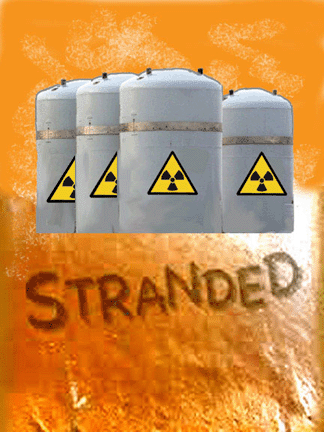 Planning is continuing for a nuclear waste disposal site in the South Australian outback, despite opposition from local residents. http://www.abc.net.au/news/2018-02-17/barndioota-nuclear-waste-site-planning-outrages-locals/9456052
 ABC North and West By Gary-Jon Lysaght 17 Feb 18 The Federal Government has shortlisted two sitesat Kimba on the Eyre Peninsula and one at Barndioota, south of Lake Torrens, near Hawker. The site that is chosen will become a permanent facility for low-level nuclear waste, and will temporarily hold intermediate-level waste.
The intermediate-level waste is currently being held at Lucas Heights, in Sydney’s south.
Barndioota is a gazetted area, and was a town between 1883 and 1929. Locals from Quorn and Hawker, the two communities closest to the Barndioota site, have been vocally opposing the site since planning began in 2015.
“We can see no reason why you’d bring stuff that’s temporarily stored somewhere else … to a completely new site that hasn’t even been built,” resident Greg Bannon said.
Mr Bannon is chairman of the Flinders Local Action Group, a community based organisation aimed at highlighting the problems with a nuclear waste storage facility in the Flinders Ranges.
He said the facility would have a significant impact on tourism, which was a chief economic driver for the Flinders Ranges.
“It’ll create a perception from tourists that they don’t want to go there,” Mr Bannon said.
“We think this facility is totally at odds with anything that’s promoted for the Flinders Ranges.”
Sacred women’s site in area The Adnyamathanha are the traditional owners of Barndioota, and have a sacred Aboriginal women’s site in the region. Enise March is the site’s custodian and said she had been astonished to hear the region was being considered for a nuclear waste disposal facility. “I received that message at 2 o’clock in the morning and I was shocked, extremely shocked,” she said.
“I felt as though I’d been hit in the back of the head with an axe.”
Region seismically active, ‘worst place’ for facility
The Barndioota site, and the entire Flinders Ranges, is considered seismically active.
Flinders University emeritus professor in geology Chris Vonderborch said because of this, it was the worst place to put a nuclear waste facility. “It seems to tick all the wrong boxes for a safe disposal site,” he said. “If you look at past earthquakes around Australia, they’ll line up and down the front of the Flinders Ranges. “It’s an area that can have earthquakes.”
Professor Vonderborch said if the facility was built, the nuclides from it could form a surface sediment on Lake Torrens. “Anything that goes in there comes to the surface, or gets washed in to the surface, and then it’s got a very good chance of blowing who knows where, towards Port Augusta or whatever,” he said.
What nuclear waste will be stored?
Low-level waste Emits radiation at levels that generally require minimal shielding during handling, transport and storage
Examples include paper, plastic, gloves, cloths and filters which contain small amounts of radioactivity
Could include items, such as test tubes, that have come into contact with nuclear medicine
Intermediate Waste Emits a higher level of radiation and requires additional shielding
Generated from radiopharmaceutical production and reactor operations
For example, steel rods that come from the reactors Source: ANSTO
Update on Submissions to the Australian Senate Inquiry on Nuclear Waste Dump Site Selection

The National Radioactive Waste Management Facility Project seems hellbent on keeping this matter “in the family” – the family being itself and a small group of local supporters in the sites already volunteering.
So, it could be a bit of a spanner in the works, for the Australian Senate to be having a Committee of Inquiry into the process. That seems to be inviting outsiders to have a say on the subject of transporting radioactive trash, particularly spent nuclear fuel rod trash 2000 km across Australia, to sit in above ground canisters “temporarily” near Kimba, South Australia.
Who are the Committee members? We don’t know. When will it report back? That’s on August 14th, which might be too late – the site selection might have been made by then.
Anyway, people can send in Submissions by April 3rd, and I urge you to do so.
Four pro nuclear submissions are already published on the Senate Committee site.
These submissions come from:
- Denise Carpenter – member of the Barndioota Consultative Committee. This Committee’s role is to help determine which is the best site for a National Radioactive Waste Dump.
- Ian Carpenter is an enthusiastic member of the Hawker Economic Working Group – “set up t0 investigate how local people at Barndioota, near Hawker and Quorn, 330km north of Adelaide could benefit if radioactive waste is stored there.”
- Chelsea Haywood
- Janice Alex McInnis
I have skimmed through the 4 submissions already published, and they are pretty crummy, repetitive pro nuclear stuff – all emphasising that the writer thinks that the Federal Nuclear Waste Dump is really a matter for the local, not the wider, community.
For example, Chelsea Haywood writes:
broad community support should be kept to those that will be affected should this proposal move forward. By this I mean that there is no need to involve the entire state as it will not impact on them either way should the project go ahead or not.
2017 – 2018 – the the trends in nuclear construction
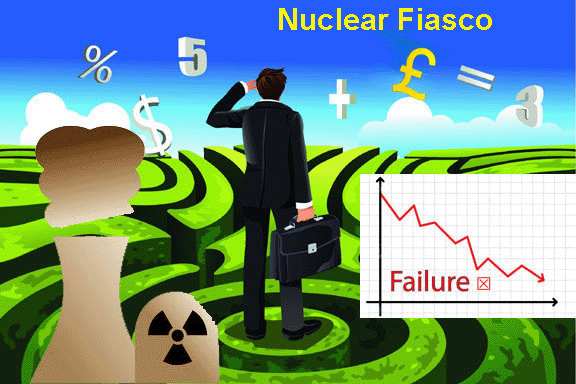 A year in review: the trends in nuclear construction http://www.constructionglobal.com/infrastructure/year-review-trends-nuclear-construction .
We look back on a mixed year for construction in the nuclear industry with the delivery of further nuclear power plants (NPPs) under threat from both the rise in renewable energy and the global trend for decommissioning in the prolonged aftermath of 2011’s Fukushima disaster.
According to the latest findings of the annual World Nuclear Report, as of January 2018, there are 52 reactors currently under construction worldwide. Four NPPs began the long-term process of construction in 2017 – one each in Bangladesh, China, India and South Korea.
The Chinese project, a pilot fast reactor, was launched on Christmas Day last year at the Xiapu site in Fujian province, but there were no other new NPP projects or construction starts announced in the country. Analysts suggest it’s a sign of a major shift or slowdown in Chinese nuclear policy, following the country’s domination of world nuclear construction for the past decade when it contributed over 60% of all new global sites since 2008.
The sector is experiencing profound structural change. The introduction of renewable energy at scale, thanks to declining costs driven by technological advances, has increased renewable power output at the expense of conventional technologies such as coal and nuclear. Though an operating NPP can provide up to nine times more electricity per installed kilowatt than a photovoltaic plant, the challenge to the industry from renewables is tangible. China’s massive rates of solar capacity deliver over 50GW to its grid. Even when taking into account lower productivity per installed GW from solar, research shows new solar plants in China alone in 2017 will generate significantly more power than all nuclear reactors started up (four) in the same year in the entire world.
Construction delays are common due to a number of factors, Continue reading
1 This month
7 April – WEBINAR – Australia and the Doomsday Clock – Preventing nuclear war through NoFirstUse and other policies
Online | Tuesday April 7, 4:00-5:30pm, Australian Eastern Time / 8:00-9:30am Central Europe Time
– Access the registration link
15 April – Zoom –Nuclear Power is Not the Solution
Apr 15, 2026 01:00 AM in Canberra, Melbourne, Sydney

Join the International Physicians for the Prevention of Nuclear War (IPPNW) on Tuesday, April 14th for a timely webinar exploring the risks associated with nuclear power and challenging the myth that it offers a simple, safe, carbon-free solution to the climate crisis

21 April Webinar: No Nuclear Weapons in Australia
Start: 2026-04-21 18:00:00 UTC Canberra, Melbourne, Sydney (GMT+10:00)
End: 2026-04-21 19:30:00 UTC Canberra, Melbourne, Sydney (GMT+10:00)
Event Type: Virtual
A virtual link will be communicated before the event.
Host Contact Info: australia@icanw.org

of the week – Australians for War Powers Reform (AWPR)
To see nuclear-related stories in greater depth and intensity
 Antinuclear