Ham’s conclusion to his very well documented and stringently argued book is that for 70 years the world has accepted an American myth – that the atomic bombs ended the war by shocking Japan into surrender. In fact it was ‘a planned massacre of innocent civilians – an unwarranted, American atrocity’.
Hiroshima: A stain on human history , HIROSHIMA NAGASAKI BY PAUL HAM (Bantam Press £25) By PETER LEWIS, PUBLISHED, 26 July 2012This controversial book delivers a double-whammy in the way of shocks. First, it argues that the Atomic Bombing of two Japanese cities in August, 1945, was militarily unnecessary and politically unjustified.
Second, by interviewing many survivors while he was living in the two cities, Paul Ham, an Australian journalist and expert on the Pacific war, gives an eye-witness picture that leaves Dante’s Inferno looking pale.
Let me start with the inferno, so that we realise just what we are considering. Tomiko Nakamura was a schoolgirl of 13 at Shintaku High School in Hiroshima when the Bomb exploded, killing almost all her 300 schoolmates in the playground. Although over a mile from the blast, the flash, she remembers, ‘felt like the sun had fallen out of the sky and landed right in front of us’.
She regained consciousness in darkness. The mushroom cloud had turned dirty brown and cut off the sun. Flashes like ‘sunrises’ were coming from it in all directions. She examined her scalp covered in glass splinters. ‘My skin rolled off my legs like stockings’. Her shirt and trousers had been burnt onto her flesh. ‘I felt very sick and sat down but the flames were coming closer’. She started to walk over the rubble. ‘Voices beneath the timbers cried “Help! Help! It’s so hot!” I just kept walking’.
She reached a bridge where people with black or red faces were jumping into the river. ‘I couldn’t tell men from women. Some were holding their insides in their hands, staring at them. Everywhere dehydrated people were crying for water but when they drank some they died. A girl screamed: ‘The faster I die the better!’ as she jumped into the river. Continue reading →
6th August Hiroshima 9th August Nagasaki – so far these anniversaries are being ignored by the media. But not in Japan. Japanese children will pass on the history of Nagasaki’s horror nuclear bombing on 9 Aug 1945
The heatwave continues in the Northern hemisphere, but rarely is that awful left-wing term “climate change”mentioned in news reports. It’s affecting all the Northern countries, though there is more news coverage about USA and Europe. Human-caused climate change made heat wave five times more likely.
Much nuclear news about the heatwave, too. The nuclear lobby’s poster boy, France, is copping it, with nuclear reactors having further cuts to their production, their cooling systems being unable to cope. Other countries’ reactors are similarly affected.
Traditional owners “locked out” of nuclear waste vote, InDaily, 3 Aug 18 Stephanie Richards The head of the Adnyamathanha Traditional Lands Association says the majority of Adnyamathanha people have been denied a vote on a proposed radioactive waste management facility near the town of Hawker in the Flinders Rangers.
Wallerberdina Station, located approximately 30km northwest of Hawker on Adnyamathanha country, has been shortlisted by the Federal Government for a facility that will permanently hold low-level nuclear waste and temporarily hold intermediate level waste.
It is one of three sites, the other two situated close to Kimba, that were shortlisted by the Federal Government to store nuclear waste.
The selection process is entering its final stages, with a postal ballot beginning on August 20 to measure community support for the three nominated sites.
But ATLA CEO Vince Coulthard said the voting guidelines were disrespectful to traditional owners, as the majority of Adnyamathanha people do not live close enough to the proposed Wallerberdina site to be eligible to vote.
The voting range includes residents of the Flinders Ranges Council and those who live within a 50km radius of the Wallerberdina site.
According to Coulthard, there are approximately 2500 Adnyamathanha people in total but only about 300 Adnyamathanha people who live in the voting range.
Coulthard said about 50 Adnyamathanha people who lived outside the voting range had expressed interest in voting, but when ATLA asked Federal Resources Minister Matt Canavan during a consultation trip to Hawker last week if those people could be granted a vote, Coulthard said Canavan told him that only those living in the prescribed voting range could participate.
“It’s a crazy situation,” Coulthard said.
“This is Adnyamathanha country and it is a very important place to the Adnyamathanha nation.
“People have strong connections to land. There’s a large amount of people, many who don’t live on the land but they go back on a regular basis to travel around the land.”
……… Coulthard said he was disappointed that Canavan had not consulted with all ATLA members during his consultation visit.
He said Adnyamathanha people had been “locked out” from the vote, despite holding native title rights over the land.
“Canavan is saying this will strengthen our culture, that this will be good for us, but what it is actually doing is punishing the environment.
“This is a place where we have gone to get bush tucker, where we have come as traditional owners for thousands of years.
They’ve shown us disrespect and this is very hurtful.”
The proposed site holds sacred meaning for Adnyamathanha people, as it is located close to the Hookina Waterhole and ancient burial sites.
…….. Last month, the Federal Government tripled the incentive package for the community that hosts the nuclear waste repository.
The Government had promised to spend more than $10 million in the district where the facility is built, but under new incentives announced by Canavan, the Government increased funding to $31 million.
Steve Dale Nuclear Fuel Cycle Watch South Australia, 3 Aug 18 ‘ANSTO has ambitions to dominate the world’s market for medical isotopes’ – oh the luxury of having your follies funded by the taxpayer.
ANSTO’s messy, fragile isotope factory is for producing Moly99/Technetium99 – but Technetium for gamma imaging is slowly being replaced with positron emission tomography (PET) scans.
““Technetium is more or less like black and white TV,” Wilson said. “It’s low definition.”
By varying the target material used in the cyclotron, the technology can produce other medical isotopes like radioactive fluorides for PET, something traditional nuclear reactors cannot produce.”
University’s cyclotron facility could fully supply province’s demand for medical isotopes HINA ALAM, Edmonton Journal : May 15, 2018
For an Albertan who needs it, the journey of a radioactive isotope that has the ability to detect a potential heart or a bone cancer could begin at the University of Alberta’s Medical Isotope Cyclotron Facility…….
Although tests conducted over the past few months have shown that the U of A facility is capable of meeting the province’s need for 1,000 diagnostic procedures a day, there are still hurdles to overcome and its future use for producing technetium is still unclear…..
But research lead and university oncology department chairman Sandy McEwan sees a silver lining….
There are three isotopes that are commonly used — technetium-99m, a radioactive molecule of fluorine used in PET (positron emission tomography) scanning, and isotopes of iodine, used to detect and treat thyroid cancers.
Technetium-99m is the most common of these, and has a half-life of six hours, meaning that only half of it remains after that time. This is advantageous because the imaging scan is quick and the technetium doesn’t linger around in the body. This also means that the isotope must be produced quickly.
In the cyclotron, McEwan said it takes about six hours to make enough technetium-99m for the province each day.
……… ……The U of A technology shows that the isotope can be made locally and the science replicated across the country.
As it stands now, a dose of technetium-99m produced by the cyclotron at U of A is about 10 per cent more expensive compared to a dose of technetium-99m produced by traditional reactors.
“But that includes costing everything,” McEwan said. “It includes costing the cyclotron, the building, the research, the operations — everything.”
McEwan said the technetium-99m produced by the cyclotron is of a slightly higher purity profile than what you get from a reactor.
Also, most of the reactors are extremely old, said John Wilson, manager of the facility……
“Nuclear reactors are the highest capacity source for technetium-99m but are very, very expensive and create nuclear waste,” he said. “No one wants a reactor built close to where they live.” Jan Andersson, a researcher at the facility said as the supply stands now, reactors produce molybdenum-99, which has a half-life of 66 days and decays into technetium-99m, which is used in patients. This allows isotope to be supplied from far away but only if the reactors are running.
McEwan believes that technetium PET imaging will soon fade to give way to newer technologies, and the cyclotron is well-positioned to handle that.
“The cyclotron is Canadian,” he said. “We have a made-in-Canada solution.”
“(F)irst, that the NRC has the statutory authority to license and regulate consolidated interim nuclear waste storage facilities, and secondly, that the comprehensiveness of that federal regulatory scheme pre-empts virtually any state involvement,
The chair of a New Mexico legislative committee that monitors radioactive and hazardous materials in the state says he finds it troubling Attorney General Hector Balderas has concluded the state cannot legally stop a New Jersey-based company from the building a nuclear waste storage facility.
Holtec International, a New Jersey-based company specializing in nuclear storage, has applied to the U.S. Nuclear Regulatory Commission for a license to construct a nuclear waste storage facility about 35 miles (56 kilometers) east of Carlsbad.
The facility, to be located in western Lea County, could eventually store up to 10,000 shipments of spent nuclear fuel, as much as 120,000 metric tons of high-level radioactive waste, from nuclear power plants around the country. It would be stored just below the surface.
The facility is intended to be a temporary storage site, storing nuclear waste only until a permanent storage facility can be built. But opponents fear that it could become permanent because plans for a long-term repository at Yucca Mountain, Nevada, have stalled because of opposition. Continue reading →
Morrison cited several fears some of the townsfolk have about the project, such as negative impact on tourism, water contamination from the DGR boring project and the risk of accident while transporting high level waste along the highway.
Morrison said money has already come into Hornepayne because of its progression into the project. NWMO’s Learn More Project provides funding to cover travel expenses for individuals who represent the community to meet with the NWMO at its office in Toronto. It also funds the hiring independent experts to advise the community ($15,000 or less) and pays to support authorities to engage citizens in the community to learn about the project ($20,000 or less).
“Businesses that are for the project get some of that money from council and businesses that aren’t don’t get any.”
Nuclear waste debate divides Northern town Ben Cohen Special To The Sault Star, August 3, 2018 Hornepayne, Ont., a community of 980 people about 400 kilometres northwest of Sault Ste. Marie, is one of the five finalists to see who becomes home to a nuclear waste facility.
In 2011, the town entered a bid to become a repository for 5.2 million log-sized bundles of used nuclear fuel. They were joined by 21 other Canadian communities that have since been whittled down due to internal protest or geological unsuitability.
The Nuclear Waste Management Organization (NWMO) of Canada’s plan is to take this used fuel, known as “high-level nuclear waste,” contain it in steel baskets stuffed into copper tubes and encased in clay, and place that in a Deep Geological Repository (DGR), a 500-metre deep hole reinforced with a series of barriers. This is where it will stay for the 400,000 years it remains radioactive.
Bradley Hammond, senior communications manager for NWMO, told the Sault Star that the project only moves forward if it receives “broad social acceptance” within the selected communities.
“We won’t proceed in an area with opposition,” he said, adding that he has complete confidence that NWMO will find a suitable town by 2023.
When asked if there was a plan in place if all five of the finalist communities, Huron-Kinloss, Ont., Ignace, Ont., Manitouwadge, Ont., and South Bruce, Ont., back out of the project, Hammond indicated there isn’t, because that would be impossible.
A rally is being held in Hornepayne Aug. 14 to oppose the town being used for nuclear waste storage. Those at the helm of the rally said the project “exploits” their small town. Continue reading →
The principal factor behind the reserve capacity rates are the energy-saving efforts that were ingrained across Japan after the March 2011 Great East Japan Earthquake and tsunami devastated the Fukushima No. 1 nuclear power plant.
“Energy saving has become common at factories and homes
Japanese households will be able to crank up their air conditioners to survive the record-setting heat wave without the risk of power outages, thanks to conservation efforts and the spread of renewable energies.
The central government had previously encouraged residents and businesses to cut their summer power usage to prevent energy shortages.
But for the third consecutive year, the government has not issued such a request.
Instead, the government has asked people to be wary of heatstroke symptoms as the torrid temperatures are expected to continue through August.
“Please turn on air conditioners and give the highest priority to preventing heatstroke,” a government official said. Continue reading →
‘Traditional Owners take land rights fight to U.N.
to head off threat of native title extinguishment for Adani
‘Authorised representatives of the Wangan and Jagalingou Traditional Owners Council, Adrian Burragubba and Murrawah Johnson, have submitted a request to the United Nations Committee on the Elimination of Racial Discrimination (CERD)
for urgent action under the early warning and urgent action procedure.
‘The complaint was also sent to the Queensland Premier and Ministers in the Queensland Government,
as well as the Foreign Affairs Minister and Federal Attorney General.
‘Adrian Burragubba, Wangan and Jagalingou (W&J) Traditional Owners’ Council spokespersonand cultural leader said,
‘“We are seeking the United Nations’ help to stop the destruction of
our ancestral homelands, waters, and sacred sites by Adani’s
massive Carmichael Coal Mine and Rail Project. Continue reading →
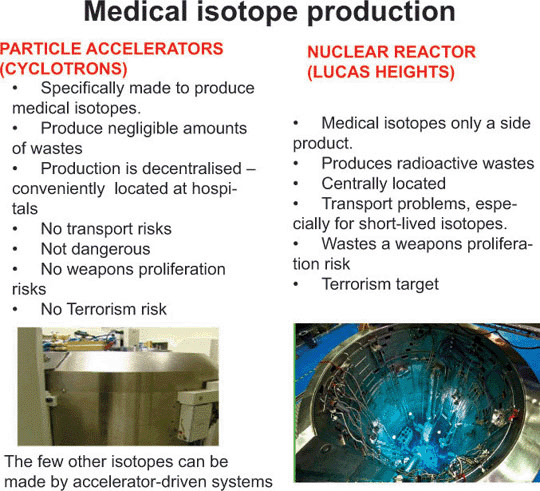
Unlike traditional nuclear methods of generating isotopes for medical imaging, the new particle accelerator at South Campus can generate a wider range of isotopes without producing nuclear waste.
The particle accelerator, known as a cyclotron, can produce enough isotopes for 1,000 diagnostic procedures a day – enough for both Calgary and Edmonton. John Wilson, the facility’s manager said the technology may soon replace nuclear reactors in providing medical isotopes for major cities across Canada.
“We’re the first to show that it can be produced to this quantity,” Wilson said.
More than 70 percent of the world’s diagnostic imaging is done using technetium-99m, a radioactive tracer. When fused with a drug or other molecule, its passage through the body can then be monitored using gamma cameras.
Wilson said the method can be used to track tumour growth and drug metabolism in cancer patients.
Technetium-99m has been traditionally supplied through splitting atoms in a nuclear reactor to produce molybdenum-99, which then decays into technetium-99m. However, only six percent of the material produced in a nuclear reactor can be used, the rest is nuclear waste.
Using a particle accelerator, Wilson said technetium-99m can now be produced directly by firing a stream of protons at a target material. The method bypasses the safety and environmental concerns surrounding traditional nuclear reactors.
“When the electricity stops, the (isotope) production stops,” Wilson said. “It’s a much safer technology.”
But Wilson said what makes the cyclotron useful is its ability to generate difficult to produce medical isotopes.
While most hospitals and clinics continue to rely on technetium for gamma imaging, Wilson said the technology is slowly being replaced with positron emission tomography (PET) scans.
“Technetium is more or less like black and white TV,” Wilson said. “It’s low definition.”
By varying the target material used in the cyclotron, the technology can produce other medical isotopes like radioactive fluorides for PET, something traditional nuclear reactors cannot produce.
Since 2010 the Canadian government has been investing in the creation of alternative medical isotope sources.
In 2009, countries across the globe faced a medical isotope shortage when the two major nuclear reactors producing technetium-99m were briefly out of service. The National Research Universal Reactor in Chalk River, Ontario was closed due to a heavy water leak the same period the High Flux Reactor in Petten, Netherlands was shut down for a month-long maintenance.
After 61 years of operation, the Chalk River reactor has since been decommissioned in 2016, and Wilson believes the 57-year-old High Flux Reactor in Petten likely won’t last much longer.
“There’s only about six or seven reactors in the world that are producing [medical isotopes] and they’re ageing,” Wilson said. “It’s not that it wasn’t good technology, it’s just that nobody wants to build reactors anymore … Nobody wants a reactor built in their backyard.”
While the cyclotron is ready for use, Canada’s federal and provincial governments have yet to determine how the technology may be implemented across the country and how it may be integrated into existing healthcare practices.
However, Wilson is optimistic that the new cyclotron will set the province up for success down the line as the demand for technetium shifts.
“The cyclotron gives you a more or less stable continuous source (of isotopes),” Wilson said. “You don’t have to worry about what’s happening on the outside.”
Group: Nuclear waste could be trucked from Illinois to Port Huron, Bob Gross, Port Huron Times Herald, 3 Aug 18
A coalition of environmental groups claims a letter from the U.S. Nuclear Regulatory Commission indicates that nuclear waste from power plants in Illinois will be trucked to Port Huron and shipped from there to an unknown destination.
“A spill, release or fire here or near waterways that flow into the St. Clair River could potentially ruin one of the largest fresh water deltas in the world – the St. Clair Flats – and potentially poison forever drinking water and freshwater ecosystems for up to 40-plus million people of the Great Lakes, including residents of Canada, the U.S., U.S. Tribes, First Nations and other indigenous peoples,” said Kay Cumbow of the Great Lakes Environmental Alliance in Port Huron, in a news release.
According to the news release from Don’t Waste Michigan, Coalition for a Nuclear-Free Great Lakes, a letter dated July 13, from the U.S. Nuclear Regulatory Commission to “Secured Transportation Services,” cites an application under 45-day review by the NRC for a highway transport route for high level radioactive waste from the LaSalle nuclear reactors in Illinois to the “Port Huron, Michigan Port of Exit.”
The letter was found July 23 among 467 documents on the Nuclear Regulatory Commission’s online ADAMS library, according to the news release. The number of transports is not given.
Secured Transportation Services, which is based in Buford, Georgia, is identified on the company’s website as the “leading transportation coordinator for spent nuclear fuel in North America.”
The letter only refers to shipping from central Illinois to Port Huron by a land route, according to the news release. It does not show where or how the waste would move from the city.
In a follow-up interview, Cumbow said the groups have more questions than answers about possible spent fuel shipments coming to Port Huron from Illinois………..
Cumbow said the letter only references highway route approval.
“Once it gets to Port Huron, we don’t know where it goes,” she said.
She said the waste is highly radioactive.
“It’s lethal when you are exposed to it,” Cumbow said. “Shielded, you’re fine. Any accident with this stuff, if there was a serious incident with this stuff, there is a likelihood people will be killed.
“The other thing is we don’t know what’s approved in Canada,” she said. “We don’t know where it is going. It might be going to Canada or it might be going through Canada to somewhere else.”
She said safety issues posed by the state’s crumbling road and bridge infrastructure are other concerns.
“There might be a little bit of this going across the border, or there might be a whole lot of it going across the border,” Cumbow said. “We just don’t know. I think as a society we should be looking at ways to stop poisoning our land and water.”
According to the news release, NRC spokesman Alex Sapountzis is quoted in an email to an NRC librarian as stating that “details of all spent nuclear fuel routes are designated as Safeguards Information/sensitive information and therefore will not be placed in ADAMS. All a member of the public will see in ADAMS is that in a letter we state we accepted for review a route (it has all the information we need to conduct our review) and then an approval letter (based on the information the applicant submitted, we accept the route and for transport by road it’s good for 5 years or by rail for 7 years).”
Opinion: ¶ “Reconciling energy and Indigenous rights” • In 2007, Canada was one of four countries to vote against the UN Declaration on the Rights of Indigenous Peoples. It signed in 2010, but has made little progress on the issue. Because it prioritizes oil sands, mining, fracking, and pipelines over indigenous rights, all its people […]
Building on others’ work, my research group is working to develop flexible solar panels, which would be as efficient as a silicon panel, but would be thin, lightweight and bendable.





 Holtec International, a New Jersey-based company specializing in nuclear storage, has applied to the U.S. Nuclear Regulatory Commission for a license to construct a nuclear waste storage facility about 35 miles (56 kilometers) east of Carlsbad.






 Antinuclear