Uncontrolled nuclear top gun Adi Paterson to spin to Kimba, Hawker and Quorn
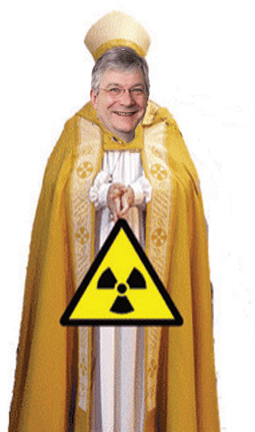
Dr Adi Paterson is the man behind the nuclear push by secretive taxpayer-funded agency Australian Nuclear Science and Technology Organisation (ANSTO).
Australians are not privy to information on how much ANSTO spends, particularly on this latest frenzy to convince rural South Australians that they have a moral duty to public health to host radioactive trash, – further encouraged by generous bribes.
Adi Paterson seems to have not only an open cheque to spend on this, but also carte blanche to do whatever he likes regarding nuclear decisions.
In 2016, he signed Australia up, all on his own, to the Framework Agreement for Generation IV Nuclear Energy Systems, committing Australia to work towards the establishment of new nuclear reactors. The government was informed of this afterwards. A month later, a Senate Committee simply ratified Adi Paterson’s action. No Parliamentary discussion, no public discussion. How long will Australians let this man make nuclear decisions for us, and pull the wool over the eyes of poorly informed farmers?
6 August, 2018 ANSTO CEO, Dr Adi Paterson, is part of a delegation who are visiting the communities of Kimba, Hawker and Quorn on 6 and 7 August, for Community Information Sessions being led by the Department of Industry, Innovation and Science.
Three sites in South Australia, two in Kimba and one at Wallerberdina Station near Quorn and Hawker, are considering whether to host Australia’s National Radioactive Waste Management Facility.
The Community Information Sessions are an opportunity for those communities to ask any remaining questions ahead of a five-week community ballot that begins on 20 August.
Dr Paterson will join the CEO of the Australian Radiation Protection and Nuclear Safety Agency (ARPANSA) Dr Carl-Magnus Larsson, and representatives from the Department.
“In particular, I will be focused on talking about the partnerships that are possible between nuclear organisations and their neighbouring communities.
Opinions on siting a nuclear waste dump at Kimba or Hawker, South Australia
https://cooberpedyregionaltimes.files.wordpress.com/2018/07/coober-pedy-regional-times-26-07-20181.pdf Resources Minister Matt Canavan announced ( THE AUSTRALIAN, 18/6/18) that on 20 August, there will be a ballot to gauge community support for a federal nuclear waste dump near one of the small towns of Kimba or Hawker, about 450km north of Adelaide. The vote will be confined to the residents in the immediate local area.“The decision will be made in the second half of this year” said Canavan ““We do not want this overlapping with a federal election”.
A Senate Inquiry will report on this on 14 August, possibly too late to make a difference. However, many people are taking this Inquiry very seriously, and have sent in 109 submissions, nearly all of which can be read at the Senate Committee’s website.
As I’ve been going through 98 published submissions to this Senate Inquiry on Selection process for a national radioactive waste management facility in South Australia, I’ve been able to learn some of the reasons why people support or oppose the idea of the nuclear waste dump.
The division of opinion was clear in the answers to the 5 main Terms of Reference, asking whether the following aspects were satisfactory: – financial compensation for land, community support, indigenous support, Community Benefit Program, and confining consultation to the local community. Answers were consistently “Yes” in submissions supporting the plan, and “No” in those opposing it.
More interesting were the comments in the 6th Term of Reference – ” Any related matters”
The 40 supporting submissions. Almost every one of the supporting submissions came from local residents, several explaining that they have been very thoroughly informed by the Department of Industry, Innovation and Science, including tours of the Lucas Heights nuclear reactor. Four submissions spent time praising the Department of Industry Innovation and Science (DIIS) and Australian Nuclear Science and Technology Organisation (ANSTO)
Their answers regarding “Any related matters” were strongly concerned with the local area and its future. Several were enthusiastic that the nuclear waste facility would ensure the survival of the town into the future. It would have no negative impact. It would be good for local business. It would be beneficial to Australia. Some complained of misleading information from anti nuclear activists. There was strong opposition to “outsiders” having a say in the decision. Kimba District Council needed detail on important financial benefits. Submissions from DIIS and ANSTO said that the facility was essential for nuclear medicine. Lobbyist Ben Heard said that it is needed for the expansion of the Lucas Heights nuclear centre.
The 58 opposing submissions come from a variety of organisations and individuals, and include residents of Eyre Peninsula. These were generally more comprehensive and wide-ranging. When it comes to “Any related matters”, they had a lot to say:
There were several comprehensive criticisms of the entire site selection process – no justification for the dump – why the assumption it has to be in South Australia? – the process is flawed. One was opposed to the process, not necessarily to the dump. One call to end the process. Concern on longterm negative effects.
Nuclear waste issues were discussed . Call for re-examination of waste plans- dangerous waste types – intermediate level wastes – probability of stranded nuclear wastes – Lucas Heights the most suitable site – this facility a prelude to commercial waste import?
Issues of dishonesty – lack of trust – dishonest process -hypocrisy of DIIS – biased committees biased and misleading information given – Conflicts of interest .
Aboriginal ssues well beyond the Term of Reference about this – strongly Aboriginal in depth on Aboriginal interaction – history of Aboriginal interaction.
Other issues discussed: – seismic danger – floods, groundwater – tourism -nuclear medicine not needing the dump – prediction of legal action – mental health issues – aim for a nuclear free world.
You can read more about these submissions, in the summaries at https://antinuclear.net/submissions-to-senate-inquiry-18–and also find links to each full submission.
Senate sites: https://www.aph.gov.au/Parliamentary_Business/Committees/Senate/Economics/Wastemanagementfacility
DEPARTMENT FAILS TO DEFINE ‘BROAD COMMUNITY SUPPORT’ – AGAIN!
Senator Rex Patrick Fight To Stop Nuclear Waste Dump In Flinders Ranges SA,
Inquiry into the Site Selction Process of the Radioactive Waste Management Facility Canberra
DEPARTMENT FAILS TO DEFINE ‘BROAD COMMUNITY SUPPORT’ – AGAIN!
At today’s hearing into the Site Selection Process for the Radioactive Waste Management Facility, the Department of Industry, Innovation and Science were unable to explain what ‘broad community support’ is.
Instead, they’re going to leave that definition up to Minister Canavan who is on record saying he wants this issue done and dusted before the next federal election.
Noting the secrecy surronding all of this, the people in Kimba and Hawker are going to get to experience what it was like to vote in the Soviet Union -the State will tell you what’s best for you.
For a good ten minutes I tried to find out how the Minister will come to his decision, to no avail. Here’s a quick 50 second snapshot, but you can watch the full exchange here. https://www.facebook.com/groups/344452605899556/?multi_permalinks=791599437851535¬if_id=1533450785067354¬if_t=group_activity
Uranium, nuclear, reactor produced isotopes – unstable industries with poor future
 Anne McMenamin Fight To Stop Nuclear Waste Dump In Flinders Ranges SA 5 Aug 18 Olympic Dam produces 90 times as much copper as uranium. Without the copper sales, the mine would not be viable. The amount of uranium produced has barely gone up over the last 10 years, and, across Australia, it’s actually gone down. Beverley is almost mined out. Four mile has recently come on line, but produced less last year than the year before. World-wide the industry is winding down.
Extreme heat shuts down French nuclear reactors
 Hot weather forces 4 French nuclear reactors to shut down https://abcnews.go.com/International/wireStory/hot-weather-forces-french-nuclear-reactors-shut-5703321, By THE ASSOCIATED PRESS, PARIS — Aug 4, 2018
Australia should follow Canada- producing medical isotopes in cyclotron, not nuclear reactor
Steve Dale Nuclear Fuel Cycle Watch South Australia, 5 Aug 18 Is this what they call a strawman argument? Who wants to import isotopes? I don’t want Australia to import isotopes, I want Australia to make them here using Cyclotrons and other forms of accelerators. If you read the author’s twitter feed you will see he is strongly advocating for nuclear power reactors, which makes you wonder if he is looking at isotope production objectively.
Here are some things to think about –
– dissolving Uranium plates to extract the Moly is a process that produces a lot of waste with many steps in the process that have potential for failure or human error
– using Low enriched Uranium plates produces much more waste than High enriched Uranium plates (obviously neither is desirable)
– apparently there is a move away from Technetium99 because it is considered low resolution imaging, some predicting that it will not be used in 10 years because of the superior imaging of PET/cyclotron isotopes
– the isotopes generated in a cyclotron have a very short half life, so they can be kept for a few days and thrown in the general trash
So to summarise. Moly99/Technetium99 is on the way out, yet tax payers have funded a factory to build a factory that can only make Moly99/Te99 – unlike a cyclotron that can make all sorts of isotopes. And instead of building a facility to cater for our own supply, they have built a taxpayer funded factory to speculate on the world wide isotope market.
Canada is showing another way using cyclotrons-
“”The newer radionuclides that are used, the so-called PET imaging agents, give a much more high-resolution picture,” said Wilson. “We’re slowly moving toward more PET isotopes.” https://www.facebook.com/groups/1021186047913052/permalink/2053022201396093/?comment_id=2053155368049443
Nuclear power takes a hit as European heatwave rolls on — RenewEconomy

Nuclear reactors shut down or curbed in France, Sweden and Finland, as record heat threatens either the safety of the power plants, or the health of nearby river systems.
via Nuclear power takes a hit as European heatwave rolls on — RenewEconomy
USA might put trade barriers on uranium, to save its own collapsing industry
 Nuclear wasteland: The explosive boom and long, painful bust of American uranium mining https://www.cnbc.com/2018/08/04/the-miners-that-fuel-americas-nuclear-power-and-atomic-arsenal-are-di.html
- Government incentives and trade barriers once sparked a gold rush for uranium, leading to a boom in mining for the nuclear fuel.
- However, U.S. uranium miners have endured decades of distress as foreign competition entered the market and demand faltered as nuclear energy fell out of favor.
- Uranium miners are now asking the Trump administration to erect trade barriers torn down more than 30 years ago to preserve the industry.
At the dawn of the atomic age, U.S. government incentives and trade barriers sparked a gold rush for uranium, the chemical element that was fueling the nuclear arms race at the time.
Now, 60 years later, American uranium miners want the government to use similar tools to prevent the collapse of the industry — and the few remaining U.S. companies still producing uranium for the nation’s fleet of nuclear power plants. Continue reading
Ionising radiation: the risk in frequent air travel, especially for women
Ionizing radiation increases cancer risk for frequent flyers, Elko Daily Free Press, Robert Ashley, M.D Aug 3, 2018
“Sharing the warning until my last breath” — Mining Awareness +

Originally posted on Beyond Nuclear International: Hiroshima survivor, and Nobel Laureate, Setskuo Thurlow’s first person account of experiencing and surviving the atomic bombing of Hiroshima at 13 is a powerful narrative that never fails to move people to tears. Now it has helped entire nations move to ban nuclear weapons. Here is a version of…
via “Sharing the warning until my last breath” — Mining Awareness +
At long last, Australia could be getting a Treaty with First Nation people
Could Australia soon recognise sovereigns other than the Queen?
‘It’s the last ex-British colony to not ratify a treaty with its First Nations people,
but that may be changing.’
by Gabriella Marchant
29 Jul 2018
‘ … “Treaty is [an agreement] between two sovereigns and to be asking the government to at least
acknowledge that Aboriginal people … maintain their sovereignty [supreme authority],
I don’t think that’s too much to ask,” says Gunnai-Gunditjmara woman Lidia Thorpe,
a Greens member of parliament in Victoria state.
‘”You know there’s this tokenistic gesture all the time to blackfellas in this country.
If you want true reconciliation and true healing then let’s be real about it
and stop these tokenistic gestures.”
‘Indeed, a treaty was the only thing indigenous leaders from Australia’s Yolngu nation
brought up with Prince Charles on his most recent visit. …
What is a treaty?
‘A treaty – defined as an “international agreement concluded between two states”
in 1969’s Vienna Convention on the Law of Treaties – would require the
government to legitimise Aboriginal nations as separate to the nation of Australia.
From there, they must negotiate decisions that affect them
as equals and on equal terms.
‘Associate Professor Dominic O’Sullivan, whose work centres on indigenous governance,
says unlike neighbouring New Zealand,
treaties were never a part of Australia’s settler history.
‘”Terra nullius was used to justify the British claim to sovereignty.
‘”Britain couldn’t identify an organised political or social order
among the indigenous population, and under international law,
these were required for a people to hold sovereignty,” O’Sullivan says.
‘”One could argue that it suited [the colony’s first Governor] Philip not to look too hard..” …
‘Obstacles remain, however, on a national level.
The current federal government has not addressed the call for
an Indigenous process similar to a treaty, makarrata, which after two years
of consultation was presented in an open letter, the Uluru Statement of the Heart.
‘”[Prime Minister] Turnbull’s government has been completely inactive in this space
and really quite offensive I think, particularly on the Uluru Statement,”
says Victorian Ged Kearney, whose opposition party supports Makaratta. … ‘
Read much much more of Gabriella Marchant‘s comprehensive, well-researched & in depth feature in Al Jazeera News:
www.aljazeera.com/indepth/features/australia-recognise-sovereigns-queen-180711052948923.html
August 5 Energy News — geoharvey

Opinion: ¶ “Our climate plans are in pieces as killer summer shreds records” • Deadly fires have scorched swaths of the Northern Hemisphere this summer, from California to Arctic Sweden and down to Greece on the sunny Mediterranean. Drought in Europe has turned verdant land barren, while people in Japan and Korea are dying from […]
NEG promises death of wind and solar, and even battery storage — RenewEconomy

NEG modelling promises death of large scale solar and wind projects, as well as battery storage under government target, and does not make the case for price falls.
via NEG promises death of wind and solar, and even battery storage — RenewEconomy
1 This month

of the week – Australians for War Powers Reform (AWPR)
To see nuclear-related stories in greater depth and intensity
 Antinuclear