Submission from Azark, Leonora, Western Australia: wants the nuclear dump, scathing about the Kimba wastes plan
- The Department has completely stage managed the initial identification and nomination of the current sites at Kimba and all the accompanying procedures for the Kimba community before the nominations were made
- It has similarly staged managed all subsequent aspects of the nominations including such things as selecting and effectively running the various community advisory groups including preparing meeting agenda and minutes
AZARK SUBMISSION to SENATE COMMITTEE INQUIRY INTO THE SELECTION PROCESS FOR A NATIONAL RADIOACTIVE WASTE MANAGEMENT FACILITY IN SOUTH AUSTRALIA (Submission no. 110)
INTRODUCTION
This submission is made by Azark Project Pty Ltd (ACN 618 973 792) on behalf of itself and Shire of Leonora and Goldfields Carbon Group Pty Ltd as the joint participants in and proponents of what is known as the Azark Project.
The Azark Project relates to the nomination of a previously identified and examined area of land near Leonora in the Eastern Goldfields of Western Australia as the site for selection by the federal government for the national for a national radioactive waste management facility.
In addition the Azark Project includes the possible development at that site of an underground nuclear waste disposal facility as a commercial enterprise.
TENOR OF SUBMISSION
It is submitted that the selection process adopted by the federal Department of Industry Innovation and Science and its responsible minister for the selection of a site for a national radioactive waste management facility at Kimba and Hawker in South Australia is completely inappropriate and lacks any proper and thorough investigation and assessment.
It seems that the selection of a site at Kimba is a predetermined decision by the federal government irrespective of the site suitability and the strong objections of a large community group which makes a complete mockery of the selection process.
Moreover the federal government has seemingly no regard to the financial aspects involved as it is intent on unnecessarily wasting taxpayers’ money by literally buying the support of the community while failing to properly assess and consider the far cheaper and technically superior option and advantages of the Azark site at Leonora in Western Australia.
The events and reasons for that submission are more full explained in the following notes on the respective nominations.
The overall submission is that the process by which the federal government is determining the site is neither appropriate nor thorough and fails to properly deal with the referred terms relating to financial compensation and the definition and determination of broad community support including indigenous support and consequently it is submitted that the process relevant to the Kimba and Hawker nominations has become a farcical exercise. Continue reading
Azark compares Western Australian site with South Australian sites for nuclear waste dump
 Submission AZARK PROJECT to Senate Inquiry (submission No 110) Attachment 1
Leonora W.A. site geologically, environmentally better suited to waste dump than is Kimba S.A.
Technical assessment information for the Azark Project at Leonora compared to the AECOM Characterisation Project for Kimba – February 2018
Seismic Survey Continue reading
Azark Submission: compares Kimba nuclear waste plan to Spain’s unsatisfactory plan
Submission AZARK PROJECT to Senate Inquiry (submission No 110) Attachment 4 EL CABRIL NUCLEAR WASTE DISPOSAL FACILITY
[ photo on original at Senate submission site] This the facility in Spain being the model adopted for the proposed above ground facility at Kimba or Hawker
The photos are extracted from the public video presentation entitled ENRESA – 25th Anniversary of El Cabril
This is a photo [on original at Senate submission site] of welding the mesh which is then concreted up into bunkers and filled with the radioactive waste material.
Over the years mesh rusts and damages the concrete. We are talking of 300 years so I would be a bit sceptical about moisture or water not seeping in and down to the water table.
The radiation may have dropped to acceptable levels by then but what else may be in there. In the middle of the night all sorts of things are likely to get thrown in the drums before they are sealed, which I have seen in other situations.
This photo [on original at Senate submission site] shows you the material that is to be stored at El Cabril which is very similar to what is proposed for Kimba or Hawker
These two photos [on original at Senate submission site] show the proposed method of covering up the above ground structure at El Cabril when it closes which is similar to the covering proposed for Kimba. The storage building and other contaminated material are covered with sand to help with the drainage and with clay to prevent moisture seeping through together with layers of plastic as additional protection.
This means that no trees with their roots will be allowed to grow for 300 years as the roots will rot under these conditions and the covering may well be susceptible to warrens and other digging by burrowing animals.
This will be just a big rubbish dump that will be there for ever and does not taken into consideration any seismic activity on which Jim Allender can give you much more professional advice.
What is Premier Steven Marshall’s position on nuclear waste dumping for South Australia? – Deafening Silence

Zac Eagle Fight To Stop Nuclear Waste Dump In Flinders Ranges SA 10 Aug 18 In 2004 the then Premier M Rann said “a nuclear waste dump would have tarnished SA’s image on the world scene and would have caused particular damage to the tourism, wine and food industries.
We’re trying to sell ourselves around the world as a clean, green place, he said.
So I did not want South Australia tagged as the nuclear dump state by every comic on TV”
And what about Marshall’s position? His silence is deafening. https://www.facebook.com/groups/344452605899556/
Climate change is increasing Australia’s heat and drought
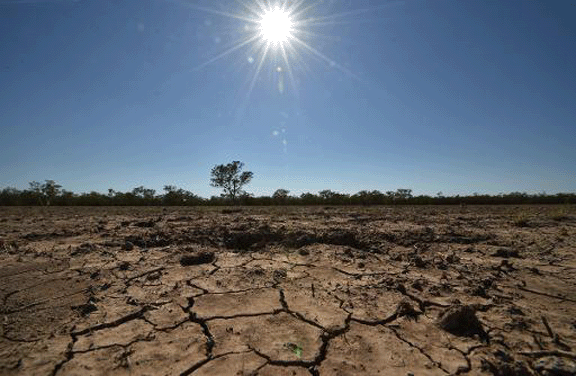
Great southern drought: Australian farmers crippled, climate action stalled https://www.dw.com/en/great-southern-drought-australian-farmers-crippled-climate-action-stalled/a-45015773
Amidst the worst drought in living memory, the world’s driest continent is also heating up due to climate change. Critics say too little is being done to prevent increasing temperatures and decreasing rainfall.
New South Wales, which is Australia’s most populous state and about the size of France, was declared 100 percent in drought on Wednesday.
Despite the fact that it is winter, farmers in the state and throughout the southern region of Australia are struggling to maintain their livelihood as crops fail and livestock die.
With grazing land turned to dust, some farmers have resorted to hand-feeding to keep their stock alive. They also have permission to shoot kangaroos that compete for pasture. Depression and suicide among farmers are on the rise.
And yet, there is no end in sight to this crippling drought, unseen for generations. The predicted start of bushfire season has been brought forward two months in New South Wales to prepare for what could be an apocalyptic summer scenario.
Though Australia is the driest inhabited continent on Earth and has regularly experienced intense droughts since modern record-taking began after European colonization, the relatively fertile southern regions continue getting hotter while receiving less rain.
Autumn of 2017 in southern Australia was the driest for 116 years. And 2017 was also the hottest year ever in New South Wales.
Increasing drought
“These regions experienced increasing intensity and frequency of hot days and heat waves over the past 50 years, in turn increasing drought severity,” said Lesley Hughes, a professor of biology at Sydney’s Macquarie University and councillor with the Climate Council — a climate change information nonprofit created after the current government closed down the state-funded Climate Commission.
But the “source of the problem is complex,” she told DW.
Scientists are confident that warming linked to human-induced climate change “has contributed to a southward shift in weather fronts from the Southern Ocean, which typically bring rain to southern Australia during winter and spring,” Hughes explained of the reduced precipitation.
As rain-inducing weather fronts drift away from land to the Southern Ocean, the risk of drought has increased, especially in agricultural heartlands such as the Murray Darling Basin in New South Wales.
Benjamin Henley, a research fellow in climate and water resources at the University of Melbourne, shares this view.
“Climate model projections suggest that with anthropogenic emissions, the storm track will shift south, reducing rainfall [over land] in the south,” he told DW.
But global warming could also be increasing the intensity of drought. “Higher temperatures during droughts, which influence evaporation rates, can be due to both the lack of rain itself [due to the reduced evaporative cooling], and the higher probability of warmer temperatures due to climate change,” Henley explained.
Nuclear Industry Not Prepared for the Impacts of Climate Change Upon It.
 How nuclear is preparing for climate change http://www.corporateknights.com/channels/utilities-energy/nuclear-preparing-climate-change-15339111/, BY JOHN VIDAL – AUGUST 10, 2018
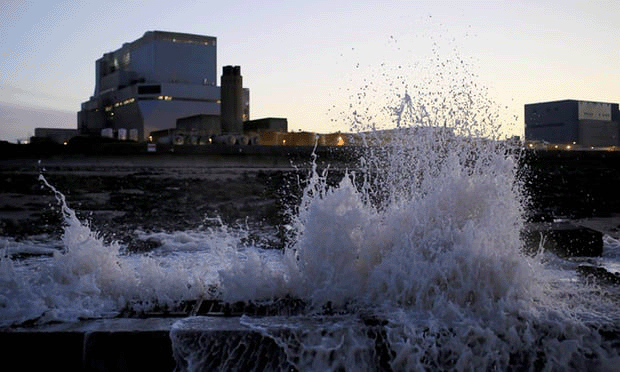 The outer defensive wall of what is expected to be the world’s most expensive nuclear power station is taking shape on the shoreline of the choppy gray waters of the Bristol Channel in western England.
By the time the US$25 billion Hinkley Point C nuclear station is finished, possibly in 2028, the concrete seawall will be 12.5 meters (41 feet) high, 900 meters (3,000 feet) long and durable enough, the UK regulator and French engineers say, to withstand the strongest storm surge, the greatest tsunami and the highest sea-level rise.
But will it? Independent nuclear consultant Pete Roche, a former adviser to the UK government and Greenpeace, points out that the tidal range along this stretch of coast is one of the highest in the world, and that erosion is heavy. Indeed, observers reported serious flooding on the site in 1981 when an earlier nuclear power station had to be shut down for a week. following a spring tide and a storm surge. However well built, says Roche, the new seawall does not adequately take into account sea-level rise due to climate change.
“The wall is strong, but the plans were drawn up in 2012, before the increasing volume of melting of the Greenland ice cap was properly understood and when most experts thought there was no net melting in the Antarctic,” he says. “Now estimates of sea level rise in the next 50 years have gone up from less than 30 centimeters to more than a meter, well within the operating lifespan of Hinkley Point C — let alone in 100 years time when the reactors are finally decommissioned or the even longer period when spent nuclear fuel is likely to be stored on site.”
In fact, research by Ensia suggests that at least 100 U.S., European and Asian nuclear power stations built just a few meters above sea level could be threatened by serious flooding caused by accelerating sea-level rise and more frequent storm surges.
Some efforts are underway to prepare for increased flooding risk in the future. But a number of scientific papers published in 2018 suggest that climate change will impact coastal nuclear plants earlier and harder than the industry, governments or regulatory bodies have expected, and that the safety standards set by national nuclear regulators and the United Nations’ nuclear watchdog, the International Atomic Energy Agency (IAEA), are out of date and take insufficient account of the effects of climate change on nuclear power.
The Problem With Flooding
Flooding can be catastrophic to a nuclear power plant because it can knock out its electrical systems, disabling its cooling mechanisms and leading to overheating and possible meltdown and a dangerous release of radioactivity. Flooding at the Fukushima Daiichi plant in Japan as a result of the March 2011 tsunami caused severe damage to several of the plant’s reactors and only narrowly avoided a catastrophic release of radioactivity that could have forced the evacuation of 50 million people.
According to maps prepared by the World Association of Nuclear Operators (WANO), around one in four of the world’s 460 working commercial nuclear reactors are situated on coastlines. Many were built only 10–20 meters (30–70 feet) above sea level at a time when climate change was barely considered a threat.
 (At left flooded Fort Calhoun nuclear plant, USA) In the U.S., where nine nuclear plants are within 2 miles (3 kilometers) of the ocean and four reactors have been identified by Stanford academics as vulnerable to storm surges and sea-level rise, flooding is common, says David Lochbaum, a former nuclear engineer and director of the nuclear safety project at the Union of Concerned Scientists (UCS).
Lochbaum says over 20 flooding incidents have been recorded at U.S. nuclear plants since the early 1980s. “The most likely [cause of flooding] is the increasing frequency of extreme events,” he says.
“There was no consideration of climate change when most U.S. plants were built,” says Natalie Kopytko, a University of Leeds researcher who has studied nuclear power plant adaptations to climate change. “They used conservative models of historical reference. Also, they were largely built at a calm period, when there were not many major storms.”
“While an accident has never yet happened due solely to sea-level rise and storms, the flooding experienced at Fukushima resembles what could occur in the future from sea-level rise,” says Kopytko.
Considering Climate Change
IAEA’s current global safety standards were published in 2011. These state that operators should only “take into account” the 18- to 59-centimeter (7- to 23-inch) sea-level rise projected by 2100 in the Intergovernmental Panel on Climate Change (IPCC)’s fourth assessment report, published in 2007.
But those safety standards don’t factor in the most recent assessment of the IPCC, published in 2013–14. This scientific consensus report has seas rising 26 centimeters (10 inches) to 1 meter (39 inches) by 2100, depending on how far temperature continue to rise and the speed at which the polar ice caps melt.
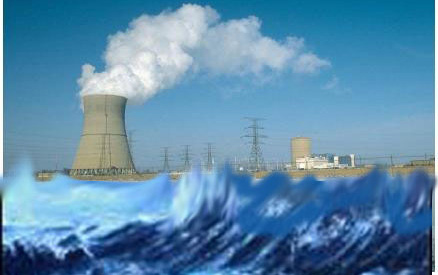 A 1-meter (39-inch) increase, combined with high tides and a storm surge, significantly increases the risk of coasts and nuclear stations being swamped, says Michael Mann, director of the Earth System Science Center at Pennsylvania State University.
“Nuclear stations are on the front line of climate change impacts both figuratively and quite literally,” Mann says. “We are likely profoundly underestimating climate change risk and damages in coastal areas.”
A recent study from NASA’s Goddard Space Flight Center expects the mean average rise to be a minimum of 65 centimeters (26 inches) by 2100.
“This 65-centimeter [rise] is almost certainly a conservative estimate,” says NASA lead author Steve Nerem, a professor of aerospace engineering sciences at the University of Colorado Boulder. “Our [study] assumes that sea level continues to change in the future as it has over the last 25 years. Given the large changes we are seeing in the ice sheets today, that’s not likely.”
A Matter of Timing Continue reading
As hibakusha numbers dwindled – a plea to carry on the campaign to get rid of nuclear weapons

Keep up the fight to eliminate nuclear weapons, Japan Times, 10 Aug 18 “……… The number of surviving hibakusha as of the end of March was 154,859, a decline of 9,762 from a year earlier. In recent years, nearly 10,000 hibakusha have been passing away annually. Their average age has surpassed 82. This nation’s firsthand experience of the atomic bombings will fade with time. That is all the more reason for us to keep pushing for the elimination of nuclear weapons.
In his address during this year’s anniversary ceremony marking the Hiroshima atomic bombing, Hiroshima Gov. Hidehiko Yuzaki summed up the danger of believing in the balance of power ensured by nuclear deterrence by asking how would you explain it to your children.
“You see, we don’t get along well with our next-door neighbor. So we have set a bomb that can blow up their house with all the family inside, just in case. We can press the button to set off this bomb any time. Our neighbor, on the other hand, has also set a bomb to blow up our house. Of course, neither family wants both families to end up dead, so I feel assured that they will never press the button. We will never do so, either. In short, we will never go into battle against each other. And the bombs will probably not malfunction. And we won’t press the button by mistake, either, I hope. So you don’t have to worry,” the governor said, adding, “How many of you could seriously offer such an explanation to your children?”
How can we continue with a policy that we cannot explain to our next generation? https://www.japantimes.co.jp/opinion/2018/08/10/editorials/keep-fight-eliminate-nuclear-weapons/#.W24MLyQzbGg
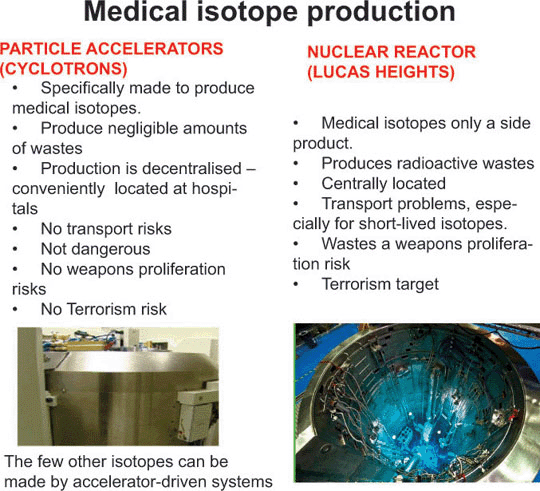
Cheaper, more reliable medical isotopes from a cyclotron – non nuclear, environmentally safe
QUANTM Irradiation System™ Earns CE Mark Approval https://business.financialpost.com/pmn/press-releases-pmn/business-wire-news-releases-pmn/quantm-irradiation-system-earns-ce-mark-approval
VANCOUVER, British Columbia — ARTMS Products today announced it received CE marking approval for its first-in-class, advanced technology QUANTM Irradiation System™ for producing high-value radioisotopes, such as Tc-99m and Ga-68, on medical cyclotrons. Cyclotron facilities are constantly facing higher isotope costs and poor supply availability. Now, with CE marking, ARTMS’ QUANTM Irradiation System™ will help ease these issues.
“CE marking is an important milestone for ARTMS,” remarked Dr. Kaley Wilson, CEO of ARTMS Products. “There is a huge opportunity in providing a cost effective and secured supply of radioisotopes to hospitals and research institutions. ARTMS provides a more economical, environmentally safe and secured supply of important radioisotopes than reactor-based sources. Now, with CE marking approval, ARTMS can be readily integrated in a standardized fashion into existing and emerging facilities which ultimately leads to improved patient access and care across Europe.”
Giving Cyclotron Facilities More Control Over the Supply of Medical Isotopes
Unlike traditional reactor and generator production methods, which are growing increasingly more expensive and cannot consistently supply user requirements, the ARTMS QUANTM Irradiation System™ combines both local production control and a cost-effective, easy-to-use solid target system for production of radioisotopes on medical cyclotrons. Medical radioisotopes are used in the field of nuclear medicine on a daily basis for both medical diagnostic imaging and therapy, particularly in the fields of oncology, cardiology and neurology.
The ARTMS QUANTM Irradiation System™ is currently available for most OEM cyclotron systems and has been installed and is operating in a number of countries.
About ARTMS Products
Based in Vancouver, British Columbia, ARTMS Products Inc. is a leader in the development of novel technologies and products which enable the production of the world’s most-used diagnostic imaging isotope, technetium-99m (Tc-99m), using local, hospital-based medical cyclotrons. ARTMS holds the exclusive global commercialization rights to award-winning and proprietary Canadian inventions which address these challenges, and which offer the prospect of revolutionizing the nuclear medicine industry.
For more information on the QUANTM Irradiation System™ and ARTMS Products, please follow us on Twitter @Quantm99 and LinkedIn and visit http://www.artms.ca/
Cyclotrons can be upgraded to produce Technetium99 right now.
Steve Dale shared a link.Nuclear Fuel Cycle Watch South Australia, 10 Aug 18
“Unlike traditional reactor and generator production methods, which are growing increasingly more expensive and cannot consistently supply user requirements, the ARTMS QUANTM Irradiation System™ combines both local production control and a cost-effective, easy-to-use solid target system for production of radioisotopes on medical cyclotrons.” …..
“The ARTMS QUANTM Irradiation System™ is currently available for most OEM cyclotron systems and has been installed and is operating in a number of countries.”
https://www.facebook.com/groups/1021186047913052/
Climate change has increased USA’s wildfires
 Factcheck: How global warming has increased US wildfires , Carbon Brief , 9 Aug 18
In the midst of record or near-record heatwaves across the northern hemisphere this summer, deadly wildfires have swept through many regions, such as the western US, Europe and Siberia. This has focused a great deal of public attention on the role that climate change plays in wildfires.
Recently, some commentators have tried to dismiss recent increases in the areas burnt by fires in the US, claiming that fires were much worse in the early part of the century. To do this, they are ignoring clear guidance by scientists that the data should not be used to make comparisons with earlier periods.
The US National Interagency Fire Center (NIFC), which maintains the database in question, tells Carbon Brief that people should not “put any stock” in numbers prior to 1960 and that comparing the modern fire area to earlier estimates is “not accurate or appropriate”.
Here, Carbon Brief takes a look at the links between climate change and wildfires, both in the US and across the globe. As with any environmental issue, there are many different contributing factors, but it is clear that in the western US climate change has made – and will continue to make – fires larger and more destructive.
As one scientist tells Carbon Brief: “There is no question whatsoever that climate plays a role in the increase in fires.”
More area burned………
US wildfires and climate change
The recent period of large wildfires in forested areas of the western US has coincided with near-record warm temperatures……… https://www.carbonbrief.org/factcheck-how-global-warming-has-increased-us-wildfires
Nagasaki Hibakusha pass on experiences through traditional story-telling — Beyond Nuclear International

Pair want to see an end to nuclear power as well as nuclear weapons
August 10 Energy News — geoharvey

Opinion: ¶ “The NEG’s failure to factor in climate change will cost our Pacific neighbours dearly” • As political leaders from across the country meet to determine the fate of the embattled National Energy Guarantee, they must be under no illusion as to how Australia’s backwardness on climate change is perceived by our Pacific island […]
1 This month

of the week – Australians for War Powers Reform (AWPR)
To see nuclear-related stories in greater depth and intensity
 Antinuclear