we can say it is highly likely that they would not have had such extreme impacts without global warming. Indeed, all weather events are affected by climate change because the environment in which they occur is warmer and moister than it used to be.
Climate change and wildfires – how do we know if there is a link? Distinguished Senior Scientist, National Center for Atmospheric Research,
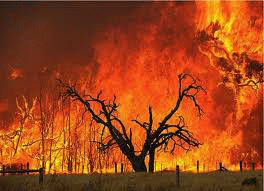
These burn forests, houses and other structures, displace thousands of people and animals, and cause major disruptions in people’s lives. The huge burden of simply firefighting has become a year-round task costing billions of dollars, let alone the cost of the destruction. The smoke veil can extend hundreds or even thousands of miles, affecting air quality and visibility. To many people, it has become very clear that human-induced climate change plays a major role by greatly increasing the risk of wildfire.
Yet it seems the role of climate change is seldom mentioned in many or even most news stories about the multitude of fires and heat waves. In part this is because the issue of attribution is not usually clear. The argument is that there have always been wildfires, and how can we attribute any particular wildfire to climate change?
As a climate scientist, I can say this is the wrong framing of the problem. Global warming does not cause wildfires. The proximate cause is often human carelessness (cigarette butts, camp fires not extinguished properly, etc.), or natural, from “dry lightning” whereby a thunderstorm produces lightning but little rain. Rather, global warming exacerbates the conditions and raises the risk of wildfire.
Even so, there is huge complexity and variability from one fire to the next, and hence the attribution can become complex. Instead, the way to think about this is from the standpoint of basic science – in this case, physics.
Global warming is happening
To understand the interplay between global warming and wildfires, consider what’s happening to our planet.
The composition of the atmosphere is changing from human activities: There has been over a 40 percent increase in carbon dioxide, mainly from fossil fuel burning since the 1800s, and over half of the increase is since 1985. Other heat-trapping gases (methane, nitrous oxide, etc.) are also increasing in concentration in the atmosphere from human activities. The rates are accelerating, not declining (as hoped for with the Paris agreement).
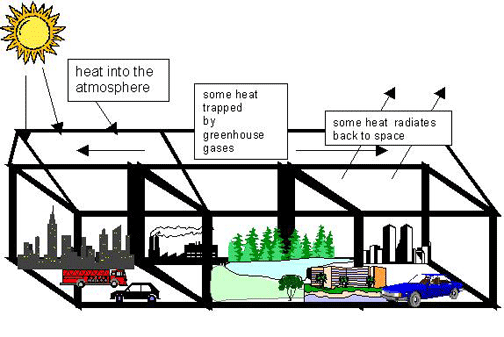
Heat-trapping gases in the atmosphere act as a blanket and inhibit the infrared radiation – that is, heat from the Earth – from escaping back into space to offset the continual radiation coming from the sun.
As these gases build up, more of this energy, mostly in the form of heat, remains in our atmosphere. The energy raises the temperature of the land, oceans and atmosphere, melts ice, thaws permafrost, and fuels the water cycle through evaporation. Continue reading →
Methane released by thawing permafrost from some Arctic lakes could significantly accelerate climate change, according to a new study. Unlike shallow, gradual thawing of terrestrial permafrost, the abrupt thaw beneath thermokarst lakes is irreversible this century. Even climate models that project only moderate warming this century will have to factor in their emissions, according to the researchers.
World: ¶ “EU backs Norway and Germany power link” • A power grid link between Norway and Germany is being backed by the European Investment Bank. It signed a €100-million financing agreement with TenneT, one of Europe’s major electricity transmission system operators. The the 624-km, 1.4-GW interconnector will go under the North Sea. [Energy Reporters] ¶ […]
August 7, 2018 When I purchased a commonly available radiation detector right after the Fukushima disaster in 2011 I never would have dreamed how it would impact the way I saw the world. Since then I would periodically test the level of radioactivity around my home here in the Sierra Nevada mountains of California. Nothing […]
Australia has huge potential for renewable hydrogen exports, possibly requiring enough new solar and wind capacity equivalent to the existing grid by 2040. The post ARENA, Finkel lead push for massive renewable hydrogen exports appeared first on RenewEconomy.
CWP Renewables wins planning approval to add 200MW solar plus battery storage to existing 270MW wind farm at Sapphire in northern NSW. The post Sapphire renewable energy hub wins approval – solar and storage to come appeared first on RenewEconomy.
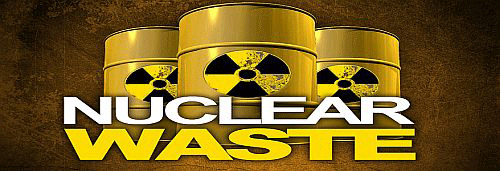
Nothing dramatically new in the nuclear news. Nuclear waste problems are still intractable around the world, while governments continue to promote “new nuclear” – in what looks like a sad act of religious faith.
CLIMATE. Climate change is increasing Australia’s heat and drought. At least 75 bushfires raging across New South Wales and Queensland. But hey! Prime Minister Malcom Turnbull, desperate to hang on to his job, is about to further weaken the emissions reduction target – trying to placate the climate deniers in his party.
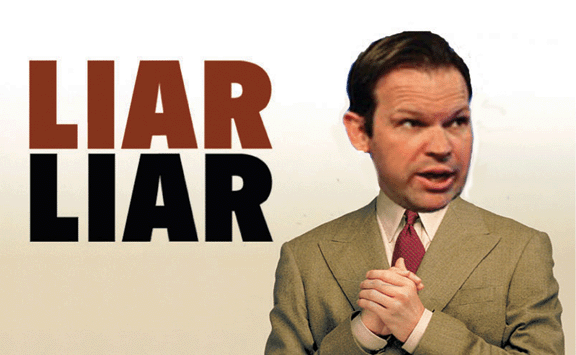
Resources Minister Matt Canavan is deceptive in his statements about “Low Level “nuclear waste. Canavan deplores delay in decision on nuclear waste dump.
A community vote on the proposed nuclear waste dump on South Australia’s Eyre Peninsula has been delayed after an Aboriginal group won a court injunction.
Key points:
The Federal Government has shortlisted Kimba for Australia’s future nuclear waste dump
The Barngarla Aboriginal people have won an injunction to halt a community vote
The Supreme Court will hear the case next Thursday
The Barngarla people, the traditional owners of much of the Eyre Peninsula, applied for an injunction to halt the vote in South Australia’s Supreme Court, arguing it contravened the Racial Discrimination Act 1975.
Lawyers for the Aboriginal group argued the District Council of Kimba did not have the power to conduct the postal ballot, which was due to begin on Monday.
The Federal Government has shortlisted two sites near Kimba as possible locations for a low-level radioactive waste storage facility, along with four other sites around Australia
The lawyer representing the Barngarla Determination Aboriginal Corporation, Daniel O’Gorman SC, told the court his clients had no issue with the vote going ahead, they just wanted to be included in it.
“That’s all they want, they just want to be included, they don’t want to be treated any differently because their rights are Aboriginal rights,” he said.
The court heard the majority of the 211 native title holders lived outside the boundary of the Kimba District Council and that excluding them from the vote had the effect “of nullifying or impairing their rights”.
But Michael Burnett, representing the District Council of Kimba, told the court its power to conduct the postal vote came from the Local Government Act.
He said the council wanted to conduct the vote in a fair manner and decided the fairest manner was to comply with “the statutory procedure that applies in the case of elections”.
“It’s not a vote that has direct consequences … it’s part of a range of consultations that will be taken into account,” he said.
Mr Burnett said there were direct consultations taking place with native title holders about the proposed sites, a claim which Mr O’Gorman rejected.
“They’re getting two bites of the cherry and therein lies the exclusion, [the native title holders are] only getting one,” Mr O’Gorman said.
Mr Burnett questioned why the Barngarla Determination Aboriginal Corporation had waited until August to seek an injunction when they had known about the vote since May.
But Mr O’Gorman said the corporation had written to the District Council of Kimba on six occasions seeking to be included in the postal vote and council had only made its final decision on July 27.
The vote of around 800 residents who live in Kimba will be delayed until after a full court hearing next Thursday.
The court action comes as The Advertiser can reveal the Turnbull Government looked at federally-owned land parcels as possible alternatives to the three South Australian sites short-listed for a national radioactive waste management facility.
Residents in the Kimba and Hawker districts had been due to begin voting next week in ballots to determine whether they would be willing to accept a low-level radioactive waste dump.
But the Barngarla indigenous people argued the Kimba ballot was discriminatory because native-title holders who lived outside the municipal boundaries would be denied voting rights. An injunction was granted ahead of a hearing before the full court next week.
Two sites near Kimba and one near Hawker have been short-listed for the waste centre. Meanwhile, documents released under the Freedom of Information Act reveal the Industry Department last year identified several land parcels which met the suitability criteria to be assessed as possible waste dump sites.
The documents also reveal the Defence Department was concerned that a site at the Woomera Defence Range could become the national radioactive waste management facility “by default’’.
Radioactive material from the CSIRO is held at the Woomera Defence Range.
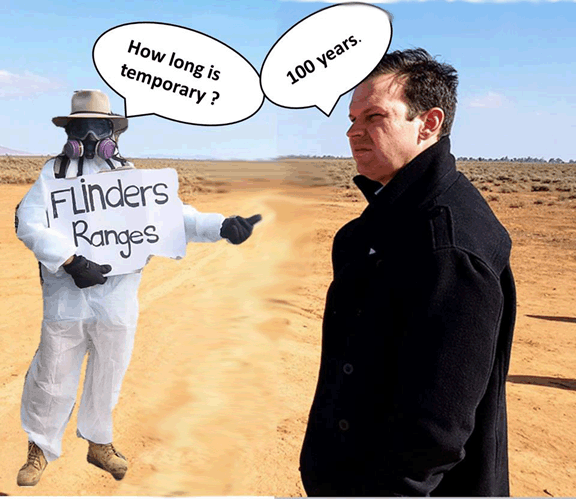
Centre Alliance Senator Rex Patrick, pictured, said the Government should release full details of the Government sites which had been studied. “I find it highly disturbing that the Government has kept the Commonwealth-owned land options a secret,’’ Senator Patrick said. “It’s quite apparent that Defence didn’t want to touch the Nuclear Waste Facility with a barge pole — they’d rather it just went to Kimba or Hawker.’’
Speaking before the court injunction was granted, Industry Minister Matt Canavan said it was up to local communities to decide whether they were willing to accept a radioactive waste facility.
“We will not impose a facility on an unwilling community,’’ Senator Canavan said.
The centre proposed by the Federal Government would be used to store low and intermediate-level radioactive waste stored at sites around Australia. About 45 local jobs would be created in the district where the centre was located and the local community would receive a $31 million incentive package from the federal Government.
Senator Canavan introduces the concept of nuclear energy into the debate on radioactive waste storage, (The Advertiser, 15/08/2018) but refers only to low level waste.
He does not mention the long-lived intermediate level waste. In April, he announced that this would also be stored at the facility. His Department admits there are no plans for its disposal at this stage, only moving it from current temporary storage, to park it temporarily near Hawker or Kimba for several decades.
People in both communities, including the Traditional Owners have said “No”.
Nuclear power generation is another matter entirely. The Scarce Royal Commission into the nuclear fuel cycle rejected nuclear power generation two years ago. The Citizens Jury even rejected the Commission’s recommendation to investigate storing nuclear waste in South Australia. The Senator’s Department vehemently denied any connection between their waste facility and the Scarce Commission’s investigation. The Senator’s reference to nuclear energy seems strange timing.
Note the Advertiser makes the mistake of saying its only for low level waste.
Federal Industry Minister Matt Canavan says Australia can’t have a serious debate about nuclear energy until a radioactive waste dump is built, Peter Jean, Senior Federal Political Reporter, The Advertiser,
AUSTRALIA can’t have a mature debate about nuclear energy until a permanent home is built for low-level radioactive waste, federal Industry Minister Matt Canavan has declared.
Senator Canavan made the comments after lawyers for the Barngarla Determination Aboriginal Corporation launched legal action to try to prevent a community vote on radioactive waste going ahead in the Kimba district next week.
Kimba and Hawker district residents are scheduled to vote on whether they’d be willing to accept a low-level radioactive waste facility in their local areas.
A hearing on the Barngarla application to stop the Kimba vote will be heard in the Supreme Court today.
The Barngarla group argues that members who are native title holders in the Kimba District but don’t live there should be permitted to vote on the waste dump proposal.
Senator Canavan said the Barngarla people were entitled to take their concerns to court.
He said discussion about the establishment of a nuclear power industry in Australia wouldn’t get off the ground unless the nation found a way to manage low-level radioactive waste, including by-products of the Lucas Heights nuclear reactor in Sydney.
“If we can’t find a long-term repository for our low-level waste – which we produce from a reactor that produces nuclear medicines, not power – we have no hope of building a nuclear power station that would produce high-level waste,’’ Senator Canavan said.
“We are supporters of an open and mature debate around this issue but we recognise that any move to nuclear power in this country would take years and require bipartisan support, those are things that we don’t have now.’’
Two sites near Kimba and one near Hawker have been short-listed as possible locations for a radioactive waste storage facility. The community votes are being held before the Government proceeds with selecting a preferred site.
Kimba Mayor Dean Johnson said he was unable to comment on the Barngarla application because the matter was before the courts.
The final report on the senate inquiry into the selection process for a national radioactive waste management facility in South Australia was released on Tuesday but those who oppose the facility say it has failed to address their main concerns.
The recommendations included the Department of Industry, Innovation and Science (DIIS) working with local stakeholders to use part of the 60 hectare buffer zone to grow and test agricultural produce to reassure the community and agricultural markets the produce is safe for consumption.
The committee also recommended the minister intensify efforts to fully engage with the Indigenous stakeholders near Kimba and Hawker; that government undertake an independent valuation of the land to be acquired to ensure that the financial compensation is consistent with the original proposal to compensate the landholder at four times the land value; and that DIIS make submissions received during the consultation process publicly available where the authors gave permission.
However, while the No Radioactive Waste on Agricultural Land in Kimba or SA group is thankful for the time and effort put into the inquiry, member Kellie Hunt said it was “disappointed” with the recommendations.
“We are disappointed that the recommendations do not address any of our primary concerns,” she said. “In particular, our issues regarding the lack of definition of what constitutes broad community support, and the lack of genuine need to move the intermediate level waste from Lucas Heights to a second interim storage location.
“We continue to oppose the siting of this facility on agriculture land in the Kimba district.”
The Senate Economics References Committee wrote the report using submissions made by stakeholders in in the affected communities near the sites in Kimba and Hawker, as well as public hearings in Kimba, Hawker and Canberra.
A spokesperson from the Department of Industry, Innovation and Science said the department thanked the committee for the report and that it “looks forward to reviewing it.”
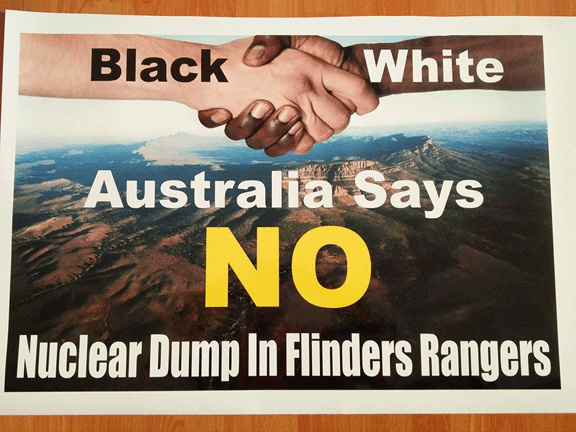
A nuclear waste facility site is on the cards for South Australia. The federal government has whittled down its list of potential sites to two communities: Hawker in the Flinders Ranges, and Kimba on the Eyre Peninsula.
But local populations, and the people of South Australia in general, have come out strongly against what they see as a natural disaster coming their way.
Local Indigenous communities have been leading the opposition.
Adnyamathanha Traditional Owner Regina McKenzie, a custodian of the Flinders Ranges site, has noted that the site is culturally significant. McKenzie told NITV: “Just in this one spot where they want to put it it’s got 14 different story lines going over it … If they put this waste dump there, that’s robbing us, that’s cultural genocide.”
Yet the federal government is choosing to ignore these views and concerns.
Instead, it is going ahead with a “consultative vote” on August 20, in which 99% of South Australian’s are not allowed to vote. Only people living within a 50-kilometre radius of the proposed sites are allowed to participate. McKenzie said Adnyamathanha people who are currently living away from the area would not be able to vote.
To incentivise voters, the federal government announced in late July that it would provide $31 million in community development funding for whichever town voted to accept the dump.
The government has also made it clear that the vote is non-binding.
“This whole process they’ve been doing, it’s totally flawed”, McKenzie said.
Australia has a looming nuclear waste problem but moving radioactive nuclear waste from one location to another makes no sense. The Australian Nuclear Science and Technology Organisation, headquartered at Lucas Heights, NSW, has the capacity and expertise to store Australia’s national nuclear waste for another three decades.
This time should be used to develop a cohesive plan for phasing out nuclear waste instead of building new waste dumps.
Taking away the land that people have considered sacred for 80,000 years is not closing the gap. And a few million dollars in “community development” is a drop in the ocean compared to the health and social costs that will be incurred if the proposed facility goes ahead.
The government must not be allowed to go ahead with its proposed nuclear waste facility in South Australia.
The Trump administration is pushing hard on its scheme to create a Space Force. Last week Vice President Pence, chairman of a newly reconstituted National Space Council, in a speech at the Pentagon declared: “The time has come to write the next great chapter in the history of our armed forces, to prepare for the next battlefield.”
Pence claimed—falsely: “Our adversaries have transformed space into a warfighting domain already and the United States will not shrink from the challenge.”
Trump, who in June announced he was “directing the Department of Defense and Pentagon to immediately begin the process necessary to establish a Space Force as the sixth branch of the armed forces,” following Pence’s address Thursday promptly tweeted: “Space Force all the way!”
At the same time, signaling that the Space Force drive will be used politically, the Trump campaign organization sent out an email asking supporters to choose between six Space Force logos that were depicted. “President Trump wants a Space Force—a groundbreaking endeavor for the future of America and the final frontier,” wrote Brad Parscale, campaign manager of “Donald J. Trump for President, 2020.” “To celebrate President Trump’s huge announcement, our campaign will be selling a new line of gear.” He asked backers pick “your favorite logo.”
“THIS IS A CRUCIAL MOMENT WHERE THE PUBLIC MUST STAND AND SAY ‘HELL NO!” SAID BRUCE GAGNON, COORDINATOR OF THE GLOBAL NETWORK AGAINST WEAPONS & NUCLEAR POWER IN SPACE, ON HIS BLOG. “STAR WARS” ISN’T “AFFORDABLE, IS AN INSANE IDEA, AND WOULD VERY LIKELY LEAD TO WW III—THE FINAL WAR,” SAID GAGNON.
THE GLOBAL NETWORK, BASED IN MAINE AND FOUNDED IN 1992, DECIDED AT ITS ANNUAL MEETING, IN JUNE IN OXFORD, UNITED KINGDOM, TO HAVE THE SPACE FORCE SCHEME BE THE TARGET OF ITS “INTERNATIONAL WEEK OF PROTEST TO STOP THE MILITARIZATION OF SPACE.”
IT WILL BE HELD BETWEEN OCTOBER 6 AND 13 WITH PROTESTS AND OTHER ACTIONS AGAINST THE SPACE FORCE PLAN HAPPENING THROUGHOUT THE UNITED STATES AND INTERNATIONALLY. WOMEN’S INTERNATIONAL LEAGUE FOR PEACE AND FREEDOM, U.S. CHAPTER, IS THE CO-SPONSOR.
“HOW IN THE WORLD CAN OUR BANKRUPT NATION AFFORD TO PAY FOR STAR WARS WHICH THE AEROSPACE INDUSTRY HAS LONG CLAIMED WOULD BE THE LARGEST INDUSTRIAL PROJECT IN HUMAN HISTORY?” SAID GAGNON. “THE ONLY WAY IS TO COMPLETELY DESTROY SOCIAL PROGRESS—CUT SOCIAL SECURITY, MEDICARE, MEDICAID AND WHAT LITTLE IS LEFT OF THE WELFARE PROGRAM. ARE YOU GOING TO STAND FOR THAT?” Continue reading →
LOOK AT CROWN SITES FOR RADIOACTIVE WASTE MANAGEMENT FACILITY
Yesterday I received copies of minutes from the National Radioactive Waste Management Facility (NRWMF) Steering Committee under Freedom of Information laws.
What is clear from these minutes is that the Government has secretly considered a number of Commonwealth owned land parcels as potential NRWMF sites. Why has this fact not been made public? Why don’t we know what sites were considered? Why has the analysis and any decisions associated with potential Commonwealth sites not been made public?
It staggers me, in a process that the Minister claims to be open and transparent, that this important aspect of site selection process has not been made public, nor open to scrutiny.
I have written to Minister Canavan asking him to provide me with details of sites considered and the associated analysis. If he won’t I will seek a Senate Order for Production of Documents to get access to them.







 Antinuclear