Climate and nuclear news this week- Australia
 Melting permafrost in Alaska reveals ancient fossils and artifacts. Container ships can now save lots of time, going via a new shipping route through the Arctic. New mining opportunities in Greenland. Americans will be able to drill for oil in the Arctic National Wildl.ife Refuge.
Ain’t it all great? Not really. The melting of the Arctic is a global horror story. Is anyone noticing? Does anyone care? That is the question that our children and grandchildren will be asking.
Australia’s climate action is now stuffed. PM Morrison visiting drought areas “not terribly interested” in climate change. Misogynist and Cowardly – Australia’s Liberal govt passes the hard jobs on to women! We in Oz now have to suffer dismissal of the climate issue by our new Energy Minister, and the hypocritical platitudes of our new Environment Minister, both comfortably in the service of the fossil fuel industries.
But – is the shit about to hit the fan? Australia’s failure on climate action is likely to doom the $15b European trade deal.
The Pacific Forum is on this week, but coal-loving PM Scott Morrison will not attend, especially as the Pacific leaders demand Australian action on climate change. Foreign Minister Marise Payne will be there, working hard to avoid that subject. Pacific nations see climate change as the top security issue.
Moderate Liberals angry at Morrison government’s stance on climate change. Malcolm Turnbull’s son can’t vote Liberal because of their failure on climate change.
NUCLEAR.
Cyclists start 900km journey to Canberra, with Nobel Peace Prize and aim to end nuclear weapons.
Call to Australian War Memorial: Stop accepting funding from weapon-makers.
South Australia’s Greens leader Mark Parnell urges a united stand against nuclear waste dump plan. Survey shows North region of South Australia mainly opposed to nuclear waste dump. Environmental and flooding dangers to planned Flinders Ranges nuclear waste dump. Michele Madigan – update on the struggle against nuclear waste dumping in the Flinders Ranges.
Western Australia’s Traditional owners steadfast in 40 years’ opposition to uranium mining. Aboriginal Elders take action against uranium mining. Last week of the Walkatjurra Walkabout.
Aboriginals not happy with former PM Tony Abbott as Envoy on Indigenous Affairs.
RENEWABLE ENERGY. Queensland says wind, solar key to lower power bills, creates new renewables generation company. APA to add solar park to biggest wind farm in Western Australia.
Cyclists start 900km journey to Canberra, with Nobel Peace Prize and aim to end nuclear weapons
 Nobel Peace Ride: Cyclists carry medal to Canberra, urging end to nuclear weapons, A group of cyclists have set off from Melbourne, bound for Canberra to deliver a message to Australia’s new Foreign Minister on banning nuclear weapons. 2 Sept 18 , SBS News, By Biwa Kwan, Twenty cyclists have begun a 900km journey to Canberra from Melbourne.
Who cares about the melting Arctic?
It’s not only summer weather that is changing. Earlier this year, one study showed that when the Arctic is unusually warm, extreme winter weather is two-to-four times more likely in the eastern U.S.
Think of the Arctic as our early warning system, a big screaming alarm that is alerting us to the fact that the planet we will live on tomorrow is nothing like the planet we lived on yesterday, and we better get ready

The Melting Arctic Is a Real-Time Horror Story — Why Doesn’t Anyone Care?https://www.rollingstone.com/politics/politics-news/arctic-ice-melting-716647/ This summer’s epic wildfires and other extreme weather events have a root cause By JEFF GOODELL , 2 Sept 128
Rally against Liberal govt’s betrayal on South Australia’s anti nuclear law
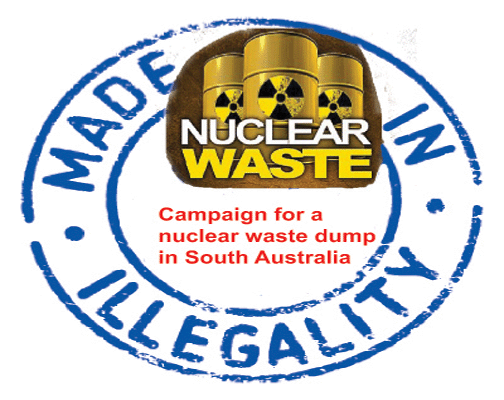
Anti-Nuclear Coalition of South Australia. Street Protest 1pm Thursday 6th September 90-94 The Parade Norwood.
Premier Steven Marshall is now at the helm of State Government. During the Nuclear Fuel Cycle Royal Commission his party heeded the wishes of the 2nd Citizen’s Jury by refusing to endorse the push for importing international radioactive waste.
During the March 2018 Election Campaign the Liberals also promised to uphold our Nuclear Waste Storage Facility (Prohibition) Act – which makes it illegal to promote, import, transport, or store radioactive waste.
That was then, this is now, & what do we find?
Marshall & his cronies – subservient to their self interested Federal counterparts – no longer oppose the promotion importation transport & storage of radioactive waste.
IN OTHER WORDS MARSHALL & STATE LIBERAL MEMBERS NOW SUPPORT A NUCLEAR DUMP IN REGIONAL SOUTH AUSTRALIA.
Join us this Thursday at Marshall’s electorate office to protest their failure to keep promises & for over-riding the clearly determined will of the people.
For further information contact Bob Lamb on 85818255
Australian War Memorial: Stop accepting funding from weapon-makers

The Australian War Memorial increasingly seeks and accepts sponsorships from the world’s largest multinational weapon manufacturers. These companies reap enormous profits from war; for them, ongoing warfare leads to greater business success. They have no place in a memorial to our war dead.
PETITION To: Australian War Memorial Director and Council
From: [Your Name]
To the Director and Council of the Australian War Memorial:
We are horrified to learn of AWM sponsorships from weapons manufacturers.
It is unacceptable that:
• Every visitor to the AWM is greeted by an illuminated screen featuring the corporate logos of these companies.
• The ‘BAE Systems Theatre’ is actively promoted for hire, thus marketing Britain’s biggest weapons maker. BAE Systems is a major military supplier to Saudi Arabia, a country known to sponsor terrorism, and which is currently committing atrocities against civilians in Yemen. BAE has been the subject of multiple corruption investigations, including for its dealings with Saudi Arabia.
• You have a three-year partnership deal with Lockheed Martin, the world’s largest weapons manufacturer, which also has a history of corruption. The deal includes assistance with commemorating the centenary of Armistice Day. During World War 1, the weapons industry made huge profits as Australians and others were slaughtered in unprecedented numbers.
We also note many other multinational weapons companies are sponsors and donors, including Boeing, Northrop Grumman, Raytheon, and Thales.
We would not accept cigarette or alcohol company sponsorship of hospital wards. It is totally inappropriate for weapons makers to sponsor our national War Memorial.
The Australian War Memorial should be a place of genuine commemoration and learning. Vested interests in warfare are incompatible with both of these goals. All funding from weapons companies should cease.
Australia’s failure on climate action is likely to doom the $15b European trade deal
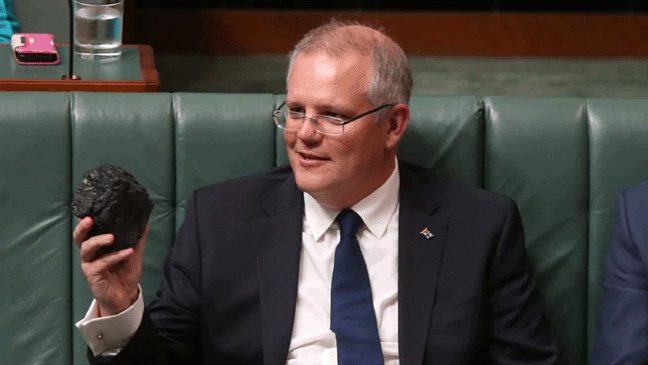 ‘Is this a red line for us?’ $15b European trade deal doomed if Australia dodges Paris pledge, SMH, By Nicole Hasham, 31 August 2018 The Coalition’s internal climate war risks damaging the economy after Europe declared it would reject a $15 billion trade deal with Australia unless the Morrison government keeps its pledge to cut pollution under the Paris accord.
Prime Minister Scott Morrison this week reset his government’s course on energy policy, declaring a focus on lowering electricity bills and increasing reliability, while relegating efforts to cut dangerous greenhouse gas emissions.
He has reaffirmed his government’s commitment to the Paris accord despite persistent calls by conservative Coalition MPs, led by Tony Abbott, to quit the agreement.
However there is deep uncertainty over how Australia will meet the Paris goal of reducing Australia’s carbon emissions by 26 per cent by 2030 given the government does not have a national strategy to meet the target.
The policy ructions did not go unnoticed at a meeting of the European Parliament’s Committee on International Trade in Brussels, where the EU’s chief negotiator on the deal, Helena König, faced angry questions from the floor over Australia’s commitment to climate action.
Australia and the EU will in November enter a second round of negotiations over the deal that would end restrictions on Australian exports and collectively add $15 billion to both economies.
In a video of this week’s proceedings, Ms König told the committee that “it’s the [European] Commission’s position … that we are talking about respect and full implementation of the Paris agreement [as part of the trade deal]”.
“No doubt we will see what comes out in the text [of the deal agreement] but that I expect to be the minimum in the text, for sure.”
Her assertion is a clear signal that any failure by Australia to meet its international climate obligations would have serious economic consequences.
Ms König fired off the warning after a question by Klaus Buchner, a German Greens member of the Parliament who said “the intention of the new Australian regime to withdraw from the Paris Agreement unsettles not only Australians”. …….
The EU bloc is Australia’s second largest trading partner, third largest export destination and second largest services market. The EU was also Australia’s largest source of foreign investment in 2017.
…….The Paris climate accord is deeply unpopular with conservative MPs, including Nationals MPs whose electorates would benefit from an EU trade deal. Keith Pitt resigned as an assistant minister last week in protest at the Paris treaty. “I will always put reducing power prices before Paris,” he said.
A 2017 report by the United Nations environment program that found Australia’s emissions were set to far exceed its Paris pledge and government data released in January showed Australia’s annual emissions had risen for the fourth year running.
Labor’s climate change and energy spokesman Mark Butler said the government had no emissions reduction plan and would fail to meet its Paris goal.
“The Prime Minister might think he can get away with [failing to cut emissions] domestically, but it is clear it will not be accepted by our international trading partners, who rightly have an expectation the Australian government will act to deliver on our international obligations,” he said.
European Australian Business Council chief executive Jason Collins, whose organisation has lobbied for the trade deal, said Europe’s commitment to the Paris agreement was “fundamental”. ……
Australian Conservation Foundation chief executive Kelly O’Shanassy said the European Union’s stance on the trade deal showed the Coalition’s climate policy division “has real-world consequences for our country”. https://www.smh.com.au/politics/federal/is-this-a-red-line-for-us-15b-european-trade-deal-doomed-if-australia-dodges-paris-pledge-20180831-p50109.html
Transport of uranium blocked by anti-nuclear campaigners in Germany


 Reporterre 1st Sept 2018 [Machine Translation] Since the morning of Saturday, September 1, several anti-nuclear Franco-German militants block a uranium transport.
They climbed a bridge 140 m high near Koblenz, Germany, blocking the railway on the Moselle, informs us the group Contratom Deutschland. The blocked train carries ” Yellow Cake ” from Namibia ; it left Hamburg on Thursday for the Orano uranium conversion plant in Narbonne Malvesi, in the south of France.
In Narbonne, uranium is transformed into UF4 and then used, after several transformations and enrichment, in nuclear power plants around the world. According to Orano, the Narbonne plant processes 25% of the world’s uranium.
“If we want to get out of the nuclear industry, ” says Cécile, a French climber living in Germany who takes part in the action, ” we must stop these transports and prevent them from reaching the Orano factory in
Narbonne Malvési, the gateway to European nuclear energy.
Germany, a net exporter of electricity, unlike political discourse, does not come out quite nuclear. The transports supplying the nuclear facilities continue and the Framatome Nuclear Fuel Plant in Lingen (Lower Saxony) and Urenco’s uranium enrichment plant in Gronau (North Westphalia) continue to operate. That’s why we want to stop nuclear transport. ”
https://reporterre.net/Un-train-d-uranium-a-destination-de-Narbonne-bloque-en-Allemagne
Climate change is the big security issue for Pacific Island nations, – and for Australia?
 For Pacific Island nations, rising sea levels are a bigger security concern than rising Chinese influence, The Conversation, Head of Department, Politics and Philosophy, La Trobe University, August 31, 2018 When the Pacific Islands Forum is held in Nauru from September 1, one of the main objectives will be signing a wide-ranging security agreementthat covers everything from defence and law and order concerns to humanitarian assistance and disaster relief.
The key question heading into the forum is: can the agreement find a balance between the security priorities of Australia and New Zealand and the needs of the Pacific Island nations?
Even though new Prime Minister Scott Morrison is not attending the forum, sending Foreign Minister Marise Payne instead, the Biketawa Plus security agreement remains a key aim for Canberra……….
A focus on climate change as a security issue
One key reason for updating Biketawa is to realign Australia’s security interests with those of Pacific Island countries that have grown more aware of their shared interests and confident in expressing them in international relations. This growing confidence is clear in the lobbying of Pacific nations for climate change action at the United Nations and in Fiji’s role as president of the UN’s COP23 climate talks.
In the absence of direct military threats, the Pacific Island nations are most concerned about security of a different kind. Key issues for the region are sustainable growth along a “blue-green” model, climate change (especially the increasing frequency and intensity of natural disasters and rising sea levels), illegal fishing and over-fishing, non-communicable diseases (NCDs), transnational crime, money laundering and human trafficking. ……..
Climate change adaptation and mitigation must also be elevated to the top of the agenda in Australia’s relations with the region. It is the most pressing problem in the Pacific, but for political and economic reasons, it hasn’t resonated to the same extent with Canberra.
In fact, Australia has recently been identified as the worst-performing country in the world on climate action. This has not gone unnoticed in the Pacific. Fiji’s prime minister, in particular, has been clear in highlighting that Australia’s “selfish” stance on climate change undermines its credibility in the region.
These shifting priorities in the Pacific present a greater challenge for Australia, especially now that there are more players in the region, such as China, Russia and Indonesia. Australia may see these “outsiders” as potential threats, but Pacific nations are just as likely to view them as alternative development partners able to provide opportunities………
there can be no authentic engagement with the region without addressing climate insecurity as well. https://theconversation.com/for-pacific-island-nations-rising-sea-levels-are-a-bigger-security-concern-than-rising-chinese-influence-102403
Climate change’s impact already here in the Pacific : Australia take notice!
 World leaders who deny climate change should go to mental hospital – Samoan PM https://www.theguardian.com/environment/2018/aug/31/world-leaders-who-deny-climate-change-should-go-to-mental-hospital-samoan-pm
Tuilaepa Sailele berates leaders who fail to take issue seriously, singling out Australia, India, China and the US, Guardian, Kate Lyons, 31 Aug 18 The prime minister of Samoa has called climate change an “existential threat … for all our Pacific family” and said that any world leader who denied climate change’s existence should be taken to a mental hospital.
In a searing speech delivered on Thursday night during a visit to Sydney, Tuilaepa Sailele berated leaders who fail to take climate change seriously, singling out Australia, as well as India, China and the US, which he said were the “three countries that are responsible for all this disaster”.
“Any leader of those countries who believes that there is no climate change I think he ought to be taken to mental confinement, he is utter[ly] stupid and I say the same thing for any leader here who says there is no climate change.”
Speaking at the Lowy Institute, just days before the beginning of the Pacific Islands Forum in Nauru, the Samoan prime minister seemed to take a swipe at Australia’s commitment to minimising the impact of climate change, which he called the “single greatest threat to the livelihood, security and wellbeing peoples of the Pacific
“While climate change may be considered a slow onset threat by some in our region, its adverse impacts are already felt by our Pacific islands peoples and communities,” said Sailele. “Greater ambition is necessary to limit global warming to 1.5 degrees centigrade and Pacific island countries continue to urge faster action by all countries.”
Sailele said addressing climate change required “political guts” from leaders. “We all know the problem, we all know the causes, we all know the solutions. All that is left would be some political courage, some political guts to get out and tell the people of your country, ‘Do this, this, this, or there is any certainty of disaster.’”
Sailele’s speech comes as leaders of Pacific nations are preparing to meet at the Pacific Islands Forum in Nauru next week, where Australia is expected to face questions about its emissions targets.
Australia’s new prime minister, Scott Morrison, is under pressure from some members of his party to abandon Australia’s commitment to reducing emissions under the Paris agreement.
His immediate predecessor, Malcolm Turnbull, was due to attend the forum, but Morrison has announced he is sending his new foreign minister, Marisa Payne, a move the opposition Labor party condemned as “an insult to our neighbours” as well as “a serious strategic mistake”.
Saliele’s speech also touched on China’s rising influence in the Pacific, saying the region had become “an increasingly contested space”. “The big powers are doggedly pursuing strategies to widen and extend their reach, inculcating a far-reaching sense of insecurity.”
Climate change; When will we start to protect our children?
Uncontrolled climate change could result in disaster for our kids. Will we do something?
Australia has no policies to really deliver on its Paris climate promises
Options on energy policy leave Coalition in a sticky situation, Guardian, Katharine Murphy, 1 Sept 18, The government finds itself in a mess after the national energy guarantee was used as a catalyst to evict Turnbull.
We’ve lost another prime minister in the front bar brawl that is Australian politics, but we’ve lost something else as well, something that’s a bit harder to see.
For the last decade or more, a group of people in the political system have been trying to land a bipartisan consensus on energy policy and climate change, persevering through all the dispiriting cycles of trying to achieve that end, hoping that a corner could be turned.
That animating current in politics, and it’s been a significant one, now seems to have hit a dead end. That’s the feeling. We’ve reached a point of no return
If that supposition proves to be correct, this a profound problem for the country, more profound than the revolving door at the Lodge, which is deeply disconcerting, but just one symptom of a deeper malaise.
The Coalition is in a terrible mess on this issue. The national energy guarantee, the last roll of the dice for consensus, was used as a catalyst to blow up a prime minister, just as emissions trading was deployed for the same end, removing the same party leader, in 2009.
As a consequence of that rancid history, the imperative of emissions reduction now hangs over Liberal leaders like the sword of Damocles. Any leader wanting to do something knows they will have to run the gauntlet of the conservatives, and the brains trust of the conservative faction has proven itself so resistant to facts and evidence that it can’t even count numbers for a leadership spill………
The Morrison government is in a position where it is a signatory to the Paris agreement, yet there are no policies to deliver the outcome. There is a talking point doing the rounds that Australia will meet its Paris commitments “in a canter” – but this is complete nonsense.
It is possible (although the Energy Security Board says otherwise) that we could reduce emissions by 26% in the electricity sector without a settled policy to get us there because emissions in the sector are already falling (because ageing coal is leaving the system and the renewable energy target has pulled forward investment).
But what about the rest of the economy? Emissions are rising elsewhere, and there is no plan or roadmap to curb them.
This government has dithered for years about the imposition of new emissions standards for vehicles. Ministers have not been brave enough to bring forward a concrete proposal because the Coalition party room would limber up for another implosion.
Then there’s agriculture. Many Nationals take it as a personal affront if someone suggests anything be done in agriculture. The fact that their own constituents are now being battered by horrendous drought and hanging on grimly in areas gradually being rendered unviable by inexorable climatic change is an irony that seems lost of many of our elected representatives.
So that’s the outlook on emissions. Now let’s ponder the concept of certainty.
The national energy guarantee was proposed to create policy certainty to help drive the correct mix of investment in Australia’s electricity generation assets. That was its purpose. That policy is now on the back burner.
What isn’t on the back burner is the new Morrison government’s need to deliver a fix on power prices once the prime minister has concluded the healing and stability tour. That’s on the front burner. But this is a problem with no easy fix.
The government slapped together a package of measures in the dying days of the Turnbull regime designed to lower power prices – work that would have normally taken months of careful deliberation in a cabinet subcommittee.
So now we have no over-arching mechanism for investment certainty, and a bunch of expedited measures proposed on the fly, including heavy handed market interventions, such as breaking up power companies if they don’t play ball with the government and lower prices.
Call me crazy, but that doesn’t sound like the building blocks of a stable investment climate……..https://www.theguardian.com/australia-news/2018/sep/01/options-on-energy-policy-leave-coalition-in-a-sticky-situation
The Indigenous STEM Awards
 The Indigenous STEM Awards recognise, reward and celebrate the achievements
 of Aboriginal and Torres Strait Islander students and scientists
who are studying and working in the science, technology, engineering and mathematics (STEM) field,
as well as the integral role schools, teachers and mentors have in
supporting Aboriginal and Torres Strait Islander students
in pursuing STEM education and careers.
The awards also recognise the immense value of connecting Aboriginal and Torres Strait Islander students
with inspirational STEM role models, both Indigenous and non-Indigenous.’
Applications close 28Sep2018
An A-Z against nuclear power — Beyond Nuclear International

The uranium fuel chain explained
via An A-Z against nuclear power — Beyond Nuclear International
September 2 Energy News — geoharvey

Opinion: ¶ “Market speeds coal’s demise” • FirstEnergy Corp announced that it will close Pennsylvania’s largest coal-fueled power plant by 2021, along with three smaller plants in Ohio. FirstEnergy tried to blame federal energy policy. But policy makers should note that coal has become uncompetitive, and its economics will not improve. [Scranton Times-Tribune] World: ¶ […]
1 This month
To see nuclear-related stories in greater depth and intensity
– go to https://nuclearinformation.wordpress.com/


 Antinuclear