Australia: new State of the Climate Report – extreme heat events, fire weather and drought
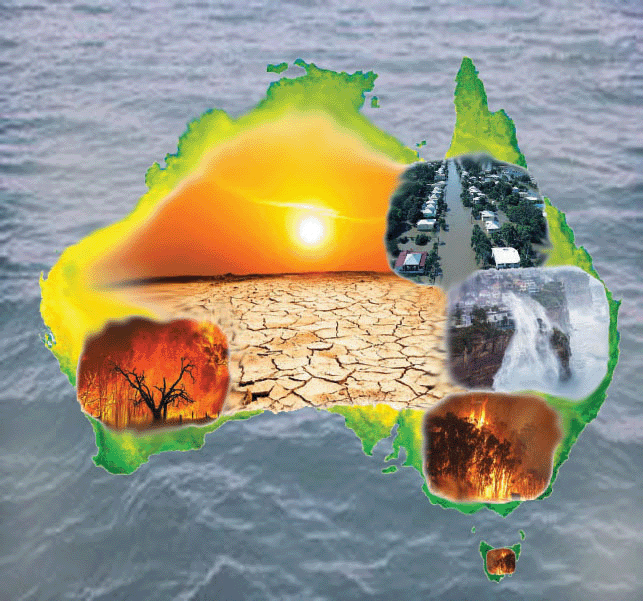 Australia experiencing more heat, longer fire seasons and rising oceans
State of the climate report points to a long-term increase in the frequency of extreme heat events, fire weather and drought, Guardian Lisa Cox
Aboriginal landowners say that radioactive waste contractors ‘damaged’ cultural sites

 Radioactive waste contractors ‘damaged’ cultural sites, allege traditional owners, SBS News, 19 Dec 18 Traditional owners in South Australia have launched a complaint to the Australian Human Rights Commission over the federal government’s plans for a nuclear waste facility.
Traditional owners in South Australia’s Flinders Ranges have launched a complaint to the Australian Human Rights Commission, alleging contractors damaged a precious cultural site while assessing land for a new nuclear waste facility.
Maurice Blackburn lawyer Nicki Lees, acting for the Adnyamathanha Traditional Lands Association (ATLA), said Adnyamathanha traditional owners were concerned about the alleged actions of contractors on their lands.
“Earlier this year, contractors of the Commonwealth caused significant harm and damage to an area that is particularly significant to traditional owners, and in particular female Adnyamathanha women,” she said.
“What we’re doing today is saying that the Commonwealth failed to deal with that damage, and they failed to take seriously the complaint that ATLA made to the Commonwealth regarding that damage.”
The complaint also alleges that a vote to determine support for a nuclear waste site excluded a large number of traditional owners.
“The complaint alleges that because a large number of traditional owners are not included in the vote, it is therefore discriminatory and unlawful,” Ms Lees said.
Earlier this year, Barngarla traditional owners launched a similar complaint alleging a community vote was discriminatory because it failed to include native title holders who didn’t reside in the community.
Vince Coulthard, Chief Executive of ATLA, said his people deeply opposed the nuclear waste proposal.
“The Adnyamathanha people have voted against the waste dump. We don’t want the waste dump on our country,” he said.
“The department on this consultation has gone and spoken with other people in the region, other interest groups, they’ve never come out and spoken directly with us.”……..
Three South Australian sites have been short-listed to house Australia’s low and medium level nuclear waste. Two are near Kimba, on the Eyre Peninsula. The third is near Hawker in the Flinders Ranges.
A planned community vote to determine support for the facility had to be postponed earlier this year after Barngarla traditional owners were granted an injunction by the South Australian Supreme Court.
This Barngarla matter will return to court in January. Three South Australian sites have been short-listed to house Australia’s low and medium level nuclear waste. Two are near Kimba, on the Eyre Peninsula. The third is near Hawker in the Flinders Ranges.
A planned community vote to determine support for the facility had to be postponed earlier this year after Barngarla traditional owners were granted an injunction by the South Australian Supreme Court.
This Barngarla matter will return to court in January.https://www.sbs.com.au/news/radioactive-waste-contractors-damaged-cultural-sites-allege-traditional-owners?fbclid=IwAR1IMP4yisi_kHZ30Bslg2ftYw75j6IjMAcsKLOmFvboX9d1G1EbMJ1iQJE
Coalition energy and climate policies hit rock bottom at year’s end — RenewEconomy

Coalition ends 2018 with its position on climate and energy policies even further to the right than when the year started. The post Coalition energy and climate policies hit rock bottom at year’s end appeared first on RenewEconomy.
via Coalition energy and climate policies hit rock bottom at year’s end — RenewEconomy
Division within the Liberal Coalition over climate change
 Coalition’s divide exposed at COAG energy meeting in Adelaide, ABC, By Casey Briggs 19 Dec 18, A meeting of Australia’s energy ministers had ended bitterly divided, with the country’s biggest Liberal-run state accusing the Commonwealth of blocking discussion on climate change. Coalition’s divide exposed at COAG energy meeting in Adelaide, ABC, By Casey Briggs 19 Dec 18, A meeting of Australia’s energy ministers had ended bitterly divided, with the country’s biggest Liberal-run state accusing the Commonwealth of blocking discussion on climate change.
|
|
|
Tuvalu island nation actually growing, not sinking – Fact Check
|
Is the Pacific island nation of Tuvalu growing, and not sinking, as Craig Kelly says? RMIT ABC Fact Check , 19 Dec 18
The claimLiberal MP and climate sceptic Craig Kelly made headlines in November when he was caught on tape mocking “lefties” for exaggerating the effects of climate change. Speaking at a local party event, audio of which was leaked to the Guardian, Mr Kelly set out to debunk several justifications for climate change action, including the argument that Tuvalu, the Pacific island nation, was slipping beneath the sea. “The science tells us that Tuvalu, which I often hear about, is actually growing not sinking,” he told colleagues. Is Tuvalu growing? RMIT ABC Fact Check investigates. The verdictMr Kelly’s claim checks out. In the four decades to 2014, Tuvalu’s total land area grew by 73 hectares, or 2.9 per cent. The expert behind this research told Fact Check the nation’s islands were continually adjusting, and that the new land was habitable. But that’s not to say Pacific nations are not at risk from rising seas. One expert told Fact Check that among the Solomon Islands, for example, reef and volcanic islands had disappeared or been eroded, in some cases displacing indigenous communities. Smaller islands in Tuvalu, though uninhabited, have also shrunk. The research cited by Mr Kelly suggests certain islands — specifically, larger atolls and reef platforms — can adapt to the current pace of sea level rise. However, the United Nations Intergovernmental Panel on Climate Change (IPCC) sets out four scenarios for future rises, three of them more severe than what Tuvalu has so far faced. Why is Tuvalu important?Halfway between Australia and Hawaii lies the tiny Pacific nation of Tuvalu……… Why is Tuvalu growing?The study looked at Tuvalu’s two island types, atolls and reef platforms. Though both are formed from coral reefs, atolls are ring-shaped formations of islets or islands surrounding a lagoon, whereas reef platform islands are solid, single structures. Their expansion, the study suggests, is the result of sediment, corals and other debris being washed ashore by storms and waves. Coastal geomorphologist Paul Kench, who led the research team, told Fact Check that Tuvalu’s islands had “always been changeable” and that they “adjust their position on the reef surface” as waves, currents and sea levels change. “This is a continual adjustment process,” he added. Notably, Tuvalu Prime Minister Enele Sopoaga criticised the research, claiming it had not considered the habitability of the new land area. But Professor Kench told Fact Check this was not the case: “These islands are essentially deposits of gravel and sand,” he said.
His previous research demonstrated similar growth in the atoll islands of Kiribati…… University of NSW Professor John Church, who is an IPCC lead contributor on rising seas, told Fact Check that sea levels did not rise uniformly but varied depending on factors such as ocean currents, surface winds and water temperature. “There is a tendency for sea level rise to be less than the global average near regions of mass loss,” Professor Church said, explaining that rises were greater in places further from melting glaciers and ice sheets…….. What about other Pacific islands?In his speech, Mr Kelly went on to say “sinking Pacific islands” were getting bigger. Simon Albert, an expert in marine ecology and climate change at the University of Queensland, told Fact Check that the threat to low-lying Pacific islands was not the possibility of sinking but of erosion. He said that although Tuvalu’s experience was largely true of the Pacific, the Solomon Islands offered a bleaker window into the future. There, sea levels had risen much faster than the global average. Between 1994 and 2014, according to Dr Albert’s research, the Solomons experienced sea level rises averaging 7-10mm per year. Meanwhile, between 1993 and 2018, the global average was 3.2mm per year. While Tuvalu recorded a total rise of 15cm over four decades, the Solomons managed that in just two. Dr Albert said that in parts of the Solomons, rising seas had combined with wave exposure to cause “dramatic coastal erosion leading to recession of coastlines and in some cases the loss of entire islands”. His research has shown that some of the Solomons’ uninhabited reef islands, similar in structure to those in Tuvalu, had completely disappeared due to erosion. The country’s volcanic islands, generally larger and steeper than atoll or reef islands, had also experienced coastal erosion. As a result, local indigenous communities — some of which had inhabited the islands for over 100 years — had been destroyed or displaced. n the Tuvalu study, referring to the Pacific more generally, Professor Kench noted: “Commonly, the densest populations are located in the economic and political centres, situated on smaller and less stable islands, which represent less than 1 per cent of the land available in the archipelagos.” Principal researchers: David Campbell, Billy Phillips factcheck@rmit.edu.au https://www.abc.net.au/news/2018-12-19/fact-check-is-the-island-nation-tuvalu-growing/10627318 |
|
Australia’s oceans absorbing most of the climate heating, but for how much longer

Key points:
- Australia’s climate has now warmed by over 1 degree Celsius since 1910
- Oceans have now warmed by around 1C since 1910
- For the first time, the report draws attention to “compound extreme events” when multiple variables coincide
An extra two years has firmed-up the data to demonstrate that climate change is happening now.
Dr Helen Cleugh, the director of the climate science centre at CSIRO, said the last time the planet saw levels of CO2 this high was at least 800,000 years ago.
She said atmospheric CO2 is up 46 per cent since before the industrial era began in the 1750s.
“We know from our analysis that the cause of the increases in CO2 concentration is human activities, through burning of fossil fuels and through land use change,” Dr Cleugh said.
Ocean sinks
That CO2 is not just staying in the atmosphere.
“As a result of the increased greenhouse gases in the atmosphere we’ve actually got more energy in the Earth’s climate system, and it turns out that over 90 per cent of that extra energy has actually been taken up by the ocean,” Dr Cleugh said.
“Our oceans and land are performing an enormous ecosystem service at the moment because they’re taking up a lot of the anthropocentric [human-generated] CO2 emissions.”
The oceans take up the CO2 directly, removing it from the atmosphere, as well as absorbing heat from the atmosphere. The land also acts as a sink but to a lesser extent.
“That has two really important implications. The first is that it means that the oceans play a really important role in modulating the rate and pace of our changing climate. But the other is it leads to warming,” Dr Cleugh said.
A very live research question right now is will those oceans and land continue to take up CO2 into the future.
“At the moment we’re not seeing any evidence of the weakening of that sink.”
But Dr Cleugh said that models of our future climate suggest that the extra CO2 and heat would not be able to be taken up by the ocean forever.
A bit like sweeping dust under a rug, eventually only so much can fit.
“There are feedbacks that could lead to a weakening of those sinks, either on the land or in the ocean, and that would mean that warming in the atmosphere would proceed at a greater rate,” she said.
Dr Cleugh said it is a very important scientific question to understand the way that the oceans are behaving.
“It turns out the Southern Hemisphere oceans are particularly important in taking out heat and CO2. So it’s really important that we do that research in our own patch,” she said.
Oceans already feeling the heat
Ocean temperatures, already up by around 1 degree Celsius since 1910, has contributed to more and longer marine heatwaves.
The back-to-back bleaching of the Great Barrier Reef in 2016 and 2017 have been well canvased, but the changing ocean is meddling with other ecosystems.
The report states that the Eastern Australian Current — of Finding Nemo fame — is extending further south, encouraging warming in the Tasman Sea and extending the habitat of other species south.
As the ocean warms it is expanding, which is coupling with ice melts to raise sea levels.
The increased CO2 in the water has also lead to a 30 per cent increase in ocean acidity since the late 1800s.
“This has significant implications for our marine ecosystem and the ability of corals to regrow, so it actually is linked back to the coral bleaching,” Dr Cleugh said.
These changes are not happening evenly. Luckily for the Great Barrier Reef, so far it looks like the worst of the ocean warming acidification has happened to the south of Australia……..https://www.abc.net.au/news/2018-12-20/bom-csiro-biennial-state-of-the-climate/10631122
A third of Australia’s spectacled flying fox population wiped out by extreme heat waves
Extreme heat wipes out almost one third of Australia’s spectacled flying fox population, ABC Far North , 20 Dec 18, By Sharnie Kim and Adam Stephen An extreme heatwave in far north Queensland last month is estimated to have killed more than 23,000 spectacled flying foxes, equating to almost one third of the species in Australia.
The deaths were from colonies in the Cairns area where the mercury soared above 42 degrees Celsius two days in a row, breaking the city’s previous record temperature for November by five degrees.
Ecologist, Dr Justin Welbergen from the Hawkesbury Institute for the Environment (Western Sydney University) is collating the numbers of bat deaths and said it was the second-largest mass die-off of flying foxes recorded in Australia and the first time it had happened to this species.
“These are certainly very serious wildlife die-off events and they occur at almost biblical scales,” he said……..https://www.abc.net.au/news/2018-12-19/heat-wipes-out-one-third-of-flying-fox-species/10632940
Britain renews its search for a community willing to host nuclear waste dump
  Search to find community host for nuclear dump expected to kick off today https://www.newsandstar.co.uk/news/17308038.search-to-find-community-host-for-nuclear-dump-expected-to-kick-off-today/ Search to find community host for nuclear dump expected to kick off today https://www.newsandstar.co.uk/news/17308038.search-to-find-community-host-for-nuclear-dump-expected-to-kick-off-today/
|
|
End of fast reactor project: uranium glut raise doubts over fuel reprocessing
December 19 Energy News — geoharvey

Opinion: ¶ “Regenerative Cities: An Urban Concept Whose Time Has Come!” • What we need is a city that can serve as a role model, combining the social, economic, and ecological dimensions of sustainability. It should be a city that embeds a vivid cultural life and a culture of creativity in the way it operates. […]
Genex brings in EnergyAustralia for solar-pumped hydro storage project — RenewEconomy

Genex brings in EnergyAustralia as potential partner to unique solar-pumped hydro facility in north Queensland, although the solar component will be delayed. The post Genex brings in EnergyAustralia for solar-pumped hydro storage project appeared first on RenewEconomy.
via Genex brings in EnergyAustralia for solar-pumped hydro storage project — RenewEconomy
NSW slams federal Coalition over “extraordinary” refusal to reinstate emissions in NEG — RenewEconomy

NSW Coalition energy minister slams federal government’s continued refusal to restore emissions component of the National Energy Guarantee, vows to continue to fight for the “critical matter.” The post NSW slams federal Coalition over “extraordinary” refusal to reinstate emissions in NEG appeared first on RenewEconomy.
State of the Climate 2018: Heatwaves, fires and floods — RenewEconomy

Australia’s average temperature has risen 1°C, leading to more high-impact weather events such as heatwaves, extreme fire weather conditions, coastal inundation and marine heatwaves. The post State of the Climate 2018: Heatwaves, fires and floods appeared first on RenewEconomy.
via State of the Climate 2018: Heatwaves, fires and floods — RenewEconomy
Coalition’s energy policy insanity brilliantly summed up in a single song — RenewEconomy

Must listen: To the tune of John Schumann’s I was only 19, three energy advocates nail the state of the Coalition’s energy policy. The post Coalition’s energy policy insanity brilliantly summed up in a single song appeared first on RenewEconomy.
via Coalition’s energy policy insanity brilliantly summed up in a single song — RenewEconomy
1 This month

of the week – Australians for War Powers Reform (AWPR)
To see nuclear-related stories in greater depth and intensity
 Antinuclear