Nuclear “education” – theme for February 2019
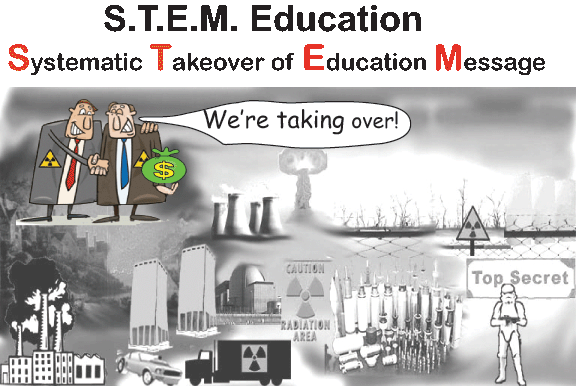
We’re now in the era of “STEM education” – Science Technology, Engineering, Mathematics” – and how the nuclear industry loves this! Don’t get me wrong. I think that everyone should have a good knowledge especially of maths and science.
BUT – alongside the current fervour for STEM, is a very wrong downgrading of the humanities – the so-called “soft subjects”. At this critical time of climate change and nuclear danger, we really need the insights from art, history, culture, sociology – the human studies – to help us to know what to do.
The nuclear industry thrives on this almost religious belief that technology is the answer. And of course, who is to educate us about nuclear technology, and how much we need it etc? That’s a no-brainer. On the whole, education about nuclear power relies on information from the nuclear industry. That is either not forthcoming or is a comfortable ‘we know best’ assurance, allied with technical information – designed to reiterate that only the nuclear experts can really understand it – so don’t bother your pretty little heads about it.
Much of the media mindlessly regurgitates information from the industry, but fortunately, not all of it.
It’s in academia that the nuclear industry increasingly gets a foothold, and of course,  universities like to get the funding grants. Just a few examples: University of Birmingham (UK) University of Bristol; University of Oxford; Kyoto University. University of California. University of Tasmania.
But, of course, the nuclear lobby ‘s “education” is all over the place, with the International Atomic Energy Agency (IAEA) running courses in the Asia Pacific and elsewhere. And Russia, expanding its nuclear propaganda to Asia, Africa, the Middle East.
Community education is a nuclear lobby speciality – to Boy Scouts, many other organisations, and especially to where the industry wants to dump radioactive trash.
Would we trust tobacco companies to control education about healthy lungs, and lung disease? So why rely on the IAEA etc for education about nuclear power?
Contrary to what ANSTO says, nuclear waste returning to Australia IS High Level Waste (HLW)
Gary See Fight To Stop Nuclear Waste Dump In Flinders Ranges SA https://www.facebook.com/groups/344452605899556/,
Scotland’s Environment Protection Agency (SEPA) clearly state that it considers radioactive waste generated at Sellafield in England, and heading to Australia, to be vitrified High Level waste, despite what ANSTO call it. https://www.gov.scot/…/0038…/00389151-pdf/govscot%3Adocument
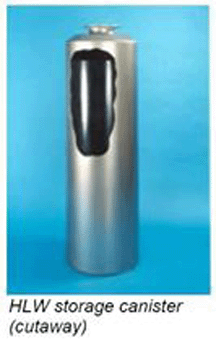 Steve Dale To think politicians and the nuclear people here got together to deliberately deceive the Australian public – to call what other countries calls “High Level Waste” something else. It’s the same toxic, corrupt thinking that brought us Maralinga. At left is a picture of High Level Waste from a UK document – looks (and is) the same as the stuff they have at Lucas Heights (same link)
from here:
https://webarchive.nationalarchives.gov.uk/…/radwaste.pdf
The growing danger of the radioactive by-products from the nuclear industry

From mining the uranium rich ore, to nuclear abandonment – a dozen by-products more radio toxic than the ore mined to fuel the reactor are discarded. These products are the raffinates culminating in 85% of the total radioactivity that goes directly into the tailings only to migrate throughout the environment.
Products like Radon gas, Polonium-210 with a 140 day half life, Radium-226, with a 1600 year half life, Thorium-230 with a 76,000 year half life are released , and yet only 1kg of Uranium oxide is recovered in every 4,000 kilos mined.
Uranium-238 subjected to neutron bombardment in the reactor becomes Uranium-239 with a 23 minute half life, then that becomes Neptunium-239 with a 2.3 day half life, and that goes on to become Plutonium-239 with a 244,000 year half life, then this spent fuel finally decays to become Uranium- 235 with a half life of 700 million years.
Moreover, x that by no less than 10 to get the life of the radioactive hazard, which equates to no less than 7 billion years, and here we have only just crossed the nuclear industries threshold within the last 76 years with many thousands of nuclear events, and accidents recorded, and yet this is not the only wastes these machines produce with one Canadian CANDU reactor that recorded 100 trillion becquerels of radiation from the Tritium released in just one year.
The nuclear embracing coterie tell us they can safely manage these radioactive wastes, yet there containment vessels are only guaranteed for 25 years not 7 billion years, and a director of Holtec has stated there is no way to remedy a breach of containment. Moreover these nuclear wastes are a gamble and risk that only grows exponentially with every generation.
1 This month

of the week – Australians for War Powers Reform (AWPR)
To see nuclear-related stories in greater depth and intensity
 Antinuclear