Climate crisis and nuclear news- Australia
 In London yesterday, police arrested 963 people who were part of the Extinction Rebellion climate protest. This movement is continuing, and spreading to other countries. They will also set up a political taskforce to take forward public negotiations with the Government. Climate awareness is gathering momentum. Still, climate scientists seem unwilling and perhaps unable to talk to the general public, to explain the basic facts on climate change, and the complicating factors, such as the effects on oceans warning, on sea ice loss, on air current changes, on low pressure areas, the polar vortex. There are two climate scientists who do make this effort. Paul Beckwith has made over 200 YouTube videos, and he does tackle the complicated science in an understandable way. Katherine Hayhoe almost deceptively makes climate science seem simple, and is well known for her entertaining video series Global Weirding.
This newsletter was always intended to inform on the nuclear threat. It’s just that the climate situation is now a global emergency.
NATIONAL
NUCLEAR – Here’s a list of the many Candidates and Members of Parliament who support the UN Treaty on the Prohibition of Nuclear Weapons.
Why is Prime Minister Scott Morrison raising the suggestion of nuclear power, knowing it’s illegal in Australia? Scott Morrison chops and changes about nuclear power. Cory Bernardi sulks as Scott Morrison, in election campaign mode, abruptly reverses his support for nuclear power. Australian Nuclear Association’s Rob Parker continues to make absurd pro nuclear claims.
CLIMATE ABC’s Vote Compass finds that environment is a high issue amongst voters. The health dangers from climate change – catching Australia unprepared.
Scott Morrison misleads the public on the costs of Labor’s climate policy.
Adani did not accept key scientific advice. Documents contradict Minister For Coal’s statement that Adani “accepted in full” changes sought by scientists regarding Carmichael mine.
RARE EARTHS Lynas rare earths corporation still struggling with its tricky problem of its radioactive wastes in Malaysia. Malaysian government insists that Lynas must remove its 450,000 tonnes of radioactive waste from the country. Kevin Rudd, as Foreign Minister in 2011, aware of Lynas’ probable radioactive wastes problem. In 2011, secret report warned of dangers of Lynas’ rare earth’s wastes in Malaysia.
RENEWABLE ENERGY. Renewables job numbers hit three-year high – led by Australia’s coal states. Australian Energy Market Operator (AEMO) to model rapid transition to renewables, quicker exit from coal. Work begins on Warwick solar farm – University of Queensland’s ticket to 100% renewables. University of New South Wales looks to solar-powered desalination to help bust droughts. South Australia Power Networks taps solar to cut dependence on its own grid. Rooftop solar to add 2,000MW in 2019, another Liddell by 2022. Woolworths green bond flooded with orders as retailer looks to solar, efficiency .
INTERNATIONAL
Earth’s surface temperature steadily rose from 2003. https://www.youtube.com/watch?v=6cRCbgTA_78 https://www.youtube.com/watch?v=0Tpzwqlj-d4 Extinction Rebellion can act as a catalyst for political debate and change . Climate action: Invest in low-carbon but not in nuclear . Nuclear power plants in no way designed, or ready for, climate change extremes. “There is no such thing as a zero or near-zero-emission nuclear power plant”.
Climate Change Could Unleash Long-Frozen Radiation.
Debunking All The Smears Against Julian Assange.
EUROPE. More disappointments for Europe’s new nuclear stations– no nuclear future for Europe?
UKRAINE. Life as a liquidator after the 1986 Chernobyl nuclear disaster. Chernobyl: How bad was it? .
UK.
- ‘We will never stop fighting’: Greta Thunberg joins London climate protest. https://www.youtube.com/watch?v=Pv9EkxudXmw Climate change rallies block London roads . Extinction Rebellion: The activists risking prison to save the planet. Britain’s slow path to zero carbon emissions.
- Britain’s Nuclear Free Local Authorities (NFLA) notes that over 70 Welsh councils formally reject hosting nuclear waste dump. UK’s EPA concerned over proposals for Sizewell new nuclear power station in Suffolk. Nuclear Transparency Watch warns on the unwisdom of UK government subsidising Small Modular Nuclear Reactors (SMRs).
JAPAN. Japan Atomic Power looks to a big business in cleaning up dead nuclear plants. Japan’s plutonium surplus, its history, and its danger. Japan’s massive task to clean up nuclear fuel pools of Fukushima stricken reactors. Hazardous removal of spent fuel rods is just one step in the long Fukushima nuclear clean-up. Japan has a new kind of visa to lure foreign blue collar workers for Fukushima clean-up.
USA.
- An emerging hopeful trend for US nuclear weapons policy. U.S. Ignored Russia’s Nuclear War Prevention Pact – Reports. Trump’s administration speeds up the revolving door between Pentagon and nuclear weapons companies. Trump administration stops govt practice of disclosing numbers of nuclear weapons. Pentagon’s strange and dangerous plan for small nuclear reactors at the battle scene.
- On climate change impacts, nuclear lobby has captured the regulators. A conservative backlash against Trump, as he appoints fossil fuel insiders to federal agencies?
- Frida Berrigan’s personal story about nuclear weapons.
- Holtec’s nuclear decommissioning and wastes empire to grab Indian Point.
- U.S. Department of Energy seeks new certification for its Waste Isolation Pilot Plant. North Dakota prohibits nuclear waste dumping in the state.
- State subsidies for nuclear power in USA are simply not necessary. America’s nuclear lobby spending up big to get $millions in State subsidies. AARP Ohio, on behalf of its 1.5 million members and families, strongly opposes Ohio nuclear subsidies. U.S.nuclear bailouts – Exelon and the death of competitive energy markets. U.S. Supreme Court rejects challenge to nuclear subsidy.
- Lawsuit against Santee Cooper, claims that investors were deceived over nuclear project risks.
- The long-lasting unsolved problem of Three Mile Island’s radioactive trash. Three Mile Island, and the nuclear industry’s legacy of cancer.
- USA Congressmen concerned at slow clean-up of dangerous San Onofre nuclear site.
- Conflicts of interest in the Trump group’s push to sell nuclear reactors to Saudi Arabia.
- USA is preparing more charges against Julian Assange.
FRANCE. Some consternation in France, as EDF plans to split off its nuclear section. Electricite de France (EDF) €33 billion debt, and more problems – its nuclear section to be nationalised. EDF’s Belleville nuclear power plant to continue to have increased monitoring by France’s nuclear regulator.
CHINA. China gambles on untested “Hualong One” nuclear reactor, and plans for international sales.
RUSSIA. Putin’s new super-dooper longest submarine packed with nuclear torpedoes. More countries headed to go into nuclear debt to Russia.
INDIA. Dangerous electioneering: India’s Modi ramps up the nuclear weapons rhetoric.
CANADA. Canada’s Came co Corp slow to clean up groundwater contaminated with uranium at Saskatchewan mill.
BANGLADESH. China keen to sell nuclear reactor to Bangladesh – an inflated and costly project.
FINLAND. Finland to start constructing nuclear plant with Russian reactor in 2021 .
ISRAEL. History of Israel getting nuclear weapons.
Busting ANSTO’s deceptive pro nuclear propaganda to the Kimba and Hawker communities
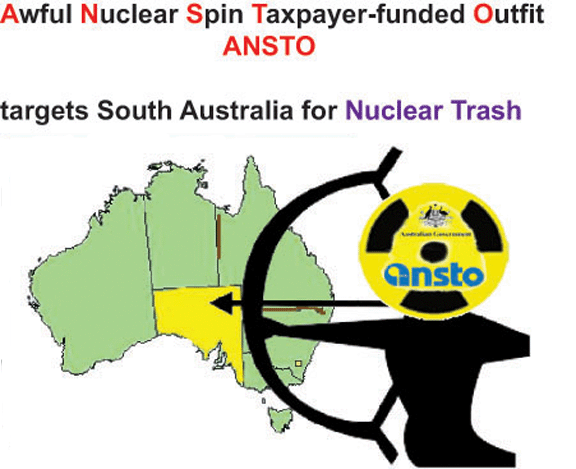 Kazzi Jai https://www.facebook.com/groups/941313402573199/ Fight To Stop Nuclear Waste In The Flinders Ranges 23 Apr 19, How many times do you have to explain this to people? In response to some of ANSTO’s propaganda directed at the rural communities targeted for nuclear waste dumping……
So you have a specific inventory of what’s in the drums do you? You must be very special then – because that is not what has yet been released to the public! You seem to assume it’s in your words “aprons and gloves” from handling radioactive objects. There is much more to it. Did they mention that it must be shielded to be handled safely? The steel drums themselves act as the shield for the Low Level Nuclear waste and must be monitored to ensure they remain intact. The proposed dump is for the PERMANENT DISPOSAL of the Low Level Nuclear Waste as an above ground dump, but covered with yet to be determined substance so that it qualifies as an “near-surface” disposal site…and must be monitored for several hundred years for safety.
No-one in their right mind would guarantee that there will not be some form of leakage during all of those hundreds of years! Steel drums…concrete….do not last forever….especially when it comes to radioactivity as well as other external factors.And then there’s the above ground “Temporary” storage of the Intermediate Level Nuclear Waste which will be coming with it. We have been told that the proposed dump is not worth doing without the Intermediate Waste being “temporarily” stored there, from Lucas Heights – which is in fact double handling and NOT World’s Best Practise in any way shape or form! What is in the Intermediate Level Nuclear Waste shielded casks – Did they say? Did they say how long the Intermediate Level Nuclear Waste remains dangerous? Did they say how long the casks were guaranteed by the manufacturers?
Did they mention any hazards or risks? Any at all?
IF it is so safe as they say – why was Sally’s Flat NSW not hounded to take this waste instead? Sally’s Flat is MUCH closer to Lucas Heights at 260kms – Lucas Heights is where over 90% of Australia’s nuclear waste is generated on site – and Sally’s Flat was deemed suitable as one of the six sites chosen by the Federal Government! Even Oman Ama in Qld is closer! Why transport it over 1500+kms into a prime export grain area or into the iconic world renowned Flinder’s Ranges in South Australia?
The answer is that once it is over the state border it becomes South Australia’s responsibility and liability and South Australia’s problem!
And to top it off – as the NATIONAL Nuclear Dump – not just ANSTO’s – the title of it should ring alarm bells – then all of the other states can effectively become “nuclear-free” at South Australia’s expense!
This is NOTHING to do with FEAR OF THE UNKNOWN or “green goo”. It is nothing to do with comparing it with other objects which frankly is pretty stupid because it is just a way of selling it and blurring lines of understanding! It is MUCH to do with SHAFTING nuclear waste from Lucas Heights, where it is currently safely stored and monitored, and is securely held. Lucas Heights in fact are the first to say “not in my backyard”!
Keep it all at Lucas Heights until the Intermediate Nuclear Waste can be PROPERLY dealt with! Then the Low Level Nuclear Waste can go in with that! In fact that was the intention of Lucas Heights and its enormous space all along – is that they would retain any waste they generated on site UNTIL they had found a suitable way of dealing with it once and for all and not for the next generations to have to come to deal with this man-made problem which they continue to generate! They had given themselves 80 – 100 years to find a solution. This current proposal is NOT a solution. It is simply burying the waste and abandoning it – a caveman’s solution to a 20th century problem!
South Australia is NOT the Nation’s Nuclear Dumping Ground!
NO means NO! https://www.facebook.com/groups/941313402573199/

ANSTO revs up its pro nuclear propaganda to schoolchildren at Kimba and Hawker- area selected for waste dump

Rachel McDonald The National Radioactive Waste Management Facility team hosted an open day at the Kimba office in conjunction with Australia’s Nuclear Science and Technology Organisation (ANSTO) recently.
Three classes from the Kimba Area School from Year 4 to Year 8 visited the office to build atomic structures for the younger children, take a look at the OPAL Nuclear Reactor through virtual reality technology and learn about the way science, technology, engineering and maths (STEM) careers would change during their lifetime.
The activities were part of ANSTO classes held around the country.
The office was open to general members of the public all day, with about fifty people visiting to take a look.
The virtual reality technology has been set up in the Kimba office for a few months to facilitate learning about the role of nuclear medicine.
It will now be moved to Hawker.
Countering the pro nuclear lies of the Minerals Council of Australia (MCA)
The Minerals Council of Australia joins in the current pro nuclear propaganda push – classing nuclear power as “reliable, at a very low cost, and with zero emissions” — Mining.com 22 April
Here’s my comment, which they did not publish – surprise, surprise
Nuclear power is not all that reliable, particularly now, as climate change brings extremes of weather, for which nuclear reactors are not prepared. As they require lots of water, they are usually placed near sea or rivers, posing an increasing problem with sea level rise, and sea surges. Australia is a water short country, and should not contemplate such a water-guzzling industry.
As for nuclear being “cheap” – it’s “cheap” only where the tax-payer cops the bill – Russia, China, France etc. In USA and UK the nuclear lobby is screaming for subsidies, and the building of new reactors -Hinkley Point C, and the boondoggle in South Carolina provide a cautionary tale. As for small nuclear reactors – their only hope of being economic is if the are ordered en masse – such a risk, and consequently there are no buyers. Then there’s that little problem of radioactive trash accumulating, with no solution in sight.
Meanwhile,Australia has the opportunity to be a leader in truly clean renewable technologies, which are getting cheaper, while nuclear costs mount.
Australian media bombarding us with pro nuclear propaganda as election approaches
South Australia’s “The Advertiser” can be depended upon to regurgitate nuclear lobby propaganda. Yesterday’s offering was ” Nuclear-powered desalination for SA?
Some people were impelled to write to the paper. Here are a couple of answers:
from Renfrey Clark: Nuclear-powered desalination for SA? B.W. Foster (The Advertiser, April …) has a vision of nuclear power in South Australia providing abundant desalinated water for domestic use and irrigation. But price considerations, alone, show that nuclear is the wrong choice.
In the most advanced desalination plants, which use reverse osmosis technology, the key price factor is the cost of electrical energy. Here, renewable energy sources have a dramatic and quickly increasing advantage.
Research at the Australian National University concludes that in future decades a 100 per cent renewable energy system, “balanced” by pumped hydropower or batteries to make supplies fully dispatchable, would have a “levelised cost” of A$75-80 per megawatt-hour.[1]
Comparable studies for nuclear power in the US suggest prices well above A$100 per megawatt-hour.[2]
That’s not taking into account the massive additional problems ‒ and real dangers ‒ of the nuclear industry. In 2016 the Nuclear Fuel Cycle Royal Commission recommended firmly against developing almost all aspects of the industry in South Australia.
In coming years advances in desalination, along with further steep drops in the cost of renewable energy, will likely make desalinated water affordable for various kinds of high-value agriculture.
Nuclear power, however, will not be part of the picture. (picture below is of MIT’s small portable system)

from Robyn Wood : Yet again we hear the same tired old calls for Australia to adopt nuclear power (The Advertiser 22.4.19). We recently had a Nuclear Royal Commission that found that nuclear power is uneconomic. Quite apart from the safety risks and lack of a permanent high level reactor waste disposal system, the costs of building nuclear power plants around the world are skyrocketing, and the costs of building renewables is rapidly coming down. Building renewables with energy storage such as big batteries and pumped hydro makes far more sense than wasting our money on nuclear power.
USA lawmakers increasingly worried about climate change causing flooding of nuclear plants

Flooding linked to climate change puts beaches, nuclear plants at risk https://www.axios.com/climate-change-flooding-waikiki-beach-nuclear-plants-f2c4da7b-0155-4749-a47d-2e606066ee52.html 22 Apr 19, An increasing risk of flooding across the U.S. from climate change has caused lawmakers — from Hawaii to the East Coast — to consider new measures to protect at-risk areas.
The big picture: The risks span from the nation’s natural jewels to some of its most important infrastructure. Rising sea levels mean that Hawaii’s Waikiki Beach could be underwater within the next 15 to 20 years — and an increasing number of U.S. nuclear plants were never designed to handle the flood risk from climate change.
- State lawmakers are considering spending millions for a coastline protection program aimed at defending the city from regular tidal inundations, AP reports.
- 54 of the 60 nuclear plants in the U.S. aren’t prepared for the flood risks expected due to climate change “Nineteen face three or more threats that they weren’t designed to handle,” Bloomberg reports.
Climate feedback loops already are making climate change worse

It’s already begun’: Feedback loops will make climate change even worse, scientists say
David Knowles, Editor, Yahoo News, April 22, 2019
When the United Nations Intergovernmental Panel on Climate Change (IPCC) released its dire report in October warning of humanity’s fast-approaching reckoning with global warming, one factor adding to the urgency was a new estimate about how much additional carbon dioxide was being added to the atmosphere as a result of the warming of Arctic permafrost.
With rising Arctic temperatures setting free a vast amount of carbon previously locked beneath permafrost, the additional greenhouse gases released into the atmosphere would speed up warming, the report concluded — and that, in turn, would further melt the permafrost.
It is “feedback loops” like that one that make climate change unpredictable and represent a threat of global warming spiraling out of control.
“It’s already begun,” Thomas Crowther, professor in the Department of Environmental Systems Science of ETH Zurich, told Yahoo News. “The feedback is in process.”
Crowther estimates that carbon dioxide and methane emissions from thawing soils are “accelerating climate change about 12 to 15 percent at the moment,” and said past IPCC reports that left out the feedback “were way more optimistic than they should have been.”
Almost every scientist studying the effects of climate change is worried about the extent to which feedback loops will hasten global warming. One of the most serious concerns is the “albedo effect,” the amount of the sun’s radiation the planet reflects back into space, mostly from the polar ice sheets. The warming that has already occurred has begun melting the ice caps, leaving the relatively dark ocean and land exposed to absorb solar radiation — further warming the planet and leading to more ice melt.
“The impact that it has on making the earth darker by removing all the snow and ice is estimated by some to be 25 to 40 percent of the warming that we’ve experienced,” Jennifer Francis, research professor at Rutgers University’s Department of Marine and Coastal Sciences, told Yahoo News. “In other words, global warming is that much worse. There’s a lot of ways these things are totaled all together.”
Feedback loops are not a root cause of the climate change problem, but they make the problem that much worse. When climatologists began seriously studying global warming in the 1970s, there was some doubt about how the feedback loops would operate. Scientists theorized there might also be negative feedback loops, which would slow global warming — for instance, by increasing cloud cover. But so far it has all gone in the opposite — wrong — direction.
“I’m not optimistic. It’s not just because of those feedbacks, it’s because we’ve already put so much carbon dioxide into the atmosphere and that carbon dioxide lasts a very long time,” Francis said. “A molecule of carbon dioxide, on average, lasts about 100 years in the atmosphere. So, we haven’t yet felt the impacts of the carbon dioxide that we’ve already put in the atmosphere. Even not thinking about feedbacks, we’re already got a lot more climate change built into the system just because it takes awhile for the climate system to adjust itself to this new level of greenhouse gases in the atmosphere. All the feedback that [happens is] just making that response even bigger than it would be otherwise.”
Francis has been researching how rising Arctic temperatures have been weakening the jet stream, causing shifts in weather and ocean current patterns that, in yet another feedback loop, warm the earth and further destabilize the jet stream.
“What we’re seeing is that the Arctic is warming much faster than the planet is farther south, making that north-south temperature difference much smaller and so there’s less of that fuel driving the jet stream wind,” Francis said. “That should cause the jet stream to take more of these big north-south swings. And the reason that’s important is because those waves in the jet stream are actually what create high- and low-pressure systems that we see on a weather map on TV and when you get those really big waves in the jet stream, they tend to move much more slowly, so those highs and lows we see on a weather map also tend to move much more slowly and so the weather conditions we see on the surface associated with those weather systems are much more persistent.”
Persistent weather patterns, such as periods of rain or drought lasting months, can have potentially devastating consequences, Francis said.
Harold Wanless, director of the University of Miami’s geological sciences department and a leading expert on sea level rise, has studied the rate at which the oceans have risen and retreated over millennia. He fears that a variety of feedback loops will contribute to a dramatic increase in sea level in the coming decades……
To Wanless, the evidence is clear that we’ve already reached a tipping point when it comes to the cascading impacts of climate change on sea level rise.
Once you start adding up these different feedbacks, because that’s the only thing we have to go on in the modern era, well, there are all these things that are speeding up ice melt, some of which we’re just becoming aware of, like the collapse of the high ice sheets. We’re just trying to figure out how fast and how dramatic that will be,” Wanless says. “A lot of them work together. The warm water getting in under the outlet fjords of Greenland and Antarctica that ends up detaching the ice from the substrate and once that happens, you can have this sort of automatic fracturing of the detached ice like a stack of books starting to splay out off a table.”
It’s sobering to realize the extent to which the planet’s ecosystem is interconnected. For years, relatively little was known about the vital role the Arctic played in keeping the world stable. As the permafrost has begun to thaw, however, the global ramifications have become unavoidable…….. https://finance.yahoo.com/news/its-already-begun-feedback-loops-will-make-climate-change-even-worse-scientists-say-090000011.html
In Ratnagiri’s Jaitapur, Fishermen Vehemently Opposed to Nuclear Power Plant
In Ratnagiri’s Jaitapur, Fishermen Vehemently Oppose Nuclear Plant. The Wire, 22 Apr 19
In Maharashtra’s Ratnagiri, the Sadak se Sansad team finds out why farmers are opposing the world’s largest nuclear power plant. In this special story from the Ratnagiri Lok Sabha constituency in Maharashtra, we speak to fishermen who have been protesting against the Jaitapur nuclear power project for over a decade. They say that the project will adversely affect their ecology and threaten their livelihoods. If completed, the plant will be the largest nuclear power generating station in the world. https://thewire.in/video/watch-in-ratnagiris-jaitapur-fishermen-vehemently-oppose-nuclear-plant
Murdoch media’s insulting coverage of the Stop Adani convoy
Former Greens leader describes Murdoch media headlines as ‘a disgrace to journalism’ The conservationist and former federal Greens leader Bob Brown delivered a broadside at “disgraceful” coverage in News Corp newspapers as his Stop Adani convoy arrived in Queensland to fervour among activists and stoushes in the local press.About 5,000 people joined Brown at a rally in the Brisbane central business district on Wednesday afternoon, protesting against the proposed Carmichael coalmine.
But Brown, whose Stop Adani convoy resembles its own mini election campaign, has attracted the ire of News Corp’s Brisbane masthead, the Courier-Mail……..
Brown, who rose to prominence because of his opposition to the Franklin Dam project in the 1980s, was asked why the Carmichael mine, and not other proposals, have become the focus of environmental and climate activism.
“I got asked that very often about the Franklin Dam. Why this dam and why not other dams?” Brown said. “This has become a litmus test for coalmining around the world. Bloomberg indeed describes it as the most contentious coalmine in the world.”….. https://www.theguardian.com/australia-news/2019/apr/22/bob-brown-accuses-news-corp-of-disgraceful-coverage-of-stop-adani-convoy
The Stop Adani Convoy
In 2017, the High Court accepted that peaceful protest is a legitimate part of Australia’s representative democracy. It is encouraging to know the Adani convoy will be a legitimate part of the nation’s public discourse. Whatever problems we encounter, they will not come near the problems caused by us doing nothing. The Adani coalmine is a harbinger of global catastrophe. This convoy of concerned Australians will be taking on Adani out of respect for our children and the future of all life on Earth.
|
Bob Brown The Stop Adani Convoy , The Saturday Paper, 15 Feb 19
“………..My foundation, the Bob Brown Foundation, is preparing for a public showdown with the coalmining industry and its political backers. In the run-up to the federal election, our focus will be Adani – as the global mining giant looks set to be pushing ahead with its colossal Carmichael coalmine in central Queensland.
Before Easter, my partner, Paul, and I will be driving from Hobart to the Galilee Basin, site of the proposed Carmichael mine. Along the way we will be joining more than 1000 fellow Australians who have already signed up for the Adani convoy. It is a community commitment – an act of defiance – for the future of our planet. A peaceful protest against Gautam Adani’s mine, which his operatives say will be under way soon. The decision-making process on the Adani mine is no less murky or corruptible than that for the Murray-Darling. Adani needs approval for water management and its bogus plan to protect the rare and beautiful black-throated finch……..
On Wednesday, Queensland grazier Bruce Currie, alarmed by Adani’s potential impact on water, delivered a petition with more than 27,000 signatures to the Queensland government to ban the mine. Meanwhile, Labor’s deputy leader Chris Bowen backed the mine, saying: “Adani was to have been the largest coalmine in Australia but it is now far from that.” He has not figured that Adani still plans to take all the coal out of Carmichael and export it, only slower.
The Stop Adani Convoy will travel the length of Australia, holding public meetings and rallies en route to the Galilee Basin, west of Mackay. We will be there in solidarity with the traditional owners of the land who oppose the mine. Having visited the mine region, we plan to move on to Canberra in May to question whether Australia really wants to back pro-Adani candidates in the federal election. Millions of Australians are deeply concerned about global warming but have limited means for demonstrating that concern. We plan to unite Australians who feel our country is in self-inflicted and unnecessary jeopardy – especially vulnerable to global heating, while at the same time jostling Indonesia into second place as the world’s biggest exporter of coal.
Australia’s environmental vulnerability has been on show as the disaster overtaking the nation’s biggest river system has played out in public during the past few months. ……
There seemed to be no good time or place to make a stand for the Murray-Darling. Head in sand, the nation let it go and hoped everything would turn out all right. We must not so easily wait for salvation from Adani. There will be no divine intervention. The onus is on us. And worse is yet to come. Yet the parliamentary majority, voted in by the majority of Australians, favours more coalmining, gas fracking across the country and new deep-sea oil drilling, including in the Great Australian Bight. With the support of the Business Council of Australia, then treasurer Scott Morrison thought it reasonable to hold up a lump of coal in parliament and claim its burning was good for us. “Don’t be afraid, don’t be scared, it won’t hurt you,” he said, taunting the opposition. “It’s coal.” With that he handed it to a gleeful Barnaby Joyce. Now the prime minister and Australia’s most powerful environment arbiter, Morrison knows – as we all do – that burning fossil fuels is both loading the atmosphere with greenhouse gases and serially lowering its content of breathable oxygen, for want of which those Murray cod are dead. Here we are in an age of popular greed-driven stupidity. Money rules. The value of life, let alone happiness, on Earth does not count in the marketplace of the richest per capita country in the world. This must change and only we, the people, can change it. That challenges us with personal discomfort. Faced with the immense wealth and power of the mining industry, it may seem an impossible task. But I have seen, firsthand, how grassroots campaigning can shift public and political opinion in Australia. In May 1982 the “Whispering Bulldozer”, Liberal premier Robin Gray, swept to power in Tasmania. By July, bulldozers were rolling into the Franklin River valley to build the Gordon-below-Franklin dam. Saving the wild river seemed a hopeless cause. But in December 1982 the Wilderness Society’s peaceful blockade began in the riverside forests. Some 6000 people went to the region, 1300 were arrested and 500 jailed, including me. In March 1983, Labor’s feisty new leader Bob Hawke was elected prime minister on a platform that included the slogan “I will stop the dam”. The rest is history. People power and strong leadership saved the Franklin, which has since become an icon for Tasmania’s job-rich tourism and hospitality industries. In 2017, the High Court accepted that peaceful protest is a legitimate part of Australia’s representative democracy. It is encouraging to know the Adani convoy will be a legitimate part of the nation’s public discourse. Whatever problems we encounter, they will not come near the problems caused by us doing nothing. The Adani coalmine is a harbinger of global catastrophe. This convoy of concerned Australians will be taking on Adani out of respect for our children and the future of all life on Earth. The convoy is a simple option for people who can spare some time, money and courage to act on their commonsense convictions in this age of absurdity. We will cop it from the radical powerbrokers who put coal before coral. There will be outrage about us not being at work, driving petrol-burning cars – in fact, our Stop Adani Convoy’s vanguard of electric cars will challenge the government to catch up with comparable countries in facilitating non-petrol vehicles – or simply our being “greenies”, “do-gooders” or a threat to big corporations. To offset this, there will be a special chair available at public meetings along the way for Gautam Adani – but not his understrappers – to personally take us on. Should he fly in, I think we will manage. This article was first published in the print edition of The Saturday Paper on Feb 9, 2019 as “A mighty convoy”. https://www.thesaturdaypaper.com.au/opinion/topic/2019/02/09/the-stop-adani-convoy/15496308007421 |
|
|
UK Business Leaders support Extinction Rebellion climate activists, and will work with them
 Times 22nd April 2019 Business leaders have voiced their support for Extinction Rebellion, the
environmental protest group that shut down parts of London last week,
calling for an “urgent redesign” of global industry in a letter to The
Times.
January, is one of 21 executives who have written in support of the
activists’ call to action on climate change. The group also includes Dale
Vince, founder of Ecotricity, the green energy provider, and Chris Davis,
director of corporate social responsibility at The Body Shop.
imposed on business are regrettable, as is the inconvenience to
Londoners,” the group write. “But future costs imposed on our economies
by the climate emergency will be many orders of magnitude greater.”
Business is being launched. Bosses, investors and corporate advisers will
meet activists to discuss how companies can counter climate change.
Electric cars to be cheaper to buy than petrol and diesel much sooner than expected.
 Express 21st April 2019 One of the barriers preventing a lot of motorists from making the
switch from petrol and diesel to electric is the higher upfront cost.
However, by 2022 the cost of electric cars is set to top below that of
internal combustion engined (ICE) cars, claims new analysis from Bloomberg
New Energy Finance.
First production delivered from Murra Warra wind farm in Victoria — RenewEconomy

First production delivered from Murra Warra wind farm near Horsham in Victoria, that will deliver cheap electricity to Telstra and other corporate buyers. The post First production delivered from Murra Warra wind farm in Victoria appeared first on RenewEconomy.
via First production delivered from Murra Warra wind farm in Victoria — RenewEconomy
April 22 Energy News — geoharvey

Opinion: ¶ “Are You Doing Enough To Fight Climate Change On Earth Day (And Every Day)?” • On this Earth Day 2019, people in the US say that they are taking environmentally-friendly actions, yet 44% believe their actions are too small to fight climate change. A total of 32% do not feel knowledgeable about the […]
1 This month

of the week – Australians for War Powers Reform (AWPR)
To see nuclear-related stories in greater depth and intensity
 Antinuclear