Bill Gates is wrong. Nuclear power will not save the climate.
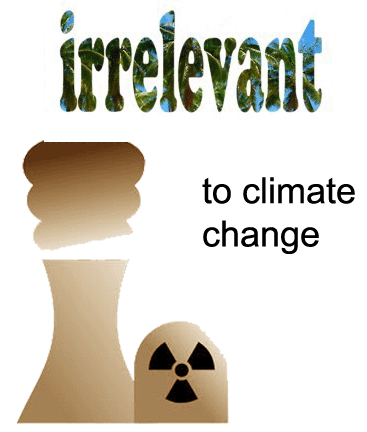 according to the International Energy Agency (IEA), the largest share of this [needed greenhouse gas] reduction – almost 40 percent – could come from improved energy efficiency….One third of that could be covered by renewable energies, while in this scenario, nuclear power would account for five percent.
..Indeed, in order to actually deliver on such a contribution, hundreds of new reactors would have to be built. “It would involve a gigantic  nuclear dimension just to make a minimal contribution to the climate,”
One of the questions that has received very little attention so far is how reliable nuclear power plants will be in a warmer world……This year, reactors were again disconnected from the grid in Europe as a result of heat waves.
|
Bill Gates is wrong. Nuclear power will not save the climate. Beyond Chernobyl and Fukushima, there’s too much speaking against it, German Times, By Christoph von Eichhorn October 2019 Nuclear power? No, thank you! “That chapter is over,” a spokesperson recently proclaimed. Nuclear power isn’t even a topic anymore, she argued. And this spokesperson wasn’t from some environmental organization or the like; she was representing RWE, one of three large corporations in Germany that still produces electricity from nuclear energy. The two other companies, EnBW and Eon, have issued similar sentiments, pointing to the fact that their priority is now the decommissioning of nuclear power plants and the switch to renewable energies…….One of the most prominent advocates of a nuclear renaissance is Bill Gates. ….
In the United States, the question of what to do with nuclear energy is particularly acute. Nuclear fission currently accounts for roughly 11 percent of global electricity, and for around 20 percent in the United States. As the Union of Concerned Scientists (UCS) points out in a recent study, one in every three of the approximately 60 nuclear power plants in the US might have to be shut down in the next few years because they are either too old or are already losing money today…… The decline in the price of renewables is seen as one of the major reasons why nuclear energy is less and less viable. Some states in the US, including Illinois, New Jersey and New York, have nonetheless subsidized unprofitable nuclear power plants in order to secure their operations. This is by all means a daring investment. The UCS estimates that it takes an average of $4 billion to make an unprofitable power plant profitable again. Equipping nuclear reactors to continue running only 20 years longer than planned usually requires expensive modernization measures designed to keep the aging technology in good condition, says Frank Peter, co-head of the think tank Agora Energiewende. “These investments often make no economic sense.” UCS researchers advise against the construction of any new power plants due to the high investment costs. “The fundamental problem is the cost,” says a recent report by the Massachusetts Institute of Technology on the future of nuclear energy. While technologies such as photovoltaics and wind power have consistently become cheaper, new nuclear power plants have become more expensive. The MIT researchers calculated the costs of nuclear energy for several regions and came up with very clear results: In terms of the cost of generating energy, wind and photovoltaics always beat nuclear power. In order to make nuclear competitive again, there would have to be massive changes in the way the technology is developed and managed. To this end, the MIT experts suggest producing components on an assembly line and testing innovative new reactor prototypes in huge “reactor parks” as quickly as possible. They even mention the idea of simplifying regulations for nuclear power plants. In the face of disasters such as those in Chernobyl and Fukushima, it is unlikely that the regimen of having lower safety standards and test sites for non-mature reactors will be able to be enforced in many countries. Even the standardization of reactors has not yet brought the savings many had hoped for. For example, European Pressurized Water Reactors are currently being built in Finland, France and the UK, and in all three cases, the costs and construction time have long since moved beyond the original scope. Construction on the third unit of the nuclear power plant in the Finnish city of Olkiluoto has already taken 10 years longer than planned. According to calculations by Greenpeace, the British plant Hinkley Point C is set to cost €108 billion in subsidies over a period of 35 years. There is one question above all that dominates the discussion, and it revolves around whether or not nuclear energy can even contribute to reducing greenhouse gas emissions. This issue has been investigated by the International Energy Agency, among others. In order to limit global warming to two degrees higher than pre-industrial levels by 2100, world emissions would have to drop from 37 billion tons today to less than five billion tons by 2050. And, according to the International Energy Agency (IEA), the largest share of this reduction – almost 40 percent – could come from improved energy efficiency. One third of that could be covered by renewable energies, while in this scenario, nuclear power would account for five percent. That would involve a reduction of more than one billion tons a year, but it would still not be enough to fundamentally shift the direction in climate policy. Indeed, in order to actually deliver on such a contribution, hundreds of new reactors would have to be built. “It would involve a gigantic nuclear dimension just to make a minimal contribution to the climate,” says Manfred Fischedick, energy expert at the Wuppertal Institute for Climate, Environment and Energy. One of the questions that has received very little attention so far is how reliable nuclear power plants will be in a warmer world. In the drought-plagued summer of 2018, several reactors in Germany and France had to be shut down because the surrounding rivers had overheated. Plant operators were no longer allowed to feed in cooling water so as not to endanger the already stressed ecosystems. This year, reactors were again disconnected from the grid in Europe as a result of heat waves. All we can do now is hope for new reactors, such as the traveling wave reactor sponsored by Bill Gates. Similar to the very slow burn of a glowing cigar, this type of reactor would produce its own fuel and consume it for decades. As it would use old fuel rods from light-water reactors and depleted uranium, this reactor type would be able to eliminate high-level nuclear waste, for which there are still no good solutions – even seven decades after the beginning of the nuclear age. If this concept were to actually work, it would certainly be a blessing. But we would be well-advised not to actually rely on this approach in our efforts to stop global warming. The concept for this type of reactor dates back to the 1950s, and the basic foundations have yet to be fully researched. For example, nuclear engineers would have to deal with enormous amounts of material that is generated in reactions involving temperatures exceeding 500 degrees Celsius. TerraPower is aiming for a prototype by the mid-2020s, and it would most likely take another 10 years to achieve a reactor that actually produces electricity. This is a very important timeframe – one in which we will have to have already shifted gears and set a course for a climate-neutral energy supply. Christoph von Eichhorn |
|
No comments yet.
1 This month
7 April – WEBINAR – Australia and the Doomsday Clock – Preventing nuclear war through NoFirstUse and other policies
Online | Tuesday April 7, 4:00-5:30pm, Australian Eastern Time / 8:00-9:30am Central Europe Time
– Access the registration link
15 April – Zoom –Nuclear Power is Not the Solution
Apr 15, 2026 01:00 AM in Canberra, Melbourne, Sydney

Join the International Physicians for the Prevention of Nuclear War (IPPNW) on Tuesday, April 14th for a timely webinar exploring the risks associated with nuclear power and challenging the myth that it offers a simple, safe, carbon-free solution to the climate crisis

of the week – Australians for War Powers Reform (AWPR)
To see nuclear-related stories in greater depth and intensity
 Antinuclear
Leave a comment