It would be wise to cancel the plan for dumping Lucas Heights’ nuclear waste in South Australia
 Paul Waldon Fight To Stop A Nuclear Waste Dump In South Australia, 16 Jan 2020
Both dichotomies do agree that radioactive waste as Harry D. puts it “needs to be placed in a managed facility that offers the best centralized logistical location,” and that location is ANSTO, Lucas Heights.
Look at a map and you will see Lucas Heights maybe the most central location amounting to the least average travel distance of such waste per volume and it has security, it also has waste on site as long as the reactor keeps pumping out waste and it’s only half full.
Logistically it would have save the taxpayers $55mil over recent years with the cancellation of the program to shift such waste, but that 55 mil may have been just but the tip of the iceberg of what it has cost communities across South Australia. https://www.facebook.com/groups/941313402573199/
Much of Australia might simply become too hot and dry for human habitation
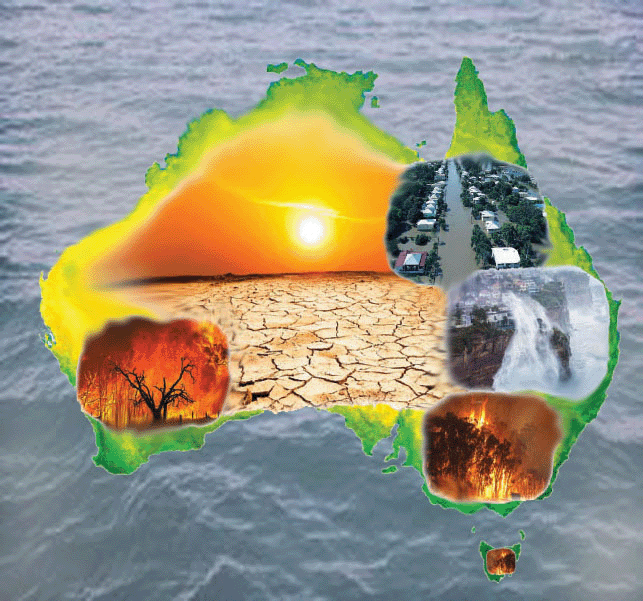 Australians ‘may become climate refugees’ as global temperatures soar: US expert, https://www.sbs.com.au/news/australians-may-become-climate-refugees-as-global-temperatures-soar-us-expert Australians ‘may become climate refugees’ as global temperatures soar: US expert, https://www.sbs.com.au/news/australians-may-become-climate-refugees-as-global-temperatures-soar-us-expertA visiting US climatologist says it’s “conceivable that much of Australia simply becomes too hot and dry for human habitation”. As global temperatures soar, Australia could become so hot and dry that the country’s residents could become climate refugees, US climatologist and geophysicist Michael Mann says. Australia is in the midst of one of its worst fire seasons on record, with bushfires burning since September and claiming nearly 30 lives, killing more than a billion animals and razing forests and farmland the size of Bulgaria. Some fires were so monstrous that they created their own weather pattern causing dry lightning and fire tornadoes as a three-year drought left woods tinder-dry. “It is conceivable that much of Australia simply becomes too hot and dry for human habitation,” Dr Mann, who is director of the Earth System Science Center at Pennsylvania State University, told Reuters. “In that case, yes, unfortunately, we could well see Australians join the ranks of the world’s climate refugees.” Climate refugees, or environmental migrants, are people forced to abandon their homes due to change in climate patterns or extreme weather events. Dr Mann, the recipient of last year’s Tyler Prize for Environmental Achievement, is on a sabbatical in Australia where he is studying climate change. The co-founder of the award-winning science website RealClimate.org said the brown skies over Sydney in recent days were a result of human-caused climate change led by record heat and unprecedented drought. The remarks resonate with his peers who published a review of 57 scientific papers suggesting clear links. Climate change has led to an increase in the frequency and severity of what scientists call “fire weather” – periods with a high fire risk due to some combination of higher temperatures, low humidity, low rainfall and strong winds, the review found. Prime Minister Scott Morrison has repeatedly said his government would “meet and beat” a 26 per cent global emissions reduction target agreed in Paris, albeit with a caveat that such goals should not come at the cost of jobs and the economy. Dr Mann, the author of four books including The Madhouse Effect, said Australia could still “easily achieve” the target by shifting towards renewable energy. “It’s possible to grow the economy, create jobs, and preserve the environment at the same time. These are things that all Australians could embrace,” he said. “They just need a government that’s willing to act on their behalf rather than on behalf of a handful of coal barons.”
|
|
The prosecution of Julian Assange – a travesty of justice
|
The international witch-hunt of Julian Assange, World Socialist Website, Eric London and Thomas Scripps, 14 January 2020 The prosecution of WikiLeaks founder Julian Assange at London’s Westminster Magistrates Court is a travesty of justice that will forever stain the governments of the United States, the United Kingdom, Australia, Sweden and Ecuador, as well as all the individuals involved.Appearing alongside Assange in court Monday morning, Assange’s attorneys revealed that they had been given only two hours to meet with their client at Belmarsh prison to review what lawyer Gareth Peirce called “volumes” worth of evidence.
Expressing the practiced cynicism of British class justice, District Judge Vanessa Baraitser said this was “not an unreasonable position,” citing a lack of space in the prison interview room. With the bang of her gavel, Baraitser sent Assange back to his dungeon at Belmarsh, where he awaits his February extradition hearing under conditions UN Rapporteur Nils Meltzer has called “torture.” At this stage in the near decade-long international witch-hunt of Assange, nobody should be surprised by such shameless lawlessness on the part of the world’s most powerful governments. Ever since Swedish, British and American prosecutors conspired in 2010 to issue a warrant for Assange’s arrest in connection with an investigation into bogus sexual misconduct allegations, these “advanced democracies” have trampled on their own laws and traditions, subjecting the journalist to a pseudo-legal process that would have been deemed unfair even by the standards of the Middle Ages. Monday’s mockery of justice is an escalation of the attack on Assange’s right to counsel. It takes place after the Spanish newspaper El País published a detailed account of how a security firm, UC Global, secretly spied on Assange’s privileged discussions with his lawyers and fed the illegally obtained surveillance to the CIA. UC Global also shared footage from cameras it installed throughout the Ecuadorian Embassy in London, where Assange was forced to seek refuge from 2012 to 2019 to avoid US extradition. El País’ reporting showed that UC Global recorded every word Assange spoke and live-streamed these conversations to the CIA. o 2019 to avoid US extradition. El País’ reporting showed that UC Global recorded every word Assange spoke and live-streamed these conversations to the CIA. Despite the support of a criminally compliant media, it is becoming increasingly difficult for the US and British governments to downplay the profoundly anti-democratic precedents they intend to set through the Assange prosecution. In an opinion article published Monday in the Hill, titled “Will alleged CIA misbehavior set Julian Assange free?” American attorney James Goodale wrote a scathing attack on the CIA’s spying on Assange’s privileged attorney-client communications. Goodale is among the most prominent and well respected attorneys in the US, best known for representing the New York Times when the newspaper was sued by the Nixon administration for publishing the Pentagon Papers in 1971. The Pentagon Papers were leaked by RAND Corporation analyst Daniel Ellsberg, who has also called for the release of Assange and whistleblower Chelsea Manning. The Pentagon Papers revealed how the US government for years lied to the public in expanding the Vietnam War, which led to the deaths of 55,000 US soldiers and 3 million Vietnamese people. Their publication triggered an explosion of public anger and fueled anti-war protests. Goodale wrote: “Can anything be more offensive to a ‘sense of justice’ than an unlimited surveillance, particularly of lawyer-client conversations, livestreamed to the opposing party in a criminal case? The alleged streaming unmasked the strategy of Assange’s lawyers, giving the government an advantage that is impossible to remove. Short of dismissing Assange’s indictment with prejudice, the government will always have an advantage that can never be matched by the defense.” Goodale explained that “the Daniel Ellsberg case may be instructive.” Ellsberg, like Assange, was prosecuted under the Espionage Act for leaking documents to the Times and the Washington Post. During the trial, Nixon’s “plumbers” broke into the office of Ellsberg’s psychiatrist and wiretapped his phone. In that case, Judge William Matthew Byrne ruled that the surveillance had “incurably infected the prosecution” and dismissed the charges, setting Ellsberg free. Goodale wrote that “for similar reasons, the case against Assange should be dismissed.”……https://www.wsws.org/en/articles/2020/01/14/pers-j14.html |
|
|
Environmentalists must stress issues of employment in renewables, and the need for energy conservation
Dennis Matthews, 16 Jan 2020, How should environmentalists deal with the results of the ongoing extremely destructive wildfires? Some points that may help them to decide:
First, in my opinion, the last Federal election was not won but was lost by the ALP and the Australian Greens, because they failed to counter the Morrison  message that stopping coal mining would cost jobs. It would have been so easy to point out that investing in the alternatives to coal would generate jobs.
Second, there has been no attempt to counter environmentally and socially destructive economic growth. The “growth is obviously good” ideology is supported by the two major parties and is not seriously challenged by the Greens.
Third, evidence for human global climate change has been gathering speed for 4 decades. The effects have such momentum that as well as needing a drastic reduction in emissions we now also need urgent action on ways to deal with the effects of more destructive weather. Australians are in the top per capita emitters in the world, if we don’t show leadership then we are in no position to criticise others – the most common target for criticism is China which has about half the per capita emissions of Australia.
 Fourth, in all the discussions and suggestions about the supply and use of energy there is negligible content about using less energy. The debate is almost 100% about increasing energy supply and almost nothing about reducing energy demand. The main reason for this imbalance appears to be that increasing supply is equated with economic growth whilst decreasing the energy demand is equated with the opposite.
Australia’s fire-driven storms are pumping smoke into the stratosphere
Blazes across the country in the past few weeks have been so intense they have generated their own weather. They create rising air mixed with ash and smoke that results in thunderstorm clouds above the fires called pyrocumulonimbus (pyroCbs).
Some of these are strong enough and rise high enough to have channelled smoke into the stratosphere, a plume of which has crossed the Atlantic Ocean in an eastward direction. NASA says this plume has now made a full circuit around the Earth. There were at least 20 pyroCbs between 28 and 31 December, and more on 4 January, some of which injected smoke into the stratosphere.
The scale of the smoke in the stratosphere has now been calculated by David Peterson at the US Naval Research Laboratory, who is presenting his preliminary findings to the American Meteorological Society at a meeting in Boston later today.
“It’s very likely on a volcanic scale,” he says. “The big thing here is really the impact that this is having on the stratosphere.” Although not of the scale of the 1991 eruption of Mount Pinatubo, the largest in modern history, the effect is similar to a more moderate eruption, Peterson says.
In 2017, Peterson found that Canadian wildfires put as much smoke as a volcano into the stratosphere. He is now working to apply the same technique to the Australian fires and thunderstorms. “At this point I can tell you that this event is one of the largest, it’s very near the top. I can’t say for sure if it’s the biggest,” he says, in terms of the amount of smoke injected into the stratosphere.
While it is well known that a volcanic eruption can put enough aerosols into the atmosphere to have a cooling effect, the different chemistry of pyroCbs means the impacts of the fires on global temperatures aren’t yet entirely clear.
They may have a warming or cooling effect, and it isn’t known how long the smoke will persist at heights of between around 10 and 50 kilometres high, which is roughly where the stratosphere starts and finishes. Peterson says the biggest question is what role proyCbs are playing in the climate system. Some of the smoke plumes are also getting high enough to affect the ozone layer.
We may have answers to some of these unknowns soon though, thanks to NASA flying a plane earlier this year through the upper level of a pyroCb generated by US wildfires. “It wasn’t as massive as these Australia plumes but fortunately at an altitude the aircraft could get to it,” says Peterson. The resulting direct observations of the chemistry will, along with satellite measurements, help unlock the answers.
Alan Robock at Rutgers University in New Jersey says any potential cooling effect from the bushfire smoke is unlikely to be huge at a global level, but could cause cooling of several degrees Celsius at a local level. If the Australian pyroCbs produce twice as much smoke as those from Canada in 2017, “it still would not be a large or long-lasting impact on climate,” he says.
However, the smoke can persist in the stratosphere for half a year or longer, as at such heights it can be heated by the sun and lofted even further up, prolonging its lifetime.
“This is the same process we have modelled in our studies of the climatic consequences of nuclear war in which much more smoke from burning cities and industrial areas would be lofted into the stratosphere and last for years,” says Robock. As such, analysis of the smoke from the bushfires could help improve simulations of the impact of nuclear Armageddon.
Our knowledge of pyroCbs is at an early stage. These thunderstorms and the smoke they put into the stratosphere have only been detectable via satellite instruments since the early 2000s, and previously were thought to be the result of volcanic eruptions, until analysis traced them back to wildfires.
World Economic Forum focusses on climate change, Australia snubs the Forum
|
Australia snubs Davos session on Australian fires https://www.politico.eu/article/australia-snubs-davos-session-australian-fires/
A new report, meanwhile, found that the Top 5 global risks are all climate-related. By RYAN HEATH 1/15/20 That marks “the first time in the survey’s history that one category has occupied all five of the top spots,” according to Børge Brende, the WEF’s president.
The WEF surveyed 1,047 members of its networks — 44 percent were from climate-conscious Europe — and asked them to rate 30 possible risks. The organization is so alarmed at governments and companies failing to heed its climate warnings that it decided to invite climate activist Greta Thunberg back to its stage next week, and has begun sharing her slap-downs of global leaders through its official channels. While the WEF survey was concluded October 22, before the worst of the Australian fire season, those fires have brought the three biggest overall risks identified by the WEF to the world’s attention: extreme weather, climate policy failure and biodiversity loss. The fires have decimated an area twice the size of Belgium and killed millions of animals, putting Australia in the Davos firing line next week. There’s only one problem: Canberra isn’t playing ball. The WEF session on the Australian fires doesn’t include any Australian speakers.
|
|
|

Nuclear power in terminal decline – cannot tackle climate change
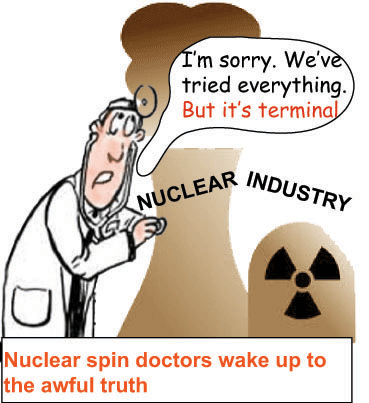 Nuclear Power ‘Cannot Rival Renewable Energy’, https://www.ecowatch.com/nuclear-power-cannot-rival-renewable-energy-2644813982.html?rebelltitem=4#rebelltitem4 By Paul Brown, 15 Jan 2020,
Nuclear power is in terminal decline worldwide and will never make a serious contribution to tackling climate change, a group of energy experts argues.
Meeting recently in London at Chatham House, the UK’s Royal Institution of International Affairs, they agreed that despite continued enthusiasm from the industry, and from some politicians, the number of nuclear power stations under construction worldwide would not be enough to replace those closing down.
The industry was disappearing, they concluded, while the wind and solar sectors were powering ahead.
The group met to discuss the updated World Nuclear Industry Status Report 2019, which concluded that money spent on building and running nuclear power stations was diverting cash away from much better ways of tackling climate change.
Money used to improve energy efficiency saved four times as much carbon as that spent on nuclear power; wind saved three times as much, and solar double.
Amory Lovins, co-founder of the Rocky Mountain Institute, told the meeting: “The fact is that nuclear power is in slow motion commercial collapse around the world. The idea that a new generation of small modular reactors would be built to replace them is not going to happen; it is just a distraction away from a climate solution.”
On nuclear and climate change, the status report says that new nuclear plants take from five to 17 years longer to build than utility-scale solar or on-shore wind power.
“Stabilising the climate is urgent, nuclear power is slow. It meets no technical or operational need that these low-carbon competitors cannot meet better, cheaper, and faster,” the report says.
There was considerable concern at the meeting about the possible danger to nuclear plants caused by climate change. Mycle Schneider, the report’s lead author, said the reason why reactors were built near or on coasts or close to large rivers or estuaries was because they needed large quantities of water to operate. This made them very vulnerable to both sea and coastal flooding, and particularly to future sea level rise.
He was also concerned about the integrity of spent fuel storage ponds that needed a constant electricity supply to prevent the fuel overheating. For example, large wildfires posed a risk to electricity supplies to nuclear plants that were often in isolated locations.
Cost Pressure
Loss of coolant because of power cuts could also be a serious risk as climate change worsened over the 60-year planned lifetime of a reactor. However, he did not believe that even the reactors currently under construction would ever be operated for that long for commercial reasons.
“The fact is that the electricity from new reactors is going to be at least three times more expensive than that from renewables and this will alarm consumers. Governments will be under pressure to prevent consumers’ bills being far higher than they need to be.
“I cannot see even the newest reactors lasting more than a decade or so in a competitive market at the prices they will have to charge. Nuclear power will become a stranded asset,” Schneider said.
Allan Jones, chairman of the International Energy Advisory Council, said one of the myths peddled was that nuclear was needed for “baseload” power because renewables were available only intermittently.
Since a number of countries now produced more than 50% of their power from renewables, and others even 100% (or very close) while not experiencing power cuts, this showed the claim was untrue.
In his opinion, having large inflexible nuclear stations that could not be switched off was a serious handicap in a modern grid system where renewables could at times produce all the energy needed at much lower cost.
Amory Lovins said the UK’s approach appeared to be dominated by “nuclear ideology.” It was driven by settled policy and beliefs, and facts had no connection to reality. “Nuclear is a waste of time and money in the climate fight,” he concluded.
New review confirms that climate change increases the risk of wildfires
|
Climate change increases the risk of wildfires confirms new review https://www.sciencedaily.com/releases/2020/01/200114074046.htm, January 14, 2020, Source: University of East Anglia
|
|
|
Australia will not hit its 2020 emissions reduction target till 2030 — RenewEconomy

Analysis shows Australia won’t achieve its 2020 target to reduce greenhouse emissions by 5 per cent until 2030. The post Australia will not hit its 2020 emissions reduction target till 2030 appeared first on RenewEconomy.
via Australia will not hit its 2020 emissions reduction target till 2030 — RenewEconomy
James Murdoch slams family’s media empire for serving as platform for climate denial — RenewEconomy

Younger Murdoch calls out climate denial spread by his family’s media interests in Australia, the US and UK. The post James Murdoch slams family’s media empire for serving as platform for climate denial appeared first on RenewEconomy.
via James Murdoch slams family’s media empire for serving as platform for climate denial — RenewEconomy
Science minister says climate denial waste of time, but emissions targets won’t change — RenewEconomy

Science minister Karen Andrews says climate science is settled and it’s time to “move on” and do things – but that doesn’t include tighter emissions targets. The post Science minister says climate denial waste of time, but emissions targets won’t change appeared first on RenewEconomy.
South Australia’s biggest wind solar hybrid project gets financial green light — RenewEconomy

320MW hybrid wind and solar project near Port Augusta in South Australia will begin construction in June after its new owner Iberdrola gives final approval. The post South Australia’s biggest wind solar hybrid project gets financial green light appeared first on RenewEconomy.
via South Australia’s biggest wind solar hybrid project gets financial green light — RenewEconomy
January 15 Energy News — geoharvey

Opinion: ¶ “Oppenheimer: Tesla Is An ‘Existential Threat’ To Automakers” • On CNBC’s Power Lunch, Oppenheimer analyst Colin Rusch explained that Tesla has proven to be an existential threat for automakers. The idea that Tesla is an existential threat to other automakers just seems accurate. It is what CleanTechnica has been publishing for many years. […]
The world is planning next step for renewables, while Australia looks backwards — RenewEconomy

It is an avoidable tragedy that the only presence Australia had at the world congress on renewables was as a harbinger of the planet’s worst case scenarios. The post The world is planning next step for renewables, while Australia looks backwards appeared first on RenewEconomy.
via The world is planning next step for renewables, while Australia looks backwards — RenewEconomy
Investors slam hard-line stance by rule-maker that could stop wind and solar projects — RenewEconomy

Group of 25 wind and solar investors slam AEMC for its position on marginal loss factors, saying it has produced no detailed modelling and its decision could halt new projects. The post Investors slam hard-line stance by rule-maker that could stop wind and solar projects appeared first on RenewEconomy.
via Investors slam hard-line stance by rule-maker that could stop wind and solar projects — RenewEconomy
1 This month
Chernobyl: The Lost Tapes – A good documentary on Chernobyl on SBS available On Demand for the next 3 weeks– https://www.sbs.com.au/ondemand/tv-program/chernobyl-the-lost-tapes/2352741955560
15 April – Zoom –Nuclear Power is Not the Solution
Apr 15, 2026 01:00 AM in Canberra, Melbourne, Sydney

Join the International Physicians for the Prevention of Nuclear War (IPPNW) on Tuesday, April 14th for a timely webinar exploring the risks associated with nuclear power and challenging the myth that it offers a simple, safe, carbon-free solution to the climate crisis

21 April Webinar: No Nuclear Weapons in Australia
Start: 2026-04-21 18:00:00 UTC Canberra, Melbourne, Sydney (GMT+10:00)
End: 2026-04-21 19:30:00 UTC Canberra, Melbourne, Sydney (GMT+10:00)
Event Type: Virtual
A virtual link will be communicated before the event.
Host Contact Info: australia@icanw.org

of the week – Australians for War Powers Reform (AWPR)
To see nuclear-related stories in greater depth and intensity
 Antinuclear