Kerri-Ann Garlick – Lucas Heights is the correct place for Australia’s nuclear waste. The Kimba dump plan is unfair, undemocratic and dangerous.
 Kerri-Ann Garlick Submission 99 to Senate Committee on National Radioactive Waste Management Amendment (Site Specification, Community Fund and Other Measures) Bill 2020 [Provisions]
The National Radioactive Waste Management Amendment Bill amends the National Radioactive Waste Management Act to specify a site near Kimba in South Australia for a nuclear waste ‘facility’ ‒ a repository for low-level waste and an above-ground ‘interim’ store for long-lived intermediate level waste.
I have deep concerns about the federal government’s proposed changes to the National Radioactive Waste Management Act. They are unfair, undemocratic and dangerous.
The government has no valid case on safety or security grounds and not made a clear case about the need for the planned national nuclear waste facility at Kimba.
The necessary infrastructure, resources and expertise for nuclear operations and waste management are all located at Lucas Heights and transferring the waste component of the system to a remote location at Kimba is a recipe for disaster in the medium and long term – up to 10,000 years from now, in the case of intermediate waste.
The whole process has been restricted and inadequate. The traditional owners of the land were disrespected and excluded from the purportedly public and democratic approval process. All citizens of Australia have a stake in the successful resolution of our national nuclear waste problems yet we were not consulted either.
The Bill is deeply flawed and should be rejected.
In particular, I am concerned that the planned changes:
- restrict or remove options for judicial review of the government’s site selection under
current laws, - unreasonably reduce the rights and options of the Barngarla Traditional Owners and other
directly impacted parties and have not been made with proper consultation, - exempt key environmental and cultural heritage protection laws from being usedfail to make any clear or compelling radiological or public health case for doubling handling the long-lived intermediate level waste (ILW) at significant public expense
- do not provide any certainty about the long-term management of Australia’s radioactive
waste, - are not consistent with international best practice in relation to siting, community
consultation or procedural fairness around radioactive waste, - do not recognise or respect long standing South Australian legislation prohibiting any federal
radioactive waste facility.Against the current context of uncertainty and disruption due to the impact of Covid 19 the further
uncertainty and contest generated by the federal government’s approach to radioactive waste is not
helpful or justified.
Western Australian uranium projects floundering, as Cameco’s Kintyre environmental approval lapses
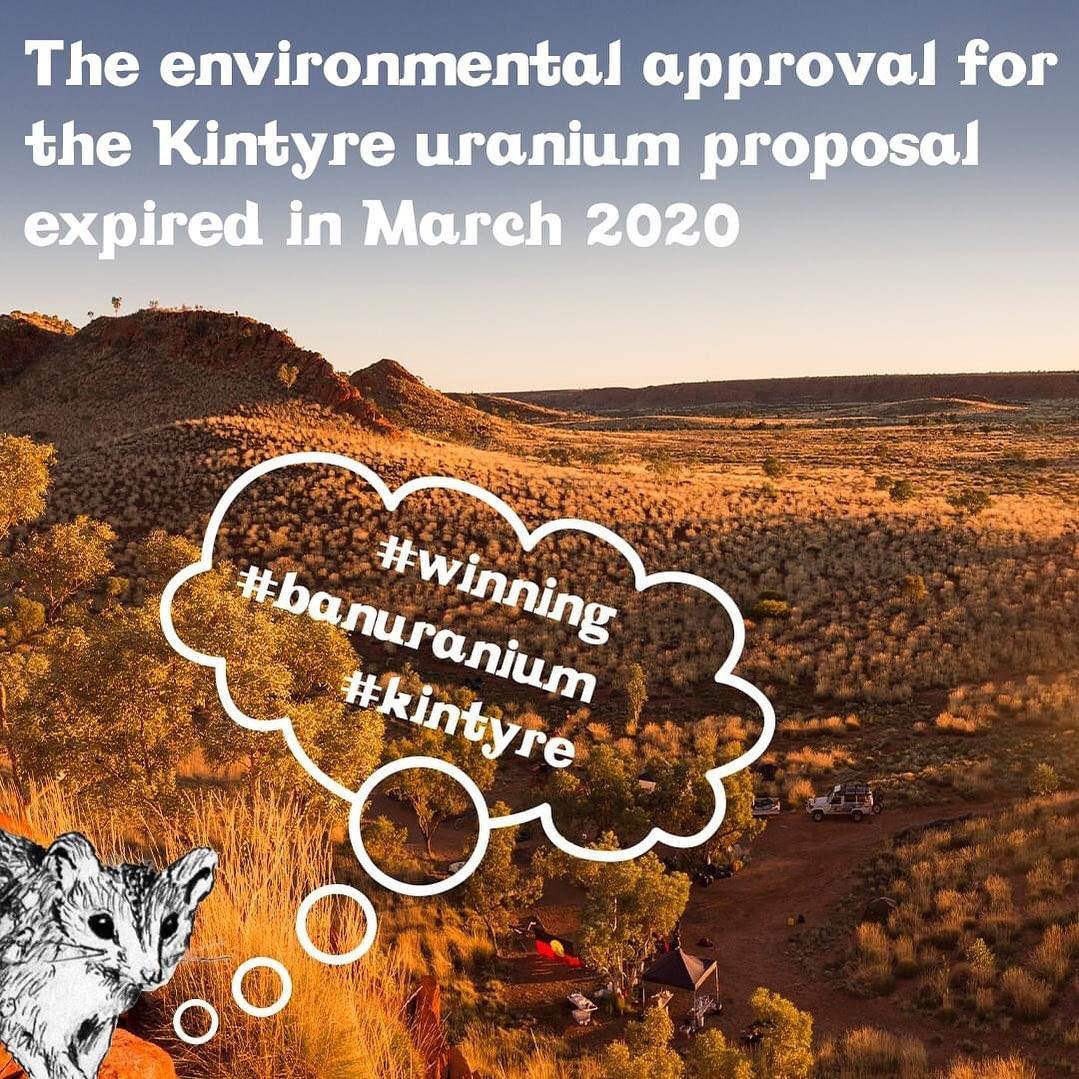 K-A Garlick at Nuclear Free WA, 6 May 20 The environmental approval for the Kintyre uranium project expired in March this year. So there is no valid environmental approval for Cameco. There can be no mining without changing or getting new environmental approval. This is great news for the campaign and shows the uncertainty of the uranium industry and Cameo who had applied for an extension but latter withdraw their application. It is great for the Martu community who have held strong and resisted over these many years. Let’s hope their beautiful country will one day be given back!
Keeping a track on all four projects and the process of asking questions on notice through State Parliament, we have found that Toro Energy, have failed to submit their annual environment reports on the Wiluna uranium project. This matter is now being pursued by the Department of Mines, Industry Regulation and Safety to ensure the report and plans are provided and any appropriate compliance action is taken.
Further good news, Yeelirrie is getting some really good attention with some upcoming media from the Freedom of Information process that has been investigated through the Australian Conservation Foundation that found an alarming lack of transparency in the Federal approvals process. The documents show that Cameco lobbied the former Federal resource Minister, Matt Canavan to fast track the approvals process and to change the conditions. If you haven’t seen the presentation from ACF, please click here.
We are excited organising a series of webinar nuclear talks that will focus on local, national and international impacts of Australian uranium industry. We will announce next week further details, but lock in Wednesday 10 June 5.30pm – 7 pm (tbc).
Time for an independent Inquiry into the true effects of a nuclear waste facility on an agricultural community
 Susan Craig shared a link. Fight To Stop A Nuclear Waste Dump In South Australia A representative from the Kimba and Hawker districts SHOULD APPLY FOR A GRANT TO FUND an independent inquiry into the true adverse effects of a nuclear waste facility facing the health of the community, denigration of reputation for the agricultural industry, detrimental effects of real estate in the region and the immediate and long term safety for the people of Eyre Peninsula and South Australia No Radioactive Waste Facility for Kimba District Food South Australia Flinders Local Action Group Flinders Food Co.https://www.stockjournal.com.au/story/6745828/funding-available-to-nuclear-affected-communities/?src=rss&utm_email=14353853cb
Radioactive Waste Management Taskforce pitching an old Community Benefit Program as something new
 Kazzi Jai Fight To Stop A Nuclear Waste Dump In South Australia, 7 May 20, What is old becomes new again it seems! This “new” Community Benefit Program is actually the “old” 2019 Community Benefit Program – which was announced by Matt Canavan on October 8th, 2019…. which just “conveniently” coincided with the posting out by Kimba Council of postal votes on October 3, 2019. (Hawker/Quorn ballot was held a month later due to a SWOT analysis being requested by Flinders Ranges Council as a stipulation to the ballot voting proceeding)>
This Community Benefit Funding is not an “extra” but was part of the agreement to remain in Phase 2 of the process in 2019 and was actually “owed” to both Communities (…as much as “bribe” money can be owed, but that is another story…)
Spin, spin, spin… https://www.facebook.com/groups/941313402573199/
Coronavirus shows that international co-operation is essential, as it is for climate action
 Coronavirus hasn’t killed globalisation – it proves why we need it The
  Conversation Sunil Venaik Associate Professor of International Business, The University of Queensland, May 6, 2020 “………………… One person practising social distancing during the pandemic might think their effect is negligible. But coronavirus is highly infectious: on one estimate, a single person with coronavirus could eventually infect 59,000 others.
Similarly, many countries seek to avoid responsibility for taking climate action by claiming their contribution to the global problem is small. The Australian government, for example, repeatedly points out it contributes just 1.3% to the world’s emissions total.
But on a per capita basis, Australia is one of the world’s highest emitters. And as a rich, developed nation, we must be seen to be taking action on cutting emissions if poorer nations are expected to follow suit. So actions Australia takes will have major global consequences.
Act quickly
In the two months it took the virus to spread from China and become a global pandemic, other nations could have readied themselves by amassing test kits, ventilators and personal protective equipment. But many nations did not adequately prepare.
Of course the world has had a far longer time to adapt to and mitigate climate change. The time lag between emissions and their consequences is years, even centuries. There has been ample opportunity to take progressive and thoughtful corrective action against climate change. Instead, the crisis has been met with complacency.
Challenges ahead
As others have noted, a major supplier of swabs used for coronavirus testing is based in Italy, and a German company is a primary supplier of chemicals needed for the tests. Many counties rely on foreign suppliers for ventilators, and an Indian firm – the world’s largest vaccine manufacturer – says once a COVID-19 vaccine is ready for mass production, it will supply large volumes to the world, at low cost.
It’s clear that international cooperation is critical for effective mass testing and treatment for the virus. Nations must work together to improve production and distribution, and resources must be shared.
So too is cooperation needed to deal with the worldwide economic downturn. The global recovery will be long and slow if nations adopt sovereign mindsets, putting up barriers to protect their own economies.
With the coronavirus as with climate change, working together is best way to secure humanity’s safety, health and well-being. https://theconversation.com/coronavirus-hasnt-killed-globalisation-it-proves-why-we-need-it-135077
More new data indicates another record hot year for 2020
 Global warming pushes April temperatures into record territory, as 2020 heads for disquieting milestone, WP, By Andrew Freedman, May 5 Last month tied for the warmest April on record for the globe, as 2020 hurtles toward the warmest year milestone.New data, released Tuesday from the European Union’s Copernicus Climate Change Service, lends further support to the prediction that 2020 will rank among the top two warmest years recorded.
In April, the National Oceanic and Atmospheric Administration, using its own temperature monitoring data, reported that there is a 75 percent chance that 2020 will become the planet’s warmest year since instrument records began in 1880, and very likely long before that.
Human-caused climate change from increasing amounts of planet-warming greenhouse gases is vaulting temperatures higher, making it easier for a given month or year to set a new warmth milestone. Carbon dioxide is the most important long-lived greenhouse gas in the atmosphere, released by the burning of fossil fuels such as coal and oil for energy and transportation.
Daily carbon dioxide levels measured at the summit of Mauna Loa in Hawaii have reached 418 parts per million this month, the highest level in at least 3 million years. It’s expected that the monthly average value for 2020 will be set this month, and will be near 417 ppm, compared with last year’s measurement of 414.7 ppm.
The new Copernicus data shows a huge area of crimson red for the month of April, denoting much-above-average temperatures, across northern Asia, especially Siberia.
Temperatures were also well above average for the month across northern and coastal central Greenland, parts of Antarctica, areas of Alaska and the Arctic Ocean……. https://www.washingtonpost.com/weather/2020/05/05/global-warming-pushes-april-temperatures-into-record-territory-2020-heads-disquieting-milestone/
Is Trump losing the opportunity to end America’s useless endless wars, as the military are affected by COVID 19?
 Trump Must Choose Between a Global Ceasefire and America’s Long Lost Wars
Like his predecessors from Truman to Obama, Trump has been caught in the trap of America’s blind, deluded militarism. Portside, May 5, 2020 Medea Benjamin and Nicolas J. S. Davies
As President Trump nears the end of his first term, he knows that at least some Americans hold him responsible for his broken promises to bring U.S. troops home and wind down Bush’s and Obama’s wars. Trump’s own day-in-day-out war-making has gone largely unreported by the subservient, tweet-baited U.S. corporate media, but Trump has dropped at least 69,000 bombs and missiles on Afghanistan, Iraq and Syria, more than either Bush or Obama did in their first terms, including in Bush’s invasions of Afghanistan and Iraq.
Undercover of highly publicized redeployments of small numbers of troops from a few isolated bases in Syria and Iraq, Trump has actually expanded U.S. bases and deployed at least 14,000 more U.S. troops to the greater Middle East, even after the U.S. bombing and artillery campaigns that destroyed Mosul in Iraq and Raqqa in Syria ended in 2017. Under the U.S. agreement with the Taliban, Trump has finally agreed to withdraw 4,400 troops from Afghanistan by July, still leaving at least 8,600 behind to conduct airstrikes, “kill or capture” raids and an even more isolated and beleaguered military occupation.
Now a compelling call by U.N. Secretary General Antonio Guterres for a global ceasefire during the Covid-19 pandemic has given Trump a chance to gracefully deescalate his unwinnable wars – if indeed he really wants to. Over 70 nations have expressed their support for the ceasefire. President Macron of France claimed on April 15th that he had persuaded Trump to join other world leaders supporting a U.N. Security Council resolution backing the Secretary General’s call. But within days it became clear that the U.S. was opposing the resolution, insisting that its own “counterterrorism” wars must go on, and that any resolution must condemn China as the source of the pandemic, a poison pill calculated to draw a swift Chinese veto.
So Trump has so far spurned this chance to make good on his promise to bring U.S. troops home, even as his lost wars and ill-defined global military occupation expose thousands of troops to the Covid-19 virus. The U.S. Navy has been plagued by the virus: as of mid-April 40 ships had confirmed cases, affecting 1,298 sailors. Training exercises, troop movements and travel have been canceled for U.S.-based troops and their families. The military reported 7,145 cases as of May 1, with more falling sick every day.
Trump to divert aid money for poor countries to bolster the nuclear industry
 Trump’s push to use global aid for nuclear projects alarms development groups, The Hill, BY REBECCA BEITSCH – 05/06/20 A new effort by the Trump administration to bolster the nuclear industry is eyeing a surprising source of financing — a fund designed to fight poverty in developing countries. Trump’s push to use global aid for nuclear projects alarms development groups, The Hill, BY REBECCA BEITSCH – 05/06/20 A new effort by the Trump administration to bolster the nuclear industry is eyeing a surprising source of financing — a fund designed to fight poverty in developing countries.
In a list of official recommendations to President Trump last month, the Nuclear Fuels Working Group argued the U.S. needs to sell nuclear power technology abroad and battle the influence of countries like China and Russia that have become dominant suppliers. One way to do that, the group said, is to lift restrictions at the U.S. International Development Finance Corporation (DFC) to let the agency fund nuclear projects alongside other development work. But development groups worry that tapping the DFC to greenlight nuclear projects will do more to promote American interests than alleviate poverty.
“I struggle to see it as something they should be doing,” Conor Savoy, executive director of the Modernizing Foreign Assistance Network. There’s also a concern that the projects won’t benefit the poorer countries the DFC is charged with helping. Setting up nuclear power systems requires a higher level of infrastructure, meaning overseas projects might be more likely to find a home in Eastern Europe than Sub-Saharan Africa. “The DFC was supposed to invest in those countries very sparingly,” Savoy said of wealthier nations.
To access DFC funds for an initiative of this kind, the agency would have to lift its prohibition on supporting nuclear projects, a move that only requires an internal policy change, without any congressional action. The agency has signaled a willingness to make that change. “DFC welcomes the recommendation in the administration’s Nuclear Fuel Working Group report to remove DFC’s prohibition on financing nuclear power projects in developing countries. Access to affordable and reliable power is essential for developing countries to advance their economies,” the agency said in a statement Monday…….
The DFC was started in 2019, replacing its predecessor — the Overseas Private Investment Corporation — with double the funding and fewer restrictions on how to spend it. But the $60 billion agency also has an expanded mission: elevating the world’s poorest countries while also advancing U.S. foreign policy. Development experts, however, say there’s been an imbalance between those two goals in the agency’s short history…….
There’s been a skewing toward more national security areas. They’ve tried to counter that by highlighting their more development-focused projects, but in terms of volume of commitments, in terms of sheer volume of money, it does seem to be skewing more toward national security priorities and less toward development,” Savoy said…….. https://thehill.com/policy/energy-environment/496295-trumps-push-to-use-global-aid-for-nuclear-projects-alarms
|
|
Technology leaps driving cost of solar PV electricity in Australia to just A$30/MWh — RenewEconomy
Technology leaps and improved efficiency are driving down the cost of solar PV electricity in Australia to $A30/MWh, below operating cost of most coal and gas. The post Technology leaps driving cost of solar PV electricity in Australia to just A$30/MWh appeared first on RenewEconomy.
via Technology leaps driving cost of solar PV electricity in Australia to just A$30/MWh — RenewEconomy
May 6 Energy News — geoharvey
Science and Technology: ¶ “Climate change and Covid-19: Five charts that explain the impacts” • No war, no recession, and no previous pandemic has had such a dramatic impact on emissions of CO₂ over the past century as Covid-19 has in a few short months. But we have to remember that atmospheric CO₂ will not […]
South Australia minister aiming for 100 per cent renewables before 2030 — RenewEconomy
South Australia minister says he has determined that the state reach its target of “net 100 per cent renewables” before 2030, rather than later. The post South Australia minister aiming for 100 per cent renewables before 2030 appeared first on RenewEconomy.
via South Australia minister aiming for 100 per cent renewables before 2030 — RenewEconomy
Canberra is a model for using climate action to drive economic recovery, minister says — RenewEconomy
ACT climate change minister says action on climate change is a win-win for economic development, and should be used to drive a post Covid-19 economic recovery. The post Canberra is a model for using climate action to drive economic recovery, minister says appeared first on RenewEconomy.
W.A. sees no new thermal generation being built, even with no state RET — RenewEconomy
Western Australia energy minister says the state has no need for a renewable energy target because “all future generation will be renewable,” thanks to low costs. The post W.A. sees no new thermal generation being built, even with no state RET appeared first on RenewEconomy.
via W.A. sees no new thermal generation being built, even with no state RET — RenewEconomy
Australia’s largest solar farm set for construction after Neoen wins deal with CleanCo — RenewEconomy
Neoen’s massive 400MW solar farm with 150MW battery storage in Queensland’s Western Downs to go ahead after signing PPA with state-owned renewables generator, CleanCo. The post Australia’s largest solar farm set for construction after Neoen wins deal with CleanCo appeared first on RenewEconomy.
Victoria research breakthrough promises safer, “better” batteries — RenewEconomy
Deakin-led research team says it has found the ingredients to create safer, more efficient, higher energy density batteries for use in households and industries. The post Victoria research breakthrough promises safer, “better” batteries appeared first on RenewEconomy.
via Victoria research breakthrough promises safer, “better” batteries — RenewEconomy
1 This month
Chernobyl: The Lost Tapes – A good documentary on Chernobyl on SBS available On Demand for the next 3 weeks– https://www.sbs.com.au/ondemand/tv-program/chernobyl-the-lost-tapes/2352741955560
15 April – Zoom –Nuclear Power is Not the Solution
Apr 15, 2026 01:00 AM in Canberra, Melbourne, Sydney

Join the International Physicians for the Prevention of Nuclear War (IPPNW) on Tuesday, April 14th for a timely webinar exploring the risks associated with nuclear power and challenging the myth that it offers a simple, safe, carbon-free solution to the climate crisis

21 April Webinar: No Nuclear Weapons in Australia
Start: 2026-04-21 18:00:00 UTC Canberra, Melbourne, Sydney (GMT+10:00)
End: 2026-04-21 19:30:00 UTC Canberra, Melbourne, Sydney (GMT+10:00)
Event Type: Virtual
A virtual link will be communicated before the event.
Host Contact Info: australia@icanw.org

of the week – Australians for War Powers Reform (AWPR)
To see nuclear-related stories in greater depth and intensity
 Antinuclear