No solution to submarine nuclear waste. Australia would be crazy to take on this mess.
Donna Gilmore, SanOnofreSafety.org 30 Sep 21,
There is no solution for the submarine nuclear waste. It’s a forever storage cost. I wonder who will pay for that?
In the U.S. the spent fuel is stored in Idaho in spent fuel pools or dry storage in unsafe thin-wall steel canisters with steel lined thick concrete casks. The concrete casks have air vents for convection cooling so the thin-wall canisters are the only real barrier. The thick concrete is need to reduce gamma rays and neutrons since the 316L stainless steel canisters are too thin to stop those.
There is no way to maintain those thin-wall canisters or detect or repair cracks before the canisters crack. No repair or inspection technology exists once loaded with fuel. If you hear otherwise, it’s a lie.
Each canister contains about one ton of spent nuclear fuel.The rest of the contaminated submarine is stored in trenches at Hanford, Washington.
Each transport cask (holding one canister) costs $20 million.
Europe and the rest of the world use maintainable thick-wall metal casks 10″ to over 19″ thick — with no air vents and no cracking problems.
In essence, there is no good short or long term solution to store the nuclear waste since geological repositories are not technically feasible even for the short-term.
The best the world has is maintable thick-wall bolted-lid metal casks stored in hardened buildings. They will last much longer than the thin-wall canisters, but are not considered a permanent solution.
Australia would be crazy to take this mess.
Norway paid to help Russian nuclear submarine waste clean-up – but now – new submarines!
Norway celebrates 25-years paying for nuclear-dump cleanup. Russia showcases new reactor weapons
Rosatom officials and Norwegian project partners are Wednesday marking that it is 25 years since the first money check was sent from Oslo to help improve infrastructure at the ill-fated Andreeva Bay dump site for spent nuclear fuel and radioactive waste accumulated from the operation of Cold War submarines. The Barents Observer ,By Thomas Nilsen September 29, 2021
Hindered from on-site meetings due to the pandemic, today’s 25-years anniversary meeting in Andreeva Bay is long overdue. However, the meeting comes in pole position as the two countries are trying to improve bilateral relations in times of more complex geopolitics and higher tensions between NATO and Russia up north.
……. ensuring nuclear safety is another topic for good bilateral cooperation.
For the Soviet nuclear navy, the Coastal Technical Base in Andreeva Bay became the main storage site for both spent fuel assemblies from submarine reactors, as well as a site to store containers with solid radioactive waste. Focus was not on safety and after years of exposure to Arctic climate, the site became contaminated and the infrastructure started to fall apart. With Russia being broke after the collapse of the Soviet Union, the call for international action was precarious. Norwegian money, and will to solve the problem, was most welcomed……………
Success story
More than 2 billion kroner (nearly €200 million) of Norwegian taxpayers money are spent on helping Russia secure its nuclear legacy since the mid-1990ties. The ground-breaking nuclear safety work initiated on the Kola Peninsula, only some 60 km from the border to Norway, has since been followed by many other countries and international financial grant programs.
For projects in Andreeva Bay, Norway has paid more than €30 million on things like fixing electricity, water pipelines, roads, fences, constructing a new sanitary building and improving the old pier in port with a new lifting crane. About half of the 21,000 spent uranium fuel elements originally stored in three rundown concrete tanks is so far lifted out, repacked and shipped out of Andreeva Bay. First to Atomflot in Murmansk, then by train further to Russia’s reprocessing plant at Mayak in the South Urals. Some 10,000 cubic meters of solid radioactive waste that previously was stored outdoor and exposed to snow and frost is now under roof in a new building erected at the site. Soon, also that will be transported away.
Present at the celebrations in Andreeva Bay is also representatives from the environmental NGO Bellona. It was this organization, with offices both in Murmansk and Oslo, that before the official country-to-country cooperation started, was first to uncover security breaches and the urgency to act before the entire storage site turned out to be a Chernobyl in slow-motion.
“Time has come”
Bellona’s Aleksandr Nikitin says to the Barents Observer that the time has come for Russia to solve its own nuclear challenges, not the international community. “But first we have to complete already started international projects, like the nuclear legacy,” Nikitin says and points to the ongoing work in Andreeva Bay………….
Meanwhile, and unlike the 1990ties, Russia is now investing huge money in building new nuclear-powered submarines and other military nuclear installations. A key question is whether Moscow now is arming the country again into a nuclear age that later could cause similar radiological waste challenges as the legacy from the last Cold War created.
…….. It is a task for Russia and Rosatom. We cannot hire anymore for a rich uncle from the west to come and help again. It was a time when it was necessary, not anymore.”
Meanwhile, Aleksandr Nikitin is glad to see the solution-oriented results of the work in Andreeva Bay.
“Bellona started it, and we have to finish it,” he says………………………………….
A Norwegian intelligence official has previously expressed fears for more accidents with the reactor-powered weapons systems now under testing and development in Norway’s neighboring areas up north.
For Norway, a challenge is to balance the aid-support to nuclear safety with making sure no funding ends up in Russia’s new crazy nuclear weapons programs…………..
The “Serebryanka” dilemma
A review made by the Barents Observer of the publicly available documents on financial aid from Norway and Sweden to equip modern communication and positioning systems on board “Serebryanka” shows that about 9 million kroner (€900,000) were spent on the project in 2013 and 2014. That was shortly before the Burevestnik testing program started.
The Swedish Radiation Safety Authority, in charge of the project, says in its annual overview of Non-Proliferation cooperation for 2013 that the “Serebryanka” was the largest project initiated in the Murmansk region.
Stockholm spent 4,1 million Swedish kroner (SEK) on equipment for “Serebryanka” in 2013 and an additional 217,000 SEK in 2014.
Describing the project, the Radiation Safety Authority writes: “This project is co-financed with Norway and the purpose is to equip the vessel “Serebryanka” with a physical protection system, as well as communications and positioning systems, in order to increase security when transporting nuclear materials and radioactive substances.”
The Norwegian share of the project was 3 million Norwegian kroner, paid as part of the Nuclear Action Plan financed by the Ministry of Foreign Affairs.
Conflict-of-interests
Asked about the potential conflicting interests, State Secretary Audun Halvorsen in Norway’s Foreign Ministry told the Barents Observer upfront of the annual meeting in the Norwegian-Russian Commission on Nuclear Safety this spring that “…. our bilateral cooperation on nuclear safety projects are related to civilian activities only, and questions regarding military activities are therefore considered outside of the scope of the commission by the Russian side.” https://thebarentsobserver.com/en/nuclear-safety/2021/09/while-norway-celebrates-25-years-paying-cleanup-nuclear-dumpsite-russia-gives
Nuclear power’s long decline in shadow of wind and solar

The World Nuclear Industry Status Report 2021 (WNISR) was released overnight. For nearly 30 years, these reports have provided important factual antidotes to industry promotion and obfuscation. This year’s report is the work of 13 interdisciplinary experts from across the world.
Naoto Kan, Japan’s Prime Minister at the time of the Fukushima disaster, writes in the foreword: “As Prime Minister of Japan at the time of the disaster, I now believe that the time has come for Japan and the world to end its reliance on nuclear power.”
In broad terms, nuclear power has been stagnant for 30 years. WNISR notes that the world’s fleet of 415
power reactors is 23 fewer than the 2002 peak of 438, but nuclear capacity and generation have marginally increased due to uprating and larger reactors being built.
There is one big difference with the situation 30 years ago: the reactor fleet was young then, now it is old. The ageing of the reactor fleet is a huge problem for the industry (as is the ageing of the nuclear workforce ‒the silver tsunami). The average age of the world’s reactor fleet continues to rise, and by mid-2021 reached 30.9 years. The mean age of the 23 reactors shut down between 2016 and 2020 was 42.6 years. The International Atomic Energy Agency anticipates the closure of around 10 reactors or 10 gigawatts (GW) per year over the next three decades.
Reactor construction starts need to match closures just for the industry to maintain its 30-year pattern of stagnation. But construction starts have averaged only 4.8 per year over the past five years, and
there’s no indication of looming growth. Nuclear power’s contribution to global electricity supply has fallen from a peak of 17.5 percent in 1996 to 10.1 percent in 2020 (a 4.3 percent share of global commercial primary energy consumption).
Renewables reached an estimated 29 percent share of global electricity generation in 2020, a record share. Non-hydro renewables(10.7 percent in 2020) overtook nuclear in 2019 and the gap grew in 2020.
Criminality
In addition to a vast amount of energy data, WNISR includes detailed analyses of the Fukushima and Chernobyl disasters; the vulnerabilities of nuclear power to the impacts of climate change (e.g. dwindling and warming water resources, storm impacts, sea-level rise, etc.); and a chapter on nuclear decommissioning.
WNISR details the slow and unsteady progress of small modular reactors. The report notes that “so-called advanced reactors of various designs, including so-called Small Modular Reactors (SMRs), make a lot of noise in the media but their promoters have provided little evidence for any implementation scheme before a decade at the very least.”
WNISR notes that previous reports have covered irregularities, fraud, counterfeiting, corruption, and other criminal activities in the nuclear sector. This year’s report dedicates a chapter to nuclear criminality and includes 14 case studies with serious implications (safety, public governance) that came to trial in the period 2010-2020.
The report states:
“A stunning number of revelations in recent years on irregularities, fraud, counterfeiting, bribery, corruption, sabotage, theft, and other criminal activities in the nuclear industry in various countries suggest that there is a systemic issue of “criminal energy” in the sector. …
“Although not comprehensive, this analysis offers several noteworthy insights:
* Criminal activities in the nuclear sector are not new. Some major scandals date back decades or have been ongoing for decades.
* Organized crime organizations have been supplying workers to nuclear sites — e.g. the Yakuza in Japan — for over a decade.
* Serious insider sabotage has hit major nuclear countries in recent years — like a Belgian nuclear power plant — without ever leading to arrests.
There is no systematic, comprehensive, public database on the issue.
* In 2019, the IAEA released a report on cases of counterfeit or fraudulent items in at least seven countries since at least the 1990s.
* In Transparency International’s 2020 Corruption Perceptions Index about half of the 35 countries operating or constructing nuclear power plants on their territory rate under 50 out of 100.
* In the Bribery Payers Index (BPI, last published in 2011), seven out of the ten worst rated
countries operate or are building nuclear power plants on their territory.”
Author: Dr. Jim Green is the national nuclear campaigner with Friends of the Earth Australia
Renew Economy 29th Sept 2021
No, a nuclear-powered superyacht won’t save the world
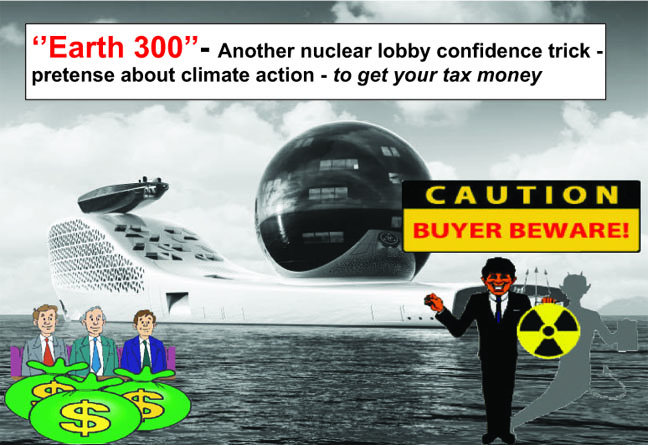
Earth to CNN: No, a nuclear-powered superyacht won’t save the world, https://thebulletin.org/2021/09/earth-to-cnn-no-a-nuclear-powered-superyacht-wont-save-the-world/ By Dawn Stover | September 28, 2021 Who knew that a sexy nuclear superyacht could save us from climate catastrophe? That was the awesome news from CNN’s travel desk yesterday.
CNN wasn’t alone. Forbes, BBC Science Focus Magazine, and a host of other media outlets have previously hailed the world-rescuing potential of what CNN described as “an emissions-free megaship that will pit together climate scientists and the wealthy in a daring quest to save the planet.”
“Pit together” sounds like an apt description of a would-be merger between luxury tourism and climate action. You can put those two things together in a sentence, but in the real world they mix about as easily as oil and water.
And there’s another big problem with the plan for this overhyped 300-meter-long vessel and its global research: Earth 300, as the $700 million superyacht is called, will be powered by a molten salt nuclear reactor that doesn’t exist yet and won’t be certified for at least five years. The company’s website illustrates the reactor with a scale model of an experiment done in the 1960s at Oak Ridge National Laboratory.
The website also says the scientists onboard Earth 300 will have the world’s first ocean-going quantum computer. But that, too, has yet to be built.
Meanwhile, the climate crisis needs immediate attention. “We really are out of time,” UN Secretary-General António Guterres warned this month.
While they wait for a modular nuclear reactor that might never come, the developers of Earth 300 say they will use green synthetic fuels. These are liquid fuels derived from coal or natural gas in a process that captures carbon. However, they are much more expensive than fossil fuels. Aaron Olivera, the entrepreneur behind Earth 300, told CNN he plans to “eventually” retrofit the yacht with a reactor being developed by the UK company Core Power in collaboration with TerraPower, a US nuclear engineering firm chaired by Bill Gates.
Globally, there are at least 171 motorized megayachts that are 75 meters (246 feet) or more in length. Jeff Bezos, the world’s richest man, is rumored to be buying a superyacht so big that it will have a dock for its own “support yacht.” Eclipse, an even bigger superyacht owned by Russian-Israeli billionaire businessman Roman Abramovich, has its own missile defense system. The largest yacht currently operating, Azzam, is 180 meters (590 feet) long and consumes 13 metric tons of fuel per hour at its top speed of 33 knots. That’s about 0.01 miles (or a little over 50 feet) per gallon.
And the customers Olivera would like to attract—the wealthiest people in the world—also tend to have the world’s largest carbon footprints, thanks in no small part to their habit of traveling aboard superyachts and private airplanes. According to calculations by two researchers at Indiana University, a superyacht with a permanent crew and helicopter pad is “by far the worst asset to own from an environmental standpoint.”
Earth 300’s luxury suites will each rent for $300,000 a day, which presumably will cover the personnel and expenses needed to operate the ship and its 22 scientific laboratories. But construction won’t begin until 2025 at the earliest, and any groundbreaking scientific discoveries or billionaire epiphanies that could help stabilize the climate are even further into the future.
Construction is already delayed on another 600-foot-long yacht that will combine climate research with charters for paying customers. Financed by Kjell Inge Røkke, a Norwegian billionaire who made his fortune in fishing and oil drilling, REV Ocean will investigate climate change and ocean acidification, plastic pollution, and overfishing, but the nonprofit project is at least three years behind schedule.
Who will be aboard these superyachts? CNN asked Olivera which famous people he’d like to host on his future ship, and he named Elon Musk, Michelle Obama, Greta Thunberg, Naomi Klein and Yvon Chouinard. Like the superyacht itself, some of those potential guests seem more aspirational than realistic.
Greta Thunberg doesn’t take airplanes or motor yachts. Elon Musk doesn’t take vacations. And Bill Gates may be hurt that he’s not on the A-list.
1 This month
15 April – Zoom –Nuclear Power is Not the Solution
Apr 15, 2026 01:00 AM in Canberra, Melbourne, Sydney

Join the International Physicians for the Prevention of Nuclear War (IPPNW) on Tuesday, April 14th for a timely webinar exploring the risks associated with nuclear power and challenging the myth that it offers a simple, safe, carbon-free solution to the climate crisis

21 April Webinar: No Nuclear Weapons in Australia
Start: 2026-04-21 18:00:00 UTC Canberra, Melbourne, Sydney (GMT+10:00)
End: 2026-04-21 19:30:00 UTC Canberra, Melbourne, Sydney (GMT+10:00)
Event Type: Virtual
A virtual link will be communicated before the event.
Host Contact Info: australia@icanw.org

of the week – Australians for War Powers Reform (AWPR)
To see nuclear-related stories in greater depth and intensity
 Antinuclear