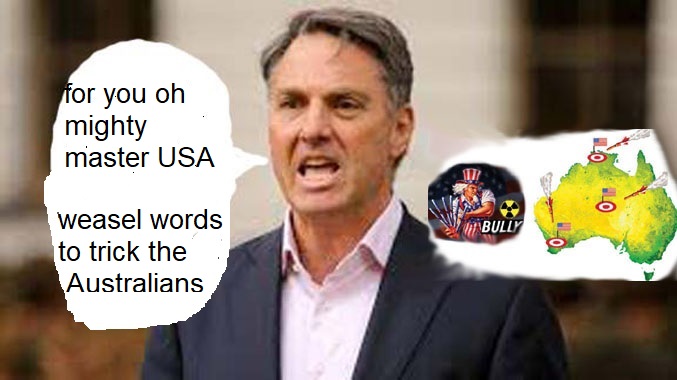
Australia’s Defence Minister Richard Marles is a master of “weasel words”
I’ve been underestimating this guy.
I thought that he was just just emotionally ignorant, just a bit stupid in that area of thought. Well, he probably is, anyway.
But Richard Marles is not stupid. He is very clever in that way that seemingly fair-minded , oh-so-reasonable people, can manage to put across militaristic, propagandist, right-wing views. He’s got a great new term for US military bases in Australia –“collaborative facilities“
I think that they’re a rising breed – these nice-looking, clean-cut, pleasantly spoken types like the USA’s Anthony Blinken, who go around persuading everybody that it’s a good idea to pay $squillions of tax-payers’ money to their friendly USA and UK weapons company, and to move towards the brink of war against China, Russia or whoever.

At times, I almost yearn for the straightforwardness of the publicly admitted extreme right – in Australia, we have the lovely Peter Dutton, Leader of the Liberal Opposition, and an out and proud spokesman for militarism. At least we know where we are with these types.

“Weasel words” are very valuable currency in the present day and age. Look at the value to the warmongers of White House National Security Council spokesman John Kirby . I mean some people have been anxious in learning that depleted uranium weapons are to be used by the Ukrainian troops. But Mr Kirby was able to reassure us – “The ammunition, which enhances ability to overcome defenses on tanks, ‘is not radioactive’ – a commonplace type of munition“
Alas the Labor Party of Gough Whitlam and Paul Keating is long gone.
The Albanese Labor government is all about strategy and cunning manipulation of policies. This is a style in which the weasel-word likes of Richard Marles thrives. I’d like to think that Albanese has some long-term goal of thwarting the militaristic control of Australia by the USA.
But for now, Labor has lost me.
Richard Marles’ ill-advised spending on completely inappropriate Tomahawk missiles for Australia’s existing submarines

Marles the drunken sailor: Rex Patrick on Defence Minister’s haste to defence spending waste
by Rex Patrick | Mar 22, 2023
News yesterday that our Collins Class submarines will get fitted with Tomahawks reveals a serious lack of understanding about the tactical use of land attack missiles on submarines. Exposing the blithe war enthusiasts of the Murdoch press, former submariner Rex Patrick explains why Tomahawks on a Collins is a dumb idea.
Richard Marles is behaving like a drunken sailor as he spends your money. Drunken sailors, most of whom are happy souls, buy things like several rounds for everyone in the bar, pink Hawaiian t-shirts for themselves and their families, or tattoos of the name of the girl they met the night before. Upon sobering up they realise that what they had purchased was a hole in their wallets.
And that’s what Mr Marles will discover in time. The Tomahawk missiles he’s purportedly buying for our Collins Class submarines, as reported in The Australian yesterday, are not a good match.
Let me explain why.
Submarines and Tomahawk Missiles
Just after noon on 19 January 1991, during operation “Desert Storm”, USS Louisville became the first submarine to launch a land attack missile in anger, when she fired eight missiles at targets in Iraq. She did this operating from the Red Sea. Shortly afterwards, USS Pittsburgh became the second submarine to launch Tomahawks when she fired four more missiles from the Mediterranean Sea.
Submarines have subsequently fired land attack missiles in a number of other operations.
USS Miami fired some into Iraq In 1998 at the start of “Desert Fox” (the 4 day bombing operation undertaken in response to Iraq’s failure to comply with UN Security Council resolutions). USS Albuquerque, USS Miami and HMS Splendid fired some into Kosovo a year later as part of “Allied Force” during the Balkan war. HMS Trafalgar and HMSTriumph fired them into Afghanistan. In 2001 as part of operation “Enduring Freedom,” and in 2003, 12 US Navy submarines and the Royal Navy submarines HMS Splendid and HMS Turbulent attacked land targets in Iraq as part of “Iraqi Freedom”.
Finally, in March 2011 guided missile submarines USS Florida, and nuclear attack submarines USS Providence, USS Scranton and HMS Triumph fired some into Libya as part of operation “Odyssey Dawn”.
The role of land attack from submarines is clearly established.
Why land-strikes from submarines?
A submarine’s endurance, autonomy and relative impunity to detection allow pre-strike positioning to occur several weeks or months prior to the commencement of hostilities. This can occur without the “presence” of a force that might otherwise negatively influence diplomatic efforts to resolve an issue. The submarine can also conduct intelligence, surveillance and reconnaissance until such time as the land strike capability is needed. The submarine can be discreetly withdrawn if offensive action is not required.
The submarine also allows a land strike capability to be deployed into an area of operation where there is a lack of sea or air control, with the aim of attacking enemy defences to make the area safer for other more vulnerable units to enter. This includes ships with larger missile magazines and aircraft who can return the next day to launch more missiles.
Finally, when the strike order is given, having an undetected submarine very close to shore provides an advantage when striking the most sensitive of military targets or executing the most time critical attacks. Launch surprise maximises targeting effectiveness and minimises the chance of the weapons being intercepted. Close-to-shore submarines can also reach targets that are further inland.
Collins submarines’ limitations
Almost all submarines fitted with Tomahawks have nuclear propulsion, The Spanish S-80 submarines are the exception.
That’s because conventional submarines have their limitations………………………………………………………………………………………
Defence of Australia or like a tattoo?
There’s hardly a case to argue that our Collins class submarine’s need land attack cruise missiles to help defend Australia.
They would only be acquired to assist in a conflict with China, where we’re acting as part of a coalition. But even then, the issues associated with conventional submarines armed with Tomahawks are highly challenging and make the choice highly questionable.
So is Richard Marles behaving like a drunken sailor? Yes. But with some difference. Mr Marles seems loose with the money, but can’t really bring himself to look back on his commitment to spend.
The cost and unnecessary suffering of military spending
By Brian Toohey, Mar 14, 2023, https://johnmenadue.com/briantoohey-on-cost-of-defence/
The authoritative Peterson Foundation calculates that last year the US spent more on its military than the next nine countries together. This means more than China, India, Russia, the UK, Saudi Arabia, Germany, France, Japan and South Korea combined. In 2023, the US allocated $US 858 billion to military spending compared to China’s $US224 billion. China’s spending is 1.7% of GDP compared to 2% for Australia and 3.5% for the US.
Military spending accounts for nearly half the discretionary spending in the US budget. The President could redirect over two thirds to deprived areas of the budget and still have the most powerful military forces in the world. Until something like this happens, many Americans will suffer unnecessarily and the country experience continuing internal turmoil. The US has been in far more wars that China.
The Costs of War project at Brown University revealed in 2021 that the US was involved in eight wars in the previous 20 years, costing it an estimated $8 trillion and killing more than 900,000 people. Earlier, Australia joined the US in losing a war of aggression in Vietnam that cost lives of 3 million people.
China has not been in a serious conflict since 1979 when it made a brutal incursion into Vietnam before withdrawing. The US and Australia didn’t object strongly because they supported China’s intention to punish Vietnam for overthrowing Pol Pot’s appalling regime in Cambodia.
Unlike the US and Australia, China has not been involved in a war of aggression since the Communist party came to power in 1949, except for of its takeover of Tibet in 1950. Tibet had been under the control of Chinese emperors from 1720 until the early 1900s. The anti-Communist Republic of China then claimed Tibet was part of China, without trying to enforce this. Otherwise, China has not tried to take over any country.
If China were an expansionist power, it would have already taken over bordering Mongolia, a defenceless, democratic state with abundant mineral deposits. Nor would it have made several important concessions to settle land border disputes.
China announced recently that its defence spending will increase by 7.2% in 2023 compared to 7.1 % in the previous year. This minor increase hardly suggests China is building up to attack Taiwan, let alone go to war with Australia which is committed to spending billions more on its military, supposedly to deter China. Contrary to the situation in the US, numerous underwater choke points bottle up China’s naval forces close to its shores.
However, China’s spending is now widely asserted to show it is about to engage in a campaign of aggressive expansion. Instead, it is reacting to the fact that it is surrounded by US military bases and those of its allies, as well being beset by constant military patrols along its borders. US has more than 700 overseas military bases, including many on Pacific Islands countries and on others such as Japan, South Korea, Australia, and the Philippines. China doesn’t have the capability to patrol off the American coastline which is over 15,000 km away as the crow flies. Nor does it have any bases close enough to operate from. China’s sole overseas base is at Djibouti on the Horn of Africa.
A recent three-part series in the Sydney Morning Herald and The Age claimed China would attack Australia within the next three years, well before any nuclear submarines are delivered well over $200 billion. The series said the government would have to reintroduce compulsory conscription and invite the US to base nuclear armed missiles on Australian territory. Anthony Albanese has not rejected these proposals.
The series made the bizarre claim that “recent decades of tranquillity were not the norm in human affairs, but an aberration.” The reality is that tranquillity did not exist for Australian military forces in Iraq and Afghanistan, nor for civilians caught up in these events.
As a result of US-led sanctions before the invasion of Iraq, UN agencies calculated that 500,000 Iraqi children had starved to death. When the then US ambassador to the UN, Madeleine Albright was asked on America’s 60 Minutes program if she thought that the death of half a million Iraqi children was a price worth paying, she said: “This is a very hard choice, but we think the price is worth it.” Most seem to have forgotten that governments killed these children.
In Australia, most also seem to have forgotten that the 2003 invasion of Iraq was based on shonky intelligence, easily exposed as such. Perversely, many Australia journalists, who now rely on anonymous intelligence reports, take it for granted the intelligence is accurate.
They also swallow propaganda claiming that China is “aggressive” and a “threat” to Australia and that Taiwan is independent country, which China now claims. Taiwan is not formally independent. Almost every country on earth, including Australia and the US recognise it as part of China. After the losing the Civil War, the leader of the Kuomintang (KMT) party Chiang Kai-shek, fled to Taiwan, where he not only claimed Taiwan was part of China, but insisted that it ruled the whole of China from its capital Taipei. To its great credit, Taiwan became a healthy democracy in 1996, but its Constitution still states it is part of China.
When he was China’s leader in Beijing in 1947, Chiang Kai-shek announced that country would control its territorial waters within a U-shaped “Eleven dash line”. The subsequent Communist government adopted a “Nine dash line”, while Taiwan has retained eleven. Given it already has de facto independence, the pragmatic position in Taiwan now seems to be that it’s not worth rocking the boat by declaring formal independence.
Australian military looks to build crucial space capabilities that will support Aukus nuclear subs
Don’t the military boys love these games? war in space and undersea.
Defence department puts out call for satellites that can talk to each other and to the ground, are ‘scalable, rapidly deployable and reconstitutable’
Tory Shepherd, Thu 23 Mar 2023
Defence is looking for a mesh of military space satellites that can talk to each other as well as to the ground, and is “scalable, rapidly deployable and reconstitutable”.
The system, in other words, would need to be able to be made bigger, to be quickly put into action and to be repaired in case of attack or accident.
The military network could include the ability to track high-velocity projectiles and the use of infrared, would need to be “resilient to cyber and electronic warfare attacks”, and would need to transmit and receive data from assets “at any global position”…………………..
The Aukus submarines have been dominating defence-related conversations recently, because of the enormous $368bn price tag and concerns that the first Australia-made nuclear submarine will not be ready until the 2040s.
Meanwhile, Guardian Australia has spoken to people in the space industry who feel the other parts of Aukus – the so-called “pillar two” – are being overlooked. Pillar two includes artificial intelligence, drones, cyber capabilities and other technologies, all of which use space-based assets and many of which are likely to be realities years before the submarines.
Satellites, and therefore space, are critical for surveillance, navigation, weapons guidance and communication already, and will become more so in the future.
Defence projects already under way include Def799 for space-based intelligence, surveillance and reconnaissance capabilities, and JP9102 for satellite communications systems.
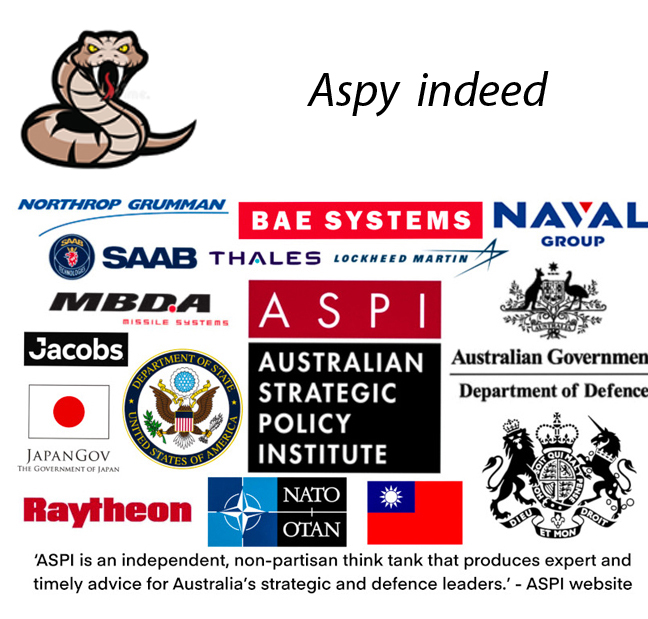
A senior defence strategy and capability analyst at the Australian Strategic Policy Institute, Malcolm Davis, said while space was critical for Aukus’s pillar two, it would also be crucial for pillar one, in terms of communicating with submarines…………………………. https://www.theguardian.com/australia-news/2023/mar/22/australian-military-looks-to-build-crucial-space-capabilities-that-will-support-aukus-nuclear-subs
National Party MPs seek nuclear submarine base in central Qld.

Perth Now, Dominic Giannini, AAP March 23, 2023
Three Nationals parliamentarians are pushing for Gladstone to be the future home of Australia’s nuclear-powered submarines.
Matt Canavan, Colin Boyce and Michelle Landry say central Queensland should be considered as a new submarine base due to its northern location.
The shortlist for an east coast base includes Brisbane, Newcastle and Wollongong…………………………………… https://www.perthnow.com.au/politics/nationals-seek-nuclear-submarine-base-in-central-qld-c-10127947
Julie Fraser: in a wide-ranging Submission calls for nuclear power to be kept ILLEGAL inAustralia

Conclusion
Section 140A of the EPBC Act 1999 states “No approval for certain nuclear installations: The Minister
must not approve an action consisting of or involving the construction or operation of any of the
following nuclear installations: (a) a nuclear fuel fabrication plant; (b) a nuclear power plant; (c) an
enrichment plant; (d) a reprocessing facility.” This should be retained.
As advised by the UN Secretary General following the Fukushima nuclear disaster because Australian
uranium was present in each of the Fukushima Daiichi reactors at the time of multiple reactor
meltdowns, there should be an inquiry into the human and environmental impacts of uranium
mining.
Uranium mining and processing is highly dangerous and pollutive and nuclear reactors tend to react
for thousands of years when climate catastrophes disturb them. Remember that uranium is a finite
resource but infinitely dangerous. It should be kept in the ground.
Renewable energy enjoys broad public support and is significantly cheaper, safer, and cleaner than
nuclear energy. Wind, solar and tidal energy has far fewer legislative implications or requirements
for emergency preparedness and radiation safety. Australia should invest more money and
resources into sustainable renewable energy.
Julie Fraser Submission No 71 against Environment and Other Legislation Amendment
(Removing Nuclear Energy Prohibitions) Bill 2022
As an Australian citizen resident in the NT, I am concerned for the health, safety and well-being of
our children and grandchildren and the natural, living environment we all depend on into the future.
I am deeply concerned at the increasing militarisation of the NT by foreign powers intent on creating
a war with nations not meeting US ideals of democratic or law-abiding decision-making. Making
Northern Australia particularly Tindal Air Base a site from which US B52 planes can be deployed
carrying nuclear arms (which appears to be a distinct possibility)1
puts us directly in harm’s way.
I do not support the development of nuclear energy in Australia as it is primarily unsafe, creates byproducts used to make nuclear weapons and is hazardous to our environments and human health, producing waste that needs to be stored safely for up to a million years.3
When governments are more prepared to spend billions – if not trillions – of public dollars on nonrenewable, dirty fossil (including nuclear) energy and war industries – instead of on sustainable social
and environmental needs – we are rushing life on Earth to extinction.
1 This month
To see nuclear-related stories in greater depth and intensity
– go to https://nuclearinformation.wordpress.com/


 Antinuclear