Senator Barbara Pocock demolishes the arguments put up for small nuclear reactors, and for nuclear submarines


There is a long list of reasons why the $368 billion spend proposed for AUKUS is a terrible idea, but it’s not least that the government has no viable solution to care for the weapons-grade nuclear waste and keep us safe.
Senator BARBARA POCOCK (South Australia) : THE SENATE CHAMBER SPEECH, Wednesday, 22 March 2023
“The proposal for nuclear power for Australia is wrong on many counts. Small modular nuclear power generation is too expensive, it’s not operating commercially and it’s a distraction from what we have to really get on with, which is a very fast move to renewables. We senators in this place have a responsibility to consider realistic proposals to advance citizens’ interests, not run impractical, risky, uncommercial proposals up the flagpole on behalf of, in this case, nuclear industry spruikers.
Last time I looked, only two small modular reactors were in operation on the planet, one in China and one Russia. In both cases the cost blowouts have been huge. Many other such next-generation nuclear reactors have been cancelled as people have worked out that renewables are the cheaper, more-reliable way forward.
But I want to especially focus on what Senator Canavan has raised, and that’s the question of nuclear waste disposal. The truth is that finding a permanent solution for the safe storage of nuclear waste arising from power generation remains a big, dangerous problem everywhere—a very expensive problem. The UK has 70 years of waste, 260,000 tonnes of it, from its nuclear power plants, in unsafe temporary storage. It’s a major problem for that country and its citizens.
The US nuclear industry has similarly been plagued by dangerous leaks and failures. No long-term solution exists in the US for waste from power generation or from nuclear powered submarines.
South Australians have had some experience with these issues. In 2016 our citizens had a very close look at a proposal that we take the world’s nuclear power waste and store it. We were promised an income stream of $51 billion. That’s a lot of money, but South Australians said no. The world’s largest citizens jury of 350 South
Australian citizens read the fine print. They saw that the proposal was for temporary storage for above-ground for more than a century. They said no to the false promise of huge incomes but especially to the safety risks and the fact that those who spruik nuclear power never offer a long-term waste solution that is safe and that will last the 100,000 years that is needed.
First Nations people across South Australia in particular said no. They remember Maralinga. This is a national challenge of long standing.
Since Australia first started producing nuclear waste, 70 years ago, five successive governments have tried and failed to find a suitable place for the permanent storage of our relatively small quantities of low-level and intermediate-level waste. Low-level waste, arising from medical use, must be stored safely for 300 years, and it’s nowhere near as dangerous as intermediate waste, but no community in this country has agreed to take and store that waste. Intermediate-level waste, arising from research at Lucas Heights, must be safely stored for 10,000 years. The previous government began a process towards that storage at Kimba, and it’s been bitterly disputed at every step of the way since, opposed by farmers, by community members and by First Nations people.
The Barngarla people are currently in the Federal Court fighting the current government, which is spending hundreds of thousands of dollars to oppose the voice of the Barngarla people.
In the case of AUKUS, the fuel from decommissioned submarines is nuclear weapons grade, and it requires military-scale security. It must be stored safely not for 300 years, not for 10,000 years, but for 100,000 years, and neither the UK nor the US have been able to find permanent storage solutions for their own submarine waste. So, given that successive governments have continuously failed to manage much-less-dangerous radioactive waste in Australia, our government would find it very difficult in this country to find a solution to dispose of nuclear waste or AUKUS submarine waste. Traditional owners of the future in particular should have a say and a veto about any such proposal.
There is a long list of reasons why the $368 billion spend proposed for AUKUS is a terrible idea, but it’s not least that the government has no viable solution to care for the weapons-grade nuclear waste and keep us safe.
The Australian public is right to be sceptical and concerned about waste disposal in relation to AUKUS. There is no plan, and the same argument applies to any ill considered, expensive adventurism around nuclear power.
Our children need practical, affordable action on renewable energy that cuts carbon pollution, not pies in the sky that generate toxic waste for which there are no safe solutions.”
In Australian conventional media, when it comes to discussion on AUKUS, only certain limited views are permissable.

Social media and independent news sites have had a significant effect on opening up the political debate over the AUKUS deal, writes Professor John Quiggin.
Social media and independent news sites have had a significant effect on opening up the political debate over the AUKUS deal, writes Professor John Quiggin.
Opening the Overton window. Independent Australia, by John Quiggin | 24 March 2023
ONE OF THE MOST useful ideas in thinking about political debate is that of the Overton window, named after American political scientist Joseph Overton. The Overton window is the range of ideas considered permissible in public discussion at any given time.
Overton’s crucial insight was that, while active participants in political debate could only take positions within the window of acceptable views, outside bodies like think tanks could help to shift it.
……………………………….The Overton window provides a way of thinking about current policy debate, particularly the treatment of the AUKUS deal by the mass media. At one end of the Overton window is the hyperbole of warmongers like Matthew Knott gushing that Australia is ‘no longer a middle power’ to the more cautious view that perhaps we should have had some public discussion before such a major change.
The mass media has been vigorous in policing even the slightest dissent within the political class, such as the questions raised, cautiously, by a handful of Labor backbenchers. It has responded with fury to criticism from those it can’t control like Paul Keating and Malcolm Turnbull. And, as usual, it has done its best to ignore criticism from outside the Overton window.
Although think tanks like the Australia Institute still play a role, the biggest challenge to the mainstream media’s role in policing debate has come from social and alternative media. The ease of communication through the internet is reflected in social media sites like Facebook, Twitter and more recently Mastodon, which have largely displaced older models of blogging. Equally important has been the proliferation of online magazines like Independent Australia and Crikey, and the rise of single-author newsletters distributed through Substack and Medium.
At least regarding issues like AUKUS, there is an Overton window for social and alternative media. Almost all opinions are critical, with the dominant viewpoint being that the project is economically wasteful and puts Australia in danger of being dragged into war. The most positive views to be found on Twitter are “Labor inherited this from Morrison” and “cheer up, it will probably never happen”. The only point of contact with the political class Overton window is the view that we need to discuss this further.
Traditional mass media still has a greater reach than online alternatives. But it can no longer constrain debate within the Overton window defined by the political class.
May Day March planned – against AUKUS

The Age (print version) , David Crowe, Matthew Knott,23 Mar 23,
Laboutr organisers will escalate their concerns about the AUKUS defence pact by movingan annual workers’ march to the NSW city of Port Kembla to oppose its use as a base for a future submarine fleet.
The organisers agreed on Tuesday night to relocate the MayDay March from Wollongong out of growing c oncern at the prospect that nearby Port Kembla could become the eas-coast home for eight nuclear-powered vessels.
“the battle for Port Kembla has begun” said Arthur Rorris, the secretary of the South Coast Labour Council, a longstanding Labor member and one of the organisers of the annual march.
The move cam after former Labor cabinet minister Kim Carr added hi svoice to concerns about AUKUS in the wake of criticism from former prime minister Paul Keating………………..
The location of the fleet is a major obstacle because the AUKUS plan includes$10 billion for an east coast base to house the submarines, with Brisbane and Newcastle named as options, but the idustrial city of Port Kembla seen as the government’s most likely choivce.
The protest will focus attention on AUKUS befoe Albanese heads to the G-7 summit in Japan on May 19 and United States President Joe Biden visits Sydney for the Quad summit in the same months, with expectatins that tehpresident will address federal parliament.
Rorris said the groups concerns about AUKUS were about the national interest and nota “not-in-my-backyard” protest.
The name is Port Kembla not Fort Kembla” he said.
“We will not cop lectures about the national interest from spooks and arms dealers”, he said……….
NuScam – the sad little canary that’s scared of a tweet

NuScale, maker of the pioneering (supposedly little) Small Modular Nuclear Reactors, must have had a little hissy fit at my beautiful picture of NuScale’s SMR plunging down a bottomless money hole.
I mean, that is pretty much what is in fact happening. But I can understand that NuScale was not all that thrilled with my artwork – they had it removed from Twitter, explaining that –
“This person has taken and modified our rendering without our permission and in a derogatory fashion. “
Well, that’s true. Unfortunately sometimes “derogatory” = “true”.
And “true” can be painful. NuScale is seen as the canary in the coal mine for SMRs,
NuScale and the Utah Municipal Power Systems, its partner in an SMR project planned for Idaho, announced early in January, that the target price for the power from their proposed modular reactor had risen by 53% from $58/MWh to $89/MWh.
So NuScale has a lot more to be sad about than just my little picture, and somebody else’s tweet of it. The reality is that the business prospects for all those hyped-up small nuclear reactors are looking very gloomy indeed.
NuScale, Rolls Royce and the rest of them might soon have to face up to the fact that SMRs can survive only as tax-payer funded toys for the military – nuclear submarines, military stations on the moon, whatever new follies that the macho boys think up.
Big Tech, weapons, tax havens, even Rupert Murdoch – secrets from the Future Fund investment vault

AUKUS wins
Paul Keating’s words still resonate in Aussie minds,
“At the Kabuki show in San Diego … there’s three leaders standing there, only one is paying, our bloke, Albo.“
Michael West Media, Philip Dorling and Rex Patrick | Mar 26, 2023
The secretive Future Fund’s chairman Peter Costello might not like it, but Freedom of Information requests are peeling back the lid on the Fund’s weighty overseas investments. Philip Dorling and Rex Patrick report the more controversial ones.
Big Tech, Big Pharma and Big Oil are the top of the pops in a newly released list of Future Fund Investments across the United States, United Kingdom and a range of tax havens, notably among the Cayman Islands.
These revelations come on top of revelations earlier this year about ethically and environmentally questionable Future Fund investments in China.
The latest FOI drilling into the side of the vault also shed light on the Fund’s investments in arms manufacturers, Chinese companies operating out of the Caymans as well as politically controversial investments in Rupert Murdoch’s right-wing media empire.
It’s so infuriated Senator Barbara Pocock, who has been pursuing the Fund’s investment practices the Senate. “It should not take FOI requests for Australian citizens to find out where their own money is being invested. The Future Fund is suffering from a corrosive secrecy disease.
The public should know about these Future Fund investments in carbon polluting fossil fuels, in arms manufacture and in companies based in tax havens – not to mention the Murdoch and Fox media empires. It’s time to come clean.
Big Tech
In what may be its largest investment in a single publicly listed foreign company, the Future Fund holds a $793 million stake in tech giant Microsoft. Other very large Future Fund tech investments include Google owner Alphabet ($559.9m), NVIDIA ($346.8m), Cisco Systems ($288.2m), Meta Platforms ($256.4m) and Intel Corp ($240.0m). Amazon comes in with a rather more modest investment of $187 million.
Given the vital importance of IT and telecommunications policy for Australian governments, business, our economy and society, disclosure of the nature and scale of these publicly funded investments is clearly in the public interest.
However, it only comes after the Future Fund was forced to abandon its deep preference for secrecy and resistance to scrutiny through FOI.
Pharma, energy and mining………………………………..
AUKUS wins
Paul Keating’s words still resonate in Aussie minds,
At the Kabuki show in San Diego … there’s three leaders standing there, only one is paying, our bloke, Albo.
But it appears the Future Fund is well ahead of Albo, with investments in leading American and British aerospace and defence manufacturers including Raytheon Technologies ($91.9m), Lockheed Martin Co ($75.1m), General Dynamics ($65.3m), Northrop Grumman ($41.5m), Honeywell International ($76.0m), BAE Systems ($20m), and Rolls-Royce ($0.7m).
A number of these companies will be deeply involved with the AUKUS nuclear submarine project, so maybe this a return path for a tiny share of the eye-watering $368 billion AUKUS price tag.
Tax haven heaven………………………………………………………
Backing Murdoch
In the end however, two quite modest investments in the United States may prove to be among the Future Fund’s more controversial holdings – a $6.3 million stake in News Corp and $13.5 million in Fox Corp which have been notable political allies of Coalition governments.
That’s $19.8 million in the two companies controlled by media mogul Rupert Murdoch and his primary channels of national and global political influence………………………………………….
The Future Fund is an independent, statutory body but it wouldn’t be entirely surprising if a “Defund Murdoch” campaign emerges.
Last month Treasurer Jim Chalmers wrote about the need to bring ethics and values into national economic and financial policy. Perhaps he should call in Costello for a chat about ESG (Environmental, Social & Governance). https://michaelwest.com.au/big-tech-weapons-tax-havens-even-rupert-murdoch-secrets-from-the-future-fund-investment-vault/
NuScale Power the canary in the small modular nuclear reactor market
SMRs are being marketed as a solution to the climate crisis, but they’re already far more expensive and take much longer to build than renewable and storage resources – that we already have.
Utility Dive, David Schlissel, 21 Mar 23, Davis Schlissel is the Institute for Energy Economics anf Financial Analysis director of resource planning analysis.
NuScale is hoping to be among the first of about a dozen companies trying to take advantage of the much-hyped market for small modular nuclear reactors or SMR. So far, however, the Oregon-based company is looking like the first canary in the coal-mine.
Considered a leader in the new technology, NuScale is marketing its SMR project by claiming that the reactor design project will save time and money – persistent problems for traditional large nuclear plants.
But NuScale and the Utah Municipal Power Systems, its partner in an SMR project planned for Idaho, announced early in January, that the target price for the power from their proposed modular reactor had risen by 53% from $58/MWh to $89/MWh……..
The announcement has serious implications for all would-be SMR manufacturers………………
the new $89/MWh target price already means that power from the NuScale SMR will be much more expensive than renewable and storage resources even with an estimated $4.2 billion in tax-payer subsidies.
……………………………….. The gap is only going to get larger as the costs of building SMRs rise and costs of renewables and storage continue to decline.
………….. Using SMRs as backups for renewables will not be financially feasible
………………………………….evryone – utilities, ratepayers, legislators, federal officials and the general public, should be very sceptical about theindustry’s current claim that the new SMRs will cost less and be built faster than previous designs. https://www.utilitydive.com/news/nuscale-power-small-modular-reactor-smr-ieefa-uamps/645554/
European Tiny Modular Reactor Deal Starts With Absurdly Expensive Electricity

Already 2.4 times as expensive as very, very expensive Hinkley. First of a kind, so very likely to double or more in price. Very unlikely to be built before 2040 due to long-tailed risks.
Small modular reactors won’t achieve economies of manufacturing scale, won’t be faster to construct, forego efficiency of vertical scaling, won’t be cheaper, aren’t suitable for remote or brownfield coal sites, still face very large security costs, will still be costly and slow to decommission, and still require liability insurance caps. They don’t solve any of the problems that they purport to while intentionally choosing to be less efficient than they could be. They’ve existed since the 1950s and they aren’t any better now than they were then.
By Michael Barnard, 25 Mar 23, https://cleantechnica.com/2023/03/23/european-tiny-modular-reactor-deal-starts-with-absurdly-expensive-electricity/
Supposedly a European energy deal has been reached in which a US firm sells a bunch of tiny nuclear reactors to European countries at an enormous price per GW. It’s hard to think that anybody would ink the deal as described.
It was a Bloomberg piece, and Bloomberg normally gets the facts right, although Bloomberg New Energy Finance gets the framing right far more often. And a bit of evaluation seems to confirm the basics. So let’s tear it apart.
Let’s start with small modular nuclear reactors (SMR). The premise is that they will be a lot cheaper than big nuclear reactors because, you know, modularity. Anything you can manufacture in large numbers drops in price, typically by 20% to 27% for every doubling of units. That’s a truism known as Wright’s Law after the first management consultant who observed it, the experience curve per Boston Consulting Group which happily stole and rebranded it or just the learning curve.
There are a bunch of problems with this premise when it comes to nuclear electricity generation. I’ve written about them, had my content peer-reviewed and included in text books, and debated them with nuclear industry proponents for audiences of a couple of hundred institutional investors likely representing funds worth close to a trillion, so I’m just going to quote myself:
Small modular reactors won’t achieve economies of manufacturing scale, won’t be faster to construct, forego efficiency of vertical scaling, won’t be cheaper, aren’t suitable for remote or brownfield coal sites, still face very large security costs, will still be costly and slow to decommission, and still require liability insurance caps. They don’t solve any of the problems that they purport to while intentionally choosing to be less efficient than they could be. They’ve existed since the 1950s and they aren’t any better now than they were then.
As I discussed with Professor Bent Flyvbjerg, megaprojects expert and author of How Big Things Get Done recently, small modular reactor firms are trying to hunt for an optimized point on the continuum between the efficiencies of big thermal generation and modularity, and I don’t think they are going to find it.
And that’s really true for Last Energy if this reporting is remotely accurate. So what’s the story? Well, apparently they’ve signed a $19 billion deal to supply 34 nuclear reactors that are 20 MW each. Apparently they are going to at least Poland and the UK, although regulatory approval stands in their way.
The first thing that caught my eye was the MW capacity. 34 reactors of 20 MW each only adds up to 680 MW of nameplate capacity. That’s smaller than a billion dollar offshore wind farm that takes ten months to build.
Side note: Nuclear nameplate capacities are usually reported with units of MWe, or megawatts of electricity. That’s because their thermal energy output is perhaps three times the size, but meaningless, as all we care about is the electricity. I just stick with MW usually because the best comparison is to wind and solar which don’t create and waste a lot of heat. However, at 20 MWe, the tininess of the reactor and related thermal generation suggests that the efficiency of turning heat into electricity is probably much worse. That’s the point about thermal generation liking to scale and why everyone building nuclear went bigger in the 1970s and 1980s so that it wouldn’t be as expensive.
So, 20 MW. Is that accurate? I went to their public website, and sure enough, that’s the size. It’s their only claimed product, although they have built and delivered none of them anywhere.
The second thing that caught my attention was the eye-watering price tag, $19 billion. That seems really high even for nuclear, and especially high for only 680 MW.
Maybe this would be reasonable if nuclear normally had capacity factors of 20%, and this tech was operating at 90%, but nuclear globally runs about 90% of the time. It has high uptime, which proponents overstate as an advantage, but is the reality. You can’t actually operate nuclear less than 90% of the time and have it be reasonably priced due to the cost of building the stuff.
How does this compare? Let’s pick the British Hinkley Point C nuclear expansion, one of the most expensive and slowest in the developed world. It is so expensive that the developers demanded and got about $150 per MWh wholesale guaranteed for 35 years with inflation bumps. This when offshore wind energy is running around $50 per MWh wholesale and onshore wind and solar are running around $30 per MWh wholesale. Yeah, Hinkley is absurdly expensive electricity.
Let’s take a walk through memory lane. Hinkley was supposed to deliver electricity for about $24 per MWh when it was originally proposed in 2008, and be in operation by now. Five times the cost per MWh accounting for inflation, so a clear miss. And the current plan is pretending that in 2027 it’s going to be grid-connected, but that’s undoubtedly 2028 at earliest, 20 years after it was originally set in motion, and 11 years after start of construction. So far, so nuclear.
Hinkley’s current cost projection — five years from grid connection, so incredibly likely to rise by billions — is about $40 billion. That’s a lot of amortization per MWh, hence the remarkably high wholesale price. As a reminder, Iceland, which runs 100% on renewables, is delivering consumer retail prices lower than this wholesale price. All of Canada is providing consumer rates below this wholesale cost, although recent news makes it clear that nuclear heavy Ontario are subsidizing consumer rates by US$4.4 billion annually to prevent revolt. Hmmm, is this a trend?
Surely Hinkley must be turning out to be more expensive than this SMR deal? Well, no. Hinkley is building two big, complex, next-generation EPR reactors with 1,630 MW capacity each. That’s 3,260 MW total capacity. That’s almost five times the capacity of the Last Energy SMRs. For only two times the cost.
The ratio is pretty clear. These SMRs will be about 2.4 times the cost per MWh of the very expensive Hinkley facility. All else being equal — and the only reason we have to think this won’t be equal is that nuclear costs always rise, so the $19 billion is likely to be closer to $40 billion — this is already about $360 per MWh wholesale prices for electricity.
What’s the consumer retail price of electricity in the UK? About $340. What about coal heavy Poland? $181.
Yes, the very first announcement of a nuclear deal, probably well over a decade before anything might be connected to the grid, has wholesale rates well over consumer retail rates today.
On original – image of project categories which meet time, budget, and benefits expectations vs ones that don’t, from How Big Things Get Done by Bent Flyvbjerg and Dan Gardner -(nuclear is the worst!)
This is the first version of new material from Flyvbjerg and his team. They have assembled over 16,000 megaprojects’ worth of data on budget, schedule, and asserted benefits vs actuals over 25 categories of projects. This is a view by likelihood of cost overruns. The top of the chart has the least likely categories to go over budget once the shovel hits the ground. The bottom has the categories most likely to go over budget, often by multiples of the original projections. You’ll note where nuclear lies.
SMRs are attempting to fix that by making a bunch of smaller, repeatable reactors instead of big ones. As I pointed out earlier, they are foregoing the efficiencies of being big enough to receive the benefits of physics for thermal generation in order to hunt for a point where modularity optimizes costs and risks sufficiently to make it economically viable.
However, at 2.4 times the cost per MWh of one of the most expensive nuclear generation projects on the planet, clearly they are nowhere near the field, never mind anywhere near the goal. As Flyvbjerg points out several times, first of a kind projects have massive long-talked risks, and Last Energy’s announcement has first of a kind in big neon screaming signage over every part of the deal.
Already 2.4 times as expensive as very, very expensive Hinkley. First of a kind, so very likely to double or more in price. Very unlikely to be built before 2040 due to long-tailed risks. Who exactly signed a deal like this, and why?
UPDATE:
Comments from Lyle Morton, Vice President of Marketing & Communications, Last Energy: Reaching out to clarify an important detail regarding the Last Energy announcement. The $19bn is not a cost figure but the total value of the electricity under contract over the duration of the 4 contracts — which range from 20-24 years.
My take: That’s still a ridiculous $160-$170 per MWh wholesale by the initial terms of the deals before all of the inevitable problems with first of a kind deployments. Even at $160-$170, I’ll believe this only when I see it in operation, at the price point specified, and delivering benefits as promised. I won’t be holding my breath.
Burning down the house — Climate options are available now. Nuclear power isn’t one of them

Our climate needs a fire hose. Our government is bringing buckets
Burning down the house — Beyond Nuclear International
Climate options are available now. Nuclear power isn’t one of them
By Linda Pentz Gunter
In 2019 at the Davos World Economic Forum, youth climate leader, Greta Thunberg, then only 16, warned the audience in a quiet and measured voice that addressing the climate crisis involved a solution “so simple that even a small child can understand it. We have to stop the emissions of greenhouse gases.”
In closing, she said: “Adults keep saying we owe it to the young people to give them hope. But I don’t want your hope. I don’t want you to be hopeful. I want you to panic. I want you to feel the fear I feel every day. And then I want you to act. I want you to act as you would in a crisis. I want you to act as if the house was on fire. Because it is.”
On March 12, 2023, the Biden administration announced that it had approved oil and gas drilling in Arctic Alaska, retaining the United States’s vaunted position, alongside China and India, as one of the world’s leading arsonists.
As the UK daily, The Guardian reported of that decision: “The ConocoPhillips Willow project will be one of the largest of its kind on US soil, involving drilling for oil and gas at three sites for multiple decades on the 23m-acre National Petroleum Reserve which is owned by the federal government and is the largest tract of undisturbed public land in the US.”
The US government’s lame excuse for approving the drilling project was that it had few legal options, given Conoco-Phillips holds lease rites to the land dating back decades.
So sue. The house is on fire. Tying the project up in the law courts would have bought us time. Green-lighting new oil and gas drilling is tone deafness to a crisis that has gone beyond the tipping point.
This was confirmed, yet again, days later, when the Intergovernmental Panel on Climate Change (IPCC) published its AR6 Synthesis Report: Climate Change 2023, the final part of its mammoth Sixth Assessment Report. It came replete with even more dire warnings than in previous AR6 reports, which should already have been panic-inducing enough for the world to wake up and understand that we cannot drill for a single more drop of oil. Ever. Period.
This time, the scientists who co-authored the AR6 Synthesis Report called it their “final warning.” However, in their press release announcing the report, the authors tried to take the high road, insisting that “There are multiple, feasible and effective options to reduce greenhouse gas emissions and adapt to human-caused climate change, and they are available now”.
None of those options includes nuclear power, according to the IPCC scientists, which never mentions ‘nuclear’ once in the report narrative. It appears only in a single graph (below on original)) to illustrate its lack of applicability to addressing the climate crisis…………………………………………..
IPCC Chair, Hoesung Lee, said: “This Synthesis Report underscores the urgency of taking more ambitious action and shows that, if we act now, we can still secure a liveable sustainable future for all.”
If we act now. Like we didn’t after Thunberg’s words of warning in 2019. Like the Biden administration didn’t last week. What’s left is the largely empty rhetoric of hope, but no signs of panic.
This lack of urgency is compounded by a failure in the media to put the climate emergency on the front page with regularity. The given reason is that it’s not what their readers are interested in, a complete abdication of responsibility to inform, educate, and in the case of the climate crisis, to inflame passion and a demand for action. And there is also, in the US at least, and as we wrote last week, a lamentable adherence to an outdated formula that relegates the voices of right and reason to the back of the quote queue.
This was no better (or should that be worse) exemplified than by the two days of coverage about the Alaskan Willow project in The Washington Post, which never once in either story quoted anyone from the Indigenous Alaskan population bitterly opposed to the drilling.
…………………………………………………… we still aren’t seeing the outrage where it really matters. We are still confronting deniers. And our governments are not taking the climate crisis nearly seriously enough. Instead of rushing for the fire hoses, they are bringing buckets.
Linda Pentz Gunter is the international specialist at Beyond Nuclear and writes for and curates Beyond Nuclear International. https://beyondnuclearinternational.org/2023/03/26/burning-down-the-house/
Where the $1.3 Trillion Per Year U.S. Military Budget Goes

The Duran, by Eric Zuesse, March 24, 2023
Nobody can give a precise dollar-number to U.S. ‘Defense’ spending because the U.S. ‘Defense’ Department has never been able to pass an audit, and is by far the most corrupt of all federal Departments (and is the ONLY Department that has never passed an audit), and also because much of America’s military spending is being paid out from other federal Departments in order to keep down the published annual U.S. Government ‘Defense’ expenditure numbers (which come from ONLY the “U.S. ‘Defense’ Department).
Those are expenditures for America’s privatized and overwhelmingly profit-driven Military-Industrial Complex. (By contrast: Russia and China require, by law, that their armaments-firms be majority-owned by the Government itself.)
According to the best available estimates, the U.S. Government has been spending, in total, for over a decade now, around $1.3T to $1.5T annually on ‘defense’, and this is around half of all military spending worldwide by all 200-or-so nations, and is more than half (around 53%) of all of the U.S. federal Government’s ‘discretionary’ (or congressionally voted for) annual expenditures.
Unlike regular manufacturers, which sell entirely or mainly to consumers and to businesses, not to their Government, armament-firms need to control their Government in order to control their markets (which are their Government and its ‘allied’ Governments — including NATO), and so they (in purely capitalist countries such as the U.S.) do control their Government. This is why the armaments-business (except in countries whose armaments-sector is socialized) is infamously corrupt. In order to hide the extent of that corruption (and to promote ever-higher military spending), the ‘news’-media need — in those countries — to be likewise effectively controlled by the investors in those firms.
Consequently, America, which has no national-security threat from any country (so, these astronomical ‘defense’-expenditures are blatantly inappropriate), spends annually around half of all of the money that the entire world spends on the military. And most of that money gets paid to its armaments-firms. Or, as Stephen Semler, an expert on these matters, put it regarding last year’s numbers, “How much of the $858 billion authorized by the FY2023 NDAA will be transferred to military contractors? I estimate $452 billion.” ………………………………
If this had not been happening each year after the end of the Soviet Union in 1991, then the current U.S. federal debt would be far less, if any at all — but, in any case, that expense (which went, and is going, to exceptionally rich individuals) will be paid by future generations of Americans, by means of both increased taxes and reduced services from the U.S. Government. What pays for bombs (and funds the purchase of yachts) today will be taken from everyone’s infants tomorrow. And it is taking millions of lives in the targeted lands, and has been doing so for decades now. A psychopathic U.S. Government is producing these results………………………………………………………………………………………………
The presumption is that the voters don’t care, and that the ‘news’-media won’t enlighten the voters about this matter, and about how it impacts, for example, which nations the US will categorize as being an “ally,” to sell weapons to, and which nations it will categorize as being an “enemy,” to target for conquest………………………………………………….. more https://theduran.com/where-the-1-3-trillion-per-year-u-s-military-budget-goes/
Australia has just lost its best energy minister, lets hope Labor doesn’t trash his legacy — RenewEconomy

Updated: The NSW Coalition loss means Australia’s best performing energy minister is no longer running the show. What does that mean for the state’s transition from coal? The post Australia has just lost its best energy minister, lets hope Labor doesn’t trash his legacy appeared first on RenewEconomy.
Australia has just lost its best energy minister, lets hope Labor doesn’t trash his legacy — RenewEconomy
Declassified Video Shows How B-52 Crews Would Conduct Nuclear Strikes During Cold War

The Aviationist March 26, 2023 STEFANO D’URSO
A 1960 Strategic Air Command training video familiarized B-52 crews with the devastating effects of nuclear weapons and how to navigate through a nuclear battlefield.
The U.S. National Archives and Records Administration (NARA) recently declassified some very interesting training films and film reports that the Strategic Air Command prepared in the 1960s to prepare bomber pilots and crews for a potential nuclear war. Among these there is the United States Air Force Training Film 5363, “Nuclear Effects During SAC Delivery Missions,” made in 1960 and which kept its secret classification until now.
The purpose of Training Film 5363 was to familiarize SAC pilots and crew members with the devastating effects of nuclear weapons detonations and the detailed plans that were developed so the crews could evade the dangers of a nuclear battlefield and return home after completing their mission. These plans were among the contents of the “Combat Mission Folders,” which included guidance needed to reach targets and return to base safely and were assigned to each nuclear-armed bomber on alert duty.
…………………… The film begins with a B-52 flying a sortie of the Emergency War Order, launched under Positive Control and on its way to the “go/no-go” position, but without the crew knowing if this is a real mission or an exercise until they get there. Before eventually going in, however, the narrator explains that, while they know that the mission can be successfully accomplished as it was carefully planned and reviewed by highly qualified combat planners and they flew countless profile missions, they need to know the nuclear effects of a detonation.
The narrator then takes the viewers trough the basics of a nuclear detonation’s thermal, blast and radiation effects and the efforts that the U.S. Air Force had taken to prepare the crews for situations where they might experience them. In fact, the central part of the film covers the effects of nuclear explosions of both aircraft and crew and the measures taken to minimize crew exposure, like carefully planned routes that created a safe distance between the bomber and the detonation of their weapon and the detonations caused by other SAC bombers operating in the same area.
The film then returns to the B-52 approaching the turnaround point, when then a radio message from SAC comes in: “Sky King. Sky King. This is Migrate. This is Migrate. Do not answer. Break. Break. Alpha Sierra Foxtrot Juliet Oscar Papa Mike Tango. Break. Go-Code.” The crew scrambles to verify the code and discover that this is the go code for a real mission: “Pilot to crew. We checked the go code and verified it. This is it. We’re going in”.
After a very brief moment of disbelief, the crew members get down to business and prepare the aircraft for the nuclear strike mission as they are about to cross the H-Hour Control Line on the way to their assigned target in the Soviet Union. As they navigate towards the target, the crew experience the shockwave from another nuclear bomb dropped in the vicinity of their route, before a low-altitude flight over lakes, mountains, forests and fields to avoid Soviet air defense missiles…………………………………………………. more https://theaviationist.com/2023/03/26/declassified-video-shows-how-b-52-crews-would-conduct-cold-war-nuclear-strikes/
March 26 Energy News — geoharvey

Opinion: ¶ “We Won’t Act On Climate Change Until Our Comfortable Lives Are Threatened – And That Day Is Coming” • The IPCC’s latest climate report stopped some of us in our tracks because there are many warnings about our heating planet and escalating climate breakdown, and each new one is a reminder that we’re […]
March 26 Energy News — geoharvey
AUKUS, the Australian Labor Party, and Growing Dissent
the Royal Australian Navy would be far better off acquiring between 40 to 50 of the Collins Class submarines to police the coastline rather than having nuclear powered submarines lying in wait off the Chinese shoreline.
March 25, 2023, by: Dr Binoy Kampmark https://theaimn.com/aukus-the-australian-labor-party-and-growing-dissent/
It was a sight to behold and took the wind out of the bellicose sails of the AUKUS cheer squad. Here, at the National Press Club in the Australian capital, was a Labor luminary, former Prime Minister of Australia and statesman, keen to weigh in with characteristic sharpness and dripping venom. Paul Keating’s target: the militaristic lunacy that has characterised Australia’s participation in the US-led security pact that promises hellish returns and pangs of insecurity.
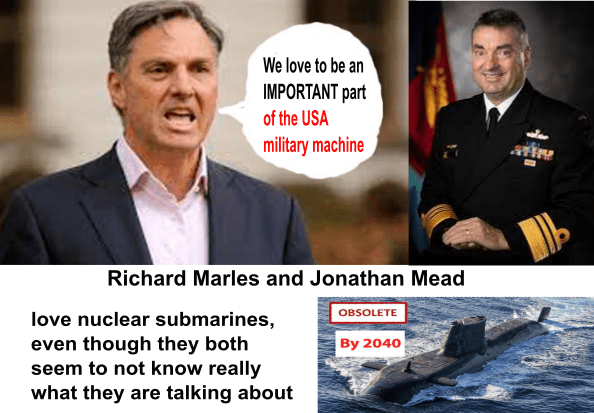
In his March 15 address to a Canberra press gallery bewitched by the magic of nuclear-propelled submarines and the China bogeyman, Keating was unsparing about those “seriously unwise ministers in government” – notably Foreign Minister Penny Wong and Defence Minister Richard Marles, unimpressed by their foolish, uncritical embrace of the US war machine. “The Albanese Government’s complicity in joining with Britain and the United States in a tripartite build of a nuclear submarine for Australia under the AUKUS arrangements represents the worst international decision by an Australian Labor government since the former Labor leader, Billy Hughes, sought to introduce conscription to augment Australian forces in World War One.”
In terms of history, this was chilling to Keating. The AUKUS security pact represented a longing gaze back at the Mother Country, Britain, “shunning security in Asia for security in and within the Anglosphere.” It also meant a locking alliance with the United States for the next half-century as a subordinate in a containment strategy of Beijing. This was a bi-partisan approach to foreign policy that saw the US dominating East Asia as “the primary strategic power” rather than a balancing one.
For Keating, the impetus for such madness came from a defence establishment that dazzled the previous Prime Minister, Scott Morrison. That effort, he argues, was spearheaded by the likes of the US-funded Australian Strategic Policy Institute and Andrew Shearer of the Office of National Intelligence. They even, he argues, managed to convince PM Albanese, Marles and Wong to abandon the 20-month review period on the scope of what they were seeking.
The steamrolling Keating was also unsparing in attacking a number of journalists for their ditzy, adolescent belligerence. The sword, once produced, was never sheathed. Peter Hartcher, most notably, received a generous pasting as a war infatuated lunatic whose anti-China campaign at the Fairfax presses had been allowed for years.
In terms of the submarines themselves, Keating also expressed the view that the Royal Australian Navy would be far better off acquiring between 40 to 50 of the Collins Class submarines to police the coastline rather than having nuclear powered submarines lying in wait off the Chinese shoreline.
As we all should know, submarine policy is where imagination goes to expire, often in frightful, costly ways. For all Keating’s admiration for the Collins Class, it was a nightmarish project marred by fiascos, poor planning and organisational dysfunction within the defence establishment. At stages, two-thirds of the Australian fleet of six submarines was unable to operate at full capacity. The lesson here is that submarines and the Australian naval complex simply do not mix.
The reaction from the Establishment was one of predictable dismissal, denial and distortion, typical of what Gore Vidal would have called deranged machismo. Instead of being critical of the powers that are, they have turned their guns and wallets on spectres, ghosts and devilish images. The tragedy looms, and it will be, like many tragedies, the result of colossal, unforgivable stupidity.
At the very least, the intervention by Keating, notably in the Labor Party, has not gone unnoticed. Within the Labor caucus, tremors of dissatisfaction are being recorded, breaches growing. West Australian Labor backbencher Josh Wilson defied his own party’s dictates by telling colleagues in the House of Representatives how he was “not yet convinced that we can adequately deal with the non-proliferation risks involved in what is a novel arrangement, by which a non-nuclear weapons state under the NPT (Non-proliferation of Nuclear Weapons Treaty) comes to acquire weapons-grade material.”
Wilson’s views are not outlandish to the man. He is keen to challenge the notion of unaccountable executive war powers, a problem that looms large in the Westminster system. “To assume that such decision-making is already perfect, immutable, and beyond scrutiny,” he wrote in December last year, “puts Australia at risk of making the most dangerous judgments without the best institutional framework for doing so.”
A gaggle of former senior Labor ministers have also emerged, even if they initially proved sluggish. Peter Garrett, former environment minister and front man of Midnight Oil, while proving a bit squeamish about Keating’s invective, found himself in general agreement. “The deal stinks with massive cost, loss of independence, weaking nuke safeguards & more.”
Kim Carr, who had previously held ministerial positions in industry and defence materiel, revealed that the matter of AUKUS had never been formally approved in the Federal Labor caucus, merely noted. Various “key” Labor figures – again Marles and Wong – agreed to endorse the proposition put forth to them on September 15, 2021 by the then Coalition government.
He also expressed deep concern “about a revival of a forward defence policy, given our performance in Vietnam.” For Carr, the shadow cast by the Iraq War was long. “Given it’s 20 years since Iraq, you can hardly say our security agencies should not be questioned when they provide their assessments.”
For former foreign minister, Gareth Evans, there were three questions: whether the submarines are actually fit for purpose; whether Australia retained genuine sovereignty over them in their use; and, were that not the case, “whether that loss of agency is a price worth paying for the US security insurance we think we might be buying.”
Will these voices make a difference? They just might – but if so, Australia will have to thank that political pugilist and Labor veteran who, for all his faults, spoke in terms that will be considered, in a matter of years, treasonous by the Empire and its sycophants.
“Collaborative” bases, and the ideology of AUKUS
What we need now under either the optimist or the more realistic pessimistic view is a massive campaign, a campaign that starts today against the background of this terrible shock, this awful sense of betrayal.
Pearls and Irritations, By Richard Tanter, Mar 24, 2023“……………………………………………. The Minister for Defence in the Albanese government made a ministerial statement last month, in which he talked about the joint facilities. But he also introduced a new category of bases under the US-Australia Force Posture Initiative that the previous Rudd-Gillard-Abbott-Turnbull-Morrison alliance supporting government had not thought of – collaborative bases.
Collaborative – an interesting word in its double meaning, isn’t it.
At the moment we don’t know how many Agreed Locations and Facilities there are on this list of collaborative bases identified in a secret part of the Force Posture Agreement – the bases given over by Australia to the US to be under varying degrees of US operational control. The most recent example is RAAF Tindal thanks to Scott Morrison, and we are going to see a lot more of that.
And the last part of nuclear permissiveness is the atmosphere that fills the room in Canberra when you listen to certain senior officials, compliant academics, and insider journalists talk about nuclear weapons for Australia.
In the past few years we have already had three former deputy secretaries of defence – the people who do the planning – saying in public it’s time for us to reconsider the decisions taken by the Fraser and Whitlam governments half a century ago to stop our development of nuclear weapons.
It’s time, they say, to think again about Australian nuclear weapons.
No, they say, we’re not advocating nuclear weapons for Australia, we just need to think about it.
But in the context of half a century of nuclear restraint, of full knowledge of what the possession of nuclear weapons will mean in our region, or what the actual effects of nuclear weapons use will mean in human and environmental terms, ‘just considering’ nuclear weapons acquisition means clearly much more than that.
The ideology of AUKUS
Ideology’s a funny word. Usually it’s used about other people. Like bad breath, ideology is something that afflicts the other guy, not us. Well, that’s nonsense. We all suffer from ideological thinking at certain times.
Ideology is that category of thinking that actually stops thought, which by its emotional logic takes means you don’t have to think about what’s actually being said.
In the ideological nonsense in The Age’s ‘Red Alert’ we saw a kind of triple equation, born of the Russian invasion of Ukraine and American plans to take the opportunity to reshape its alliances.
Russia = China – we don’t need to think about that, do we – they’re autocracies, and we’re not.
Putin = Xi. I’m happy to see that President Putin is to be indicted by the International Criminal Court for the war crime of his invasion of Ukraine. President Xi is not a particularly nice man, but a long way from Putin’s desperate criminality.
Ukraine = Taiwan. Putin invaded Ukraine, so Xi must be about to invade Taiwan – without any serious evidence, and in contrast to the behaviour of China since 1949.
This is the kind of talk that disables critical thinking. None of that makes any sense of the biggest historical defence spend we’ve ever seen, and nothing to say what will happen over the next forty years.
I think that China has some problems. If I lived in Tibet or Xinjiang I would be extremely concerned about what is happening to most of the people in those provinces of China in a deeply repressive kind of way.
If I lived in Vietnam I would know from a thousand years of history there’s a lot of pushing and shoving between China and its neighbours.
But the Vietnamese are still there – they have survived on their own resources.
I would be very concerned about some of the ways China treats its own citizens.
I would not like the concrete islands that China has made – and militarised – in the South China Sea.
True, China now has its first overseas base, in Djibouti on the Horn of Africa – a little one across the bay from giant American and French bases of longstanding.
There may be, may be, some kind of PLA naval access to a port in the Solomon Islands, largely, if it eventuates, because of the arrogance with which Australia has treated the Pacific Islands for decades – ‘family’ when we wanted; shoved into the outhouse of history when we don’t care.
I don’t know. That might happen. That would mean, oh dear, they will have two overseas bases – just 798 or so to go before they equal the Americans.
We need a country-agnostic policy of opposing all foreign bases in our neighbourhood – all.
I think Australia needs to be a little more careful and self-reflective about the way in which it talks about some of these undoubted sins of China.
We know something about islands that have been taken over for military purposes.
The forced removal of the people of the Chagos Islands so the US could build Diego Garcia – a British crime even recognised in the World Court.
Guam, an unvarnished American military colony since the end of the Second World War.
We know that China has bullied countries whose policies it doesn’t like with economic coercion – including Australia. We might, though, remember the seven decades of crushing US sanctions against Cuba – for the crime of defeating American plans. And now, again, the people of Afghanistan facing punishing sanctions for the crime of winning a war against the US.
We just need to be a little more honest and self-critical about this.
What China is doing in Xinjiang and Tibet is pretty recognisable as settler-colonialism with an overlay of ghastly pre-emptive counter-terrorism.
We know a bit about that sort of thing here.
And it doesn’t matter how we weigh the balances of these sins, whether we think any of these are equal or not.
But the important thing is that this must not stand.
I heard Lenore Taylor, the excellent editor of The Guardian Australia talking in a podcast the other day in an interesting way about a small sense of optimism buried in the Albanese proposal.
Taylor pointed out, and other people have noted the same thing, that in terms of the finances, the only thing that has been agreed to by the Albanese government concerns the forward estimates, the four year commitment from the budget in May.
The forward estimates, Taylor reminded us, amount to about $9 bn over those four years – probably mostly as an industrial subsidy to expand the US submarine-building yards.
Now, to you and me, $9 bn is a lot of money, but to the Defence Department, I suspect they waste something like that every month with costs overruns, white elephants, and renegotiating contracts when they change their minds.
This optimistic view suggests that the Albanese government, wedged by Morrison’s brilliant stroke of madness, has done the only thing it could do – gone along verbally, and got itself as much wiggle room as possible by pushing the serious spending out for years.
Events, they may be hoping, will save them from going through with the whole plan.
And on that they may not be wrong. The AUKUS scheme is so poorly conceived, so grandiosely conceived, so incalculably expensive, and so contingent on so many highly risky contingencies that it is very likely to go badly wrong.
So, they have, on this view, left themselves a back door out of the trap.
May be. Maybe not.
But the US has a long history of keeping recalcitrant junior partners in line, and Australian political, academic and media life does not lack for alliance supporters and enforcers who will keep a foot on that back door to keep it shut.
But it doesn’t matter, whichever view is right.
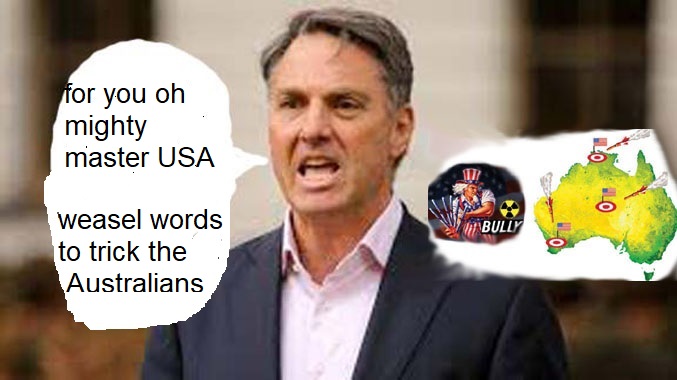
What we need now under either the optimist or the more realistic pessimistic view is a massive campaign, a campaign that starts today against the background of this terrible shock, this awful sense of betrayal.
A campaign which is made up diverse community-based groups, which has branches in suburbs and branches in country towns, broadly based with all sorts of elements and streams of opinion about peace.
Making the argument very clearly, based on experience, that the only times we have known Labor governments to stand up to the will of the United States have been on the back of huge long-running popular campaigns.
The first, now a long way back, was in the days of the Vietnam War, when Gough Whitlam became prime minister in 1972, and immediately responded to that high public pressure by ending our war in Vietnam, and of course, conscription of 19 year-olds for that purpose.
That only happened because of the pressure.
And the second was in the early 1980s when the Reagan administration, the most extreme rightwing administration since the early 1950s was pressuring Australia to take a greater role in the war against the then current demon, the Soviet Union.
It was again public pressure that forced the Hawke government to back down – in this city the role of the coalition of groups around People for Nuclear Disarmament and similar groups across the country – and then the electoral success of Nuclear Disarmament Party in the 1984 federal election.
We need that pressure – whether there is in fact a back door way out of this or not, there has to be huge public pressure on the Albanese Labor government.
Every time a Labor member of parliament or senator puts foot outside their office to appear in public, turns up at a public meeting, we need to ask them why have you betrayed us. Why have you allowed this to happen? What are you going to do?
We have to make it personal and objectionable and we have to make a whole lot of noise.
This must not stand.
Thank you. https://johnmenadue.com/these-are-the-horrors-of-aukus/
Lethal underwater nuclear submarines -their power to devastate the climate
Insanity: governments betray what climate science demands, Pearls and Irritations, By Andrew Glikson, Mar 25, 2023
Nowadays the last thing governments and major parties are following is what climate science requires, the single most critical factor society has ever faced…………………………………………………………………….
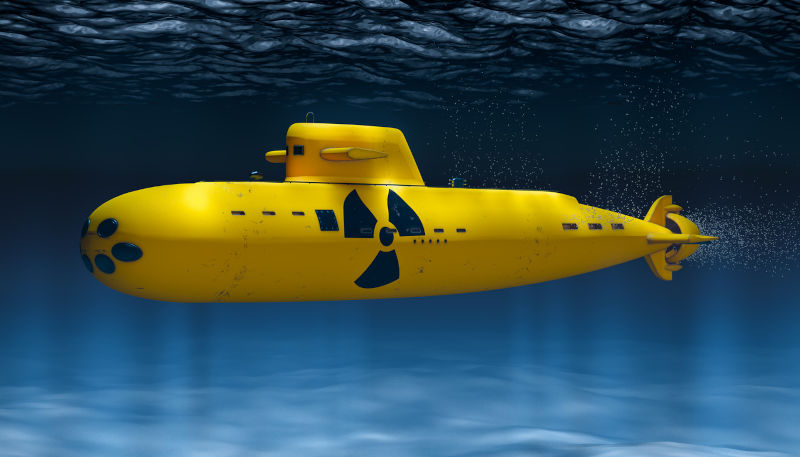
………………………………….another factor triggering major climate change: With the proliferation of nuclear weapons world-wide a combination of greenhouse and nuclear-induced climate changes have become increasingly likely. Armed with up to 40 nuclear Tomahawk Cruise missiles equipped with multiple warheads the Virginia class submarines constitute a lethal nuclear war platform whereby the arsenal of a single submarine can potentially annihilate major industrial centres and large population concentrations of an adversary. The firing of these missiles and retaliation from the surviving nuclear forces of the opponent virtually guarantee a global nuclear conflagration, including clouding of the atmosphere and obliteration of agriculture on a time scale of up to decades.
There were times when prophets promised the people peace on Earth, now the powers-to-be and their media mouthpieces are promising the world a nuclear holocaust between the rival empires in three years to come. Previous wars often erupted from territorial, economic, political, religious or ideological disputes, now the US vs China + Russia conflict is taking place between essentially private enterprise systems, repeating “sapiens’” insane obsession with war for the sake of war.
A nuclear war would terminate such insanity. Is it too late to hold pre-emptive Nuremberg trial for those who poison the planetary atmosphere and promote nuclear war? https://johnmenadue.com/the-faustian-bargain-how-governments-betray-what-climate-science-demands/
1 This month
7 April – WEBINAR – Australia and the Doomsday Clock – Preventing nuclear war through NoFirstUse and other policies
Online | Tuesday April 7, 4:00-5:30pm, Australian Eastern Time / 8:00-9:30am Central Europe Time
– Access the registration link
15 April – Zoom –Nuclear Power is Not the Solution
Apr 15, 2026 01:00 AM in Canberra, Melbourne, Sydney

Join the International Physicians for the Prevention of Nuclear War (IPPNW) on Tuesday, April 14th for a timely webinar exploring the risks associated with nuclear power and challenging the myth that it offers a simple, safe, carbon-free solution to the climate crisis

21 April Webinar: No Nuclear Weapons in Australia
Start: 2026-04-21 18:00:00 UTC Canberra, Melbourne, Sydney (GMT+10:00)
End: 2026-04-21 19:30:00 UTC Canberra, Melbourne, Sydney (GMT+10:00)
Event Type: Virtual
A virtual link will be communicated before the event.
Host Contact Info: australia@icanw.org

of the week – Australians for War Powers Reform (AWPR)
To see nuclear-related stories in greater depth and intensity
 Antinuclear