Australia Isn’t A Nation, It’s A US Military Base With Kangaroos, and happy to have Julian Assange imprisoned


Caitlin Johnstone 1 Apr 23 https://caitlinjohnstone.substack.com/p/australia-isnt-a-nation-its-a-us?utm_source=post-email-title&publication_id=82124&post_id=111947244&isFreemail=true&utm_medium=email
One of the many, many signs that Australia is nothing more than a US military and intelligence asset is the way its government has consistently refused to intervene to protect Australian citizen Julian Assange from political persecution at the hands of the US empire.
In a new article titled “Penny Wong moves to dampen expectation of breakthrough in Julian Assange case,” The Guardian quotes Australia’s foreign minister as saying, “We are doing what we can, between government and government, but there are limits to what that diplomacy can achieve.” Wong said this when asked if Prime Minister Anthony Albanese discussed the world’s most famous press freedom case with the US president and British prime minister when he met with them together two weeks ago.
Wong refused to say whether her government’s leader had raised the issue with his supposed US and UK counterparts, repeating instead the same line she’s been bleating since Labor took over: that the Assange case “has dragged on long enough and should be brought to a close.” Which if you listen carefully isn’t actually a statement in favor of releasing the WikiLeaks founder or blocking extradition — it’s just saying the case should be concluded hastily, one way or another.
These statements came in response to questions from Greens Senator David Shoebridge, who took a jab at the Labor government’s “quiet diplomacy” approach to the Assange case.
“The idea that quiet diplomacy must be so silent that the government can’t tell the public or the parliament if the PM even spoke to the president is bizarre,” Shoebridge said.
Wong told Shoebridge that Australia is powerless to intervene to protect the acclaimed Australian journalist, saying, “We are not able as an Australian government to intervene in another country’s legal or court processes.”
While it is true that Australia can’t force the US to end the political imprisonment and persecution of Assange for exposing US war crimes, it obviously can conduct diplomacy with its supposed ally in order to protect an Australian citizen. Even nations with whom Australia has no form of alliance are vocally confronted by Canberra when they imprison Australian citizens, like the statement Wong released yesterday regarding China’s detention of Chinese-Australian journalist Cheng Lei in which the foreign minister explicitly and unequivocally calls for “Ms Cheng to be reunited with her family.”
Just yesterday alone Wong tweeted to demand justice for Cheng and for American journalist Evan Gershkovich, who has been arrested in Russia on espionage charges.
“It is one year since Australian citizen Cheng Lei faced a closed trial in Beijing on national security charges,” tweeted Wong. “She is yet to learn the outcome. Our thoughts are with Ms Cheng and her loved ones. Australia will continue to advocate for her to be reunited with her children.”
“Australia is deeply concerned by Russia’s detention of Wall Street Journal Moscow correspondent Evan Gershkovich. We call on Russia to ensure access to consular and legal assistance,” Wong tweeted a few hours later.
Now guess how many times Penny Wong has tweeted the word “Assange”?
Answer: zero.
What is the basis for this discrepancy? Why has Australia’s foreign minister been publicly demanding that China release Cheng Lei and return her to her children, without making the same demands of the US for Julian Assange? Assange has children too, and he has been imprisoned for four times longer than Cheng — more than ten times longer if you count the period of his arbitrary detention in the Ecuadorian embassy in London before his arrest. Why are we seeing more action from the Australian government to defend an Australian journalist in China than to defend an Australian journalist fighting extradition to a nation we’re supposedly allied with which upholds itself as the leader of the rules-based international order?
The answer is that Australia is not a real country. It’s an American colony. It’s a giant US military base with kangaroos.
That’s why the Albanese government’s “quiet diplomacy” to free Assange is so quiet that it can’t actually be said to exist.
Regular readers may recall that the last time we discussed an interaction between Senators Wong and Shoebridge was when the former condescendingly dismissed the latter’s efforts to find out if the Australian government is allowing the US military to bring nuclear weapons into the country. Wong angrily told Shoebridge that the US has a standing “neither confirm nor deny” position with regard to where it keeps its nuclear weapons, and that the Australian government understands and respects that position.
We’re so far under Washington’s thumb that we’re not even allowed to know if there are American nukes in our country, and our own government can’t even advocate in defense of its own citizen when he’s being persecuted for the crime of good journalism.
Add that to the fact that Australia has been pressed into an AUKUS pact which makes us much less safe and a hostile relationship with China which hurts our own economic and security interests, the stationing of a US nuclear intelligence site which makes us a nuclear target, and the US staging literal coups of our government whenever its elected leaders threaten US strategic interests, and it becomes clear that our so-called “country” is functionally just a US aircraft carrier that happens to be the size of a continent.
Which would be bad enough if these bastards weren’t pushing us to play a front-and-center role in World War Three. We’ve got to start fighting against our enslavement to the US empire and against the Pentagon puppets in our own government like our lives depend on it, because they very clearly do.
AUKUS Exists To Manage The Risks Created By Its Existence
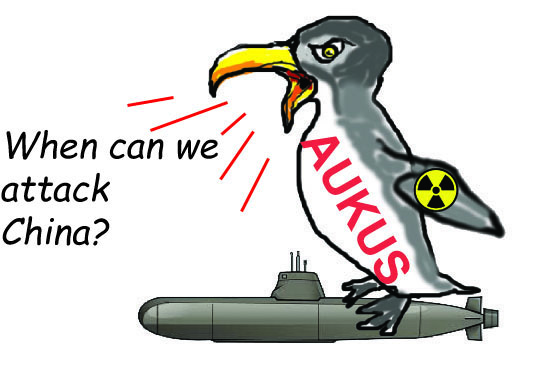
Australia would be at risk of being attacked by China because the US wants to use Australia to attack China.
The only way China attacks Australia is if Australia’s role as a US military asset makes us a target when the US attacks China
“NATO exists to manage the risks created by its existence,” Professor Richard Sakwa once wrote in an attempt to articulate the absurdity of the military alliance’s provocative nature on the world stage. At some point Australians must wake up to the fact that this is equally true of AUKUS: we’re told the military alliance exists for our protection, but its very existence makes us less safe.
As former prime minister Paul Keating recently observed in the Australian Financial Review, this government’s justification for the AUKUS alliance and the obscenely expensive nuclear submarine deal that goes with it has been all over the map, first claiming that it’s to protect our own shores from a Chinese attack, then pivoting to claiming it’s to protect sea lanes from being blocked off by China after Keating dismantled the first claim at the National Press Club two weeks ago.
One thing Canberra has struggled to do is to explain exactly why China would launch an unprovoked attack on Australia or its shipping routes; the former couldn’t yield any benefit that would outweigh the immense cost even if it succeeded, and the latter is absurd because open trade routes are what makes China an economic superpower in the first place.
Luckily for us, the Pentagon pets cited in the Australian media’s recent propaganda blitz to promote war with China explained precisely what the argument is on Canberra’s behalf. They say Australia would be at risk of being attacked by China because the US wants to use Australia to attack China.
…………………………………………………… In their haste to make the case for more militarism and brinkmanship, these war propagandists admit what’s long been obvious to anyone paying attention: that the only thing putting Australia in danger from China is its alliances and agreements with the United States. The difference between them and normal human beings is that they see no problem with this.
Other empire lackeys have been making similar admissions. In a recent article by Foreign Policy, Lowy Institute think tanker Sam Roggeveen is quoted as saying the AUKUS nuclear submarine deal will make it “almost impossible” for Australia to avoid getting entangled in a war between the US and China:………………
The only way China attacks Australia is if Australia’s role as a US military asset makes us a target when the US attacks China
…………………………………………………AUKUS has nothing to do with “defence”. You don’t need long-range submarines to defend Australia’s easily-defended shores, you need long-range submarines to attack China. Australia’s “defence posture” is an attack posture.
………………
AUKUS is not a defence partnership because it’s got nothing to do with defence, and it’s also not a defence partnership because it is not a “partnership”. It’s the US empire driving Australia to its doom, to nobody’s benefit but the US empire.
AUKUS exists to manage the risks created by its existence, and the same is true of ANZUS and all the other ways our nation has become knit into the workings of the US war machine. If we’re being told that our entanglements with the US war machine will make it almost impossible for us to avoid entering into a horrific war that will destroy our country, then the obvious conclusion is that we must disentangle ourselves from it immediately.
The problem is not that Australia’s corrupt media are saying our nation will have to follow the US into war with China, the problem is that they’re almost certainly correct.
The Australian media aren’t criminal in telling us the US is going to drag us into a war of unimaginable horror; that’s just telling the truth. No, the Australian media are criminal for telling us that we just need to accept that and get comfortable with the idea.
No. Absolutely not. This war cannot happen. Must not happen. We cannot go to war with a nuclear-armed country that also happens to be propping up our economy as our number one trading partner. We need to shred whatever alliances need to be shredded, enrage whatever powers we need to enrage, kick the US troops out of this country, get ourselves out of the Commonwealth while we’re at it, bring Assange home where he belongs, and become a real nation. https://caitlinjohnstone.substack.com/p/aukus-exists-to-manage-the-risks?utm_source=post-email-title&publication_id=82124&post_id=111711350&isFreemail=true&utm_medium=email
Small Modular Nuclear Reactors may not be the holy grail for energy security, net zero

So, if SMRs are the current political flavour of the month, how have we reached this position when there is still no formal approval of the technology from regulators, let alone practical evidence of how it can operate in the real world?
It’s possible to achieve both energy security and the UK’s climate goals without blowing the budget on next-gen nuclear technologies, according to Andrew Warren.
Andrew Warren, Chairman of the British Energy Efficiency Federation. https://electricalreview.co.uk/2023/03/29/smrs-may-not-be-the-holy-grail-for-energy-security-net-zero/
Electrical Review covered in-depth the array of announcements that were made during the Spring Budget, but there was arguably one announcement above all that was most pertinent to the net zero drive. That was when Chancellor Jeremy Hunt reconfirmed – for the fifth time – that the Government intends to create a new Great British Nuclear agency.

It is a name that of itself may bring comfort to all those living on the nuclear-free island of Ireland.
So what will this agency do? Well, the Chancellor explained that, when launched, it will run a competition this year for the UK’s first Small Modular Reactor (SMR). The plan is for it to eventually award £1 billion in co-funding to a winner to build out an SMR plan.
This competition has some distinct echoes. Back in March 2016, the Government launched a competition to identify the best value SMR design for the UK. To the best of my knowledge, nobody has ever claimed that prize, of £250 million.
This re-announcement prompted me to consider the background to this Budget announcement.
It comes at a time in which private sector funding for larger nuclear power stations is proving to be extremely difficult. There is a lengthy list of large pension funds that have publicly refused to get involved with providing capital for the hapless Sizewell C pressurised water reactor project in Suffolk. Meanwhile, European Commission President Ursula von der Leyen is rumoured to be promoting the inclusion of SMRs within the European green investment taxonomy, whilst simultaneously excluding pressurised water reactors which make up most of the existing nuclear fleet.
So, if SMRs are the current political flavour of the month, how have we reached this position when there is still no formal approval of the technology from regulators, let alone practical evidence of how it can operate in the real world?

In January, the UK Government announced that six SMR vendors had applied for their designs to be formally assessed with a view to commercialisation in Britain. The companies have joined a much publicised Rolls-Royce-led consortium and will be subjected to an assessment process carried out by the UK’s Office of Nuclear Regulation (ONR), which will look in exhaustive detail at reactor designs proposed for construction.
Designs that successfully complete the Generic Design Assessment (GDA) – which is expected to take between four and five years – will then be ready to be built anywhere in the country, subject to meeting site-specific requirements.
Why do we need new reactor designs?
Recent results of orders placed for larger nukes are uniformly poor, with reactors invariably late and over budget. Some of the worst cases, notorious projects in Olkiluoto, Finland and Flamanville, France, have seen construction periods of 18 years and costs of three to four times above the expected level.

So, SMRs are being increasingly seen as the new saviours for the nuclear industry. This category embodies a range of technologies, uses and sizes, but relies heavily on features that were the selling points for larger designs. They are smaller than current stations which produce 1,200MW to 1,700MW of electricity. Instead, sizes range from 3MW to about 500MW. The Rolls-Royce design is a 470MW pressurised water reactor, which is bigger than one of the reactors at Fukushima in Japan that suffered serious damage in the 2011 tsunami.
These advanced designs are not new – sodium-cooled fast reactors and high temperature reactors were built as prototypes in the 1950s and 1960s – but successive attempts to build demonstration plants have been short-lived failures. It is hard to see why these technologies should now succeed given their poor record.
A particular usage envisaged for some of the technologies is production of hydrogen. However, as Professor Stephen Thomas of Greenwich University recently pointed out to me, to produce hydrogen efficiently, reactors would need to provide heat at 900°C. This, he said, is “a temperature not yet achieved in any power reactor, not feasible for a pressurised water reactor or boiling water reactor and one that will require new exotic and expensive materials.”

Developers of SMRs like to give the impression that their designs are ready to build, the technology proven, the economic case established and all that is holding them back is Government inactivity. However, taking a reactor design from conception to commercial availability is a lengthy and expensive process taking more than a decade and certainly costing more than £1 billion.
How can the economics of SMRs be tested?
The main claim for SMRs over their predecessors is that being smaller, they can be made in factories as modules using cheaper production line techniques, rather than one-off component fabrication methods being used at Hinkley Point C. The idea is that the module would be delivered to the site on a truck essentially as a ‘flatpack’. This would avoid much of the on-site work which is notoriously difficult to manage and a major cause of the delays and cost overruns that every European large reactor project suffers from.
However, any savings made from factory-built modules will have to compensate for the scale economies lost. A 1,600MW reactor is likely to be much cheaper than 10 reactors of 160MW.
And it will be expensive to test the claim that production line techniques will compensate for lost scale economies. The first reactor constructed will need to be built using production lines if the economics are to be tested. But once the production lines are switched on, they must be fed. Rolls-Royce assumes its production lines will produce two reactors per year and that costs will not reach the target level until about the fifth order. So, if we assume the first reactor takes five years to build, there will be another nine reactors in various stages of construction before a single unit of electricity has been generated from the first, and the viability of the design tested.
This could mean that perhaps about 15 SMRs will need to be under construction before the so-called ‘nth of a kind’ settled-down cost is demonstrated. But once the initial go ahead is given, there will be pressure on the Government to continue to place orders before the design is technically and economically proven, so the production lines do not sit idle.
Will SMRs be a major contributor to meeting the UK’s climate change targets?

The selling point for nuclear power is that it is a relatively low-carbon source of power that can replace fossil fuel electricity generation in the UK and elsewhere. However, by the time SMRs might be deployable in significant numbers, realistically after 2035, it will be too late for them to contribute to reducing greenhouse gas emissions. Electricity is acknowledged to be the easiest sector to decarbonise. If the whole economy is to reach net zero emissions by 2050, then this sector will have to reach that point long before then, probably by 2035. So SMRs appear to be too little, too late.

There is also a fear that SMRs will create more waste than conventional reactors, according to a study recently published in Proceedings of the American National Academy of Sciences. The research notes that SMRs would create far more radioactive waste, per unit of electricity they generate, than conventional reactors by a factor of up to 30. Some of these smaller reactors, with molten salt and sodium-cooled designs, are expected to create waste that needs to go through additional conditioning to make it safe to store in a repository.
And yet, despite the past failures of nuclear power and increasing public scepticism, there remains an appetite within the British Government to give the nuclear industry one more chance.
It remains to be seen whether the Government follows its instinct to continue supporting the sector or whether the amount of public money at risk makes such a decision politically impossible, given the massive underwriting these projects require by consumers and taxpayers.
Nuclear’s specious claims
The claims being made for SMRs will be familiar to long-time observers of the nuclear industry: costs will be dramatically reduced; construction times will be shortened; safety will be improved; there are no significant technical issues to solve; nuclear is an essential element to our energy mix.
In the past such claims have proved hopelessly over-optimistic and there is no reason to believe results would turn out differently this time. Indeed, the nuclear industry may well see itself in this ‘last-chance saloon’.
The risk is not so much that large numbers of SMRs will be built; it is my belief that they won’t be. The risk is that, as in all the previous failed nuclear revivals, the fruitless pursuit of SMRs will divert resources away from options that are cheaper, at least as effective, much less risky, and better able to contribute to energy security and environmental goals. Given the climate emergency we face, surely it is time to finally turn our backs on this failing technology.
Andrew Warren is a former special advisor to the House of Commons environment committee. Special thanks to Greenwich University’s Professor Stephen Thomas for his advice for this piece.
Timothy Clifford – Submission – Australia has the opportunity to become a clean energy superpower – nuclear is unviable and a distraction.
Submission No. 122 To: Committee Secretary, Senate Standing Committees on Environment and
Communications
Submission: The Environment and Other Legislation Amendment (Removing
Nuclear Energy Prohibitions) Bill 2022
I am writing as I was extremely concerned to learn that several politicians are
pushing for the removal of the Nuclear Energy Prohibitions Bill. I am strongly
opposed to this as nuclear energy is not a viable solution both in a financial and
technological sense and presents a huge risk for current and future Australians.
Everyday Australians are currently feeling the pressure of energy price
increases due to our ageing infrastructure, a result of political inaction for over
a year. Renewables are here, they’re cheaper than all other forms of energy
and have virtually no environmental impact when compared to fossil fuels or
nuclear. Considering nuclear energy will only slow the transition to renewables
and lead to further increases in energy bills for Australian families.
It’s true that sunshine and wind can’t be dug up, which is likely why some
politicians and their millionaire mining donors are so against them.
The proponents of nuclear talk about futuristic, modular reactors. These are
nowhere near being commercially available and it’s unclear if they ever will be.
Even if we assume they will be at some point, the issues around nuclear waste
and security threats remain and these will only increase as climate change
grows more extreme
Our own climate science and policy experts, Climate Council, have already
ruled out nuclear energy as a viable solution – “Nuclear power stations are
highly controversial, can’t be built under existing law in any Australian state or territory, are a more expensive source of power than renewable energy, and present significant challenges in terms of the storage and
transport of nuclear waste, and use of water.”
Let’s listen to the experts, not a
group of self-interested politicians and lobbyists.
I strongly urge members of the senate to decouple Australia’s energy resources
from dangerous, polluting, finite resources and focus our efforts on natural, clean, infinite renewables. We have the potential to be a clean energy superpower, strengthening our economy, security and environment for
Australians now, and in centuries to come. https://www.aph.gov.au/Parliamentary_Business/Committees/Senate/Environment_and_Communications/Nuclearprohibitions/Submission
Australian Labor prepares return to disastrous Forward Defence doctrine
Pearls and Irritations, By Brian Toohey, Mar 31, 2023
Nearly everything the Labor government says about nuclear subs is ludicrous and highly damaging.
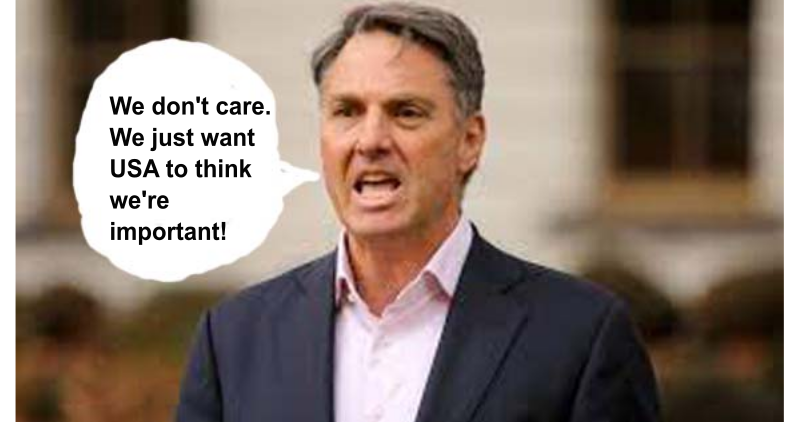
Despite Defence Minister Marles apparently saying Australia will not participate in a war over Taiwan, Hugh White (ex- Dep Head Defence) says the US would never sell nuclear submarines to Australia without guarantees they will always be used in a US war. The reason is that these subs are taken from off its own line of battle. They are not additional submarines from the production line. Once again, Australian sovereignty does not exist in the sense of being able to use US weapons how we want to do after buying them.
Marles now says the nuclear subs are not for war, but to protect Australian merchant shipping. A leading economist Percy Allan points out there are 26,000 cargo ship movements to and from Australia each year. Nuclear subs have terrible maintenance problems and if we buy the expected three second hand Virginia Class attack subs from America, only one might be operationally available at any time and probably none.
One sub, let alone none, can’t protect 26,000 cargo shipping movements, but mainstream journalists swallow this nonsense.
Before his sudden conversion to pacifism, Marles wanted to deploy the nuclear subs off the Chinese coast to fire long-range cruise missiles into the mainland. This represents a return to the Forward Defence doctrine that failed in Singapore in 1942, and later in Vietnam. Arthur Calwell gave a magnificent anti-war speech in 1965. He was fully vindicated when the Vietnamese won a war against a horrendously destructive invasion that was a war crime. Now, Albanese effectively supports war.
With Labor now returning to the disastrous Forward Defence doctrine, it’s worth remembering the Coalition defence minister in 1969 Allen Fairhall scrapped this doctrine and cut military spending by 5%, while there were still 7,000 Australian troops in Vietnam. The Coalition then switched to the direct defence of Australia. Whitlam, Fraser, Hawke and Keating all embraced the defence of Australia, not forward defence. Keating also adopted a long sighted policy of seeking our security in Asia, not from it.
Later, in the 2003 invasion of Iraq, Howard reverted to do America’s bidding in another war crime of aggression.
Australia’s best defence is it’s surrounded by water and a long way from China or India. There is no evidence either is a threat. If this changes for the worse, the Defence of Australia doctrine will come into its own.
Marles and Albanese will recklessly position nuclear subs off China. But that’s where China’s forces are concentrated. Because Marles and Albanese would be playing to China’s strengths, they would then be responsible for a disastrous military blunder when the subs are sunk.
It would be much better to play to our strengths, by defending the approaches to Australia by buying highly advanced, medium sized, submarines that are superior to nuclear subs.

Marles estimates his subs will cost up to $368 billion (realistically over $400b). As explained later, that includes the crazy decision to pay the UK to co-design 8 new submarines for Australia. This dwarfs the next highest defence acquisition —$17 billion for F-35 fighter jets.
The US Government Accountability Office and the Congressional Research Service have an outstanding record for exposing appalling waste and incompetence in US submarine shipyards. One Virginia sub was tied up at a jetty for five years before it could be fixed. The US has a military budget of $US880, yet Albanese is donating $3 billion to help improve the shipyards.
Marles did not take the responsible ministerial step and commission a cost-effectiveness study of the options before splurging $400 billion. Australia could get ten superior conventional submarines for a total $10-$15 billion from Japan, South Korea or Germany that could deter any hostile ships approaching Australia from a couple of thousand kilometres away. Submerged drones and mines could also help at a low cost.
Japan’s new Taigei subs use highly advanced batteries that run silently for several weeks without needing to surface to charge the batteries. South Korean and German submarines are about to get much improved batteries. These new subs can run silently on hydrogen fuel cells as well as batteries.
Nuclear subs are easier to detect. When they go at high-speed, they make a detectable wake. Being much bigger, they have a stronger magnetic impression than suitable conventional boats.
Like other subs, nuclear ones have to come to the surface to stick up periscopes and radar and electronic warfare equipment. They produce an easily detected infrared signal due to the reactor constantly boiling water for steam engines to propel the subs. (Nuclear power does not propel the sub. Puffing Billy does.)
Another huge problem with nuclear subs is the government has rightly said it will take all the highly enriched uranium waste at end of the sub’s life, then safely store it. This requires the waste to be vitrified overseas and returned in thick drums for burying deep in stable dry underground rock formations for hundreds of years and heavily guarded. Each reactor weighs 100 tons and contains 200 kg of highly radioactive uranium. When used in nuclear power stations, uranium is enriched to about 5%, the same as for French and Chinese nuclear submarines and 20% for Russian. It’s 93% for ours, greatly exacerbating the disposal problem.
I recently asked Australia’s principal nuclear safety organisation, the Australian Radiation Protection and Nuclear Safety Agency about how such waste could be safely stored. It refused to answer. Perhaps it was intimidated by Defence.
Marles exacerbated the problem by saying the waste uranium would be stored “on” defence land. It can’t be stored safely on top of the land. It must be stored deep underground. He’s not dealing with low-grade hospital nuclear waste.
Neither the US or the UK has a high-level underground nuclear waste repository. They could easily pressure Australia into securing their waste from their nuclear subs reactors here.
It seems likely the burial site will be on land in central Australia that is important to Australia’s indigenous population. Whatever happens, it is essential there is no repeat of the way the indigenous people were wilfully exposed to radiation during and after the British nuclear tests in the 1950s and 60s in Australia’s south and central desert areas…………………………………………………………….. more https://johnmenadue.com/labor-prepares-return-to-disastrous-forward-defence-doctrine/
Fight For Country – the story of the Jabiluka Blockade (Pip Starr) – anniversary 1 April 23
Today is the 25th Anniversary in stopping the Jabiluka Uranium Mine in Kakadu Northern Territory and this movie is about their fight called Fight for Country
Fight For Country tells the story of one of Australia’s largest ever land rights and environmental campaigns, the fight to stop the building of a second uranium mine within Kakadu National Park.
Made with the cooperation of the Mirrar aboriginal clan, the owners of the land on which Jabiluka was proposed to be built on. Includes a 12 minute animation of the nuclear fuel cycle with archival footage from Chernobyl, Chelyabinsk, Sellafield and others.
Features some very funky animations made by Fishfeet Designs. Writer/director/camera/editor: Pip Starr Producer/Technical Direction/ Audio : Bill Runting Animations – Dermot Egan, Fishfeet Designs. Digitized from FOE (Melbourne) Anti-Nuclear Archives.
Helen Bradbury – Submission – nuclear power not only useless against climate change, but also becomes a serious risk in extreme weather events.

Environment and Other Legislation Amendment (Removing Nuclear Energy Prohibitions) Bill 2022 Submission No. 103
Australians do not need or want Nuclear Power in this country.
Australia needs FAST transition to renewable energy & going down the nuclear energy path is expensive, slow & delays our country’s path to a better energy solution to assist in delaying climate change. The delays in regulating & building nuclear power will seriously delay actions that can mitigate climate change issues.
With floods & fires recently all over Australia (& extreme weather events World wise)we need alternative power solutions Immediately!
Nuclear Power is 5 times more expensive to establish than renewable energy infrastructure
It is a serious risk during 1 in 100/ climate change weather events( floods/fires etc).
We don’t need nuclear power. Australians need renewable energy infrastructure to be encouraged & built.
Saul Griffith “The Big Switch” author has worked in the US but now lives back in Australia & is the man to speak to. ( listen to his Radio National interview) we need renewables.
Nuclear power is risky, very slow to provide an energy solution and very expensive to build, operate and the … https://www.aph.gov.au/Parliamentary_Business/Committees/Senate/Environment_and_Communications/Nuclearprohibitions/Submission
AUKUS: Mirage or reality?

So far, all this remains hypothetical.
Less hypothetical are the immediate benefits to flow to UK and US shipyards. In the absence of its own facilities to build such submarines, the Australian taxpayer is funding the naval industries of both countries.
It was little wonder that British Prime Minister Rishi Sunak was reported to be ‘buzzing about it when he told ministers, smiling and bouncing on the balls of his feet.’
Eureka Street Binoy Kampmark, 28 March 2023
In his March 15 address to a Canberra press gallery, former Labor Prime Minister Paul Keating was unsparing about those ‘seriously unwise ministers in government’ – notably Foreign Minister Penny Wong and Defence Minister Richard Marles, unimpressed by their uncritical embrace of the US war machine. ‘The Albanese Government’s complicity in joining with Britain and the United States in a tripartite build of a nuclear submarine for Australia under the AUKUS arrangements represents the worst international decision by an Australian Labor government since the former Labor leader, Billy Hughes, sought to introduce conscription to augment Australian forces in World War One.’
The bipartisanship extended to a meeting between Marles and Wong with their Coalition counterparts on September 15, 2021 just prior to the announcement of the security pact. Since then, questions loomed about acquisition, construction and delivery of the nuclear-propelled submarines. This month, the picture was made clearer, if troublingly so.
The scale of this project is staggering in cost projections, envisaging an outlay of $368 billion for up to eight vessels over three decades, with possibly more in the offing. Canberra will initially purchase at least three US-manufactured nuclear submarines while contributing ‘significant additional resources’ to US shipyards. Two more vessels are also being thrown in as a possibility, should the ‘need’ arise.
During this time, design and construction will take place on a new submarine dubbed the SSN-AUKUS, building on existing work undertaken by the UK on replacing the Astute-class submarines. It will be, according to the White House, ‘based upon the United Kingdom’s next generation SSN design while incorporating cutting edge US submarine technologies, and will be built and deployed by both Australia and the United Kingdom.’
The White House statement also promises visits by US nuclear submarines to Australia this year, with Australian personnel joining US crews for ‘training and development’. The UK will take its turn at the start of 2026. In 2027, a UK-US ‘Submarine Rotational Force-West’ (SRF-West) will be established at HMAS Stirling near Perth. It follows that Australia will be further militarised as a forward base in future US operations in the Indo-Pacific…………………………………………………………
So far, all this remains hypothetical. Less hypothetical are the immediate benefits to flow to UK and US shipyards. In the absence of its own facilities to build such submarines, the Australian taxpayer is funding the naval industries of both countries. It was little wonder that British Prime Minister Rishi Sunak was reported to be ‘buzzing about it when he told ministers, smiling and bouncing on the balls of his feet.’
,,,,,,,,,,,,,,,,,,,,,,,,,,,,,,,,,,,,, West Australian Labor backbencher Josh Wilson, echoing the concerns of regional powers such as Indonesia and Malaysia, has also raised the issue of how ‘we can adequately deal with the non-proliferation risks involved in what is a novel arrangement, by which a non-nuclear weapons state under the NPT (Non-proliferation of Nuclear Weapons Treaty) comes to acquire weapons-grade material.
To this can be added the problem of how to dispose of nuclear waste; for decades the Australian government has failed to identify and build a deep storage facility for low- to intermediate-level waste. Currently, the controversial selection of the Kimba site in South Australia is being litigated in the Federal Court by the Barngarla Determination Aboriginal Corporation (BDAC). The proposed facility does not cover the issues surrounding high-level waste typical from such submarines, which are bound to be even more contentious.
A gaggle of former senior Labor ministers have also emerged with questions and criticisms. unanswered questions. …………………………………………
For all the salutes, flag waving and celebrations, the AUKUS balance sheet is looking increasingly bleak for the peacemakers, even as Australia enmeshes itself further within the US military apparatus and its lines of command and control. Tubagus Hasanuddin, a senior member of Indonesia’s ruling Democratic Party of Struggle (PDI-P) has made the pertinent observation: ‘AUKUS is created for fighting.’ more https://www.eurekastreet.com.au/aukus-mirage-or-reality?utm_medium=email&utm_campaign=Eureka%20Street%20-%20Thursday%2030%20March%202023&utm_content=Eureka%20Street%20-%20Thursday%2030%20March%202023+CID_4e2ec283f8d3ec87304b26f5363c5818&utm_source=Jescom%20Newsletters&utm_term=READ%20MORE
Community trust requires public discussion and transparency.

David Noonan 30 Mar 23

According to the Department of Defence, the process for selecting a site for high-level nuclear waste will include engaging with community and First Nations groups.
Community engagement expert, Professor Sara Bice from the Australian National University, says best practice consultation for something as controversial as nuclear submarines or high-level radioactive waste would ideally begin early, be transparent and involve public discussion about whether the technology is desired in the first place.
“We’re beyond the point where communities can have genuine consultation on this issue. Because the decision has already been made for them. The government has decided that this is a type of weaponry and defence mechanism that is going to occur within Australia. So, things like the nuclear waste sites […] will have to occur in order for AUKUS to proceed.”
The option of a site in outback South Australia has been floated by the Premiers of Victoria and Western Australia.
But Bice says there are implications of proposing a waste site in outback South Australia, given that state already went through a robust process – with a Royal Commission, public engagement and a Citizen Jury – to consider high-level waste in 2015 and 2016. That process concluded with 27 Native Title groups and the majority of the Citizen Jury rejecting the idea.
Re-opening the discussion of nuclear waste in South Australia suggests the expectation you might get a different outcome, she says.
“I think that’s a bit disingenuous, and it undermines the thing that we look for most when we talk about a social licence, which is trust.”
She says when large, controversial decisions are made without public discussion or consultation, it creates fear and conditions ripe for opposition and protest.
Australia finally has a climate policy after lost decade, but not everyone is making progress — RenewEconomy

After lost decade, Australia has a climate policy. It feels right to enjoy the moment – at least for the remainder of the week. Another small, baby step for mankind. The post Australia finally has a climate policy after lost decade, but not everyone is making progress appeared first on RenewEconomy.
Australia finally has a climate policy after lost decade, but not everyone is making progress — RenewEconomy
Fire on Trident nuclear submarine at Scots navy base prompts safety concern for nearby locals.
Fire on Trident nuclear submarine at Scots navy base prompts safety
concern for nearby locals. The fire on-board HMS Victorious last year
raised concerns from local councillors about what was being done to keep
residents safe in the event of a nuclear incident.
Daily Record 30th March 2023
https://www.dailyrecord.co.uk/news/scottish-news/fire-trident-nuclear-submarine-scots-29592800
Glasgow Live 30th March 2023
https://www.glasgowlive.co.uk/news/fire-trident-nuclear-submarine-prompts-26592968
China’s new warning to Australia over nuclear submarine deal
China has fired off another dire warning to Australia, amid growing tension over the nuclear submarine deal with the US and Britain.
Carla Mascarenhas, 1 Apr 23
Global superpowers unite against US
‘Anytime, anywhere’: Kim’s nuke threat
Dan appears on Chinese TV
China has fired off a frightening warning to Australia over its nuclear submarines deal with the US and the UK, declaring it may trigger an unpredictable global arms race.
The Chinese foreign ministry said on Thursday that once a Pandora’s box is opened, the “regional strategic balance will be disrupted and regional security will be seriously threatened”.
The United States, Australia and UK this month unveiled details of a plan to provide Australia with nuclear-powered attack submarines from the early 2030s to counter China’s ambitions in the Indo-Pacific.
“China firmly opposes the establishment of the so-called ‘trilateral security partnership’ between the United States, the United Kingdom and Australia,” said Tan Kefei, a spokesman at the Chinese defence ministry, during a regular press briefing.
“This small circle dominated by Cold War mentality is useless and extremely harmful.”
Mr Tan added such co-operation was an extension of the nuclear deterrence policy of individual countries, a game tool for building an “Asia-Pacific version of NATO” and seriously affected peace and stability in the Asia-Pacific region………………………………………………………….
Richard Dunley, a naval and diplomatic historian, said the deal “looks best from Washington – they get major wins in terms of basing, maintenance support and recapitalisation in their yards”.
He noted the Australian perspective was “less clear”.
“The cost is astronomical,” he wrote on Twitter.
Huge but still unknown amounts will be paid to the US in subsidies and then to buy the Virginias. This capability will only realise materialise mid-next decade, and is only a stopgap.”
carla.mascarenhas@news.com.au https://www.news.com.au/world/asia/chinas-new-warning-to-australia-over-nuclear-submarine-deal/news-story/16904f97d0a534af20dd69815f9c1986
1 This month
7 April – WEBINAR – Australia and the Doomsday Clock – Preventing nuclear war through NoFirstUse and other policies
Online | Tuesday April 7, 4:00-5:30pm, Australian Eastern Time / 8:00-9:30am Central Europe Time
– Access the registration link
15 April – Zoom –Nuclear Power is Not the Solution
Apr 15, 2026 01:00 AM in Canberra, Melbourne, Sydney

Join the International Physicians for the Prevention of Nuclear War (IPPNW) on Tuesday, April 14th for a timely webinar exploring the risks associated with nuclear power and challenging the myth that it offers a simple, safe, carbon-free solution to the climate crisis

of the week – Australians for War Powers Reform (AWPR)
To see nuclear-related stories in greater depth and intensity
 Antinuclear