Opposition grows to nuclear submarines in Port Kembla
by Owen Marsden-Readford https://redflag.org.au/article/opposition-grows-nuclear-submarines-port-kembla, Wednesday, 19 April 2023

Last year, as part of the AUKUS pact, Liberal Prime Minister Scott Morrison announced plans for a new submarine base on Australia’s east coast. The Labor government that succeeded Morrison’s has said it will stick with this plan.
There is increasing speculation that the site for the base will be Port Kembla, a southern suburb of Wollongong in the Illawarra region of the NSW south coast. While Labor insiders have claimed a final decision won’t be made until after the next federal election, the ABC recently reported that, according to “defence, government and industry figures”, Port Kembla “is now the strongly favoured option” for its deep port and proximity to other military bases and Australia’s lone nuclear reactor at Lucas Heights.
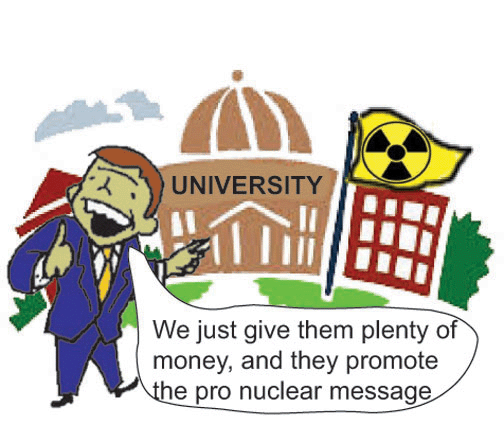
The plan has received support from some local business figures, and the University of Wollongong is deepening its already extensive ties with the military-industrial complex in anticipation. Among the wider community, however, opposition is growing.
Several unions have already come out against the proposed base. The New South Wales Teachers Federation passed a motion at its March council meeting:
“Continuing reports that Port Kembla is being considered as the site for a nuclear submarine base is of deep concern for our public education communities. While governments appear ever ready to commit huge amounts of public revenue on military expenditure there remains a serious underfunding of public pre-schools, public schools, TAFE and higher education, and other areas of the public sector.”
The Kiama council also passed a motion opposing a submarine base at Port Kembla. Even the Dapto and Port Kembla branches of the Labor Party have passed oppositional motions. Socialist students in the Wollongong Undergraduate Students’ Association have passed motions opposing the nuclear submarines, the AUKUS pact and the Australian government’s war drive.
Importantly, the South Coast Labour Council has called for this year’s May Day rally to be held in Port Kembla on Saturday, 6 May, to oppose the planned base. Council secretary Arthur Rorris told the Sydney Morning Herald, “If they want to turn our harbour into a nuclear parking lot, we will fight them tooth and nail”. There will even be a solidarity action held in San Francisco outside the Australian consulate.
Wollongong Against War and Nukes (WAWAN)—a campaign group formed last year—has held a series of protests against AUKUS. The most recent, on 4 April, drew more than 80 people in opposition to the Illawarra Defence Industry Conference—a gathering of war hawks and military profiteers.
Socialist and WAWAN activist Luke Hocking said in a speech at the protest, “If we are all committed to building this movement … then we can make something that can physically get in the way of their plans. And the more of us there are, the better we will be able to do that”. WAWAN will be holding a community forum in Port Kembla on Saturday, 29 April, and is planning further protests.
The Illawarra has a proud history of working-class anti-imperialism. We should look to these traditions as we set out to build resistance to the planned submarine base, the AUKUS pact and the militarism of the Australian ruling class and its US and British allies.
Penny Wong’s World View: AUKUS All The Way

Australian Independent Media, April 19, 2023, Dr Binoy Kampmark
If anyone was expecting a new tilt, a shine of novelty, a flash of independence from Australian Foreign Minister Penny Wong’s address to the National Press Club on April 17, they were bound to be disappointed. The anti-China hawks, talons polished, got their fill. The US State Department would not be disturbed. The Pentagon could rest easy. The toadyish musings of the Canberra establishment would continue to circulate in reliable staleness.
In reading (and hearing) Wong’s speech, one must always assume the opposite, or something close to it. Whatever is said about strategic balance, don’t believe a word of it; such views are always uttered in the shadow of US power. From that vantage point, Occam’s Razor becomes a delicious blessing: nothing said by any Australian official in foreign policy should ever be taken as independently relevant. Best gaze across the Pacific for confirmation.
………….. Like a lecture losing steam early, she finally gets to the point of her address: “how we avert war and maintain peace – and more than that, how we shape a region that reflects our national interests and our shared regional interests.” It does not take long to realise what this entails: talk about “rules, standards and norms – where a larger country does not determine the fate of the smaller country, where each country can pursue its own aspirations, its own prosperity.”
That the United States has determined the fate of Australia since the Second World War, manipulating, interfering and guiding its politics and its policies, makes this statement risible, but no less significant. We are on bullying terrain, and Wong is trying to pick the most preferable bully.
She can’t quite put it in those terms, so speaks about “the regional balance of power” instead, with Australia performing the role of handmaiden. ……..
It takes one, obviously, to know another, and Senator Wong, along with Prime Minister Anthony Albanese, have shown little resistance to the very binary concept they supposedly repudiate. Far from opposing it, we might even go so far as to see their seduction by US power as a move towards the unitary: there is only one choice for the Canberra cocktail set.
……… Wong is keen to point the finger to one great power’s behaviour: unstainable lending, political interference, disinformation, reshaping international rules and standards.
Finally, the dastardly feline is out of the bag – and it is not the United States. “China continues to modernise its military at a pace and scale not seen in the world for nearly a century with little transparency or assurance about its strategic intent.”
….
Jonathon Porritt: Germany’s nuclear nous vs UK nuclear nutters.

So that’s another dead duck in the case made for new nuclear. Which just leaves the final barrier: the continuing reality that our nuclear weapons capability still depends very heavily on maintaining a civil nuclear power programme – not just to guarantee a continuing supply of nuclear engineers and R&D funding, but to keep the public in the dark about the increasingly insupportable costs of renewing our notionally ‘independent’ nuclear deterrent.
I’m celebrating today – for the simple reason that Germany closed down its three remaining nuclear reactors on Saturday 15th April.
I’ve followed the nuclear debate in Germany ever since I first got involved in green politics back in the 1970s, and was hugely inspired by the campaigns of Die Grünen against both nuclear power and nuclear weapons – seeing the two as inextricably linked. Interestingly, it’s as controversial a debate now as it was then – with a majority of people in Germany (including some Die Grünen voters) still believing that nuclear power should be part of the electricity mix.
As I argued back in 2011, I did not agree with the decision of the Merkel Government (in coalition with Die Grünen) to close down all its remaining reactors in response to the Fukushima disaster – well before the end of their scheduled operational lifetime. Inevitably, this decision caused an (albeit temporary) increase in burning coal and gas.
That’s now water under the bridge – and Germany’s energy system will now be completely nuclear-free, even if it will be dealing with the legacy of its nuclear waste for many years to come. As the German Environment Minster, Steffi Lemke, said: ‘Three generations have benefitted from nuclear power in Germany, but about 30,000 generations will be affected by the ongoing presence of nuclear waste.’
But my celebration has been sadly attenuated by the current nuclear frenzy going on here in the UK. I’ve been through many periods of nuclear hype over the years, but nothing quite like this one – with all the mainstream political parties, the industry itself and all mainstream media (including some sorely deluded muppets in the BBC and the Guardian) ramping up their ‘nuclear renaissance’ rhetoric in increasingly dishonest and fact-free ways.
I suspect they see this as a ‘now or never’ moment before economic reality kills off nuclear power once and for all – when that combination of renewables-storage-efficiency is so massively outperforming nuclear as to starve all nuclear options of the capital they will still need. Government subsidy can only go so far.
In the meantime, however, we have a Government still strenuously seeking investors in its godforsaken plans for two more ludicrously expensive reactors at Sizewell C – an asset that already looks totally stranded even before a Final Investment Decision is taken.
Even that, however, is just a sideshow in comparison to the hype around prospects for Small Modular Reactors (SMRs) here in the UK. In March, the Chancellor announced a new competition to identify the best value SMR design for the UK, with a view to its eventually handing over a full £1bn in co-funding to get that design off the ground. Ludicrous. But full marks to the Tories for ‘recycling’ here: the announcement sounded almost identical to the earlier competition it announced back in March 2016. (And it was only the fifth time that the Chancellor reconfirmed plans for a new Great British Nuclear agency!)

Apart from the nuclear industry itself, and all its happy-clappy cheerleaders, the majority of independent commentators continue to point out that SMRs cannot possibly deliver what we now need: safe, affordable, ultra-low-carbon electricity that can actually make a practical difference in meeting our Net Zero target by 2035.

And that’s before one thinks about the nuclear waste nightmare: a new study published in Proceedings of the American National Academy of Sciences estimates that SMRs will create 30 times as much nuclear waste (per unit of electricity generated) as conventional reactors.
It’s all just a massive waste of time and public money – but with devastating consequences. If we could just free ourselves of our residual hankering after nuclear power, we could (finally!) double down on the infinitely more cost-effective renewables-storage-efficiency alternatives. With massive benefits in terms of decarbonisation, jobs, addressing fuel poverty and so on.
The case for this transition (away from fossil fuels and nuclear) is now incontrovertible but two remaining barriers stand in the way of us doing what Germany has managed to do.
The first is the endlessly repeated argument from nuclear industry spokespeople that nuclear power is the only way of providing the baseload generation our current electricity supply system depends on – once big thermal coal and gas plants are taken off the grid. There was indeed a time when grid stability depended on ‘always on’ big power stations. But that is now widely seen (outside the nuclear industry) to be a completely outmoded concept.
……………………… , the Government acknowledges that there is now no specific baseload expectations of nuclear or anything else. It is now all about ‘lowest cost’, rather than baseload,………..
So that’s another dead duck in the case made for new nuclear. Which just leaves the final barrier: the continuing reality that our nuclear weapons capability still depends very heavily on maintaining a civil nuclear power programme – not just to guarantee a continuing supply of nuclear engineers and R&D funding, but to keep the public in the dark about the increasingly insupportable costs of renewing our notionally ‘independent’ nuclear deterrent.

Which takes us right back to the origins of the German anti-nuclear movement in the 1970s. These ‘evil twins’, nuclear weapons and nuclear power, have forever been joined at the hip, and always will be until the world rids itself of the deadly incubus of nuclear weaponry.
Leaks Reveal Reality Behind U.S. Propaganda in Ukraine
The inability of either side to decisively defeat the other in the ruins of Bakhmut and other front-line towns in Donbas is why one of the most important documents predicted that the war was locked in a “grinding campaign of attrition” and was “likely heading toward a stalemate.”
What U.S. intelligence officials know, but the White House is doggedly ignoring, is that, as in Afghanistan and Iraq, top Ukrainian officials running this endemically corrupt country are making fortunes skimming money from the over $100 billion in aid and weapons that America has sent them.
By Medea Benjamin and Nicolas J. S. Davies, World BEYOND War, April 19, 2023
The U.S. corporate media’s first response to the leaking of secret documents about the war in Ukraine was to throw some mud in the water, declare “nothing to see here,” and cover it as a depoliticized crime story about a 21-year-old Air National Guardsman who published secret documents to impress his friends. President Biden dismissed the leaks as revealing nothing of “great consequence.”
What these documents reveal, however, is that the war is going worse for Ukraine than our political leaders have admitted to us, while going badly for Russia too, so that neither side is likely to break the stalemate this year, and this will lead to “a protracted war beyond 2023,” as one of the documents says.
The publication of these assessments should lead to renewed calls for our government to level with the public about what it realistically hopes to achieve by prolonging the bloodshed, and why it continues to reject the resumption of the promising peace negotiations it blocked in April 2022.
We believe that blocking those talks was a dreadful mistake, in which the Biden administration capitulated to the warmongering, since-disgraced U.K. Prime Minister Boris Johnson, and that current U.S. policy is compounding that mistake at the cost of tens of thousands more Ukrainian lives and the destruction of even more of their country.
In most wars, while the warring parties strenuously suppress the reporting of civilian casualties for which they are responsible, professional militaries generally treat accurate reporting of their own military casualties as a basic responsibility. But in the virulent propaganda surrounding the war in Ukraine, all sides have treated military casualty figures as fair game, systematically exaggerating enemy casualties and understating their own.
Publicly available U.S. estimates have supported the idea that many more Russians are being killed than Ukrainians, deliberately skewing public perceptions to support the notion that Ukraine can somehow win the war, as long as we just keep sending more weapons.
The leaked documents provide internal U.S. military intelligence assessments of casualties on both sides. But different documents, and different copies of the documents circulating online, show conflicting numbers, so the propaganda war rages on despite the leak.
The most detailed assessment of attrition rates of troops says explicitly that U.S. military intelligence has “low confidence” in the attrition rates it cites. It attributes that partly to “potential bias” in Ukraine’s information sharing, and notes that casualty assessments “fluctuate according to the source.”
So, despite denials by the Pentagon, a document that shows a higher death toll on the Ukrainian side may be correct, since it has been widely reported that Russia has been firing several times the number of artillery shells as Ukraine, in a bloody war of attrition in which artillery appears to be the main instrument of death. Altogether, some of the documents estimate a total death toll on both sides approaching 100,000 and total casualties, killed and wounded, of up to 350,000.
Another document reveals that, after using up the stocks sent by NATO countries, Ukraine is running out of missiles for the S-300 and BUK systems that make up 89% of its air defenses. By May or June, Ukraine will therefore be vulnerable, for the first time, to the full strength of the Russian air force, which has until now been limited mainly to long-range missile strikes and drone attacks.
Recent Western arms shipments have been justified to the public by predictions that Ukraine will soon be able to launch new counter-offensives to take back territory from Russia. Twelve brigades, or up to 60,000 troops, were assembled to train on newly delivered Western tanks for this “spring offensive,” with three brigades in Ukraine and nine more in Poland, Romania and Slovenia.
But a leaked document from the end of February reveals that the nine brigades being equipped and trained abroad had less than half their equipment and, on average, were only 15% trained. Meanwhile, Ukraine faced a stark choice to either send reinforcements to Bakhmut or withdraw from the town entirely, and it chose to sacrifice some of its “spring offensive” forces to prevent the imminent fall of Bakhmut…………………………………….
The inability of either side to decisively defeat the other in the ruins of Bakhmut and other front-line towns in Donbas is why one of the most important documents predicted that the war was locked in a “grinding campaign of attrition” and was “likely heading toward a stalemate.”
Adding to the concerns about where this conflict is headed is the revelation in the leaked documents about the presence of 97 special forces from NATO countries, including from the U.K. and the U.S. This is in addition to previous reports about the presence of CIA personnel, trainers and Pentagon contractors, and the unexplained deployment of 20,000 troops from the 82nd and 101st Airborne Brigades near the border between Poland and Ukraine.
Worried about the ever-increasing direct U.S. military involvement, Republican Congressman Matt Gaetz has introduced a Privileged Resolution of Inquiry to force President Biden to notify the House of the exact number of U.S. military personnel inside Ukraine and precise U.S. plans to assist Ukraine militarily.
We can’t help wondering what President Biden’s plan could be, or if he even has one. But it turns out that we’re not alone. In what amounts to a second leak that the corporate media have studiously ignored, U.S. intelligence sources have told veteran investigative reporter Seymour Hersh that they are asking the same questions, and they describe a “total breakdown” between the White House and the U.S. intelligence
community.

Hersh’s sources describe a pattern that echoes the use of fabricated and unvetted intelligence to justify U.S. aggression against Iraq in 2003, in which Secretary of State Antony Blinken and National Security Advisor Sullivan are by-passing regular intelligence analysis and procedures and running the Ukraine War as their own private fiefdom. They reportedly smear all criticism of President Zelenskyy as “pro-Putin,” and leave U.S. intelligence agencies out in the cold trying to understand a policy that makes no sense to them.
What U.S. intelligence officials know, but the White House is doggedly ignoring, is that, as in Afghanistan and Iraq, top Ukrainian officials running this endemically corrupt country are making fortunes skimming money from the over $100 billion in aid and weapons that America has sent them.
According to Hersh’s report, the CIA assesses that Ukrainian officials, including President Zelenskyy, have embezzled $400 million from money the United States sent Ukraine to buy diesel fuel for its war effort, in a scheme that involves buying cheap, discounted fuel from Russia. Meanwhile, Hersh says, Ukrainian government ministries literally compete with each other to sell weapons paid for by U.S. taxpayers to private arms dealers in Poland, the Czech Republic and around the world…………………….
First-hand reporting from inside Ukraine by New Cold War has described the same systematic pyramid of corruption as Hersh. A member of parliament, formerly in Zelenskyy’s party, told New Cold War that Zelenskyy and other officials skimmed 170 million euros from money that was supposed to pay for Bulgarian artillery shells.
The corruption reportedly extends to bribes to avoid conscription. The Open Ukraine Telegram channel was told by a military recruitment office that it could get the son of one of its writers released from the front line in Bakhmut and sent out of the country for $32,000.
As has happened in Vietnam, Iraq, Afghanistan and all the wars the United States has been involved in for many decades, the longer the war goes on, the more the web of corruption, lies and distortions unravels…………………………….
These leaks and investigative reports are not the first, nor will they be the last, to shine a light through the veil of propaganda that permits these wars to destroy young people’s lives in faraway places, so that oligarchs in Russia, Ukraine and the United States can amass wealth and power.
The only way this will stop is if more and more people get active in opposing those companies and individuals that profit from war–who Pope Francis calls the Merchants of Death–and boot out the politicians who do their bidding, before they make an even more fatal misstep and start a nuclear war.
Medea Benjamin and Nicolas J. S. Davies are the authors of War in Ukraine: Making Sense of a Senseless Conflict, published by OR Books in November 2022.
Medea Benjamin is the cofounder of CODEPINK for Peace, and the author of several books, including Inside Iran: The Real History and Politics of the Islamic Republic of Iran.
Nicolas J. S. Davies is an independent journalist, a researcher with CODEPINK and the author of Blood on Our Hands: The American Invasion and Destruction of Iraq. https://worldbeyondwar.org/leaks-reveal-reality-behind-u-s-propaganda-in-ukraine/
NUCLEAR AFTER-LIFE: FROM TRAGEDY TO FARCE, THE CLAIMS OF A NUCLEAR RENAISSANCE
the nuclear industry. It is the option you choose when you have trouble moving on and you embrace absurd self-destruction and the visiting of farce and misery on others.

[ED. I’m not attempting here to reproduce this entire scholarly and well-referenced article, or even to summarise it. I recommend the whole article – but here are extracts, including ones that particularly refer to Australia]
ARENA QUARTERLY NO.13, DARRIN DURANT, MAR 2023
……………….YESTERDAY’S HERO
The World Nuclear Industry Status Report (WNISR) is an annual update charting what is in effect the demise of the nuclear industry. The WNISR (2022) shows that nuclear power’s global share of commercial gross electricity generation peaked at 17.5% in 1996, but by the end of 2021 had dropped to 9.8%. Reactor construction starts peaked in 1979 at 234, but forty-eight of those were later abandoned. Thus 1979 was also a year of peak-abandonment. The number of operating reactors peaked in 2005 at 440. Net operating capacity peaked in 1990 at 312GW and has held roughly steady at 312-381GW until the present; it is what can be called a stagnant industry.
………………………….The false claim of mastery of technological destiny is a key part of the tragedy of nuclear power. A tragedy is not just an unhappy ending, but a story of an imperfect and flawed hero occasioning his or her own downfall. In many Greek tragedies, that flaw was hubris, and hubris characterized the development of the nuclear industry.
While Dwight D. Eisenhower’s ‘Atoms for Peace‘ speech in December 1953 promised to solve the atomic dilemma by turning that power from death to life, that hope was immediately translated into hubristic over-promising.
…………….The over-confidence of the nuclear industry is illustrated by its failed projections. …………..
The nuclear industry has always tried to distance itself from its parent, the atomic bomb, but in the 1950’s and 60’s the legacy of weapons testing was a litany of environmental, political, and social injustices. British weapons testing in Australia is a case in point. ……………
Nuclear power is also an extractive industry, and uranium mining is a story of environmental degradation, contamination, and health inequalities visited upon vulnerable communities…………………………
The closing of the nuclear fuel cycle is similarly problematic, with waste disposal programs encountering persistent technical and social obstacles. My own volume, Nuclear Waste Management in Canada: Critical Issues, Critical Perspectives, co-edited with Genevieve Fuji-Johnson, shows how public participation initiatives nevertheless retain a scientistic framing of the issue. Only the public’s knowledge was problematized, as either emotively irrational or too diverse to constitute a coherent political demand. …………………….
IS NUCLEAR POWER NECESSARY FOR DECARBONIZATION?
………………… the GenCost 2022 report by Australia’s Commonwealth Scientific and Industrial Research Organisation (CSIRO), in conjunction with the Australian Energy Market Operator (AEMO), found renewables vastly cheaper than nuclear even after factoring in integration costs such as storage and transmission.
Dumbfounded by such cost comparisons, those new to the nuclear vs renewables debate wonder how nuclear survives as a financial idea at all. Martin Cohen and Andrew McKillop, in The Doomsday Machine: The High Price of Nuclear Energy, provide some clues, revealing an array of nuclear industry accounting tricks and a strategy that amounts to a nuclear asset bubble…………………….Independent energy analysts concluded power from Vogtle 3 & 4 will be five times as expensive as Georgia Power having acquired the same amounts of energy and capacity from renewables plus storage.
A POOR FIT FOR AUSTRALIA
…………………………. The trend is clear: nuclear is being replaced as a source of electricity. The first replacement was by natural gas and the second by non-hydro renewables. Renewables advocates point to such trends as indicators that nuclear power is not necessary for decarbonization.
Australia, which operates an Open-pool lightwater 20MW research reactor at Lucas Heights in New South Wales, has no commercial nuclear power reactors, and is thus an interesting test-case for the ‘nuclear is necessary’ claim.
South Australia is the model for an all-renewables grid, having already had extended runs (10+ days) in which wind and solar accounted for 100% of local demand. Moreover, AEMO’s Quarterly Energy Dynamics report (for 2022) depicts a north/south divide. Northern States (Queensland and New South Wales) are reliant on unreliable coal plants and suffer price spikes, while the southern States (Victoria and South Australia) saw a surge in renewables penetration into the grid, driving prices down. Renewables directly replace coal and lower prices.
Nuclear power is not deemed necessary for decarbonization in the Australian context. AEMO’s Integrated System Plan of 2022 modelled a step-change scenario, regarding it both most likely and compatible with net-zero emissions, in which renewables generate 98% of national electricity market energy by 2050 (including 10GW gas and 26GW dispatchable storage). Successive GenCost reports by AEMO, up to the latest in 2022, have deemed nuclear power in general too costly compared to renewables.
AEMO also skewers Small Modular Reactors (SMR), which are the modern nuclear industry fantasy. AEMO argues that SMR cost estimates are hopelessly biased and unreliable and that evidence of a positive learning rate (capacity to lower costs and build time when scaling up) is absent……..
THE MEANINGS OF NUCLEAR POWER
The Australian example suggests nuclear power is not a solution to climate concerns, but a potentially costly and burdensome engineering redundancy. ……………………………
The World Nuclear Association (WNA_ presents the nuclear industry as the victim of a renewables-biased investment and electricity market and an over-zealous regulatory environment. Calling for a more level playing field, nuclear power here is ‘victimized nuclear power’.
TECHNOLOGICAL DRAMAS
………………………… The far-right are straight climate deniers, yet fans of nuclear power. In Australia, see Pauline Hanson and Craig Kelly. In Europe, see the AfD (Germany), SvP (Sweden), Nye Borgerlige (Denmark), Fdl (Italy), Vlaams Belang (Belgium) and RN (France). Lukewarmer ecomodernists agree on anthropogenic warming but minimize the climate problem, criticize environmentalism for being alarmist, and support nuclear power on scientistic grounds Some craft their messages in a way that climate deniers and/or advocates for fossil fuels always (just so happen to) find them acceptable. ……………….
GO BIG OR GO HOME
The nuclear renaissance has been offered as a magical and flexible antidote to concerns that we cannot power our way through to decarbonization……..
Chief among the conjuring tricks is a conflation of abundant and minimum power. The World Nuclear Association depicts the future as a big energy world, where electricity demand will rise substantially, engorged by urbanisation and the electrification of end-uses, and outpace total final energy demand. Simultaneously we are told that renewables are intermittent and only nuclear power can supply baseload power (minimum power required to supply average electricity demand). We are told that only baseload (nuclear) gives us reliable power. ‘Reliable’ is made to stand for both abundant and minimum. Unpacking each of those elements is part of demystifying the potential role of nuclear power.
Forecasts of electricity demand vary greatly. Amory Lovins predicts soft energy paths can protect both climate and economy at the same time as curtailing rampant consumption………….
‘Baseload is required for reliable power’ is a myth. Baseload power is more an economic than a technical concept, because baseload power supplies average electricity demand: it is the minimum power a power plant can produce without being switched off. When your car is idling at a traffic light, it is at baseload power. Practical experience and modelling confirm that variable renewables can be balanced by dispatchable (supply on demand) energy sources…………………………………..
THE NUCLEAR RENAISSANCE
………….. Is nuclear power there when you need it, as renaissance rhetoric suggests? France has a fleet of fifty-six reactors supplying 70 per cent of its electricity, but as gas shortages hit Europe in 2022 in the wake of Russia’s invasion of Ukraine, the Électricité de France fleet suffered an annus horribilis. Over half of the fleet was shut down for repair, maintenance, and cracking and corrosion issues, resulting in record unplanned outages and nuclear output at a thirty-year low.
Consider the Japanese nuclear fleet post- Fukushima. Gross electricity generation dropped from 275 TWh in 2011 to about 50 TWh as of July 2022…………..Neither reliable nor resilient, nuclear is often not there when you need it.
Can nuclear be there if we want it? …………………………… In 2019–2021 the mean construction time for reactors connected to the grid was 8.2 years, exceeding ‘expected’ estimates, which are usually quoted in the range of 4–5 years. Moreover, a host of Generation III+ reactor projects, touted as resolving engineering and project management issues that contributed to cost and construction blowouts, have all experienced cost and construction blowouts.
Prime examples are Olkiluoto-3 in Finland (expected 2009 become 2023, costs quadrupled), Flamanville-3 in France (expected 2012, still building, and costs increased fivefold), and Vogtle 3 & 4 in the USA (expected 2016-17, still building, and costs increased fivefold). The nuclear power industry has a negative, almost forgetting by doing, learning curve, rather than a positive learning curve. Even the IAEA admitted investors were being scared off nuclear power by repeated failure to live up to promises…………….
Can nuclear power change? Advocates often pin their hopes on Small Modular Reactors (SMR), defined as sub-300MWe, designed for either serial construction or as sub-15MWe reactors for remote uses. Yet SMR’s are framed by the same kinds of utopian rhetorical visions we saw in the industry development stage, such as SMR’s as risk-free (extreme reliability and perfect safety), vehicles for indigenous autonomy (remote, portable or infrastructure-lite), and environmental saviours (waste and carbon free).

Meanwhile material reality reveals the would-be emperor already has excessively expensive clothes. As documented by independent energy analysts at the Institute for Energy Economics and Financial Analysis, the NuScale SMR-plant proposal offered to Utah in the USA has already seen a reduction in units and a 53% jump in costs that render it even less cost-competitive with renewables than its originally uncompetitive offer.
SMRs do more than inherit farcical versions of the nuclear industry’s past over-promising. SMR proponents also push the technology in a way that would be a hindrance to decarbonisation……………..
………………… We should be suspicious about breezy nuclear industry claims that nuclear power and renewables can co-exist. In fact, research on resource allocation between nuclear and renewables finds evidence for the ‘crowding-out hypothesis’: that countries with greater attachment to nuclear will tend to have lesser attachment to renewables and vice versa). Any talk of SMRs should be interrogated for signs of material commitments, such as opposing grid upgrades, that would in fact mitigate against renewables, thus casting doubt on claims of ‘all of the above’ and on lip service paid to renewables as parts of decarbonisation pathways.
NUCLEAR AFTERLIFE
Some will respond to this analysis by suggesting my anti-nuclear stance is anti-technology or anti-science………..
An apt metaphor for nuclear power might thus be that of the afterlife: not the religious one – rather the Netflix series After Life, a dark comedy written and produced by Ricky Gervais. The central character Tony, played by Gervais, has lost his wife and, in his grief, decides he is just going to punish himself and the world by being a complete jerk. That is the nuclear industry. It is the option you choose when you have trouble moving on and you embrace absurd self-destruction and the visiting of farce and misery on others.
1 This month

of the week – Australians for War Powers Reform (AWPR)
To see nuclear-related stories in greater depth and intensity
 Antinuclear

